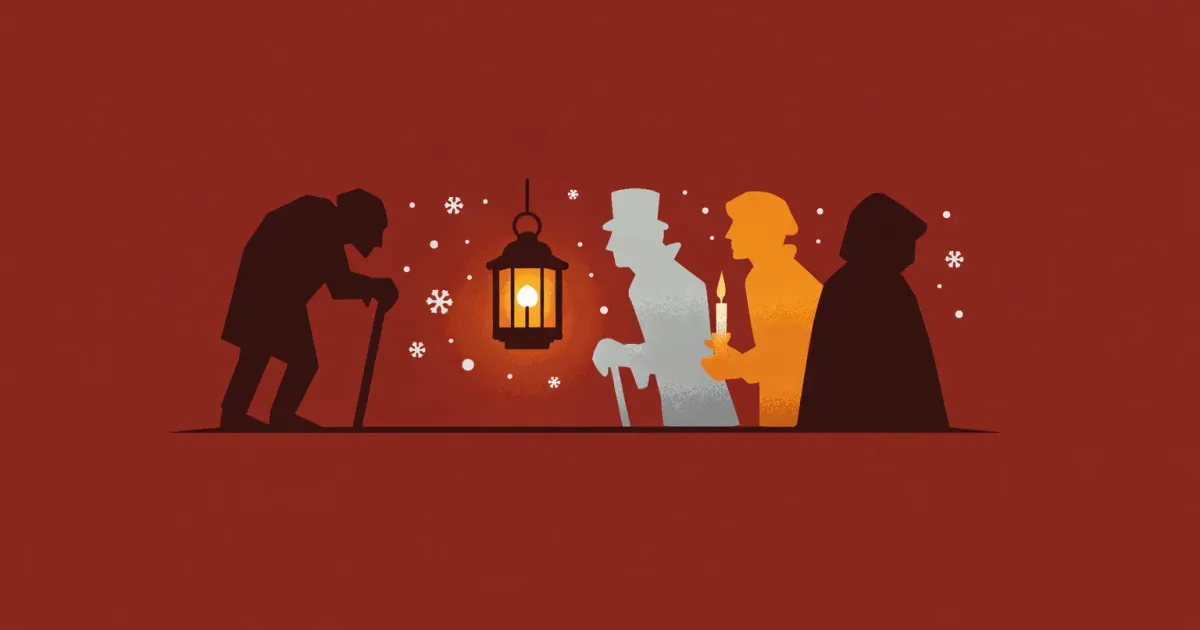
Characters
Ebenezer Scrooge
Scrooge is the rare protagonist whose name became a common noun. By the time Dickens finishes introducing him — "a squeezing, wrenching, grasping, scraping, clutching, covetous, old sinner" — we have a portrait so thoroughgoing it threatens to become a cartoon. He is a London moneylender who keeps his counting-house chilled to save on coal, underpays his one clerk, refuses his nephew's Christmas invitation, insults two charity collectors, and goes home to eat gruel alone in the dark. Dickens lingers on the physical details — the frosty rime on his eyebrows, the pointed nose, the "thin blue lips" — because Scrooge has literally become the weather he loves. "He carried his own low temperature always about with him."
What saves Scrooge from being a pure caricature is that Dickens shows us, over the course of one supernatural night, how he got this way. A lonely boy at a boarding school, a young apprentice who once danced at Fezziwig's ball, a young man who loved a woman named Belle before he let gold displace her — the miser contains all of these earlier selves, frozen under the ice. The spirits do not argue him into change. They thaw him.
Scrooge's arc is the skeleton key to the whole book, but it is subtler than the folklore version suggests. He is not simply a bad man who becomes good. Dickens is careful to establish, through the Ghost of Christmas Past, that Scrooge was once capable of love, gratitude, and play — he weeps when he sees his younger self reading alone at school; he laughs when he sees Fezziwig; he begs the spirit to stop when Belle speaks. The hardness, in other words, was acquired, and Dickens traces its acquisition to a specific choice. Belle names it directly: "Another idol has displaced me. A golden one." What happens on Christmas Eve is not conversion but excavation — the recovery of a man who had been buried under his own ledger books.
The chain is the governing image of his inner life. Marley tells him that the invisible coil Scrooge has forged is already as heavy as his own was seven years earlier, and the book hangs its supernatural premise on that metaphor: the moral consequences of stinginess are literal accumulation, link by link. Scrooge's redemption must therefore be read as a kind of unshackling, which is why the Stave V Scrooge behaves with such manic physicality — "a perfect Laocoön of himself with his stockings," tearing his clothes on inside out, laughing until he cries. The body that had been locked shut is suddenly loose. What looks like sentimentality is actually the comic recoil of a man who has just escaped his own grave. Dickens's final joke is that Scrooge's new generosity is powered by the same abruptness that made him terrifying — he pays for a turkey twice the size of Tiny Tim, tips in half-crowns, and ambushes Bob Cratchit with a raise. The miser's energy was never the problem. It was aimed at the wrong target.
Scrooge also carries the book's political argument in his own body. His infamous line about prisons and workhouses — "If they would rather die, they had better do it, and decrease the surplus population" — is a paraphrase of the Malthusian orthodoxy that Dickens loathed. When the Ghost of Christmas Present throws those words back in his face in Stave III, the polemic becomes personal. Scrooge is not just selfish; he is an embodiment of a widespread Victorian attitude toward the poor, and his conversion is therefore the conversion Dickens wanted from his whole readership. That the novella has never gone out of print suggests the readership remains, and still needs converting.
Jacob Marley
Marley has been dead for seven years when the book begins, and dead is how he stays — Dickens opens the story with the sentence "Marley was dead: to begin with" and insists on the point until the reader cannot escape it. When his ghost arrives in Scrooge's rooms, he drags a chain "made of cash-boxes, keys, padlocks, ledgers, deeds, and heavy purses wrought in steel." He is Scrooge's former business partner, his doppelgänger in miserliness, and now his unlikely rescuer. The ghost has one job: to warn Scrooge that the same fate is waiting for him and that three more spirits will come to prevent it.
Marley is less a character than a thesis delivered in a voice. Dickens gives him the book's central line, and the line reorganizes the moral vocabulary of everything that follows. When Scrooge tries to console him — "But you were always a good man of business, Jacob" — Marley erupts: "Mankind was my business. The common welfare was my business; charity, mercy, forbearance, and benevolence, were, all, my business. The dealings of my trade were but a drop of water in the comprehensive ocean of my business!" In a single speech, Dickens redefines what "business" actually is, stripping the word of its narrow mercantile meaning and returning it to an older ethical register. Everything in the novella afterward is a variation on this idea.
The ghost's physical details also do work the plot alone could not accomplish. Marley is transparent — Scrooge can see the two buttons on the coat behind him — and when he removes the bandage tied around his skull, his lower jaw falls onto his chest. These are gothic effects, but they are also a kind of moral anatomy. The damned, in Dickens's imagination, are visibly hollow and literally unable to speak whole. Before Marley departs, he shows Scrooge a window full of other chained phantoms wandering above the London streets, "moaning as they went" — some of them once known to Scrooge personally, including an old ghost "in a white waistcoat, with a monstrous iron safe attached to its ankle," crying over a mother and infant on a doorstep he cannot help. The image widens the warning from personal to social. Scrooge is not one bad man being frightened into goodness; he is one member of a whole class of men too late to do anything about it.
Bob Cratchit
Bob earns fifteen shillings a week as Scrooge's clerk, works in an unheated "tank" of an office, and walks home to Camden Town wearing a long white comforter because he owns no great-coat. He is the father of six children, the husband of the formidable Mrs. Cratchit, and the nearly impossible figure of a poor man who is not embittered. On Christmas Eve he sneaks twenty turns down an ice slide on Cornhill behind a lane of boys. On Christmas Day he toasts the employer who torments him as "the Founder of the Feast."
Cratchit is Dickens's portrait of virtuous poverty, and he walks a tightrope the modern reader should notice. He is so unfailingly cheerful, so grateful for so little, that in lesser hands the characterization would tip into the very condescension Dickens is trying to criticize. What saves Bob from becoming a Victorian stock figure is the grief Dickens gives him in Stave IV. When Tiny Tim dies in the possible future, Bob comes home from his son's fresh grave, goes upstairs alone, and kisses the child's face. Back downstairs, his voice breaks in mid-sentence: "My little, little child! My little child!" The moment punctures the sentimental sheen and reveals a man whose cheerfulness is not naive but chosen — a defense maintained against real precariousness.
His relationship with Scrooge is the book's central working-class/owning-class pairing, and Dickens is careful not to make it simple. Bob is loyal to a fault — he raises a glass to Scrooge despite his wife's furious protests that the old man does not deserve it — and yet Dickens does not pretend the loyalty is deserved. Mrs. Cratchit is allowed to name Scrooge "an odious, stingy, hard, unfeeling man." Bob insists on the toast anyway, and the tension between husband and wife at the table is the class politics of the book distilled into a domestic scene. When Scrooge's reformation finally reaches Bob in Stave V, it comes disguised as a firing — Scrooge feigns anger at his clerk's lateness to set up the punchline of a raise. The gag works because, by that point, we have watched Bob absorb so much mistreatment without protest that the reversal registers less as comedy than as overdue justice.
Tiny Tim
Tim is Bob Cratchit's youngest son, lame and carried on his father's shoulder, with a little crutch and an iron frame supporting his limbs. We see him first at Christmas dinner, raising his small voice to say, "God bless us, every one!" — a line so overused in adaptations that it risks sounding twee, but in context it is the unguarded utterance of a dying child at the only feast his family can afford. The Ghost of Christmas Present tells Scrooge that if the shadows do not change, "the child will die." Stave IV shows the shadow if it does not. Stave V saves him.
Tiny Tim is the book's emotional lever, and Dickens uses him with unsentimental precision. He is not a character so much as a stake — the human cost of Scrooge's indifference made small enough to fit in a single image. Dickens places him carefully. We meet Tim in the middle of the book, not the end, because his fate needs to be undecided when we see it; sentimental climaxes lose their force if the reader knows they are coming. Bob's report that Tim had said in church he "hoped the people saw him in the church, because he was a cripple, and it might be pleasant to them to remember upon Christmas Day, who made lame beggars walk, and blind men see" ties the child to a specifically Christian understanding of visible suffering, which Dickens wants his Victorian readership to be unable to ignore.
It is essential that Tim dies in the future that is averted, not in the one that arrives. Dickens could have spared him outright. He chooses instead to make us attend his grave — "this first parting there was among us" — and to watch Bob kiss his dead son's face, before pulling the possibility back. The strategy is morally pointed. Scrooge's cruelty in Stave I is the kind that kills children like Tim. The book will not let him, or the reader, forget what the stakes are before it grants the reprieve. The final line of the novella, restored to Tim — "God bless Us, Every One!" — is Dickens's signature on an argument he has just spent five staves making: the blessing is reciprocal or it is nothing.
Fred
Fred is Scrooge's nephew, the son of his dead sister Fan, and the book's walking argument that a cold world does not produce cold people by necessity. He arrives at the counting-house in Stave I flushed from walking in the frost, "his face was ruddy and handsome; his eyes sparkled," and proceeds to out-argue his uncle on the meaning of Christmas. Scrooge attacks him for being poor enough to have no business being merry; Fred replies, "What right have you to be dismal? What reason have you to be morose? You're rich enough." He is the nephew we later learn is loved by a wife, surrounded by witty friends, and — in the hypothetical future of Stave IV — kind enough to stop Bob Cratchit in the street after Tim's death and offer help.
Fred gets less page-time than his importance to the scheme deserves, but his function is structural. He is the living counter-example to Scrooge's whole worldview — the nephew inherited Fan's warmth rather than the family's money, and he refuses to be embarrassed about it. His speech on Christmas as "a good time; a kind, forgiving, charitable, pleasant time" is not padding; it is the positive statement of the thesis that Marley delivers negatively. Both uncles, living and dead, end up saying the same thing: human connection is the business.
Dickens also uses Fred to complicate the book's economics. Scrooge's nephew is not rich. He dines modestly, plays parlor games, laughs at his uncle behind his back with warmth rather than malice, and persists in inviting Scrooge to dinner year after year without expectation. The Ghost of Christmas Present takes Scrooge to Fred's party specifically so that Scrooge can overhear himself being forgiven in absentia — Fred refuses to write him off, and the room's laughter at his expense is the laughter of people who have room in their lives for an uncle they pity more than resent. When Scrooge finally knocks on Fred's door in Stave V after pacing outside "a dozen times," what he receives is not gratitude or triumph but simple welcome. Fred has been waiting, in effect, for the whole book.
Fan, Fezziwig, and Belle
These three figures appear only in Stave II, in the tour of Scrooge's past, and Dickens uses them to diagram the specific wounds and roads-not-taken that produced the miser of Stave I. Fan is Scrooge's beloved younger sister, who arrives at his boarding school to fetch him home — "Father is so much kinder than he used to be, that home's like Heaven!" — and who, the Ghost tells him, died a woman with one child. That child is Fred. Fezziwig is Scrooge's apprentice-master, a "jovial" employer who throws an extravagant Christmas Eve ball in his warehouse and demonstrates, by example, what the merchant class could be. Belle is Scrooge's fiancée, the young woman who releases him from their engagement when she sees that "another idol has displaced me. A golden one."
Each of these three characters functions as a mirror held up to Scrooge at a different angle, and Dickens does not let him look away from any of them. Fan is the relationship Scrooge has already betrayed — by refusing Fred, he is refusing the sister he loved, a generation too late. The Ghost's quiet reminder that Fan "had, as I think, children," followed by Scrooge's flustered "one child," is one of the book's sharpest small punctures. Scrooge has been carrying Fan's grief without knowing what to do with it, and his estrangement from Fred is what he has done with it: a grief converted into coldness.
Fezziwig is Dickens's answer to the question of whether capitalism and kindness can coexist in the same man. Young Scrooge, watching his old master set tables and call a fiddler, tells the Ghost that "the happiness he gives, is quite as great as if it cost a fortune" — Fezziwig spends "three or four pounds" on a party, and in return earns the devotion of workers for life. The scene is not nostalgia. It is a policy proposal disguised as a memory, and it is aimed directly at the employer class that was Dickens's reading audience. Belle's farewell provides the other half of the argument: she is not jilted so much as she is outranked. "I have seen your nobler aspirations fall off one by one, until the master-passion, Gain, engrosses you." When the Ghost forces Scrooge to see Belle years later, happy in a tumultuous household full of children, the torture is not that she suffered without him but that she did not. The life Scrooge could have had went on, without him in it. Together, Fan, Fezziwig, and Belle establish that Scrooge's cruelty was neither inevitable nor untimely; he chose it, and the book knows exactly when.
The Three Spirits
The Ghost of Christmas Past is a flickering paradox — "like a child: yet not so like a child as like an old man" — crowned with a jet of light and carrying its own extinguisher cap under its arm. The Ghost of Christmas Present is a green-robed giant in a holly crown, seated on a throne of turkeys, puddings, and "seething bowls of punch," who ages visibly over the course of his single day of existence. The Ghost of Christmas Yet to Come is a silent, black-shrouded figure with no face and only an outstretched hand. None of them argues with Scrooge. They show him things.
The spirits are structurally brilliant because Dickens has given each one a form that matches the epistemology of its time zone. The Past is flickering and unstable — simultaneously young and old — because memory is both; the extinguisher cap is the book's sharpest image of repression, and it is Scrooge who forces the cap down, unable to "hide the light: which streamed from under it, in an unbroken flood upon the ground." The Present is superabundant and mortal; the spirit's year-long life, compressed into a single night, mirrors the fleeting nature of present tense itself. The Future is silent because it has not happened yet. When Scrooge finally asks — "Are these the shadows of the things that Will be, or are they shadows of things that May be, only?" — the phantom refuses to answer, and the ambiguity is the entire point. The future in this book is consequence, not prophecy.
The Ghost of Christmas Present carries the book's fiercest politics. Before he vanishes, he opens his robe to reveal two starving children clinging to him — "This boy is Ignorance. This girl is Want." These allegorical figures are not Scrooge's personal responsibility; they are, Dickens insists, everybody's. The spirit warns specifically against the boy: "most of all beware this boy, for on his brow I see that written which is Doom." Dickens had considered writing a political pamphlet on the plight of poor children before choosing instead to write this story, and Ignorance and Want are what that pamphlet would have said, condensed into an image so harrowing that it resists the sentimentality of the surrounding stave. When Scrooge asks whether the children have any refuge, the spirit turns the miser's own words against him: "Are there no prisons? Are there no workhouses?" It is the book's most efficient indictment — a character's casual cruelty in Stave I returned to him in Stave III as moral verdict. The three spirits, considered together, are less a sequence of haunters than a single argument in three moods: this is how you got here, this is what is happening right now, this is where you are going if you do not change.