Summary
Overview
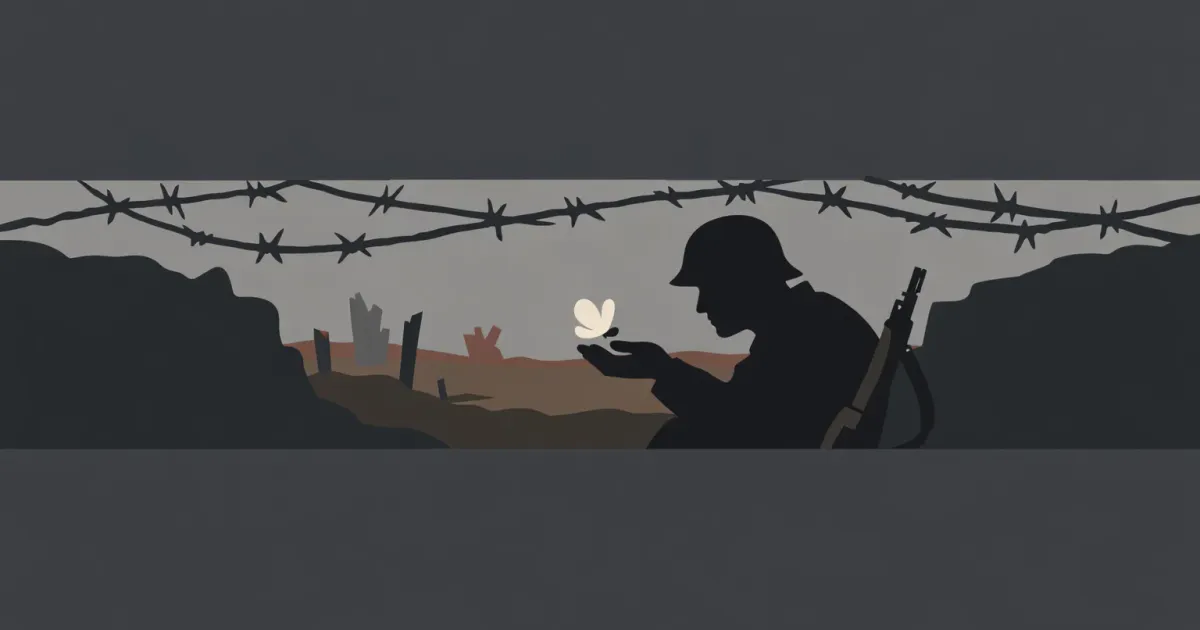
All Quiet on the Western Front is Erich Maria Remarque's 1929 novel about a German schoolboy named Paul Bäumer who marches off to the First World War at nineteen and slowly discovers that everything his teachers told him about duty, heroism, and the Fatherland is a lie. The story unfolds on the Western Front in the final years of the war, moving between trenches, rest billets, field hospitals, a brief disastrous home leave, and one unforgettable afternoon in a shell hole with a dying enemy soldier. There are battles and bombardments in it, but the book is not really a war story in the adventurous sense. It is a slow record of how a generation of boys was hollowed out — physically, morally, spiritually — by an industrial war their elders sent them to fight and then failed to understand.
Paul is the narrator, and he speaks in the first-person plural as often as the singular: "we" are the remnants of a single classroom who volunteered together after their teacher Kantorek shamed them into it. His comrades — the clear-thinking Albert Kropp, the bookish Müller, the bearded Leer, the frail Franz Kemmerich, and the older, scrounging, mothering Stanislaus Katczinsky, known as Kat — become his real family. One by one they die or disappear, and the novel's awful rhythm is the rhythm of their removal: a leg amputated, a lung punctured, a splinter in the skull on the walk to the dressing station. By the final page Paul stands alone, and the short closing paragraph — written in a different, distant voice — records his death in October 1918 on a day so quiet the army bulletin reported nothing at all.
What has kept the novel alive for almost a century is the honesty of its observation and the flatness of its refusal to comfort the reader. Remarque's soldiers are not heroes, cowards, or symbols; they are hungry, lice-ridden teenagers who steal geese, play skat on latrine boxes, and learn to duck before the shell they heard whistling ever registers as a thought. The book does not argue against war so much as photograph it from inside the body that is trying to survive it, and that first-person, anti-abstract method is what made the novel an international phenomenon the moment it appeared.
Remarque published Im Westen nichts Neues in Germany in late 1928 and early 1929, ten years after the Armistice, and A. W. Wheen's English translation — the text most readers still encounter — appeared the same spring. The timing matters. By 1929 the trench memoir had become a small subgenre (Sassoon, Graves, Barbusse, Jünger), and the market was primed for a reckoning with the war. What distinguished Remarque's book was its refusal to frame the experience within any inherited form — not heroic epic, not Bildungsroman, not political tract. The chapters are loosely episodic, almost anti-plot: long meditative passages on the earth as mother and shelter sit alongside grimly comic scenes of lice-hunting and goose-stealing, and the transitions happen without the connective tissue a conventional novel would supply. Remarque is reproducing, at the level of form, the way wartime memory actually works for the survivor — nothing but fragments, held together by the repeated shock of loss.
The novel's structural innovation is its use of the first-person present tense. Paul narrates as the events occur, which collapses the distance between reader and sensation and makes the book's final third-person coda — the omniscient voice that announces his death — all the more devastating, because until that moment the "I" has been the reader's only anchor. Remarque's author's note frames the whole as a report on "a generation of men who, even though they may have escaped shells, were destroyed by the war," and the novel earns that claim through accumulation rather than argument. It was banned and publicly burned by the Nazis in 1933, precisely because its matter-of-fact realism — no glory, no redemption, no German virtue set against French savagery — undercut the mythology a rising nationalism was trying to build on the war's ashes. That the book survived those bonfires and has never been out of print since is itself a kind of answer to Kantorek's classroom speeches about the Fatherland.
Chapters 1–2: Arriving at the Front
The novel opens not in battle but after one. Paul's company of 150 has come back to rest billets eighty strong, and the cook has rations for a full company — so the survivors gorge themselves. This black-comic windfall sets the book's tone: a soldier's body gets what a soldier's body can get, and nothing more elevated is on offer. Paul introduces his school friends Kropp, Müller, and Leer, then the older men: Tjaden, Haie Westhus, the horse-loving farmer Detering, and Katczinsky. We learn their schoolteacher Kantorek lectured the class into enlisting together, and that their classmate Josef Behm — the one boy who hesitated — was among the first killed. The men visit Kemmerich, who had his leg amputated after a thigh wound; Müller eyes his fine English lace-up boots. Chapter 2 returns to the hospital as Kemmerich dies, and Paul walks away carrying the boots for Müller. A strange, guilty rush of life surges through him on the way back: he is alive, and he is hungry.
These opening chapters do the quiet but essential work of dismantling the reader's expectations of a war novel. Chapter 1 lingers on food, latrines, card games, and gossip; the "action" — Behm's death — is delivered in a single reported sentence. This is deliberate. Remarque is teaching us to read the way soldiers live, where physical need and animal habit take precedence over dramatic event. The episode with Kantorek, narrated in flashback, establishes the book's central indictment: that "thousands of Kantoreks" mistook their own rhetoric for wisdom and "let us down so badly." Kemmerich's death in Chapter 2 then introduces the motif of the inherited object. The boots will pass from Kemmerich to Müller to Paul to Tjaden, outliving each of their owners, a quiet mechanical inventory of attrition. When Paul breathes deeply outside the dressing station and feels hunger "greater than comes from the belly alone," Remarque is showing us, without italicizing it, the survivor's shame that will shadow the rest of the book.
Chapters 3–5: Comradeship, Himmelstoss, and the Question of What's Next
Chapter 3 pulls back into memory. Reinforcements arrive, and Kat — the novel's unsentimental sage — holds forth on authority, uniforms, and how a little power ruins an ordinary man. Paul recounts basic training under Corporal Himmelstoss, the former postman turned petty tyrant who drilled the recruits until they were half-mad, and describes the night before shipping out when the boys ambushed Himmelstoss in the dark, threw a bedsheet over his head, and thrashed him. Chapters 4 and 5 alternate between a terrifying wiring detail under gas attack — during which Paul shields a panicked young recruit, Detering breaks down at the screams of wounded horses, and the men take cover in a graveyard where the shells exhume the dead — and an almost bucolic afternoon hunting lice, during which Müller keeps pressing the question: what would you do if peace came tomorrow? Nobody can answer. Paul and Kat end Chapter 5 stealing a goose and roasting it in the middle of the night, a scene of almost sacramental quiet between two men who know the war has ruined them for everything else.
The Himmelstoss material matters less as revenge fantasy than as the novel's first sustained argument about institutions. Kat's theory — "if you give a man a little bit of authority he behaves just the same way, he snaps at it too" — extends outward from one corporal to an entire social order. The Himmelstoss sequence also prepares the reader for Chapter 7's parallel episode with Kantorek in ill-fitting territorial uniform, completing a diptych in which both of Paul's original tormentors are revealed as small, frightened men whose power depended on a system rather than on any personal authority. Chapter 5's unanswerable question — what will you do when it's over? — is the spiritual center of the novel's first half. Kat, Detering, and Haie can imagine going back, because they had lives before. The volunteers from the classroom had only their schoolbooks and vague ambitions, and the war has made those fluent in nothing. The goose-roasting scene with Kat gives this despair its counterweight: a moment of wordless communion that, for Paul, is "more complete than even lovers have." Remarque is deliberately staging the book's deepest human bond not in combat but in a dark hut with greasy fingers, to insist that whatever survives the war will be this — not glory, not cause, just the warmth between two soldiers who have outlasted another day.
Chapter 6: The Great Bombardment
Chapter 6 is the novel's longest, most relentless chapter, and it represents the war's worst face. Sent up to the front ahead of an offensive, the men pass a stack of fresh coffins — a hundred of them — and know at once who they are for. A days-long bombardment traps them in a dugout with rats so bold they eat the bread off men's faces in the dark. Recruits crack under the strain; one rushes outside into the barrage and is torn to pieces, another butts his head against the wall. When the attack finally comes, the fighting is hand to hand with spades, bombs, and bayonets. Haie Westhus is hit in the back, his lung pulsing through the wound. The fighting goes on for days — attack, counter-attack, more attack — and when the survivors are finally relieved, the company-commander calls the roll: out of the 150 who went up, thirty-two answer their numbers.
This chapter is where Remarque's technique achieves its full power. The prose abandons the contemplative cadences of the earlier chapters and becomes jagged, verbless, almost telegraphic: "Bombardment, barrage, curtain-fire, mines, gas, tanks, machine-guns, hand-grenades — words, words, but they hold the horror of the world." The famous image of the earth as mother — "when he presses himself down upon her long and powerfully … she is his only friend, his brother, his mother" — appears here, and it is not romantic rhetoric but tactical description: the soldier who fails to make love to the ground in time is dead. Chapter 6 also contains one of the novel's most unflinching passages on the young recruits who "fall like flies," their bodies "too slight" for their uniforms, "their sharp, downy, dead faces" wearing "the awful expressionlessness of dead children." This passage is the moral counter to Kantorek's "Iron Youth." The boys his rhetoric produced are children in adult uniforms, dying because no one thought to teach them to distinguish a whistling shell from a droning one. The chapter closes with the bookkeeping horror of the roll-call — a number instead of a scene — and Remarque trusts the arithmetic to do the work prose would blunt.
Chapter 7: Leave
In the gentler rear area between offensives, Paul and his friends flirt with three French women across a canal, smuggle bread to them at night, and experience a fleeting tenderness that exists entirely outside the soldier's world. Then Paul gets seventeen days' leave. He travels home, finds his mother bedridden with what will turn out to be cancer, puts on civilian clothes that no longer fit, and discovers that he cannot talk to his father, cannot re-enter his childhood bedroom full of the books he used to love, cannot answer his old German master's confident pronouncements about annexing Belgium and breaking through in Flanders. He visits Kemmerich's mother and lies to her — under oath, before everything he calls sacred — that her son died instantly and without pain. On his last night, his own mother sits by his bed in the dark and tells him to be careful of the French women, not knowing what he has become. Paul concludes that he should never have come on leave at all.
Chapter 7 is the book's quietest and most devastating section, and it articulates a theme no combat scene could: that the war's deepest damage is the rupture it opens between the soldier and the civilian world he thought he was defending. Remarque structures the chapter around a series of failed reunions — with the childhood room, the books, the father, the German master, Kemmerich's mother, and finally his own dying mother — and each one confirms that Paul has become a stranger in his own life. The scene with Frau Kemmerich is morally the most complex in the novel: Paul perjures himself, swearing on "everything that is sacred" that her son died without suffering, and then privately asks himself what is actually sacred to him anymore. The lie is a kindness, but it is also the mark of a man who has learned that the truth he carries has no place in the drawing rooms of home. The chapter's closing line — "I ought never to have come on leave" — is not melodrama. It is Paul recognizing that he has seen the size of the gulf, and that knowledge is itself a wound that will not close.
Chapters 8–9: The Russian Prisoners and the Man in the Shell Hole
Paul does his four weeks of training at a camp on the moors adjacent to a Russian prisoner-of-war compound. The prisoners are starving, dysenteric, and eerily gentle — bearded peasants who beg for crusts and sing chorales at their comrades' burials. Paul gives them his cigarettes and finds himself pushed to the edge of a thought he cannot yet finish: a word of command has made these men his enemies, and a word could make them his friends. When he returns to the line, he volunteers for a patrol, gets lost in No Man's Land during an attack, and is forced to hide in a shell hole where he stabs a French soldier who falls in on top of him. The Frenchman does not die quickly. Over the course of a full day and night, Paul watches him gurgle, bandages his wounds, fetches him muddy water, reads the letters in his wallet, and learns his name and trade: Gerard Duval, a compositor with a wife and a small daughter. When he finally makes it back to his lines, his comrades reassure him that this is simply war. Kat points to a sniper on the fire-step racking up easy kills, and by afternoon Paul is almost persuaded.
These two chapters form the moral heart of the novel. The Russian prisoner section establishes, in slow and careful prose, that nothing separates "the enemy" from Paul except the paperwork of nation-states. Remarque italicizes the epiphany only obliquely — Paul tells himself he "dare think this way no more" because "this way lies the abyss" — but the chapters that follow detonate the abyss anyway. The Gerard Duval episode is one of the most harrowing scenes in twentieth-century literature precisely because it forces Paul to experience, in a single confined space, the full human reality he had successfully kept abstract. When he reads the dead man's letters and finds the wife and child in the photograph, the war's whole machinery of abstraction is exposed: "you were only an idea to me before, an abstraction that lived in my mind and called forth its appropriate response." Remarque is careful, though, not to let the scene resolve into easy pacifist uplift. By the end of Chapter 9, Paul has already begun the work of unlearning what he learned in the hole — "after all, war is war" — and the sniper cracking off his fourth kill shows how quickly the soldier's mind must re-armor itself to survive. The novel earns its anti-war stance by refusing the consolation that the soldier can permanently hold on to what he saw.
Chapter 10: The Village and the Hospital
Paul, Kat, Albert, and the rest of the gang land a plum assignment guarding an abandoned supply depot in a shelled village. For nearly two weeks they roast suckling pigs, sleep in looted four-poster beds, and eat themselves sick on officers' rations while the town crumbles around them. Then they are sent to evacuate civilians from another village, and Paul and Albert are both wounded — Albert in the knee, Paul in the leg and arm. At the dressing station, a doctor hacks shrapnel out of Paul without chloroform. A sergeant-major bribed with cigars gets the two friends onto the same hospital train, and a faked fever gets them off at the same Catholic hospital in a German town, where they spend weeks among the wounded. Albert's leg is amputated above the thigh; he talks about shooting himself. Paul sees the hospital's full inventory of broken bodies — the jaw ward, the abdominal ward, the blind ward, the dying room — and the chapter contains the novel's most direct indictment: "A hospital alone shows what war is."
The structural genius of Chapter 10 is its juxtaposition of the idyll with the hospital, back to back, without commentary. The suckling-pig feast reads like a boy's adventure — gleeful, absurd, almost wholesome in its appetite — and then the same boys are on the chopping-block under a surgeon's knife a page later. Remarque's point is that the soldier's life has no stable mode; happiness and horror occupy the same body hours apart, and neither can be trusted. The hospital sequence also widens the novel's lens beyond the trench: the Lewandowski scene, in which a roomful of wounded soldiers shield a fellow patient and his wife so the couple can have twenty minutes of privacy, is one of the book's rare moments of collective tenderness, and it is achieved against institutional religion rather than with its help. The flat-foot surgeon who turns healthy conscripts into cripples "for science" and the staff doctors who stamp "A1" on men with wooden legs make explicit the novel's argument that the machinery of war extends far past the front: it operates in every institution the soldier passes through. By the time Paul concludes that all a thousand years of culture produced was these "torture-chambers in their hundreds of thousands," the reader understands that the book's moral reckoning is not with any single battle or general, but with a civilization.
Chapters 11–12: Dissolution
The final chapters compress the last months of 1918 into a chronicle of endings. The men have become, in Paul's phrase, "little flames poorly sheltered" against the storm. Detering, the farmer, sees a cherry tree in blossom and deserts homeward; he is caught by the military police and never heard from again. Berger is shot trying to save a wounded messenger-dog. Müller is killed by a flare at point-blank range and leaves Paul the inherited boots, now on their third owner. Leer bleeds out from a hip wound — "what use is it to him now that he was such a good mathematician at school." Bertinck, the decent company commander, takes a rifle, drops a flame-thrower, and is killed in the same moment. The German army is starving, out-gunned, out-supplied by Americans whose corned beef and white bread the exhausted men can smell across the line. On a summer day carrying food, Kat takes a splinter in the shin. Paul carries him on his back all the way to the dressing station — and learns, on arrival, that a stray second splinter hit Kat in the head during the walk. Kat is dead. Paul does not know he is carrying a corpse.
Chapter 12 is three pages long. It is autumn 1918. Paul, the last of the classmates, sits in the garden of a convalescent ward recovering from a light gas wound, and the canteens are "humming like beehives with rumours of peace." He tries to think about the future and cannot. He concludes that his generation will come back "weary, broken, burnt out, rootless, and without hope." Then the narration switches, mid-page, into a detached third-person voice — the first time in the novel — to report that Paul fell in October 1918, "on a day that was so quiet and still on the whole front, that the army report confined itself to the single sentence: All quiet on the Western Front."
The closing movement works by accelerating the novel's inventory of loss until the losses blur into a single current. Remarque deliberately refuses to make Kat's death climactic or meaningful; Paul carries a dead man on his back for half a chapter without knowing it, and the horror of that unknowing is the horror the whole novel has been circling. The prose in these final pages also abandons the earlier present-tense intimacy at the precise moment Paul does. When Paul dies in that final paragraph, he cannot narrate it, and Remarque's choice to slip into a cold third person — the register of the army bulletin, the register of history — enacts at the level of voice the erasure the novel has been describing. The title, revealed as a line from the official report on the day of Paul's death, becomes one of the cruelest ironies in modern literature: a whole generation has been consumed to produce a sentence that means nothing happened. The book's last image — Paul's face with "an expression of calm, as though almost glad the end had come" — is not a consolation. It is the final piece of evidence that the war killed everything in him long before the shell found him, and that death, at the end, was only the last formality.