Themes & Motifs
Action vs. Inaction
Hamlet knows what he should do almost from the start. The ghost tells him Claudius is the murderer, demands revenge, and Hamlet swears to obey. Then he does nothing for four acts. This gap between intention and execution is the engine of the entire play. Hamlet berates himself for it in soliloquy after soliloquy — "What a rogue and peasant slave am I!" — and yet each burst of self-criticism ends not in action but in another plan to delay: a play-within-a-play, a speech to his mother, a philosophical tangent. When he does finally act on impulse, he stabs through a curtain and kills the wrong man.
Shakespeare puts the problem in sharp relief by surrounding Hamlet with characters who have no trouble acting. Laertes raises a rebellion hours after learning of his father's death. Fortinbras marches twenty thousand men across a continent to fight over a worthless patch of ground. Even Claudius, the villain, acts decisively — he murders his brother, secures the throne, and manages the political fallout with chilling efficiency. Hamlet alone is paralyzed, and the play never gives a single clean explanation for why.
The "To be, or not to be" soliloquy (3.1) offers Hamlet's most sustained attempt to understand his own paralysis, and what he discovers is not flattering. The speech begins as a question about suicide but swerves into a theory of universal cowardice: "Thus conscience does make cowards of us all, / And thus the native hue of resolution / Is sicklied o'er with the pale cast of thought." The word "conscience" here carries a double meaning — both moral awareness and consciousness itself. Hamlet is arguing that the capacity to think, to foresee consequences, to imagine "the undiscover'd country" of death, is precisely what prevents human beings from acting. Thought is not preparation for action; it is the enemy of action.
This diagnosis gains force through the play's structure. The Mousetrap, Hamlet's plan to "catch the conscience of the King" by staging a play mirroring the murder, is brilliant — and entirely unnecessary if Hamlet were willing to simply trust the ghost and act. He frames it as epistemological caution (the ghost might be a demon), but the timing is telling: he conceives the plan at the exact moment he is most disgusted with his own inaction. The Mousetrap is delay dressed as prudence. And when it works — when Claudius's guilt is confirmed beyond doubt — Hamlet still does not kill him. He passes up the prayer scene (3.3) on theological grounds that the play immediately undercuts: Claudius was not actually praying successfully. "My words fly up, my thoughts remain below. / Words without thoughts never to heaven go." The perfect opportunity vanished because Hamlet overthought it.
What makes Shakespeare's treatment genuinely radical is that he refuses to diagnose Hamlet's problem in a way that resolves it. Hamlet is not a coward — he kills Polonius without hesitation when startled, and he faces the final duel with calm fatalism. He is not stupid — he outmaneuvers Rosencrantz and Guildenstern at sea and instantly reads the political dynamics around him. The paralysis is specific to the task the ghost assigns: premeditated, purposeful violence against a specific target. Hamlet can act rashly and he can reason brilliantly, but he cannot combine the two — and the play suggests this may be a feature of consciousness rather than a personal failing.
Appearance vs. Reality
Elsinore runs on deception. Claudius presents himself as a grieving brother and legitimate king while hiding a murder. Gertrude's rapid remarriage presents an image of continuity while the court is rotting from within. Polonius uses his daughter as bait in a surveillance operation while pretending to care about her welfare. Rosencrantz and Guildenstern arrive as old friends but are instruments of the king's espionage. Hamlet himself puts on an "antic disposition" — feigned madness — as a shield against a court where honesty is dangerous. The play is saturated with performance, and nearly every character is simultaneously an actor and an audience member being deceived by someone else.
Hamlet's first major speech announces this theme with startling directness. When Gertrude asks why his grief "seems" so intense, he erupts: "Seems, madam! Nay, it is; I know not seems" (1.2). He catalogs the external markers of mourning — the black clothes, the sighing, the tears — and dismisses them all as "actions that a man might play." He alone, he claims, has "that within which passeth show." The irony is that Hamlet will spend the rest of the play "playing" more extravagantly than anyone, adopting madness as a disguise and using theater itself as a weapon.
The gap between appearance and reality is not just a theme Shakespeare explores — it is the structural principle of the play. Nearly every scene involves someone watching someone else from a hidden position. Claudius and Polonius spy on the Hamlet-Ophelia encounter from behind a curtain. Polonius hides behind the arras in Gertrude's closet (and dies for it). Hamlet uses the Mousetrap to observe Claudius's reaction to a staged fiction. Polonius sends Reynaldo to Paris to spy on Laertes through indirect questioning. The result is a court where no interaction is unmediated — every conversation has a hidden audience, and every honest statement might be a performance for the unseen watchers.
Claudius embodies this theme most completely. His first speech in the play is a masterpiece of public performance: "With mirth in funeral, and with dirge in marriage, / In equal scale weighing delight and dole" (1.2). The line is syntactically beautiful and morally hideous — it papers over fratricide with rhetorical balance. But Shakespeare complicates matters by showing that Claudius is not simply a hypocrite. His aside during the nunnery scene — "How smart a lash that speech doth give my conscience! / The harlot's cheek, beautied with plastering art, / Is not more ugly to the thing that helps it / Than is my deed to my most painted word" (3.1) — reveals a man fully aware that his public persona is a mask. Claudius knows the gap between his appearance and his reality. He simply cannot close it, because closing it would mean confessing and losing everything. The prayer scene confirms this: he wants to repent but cannot give up "my crown, mine own ambition, and my queen."
The play's most unsettling implication is that Hamlet, the character who claims to reject "seeming," becomes its most skillful practitioner. His antic disposition convinces the court he is mad. He manipulates the players to produce a specific emotional reaction in his audience. He tells Ophelia "I loved you not" when the audience knows he did. By Act 5, the boundary between Hamlet's genuine self and his performances has grown almost impossible to locate — which may be Shakespeare's point. In a world built on deception, the search for authentic selfhood is not just difficult but philosophically destabilizing. If everyone is performing, including the person who insists he is not, then "that within which passeth show" may be a comforting fiction rather than a discoverable truth.
Death and the Leveling of All Things
Death is everywhere in Hamlet, but Shakespeare does something unusual with it: he makes death mundane. The play opens with a dead king's ghost and ends with a stage full of corpses, but between those endpoints, Shakespeare forces his characters — and his audience — to sit with what death actually means in physical, material terms. A king's body rots like anyone else's. A court jester's skull is indistinguishable from a politician's. Worms eat emperors and beggars alike. The play's most profound meditation on mortality happens not during a soliloquy but in a graveyard, with a clown tossing skulls out of the earth.
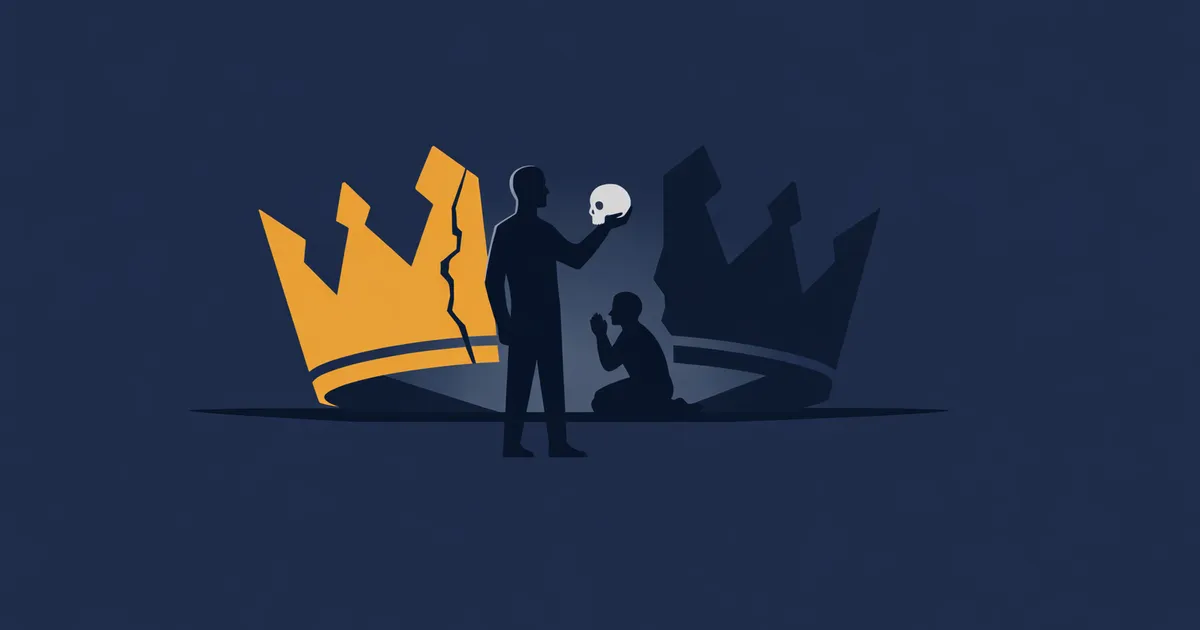
The graveyard scene in Act 5 transforms Hamlet's philosophical relationship with death. In earlier acts, death was an abstraction — "the undiscover'd country, from whose bourn / No traveller returns." In the graveyard, it becomes tactile. Hamlet holds Yorick's skull and remembers a living, laughing man: "Here hung those lips that I have kissed I know not how oft." Then he traces the logic further: Alexander the Great died, was buried, decomposed into dirt, and that dirt might now be stopping a beer barrel. The chain is absurd and irrefutable. It does not matter how powerful or brilliant you were in life — death reduces everyone to the same substance.
Shakespeare develops death as a leveling force across a carefully constructed arc. In Act 1, death appears in its most elevated form: the ghost of a king in full armor, demanding justice from beyond the grave. Death here still carries majesty and purpose. But each subsequent encounter with death strips away another layer of dignity. Polonius, killed by accident through a curtain, is reduced to a joke — Hamlet tells the king the old man is "at supper... Not where he eats, but where he is eaten. A certain convocation of politic worms are e'en at him." Ophelia's death, described in beautiful verse — flowers, a willow, a singing drowning — has a terrible passivity to it, as if she simply allowed the water to take her. By the graveyard scene, death has lost all ceremony. The gravedigger, who has been in the trade for thirty years, treats skulls as occupational debris, tossing them aside to make room for fresh tenants.
Hamlet's speech over Yorick's skull deserves attention for what it does not do. He does not moralize. He does not draw a lesson about living well or preparing for the afterlife. He simply follows the material logic of decomposition to its conclusion: "Alexander died, Alexander was buried, Alexander returneth into dust; the dust is earth; of earth we make loam; and why of that loam whereto he was converted might they not stop a bung-hole?" The reasoning is playful, almost comic, and that tone is the point. Hamlet has stopped treating death as tragic or terrifying. He has arrived at a kind of acceptance rooted not in faith but in physics — all matter recycles, all distinctions dissolve.
This shift makes possible the fatalism of Hamlet's final act. "There's a divinity that shapes our ends, / Rough-hew them how we will," he tells Horatio, and later: "The readiness is all" (5.2). These are not the words of the man who agonized over "To be, or not to be." That earlier Hamlet was paralyzed by death's unknowability. The Hamlet who returns from sea has passed through the graveyard's lesson: death is not an undiscovered country to be feared but a universal material fact to be accepted. The irony is that this acceptance — the closest Hamlet comes to peace — is what allows him to walk into the rigged fencing match that kills him.
Corruption and Moral Decay
Something is rotten in the state of Denmark, and Marcellus's famous line (1.4) understates the problem. The rot in Hamlet is not confined to Claudius's murder of his brother — it has spread through every institution and relationship in the play. The court rewards sycophancy. The family operates through surveillance and manipulation. Friendships are weaponized as intelligence operations. Even Hamlet, the character most repelled by the corruption around him, contributes to it: he drives Ophelia to madness, kills her father, and sends his university friends to their deaths. The play presents moral decay not as the work of a single villain but as a contagion — once the head of state is poisoned, the infection spreads outward until it consumes everyone.
The imagery of disease and decay runs through the play like a fever. Hamlet calls Denmark "an unweeded garden / That grows to seed; things rank and gross in nature / Possess it merely" (1.2). The ghost describes the actual murder through the language of infection — poison poured into a sleeping ear, curdling the blood "like eager droppings into milk." Claudius himself uses the language of disease management to justify shipping Hamlet to England: the prince's "liberty is full of threats to all," and like "the owner of a foul disease," the state must act before the sickness kills the host.
The poison-in-the-ear murder is the play's originating image, and Shakespeare embeds it into the dramatic structure through repeated variations. The ghost tells Hamlet a story — pours words into his ear — that corrupts his ability to function normally. Claudius pours false counsel into Laertes's ear, redirecting a son's grief into a poisoned-sword conspiracy. Polonius pours instructions into Ophelia's ear that destroy her relationship with Hamlet and, ultimately, her sanity. Rosencrantz and Guildenstern attempt to pour their way into Hamlet's confidence to extract information for the king. The literal poison that kills King Hamlet becomes a metaphor for every form of corrupt influence in the play — and by the final scene, literal poison returns in both the sword and the cup, killing four people in rapid succession.
What makes this theme genuinely uncomfortable is that Shakespeare refuses to exempt his hero from it. Hamlet's "antic disposition" — which he adopts as a protective strategy — becomes a weapon he uses to abuse Ophelia ("Get thee to a nunnery"), humiliate Polonius, and torment his mother with graphic descriptions of her sex life. His righteous anger at corruption slides, scene by scene, into cruelty that is difficult to distinguish from the behavior he condemns. The killing of Polonius is the clearest case: an act of impulsive violence against an innocent man, followed not by remorse but by mordant jokes about worms. Hamlet recognizes this trajectory without being able to stop it. "I must be cruel, only to be kind," he tells Gertrude (3.4), but the formulation is self-serving — the cruelty is real and immediate, while the "kindness" remains hypothetical.
The play's ending confirms the totality of the corruption. The Danish throne does not pass to a reformed court or a surviving heir. It passes to Fortinbras, a Norwegian outsider who has no connection to Elsinore's tangled web of guilt. The infected state does not heal itself; it is replaced entirely. Horatio's promise to tell the story — "Of carnal, bloody and unnatural acts, / Of accidental judgements, casual slaughters" — frames the entire play as a catalog of moral failure so comprehensive that explanation, not reform, is all that remains.
The Motif of Surveillance and Espionage
Most first-time readers notice the big themes — revenge, death, madness — but miss the quieter pattern running beneath them: almost nothing in Hamlet happens without someone watching from a concealed position. The play is structured as an elaborate intelligence operation where every character is simultaneously spying and being spied upon. Polonius sends Reynaldo to monitor Laertes in Paris through planted rumors. Claudius deploys Rosencrantz and Guildenstern to extract information from Hamlet. Polonius and Claudius hide behind a curtain to observe Hamlet with Ophelia. Hamlet stages a play to read Claudius's face for signs of guilt. Polonius conceals himself behind the arras in Gertrude's room. The pattern is relentless, and it is lethal — Polonius dies because he was eavesdropping, and the entire final catastrophe springs from Claudius's clandestine plotting.
This constant surveillance makes Elsinore feel claustrophobic in a way that has little to do with its physical walls. No one can speak freely. Hamlet tests Rosencrantz and Guildenstern before sharing anything genuine with them. Ophelia is "loosed" to Hamlet like a hunting falcon while her father takes notes. Even Hamlet's soliloquies — the moments we expect to hear his unguarded thoughts — happen in a space that the audience knows is never truly private. The architecture of the play is the architecture of a surveillance state.
Shakespeare makes the surveillance motif structural rather than incidental by ensuring that most of the play's major plot turns hinge on acts of observation. The Mousetrap functions as Hamlet's intelligence operation against Claudius — he tells Horatio to "observe mine uncle" during the play and "after we will both our judgments join / In censure of his seeming" (3.2). Hamlet has essentially designed an interrogation technique using theater as the instrument. The nunnery scene (3.1) is a parallel operation run by the opposition: Claudius and Polonius position Ophelia as bait to determine whether Hamlet's madness stems from love. Both operations yield results — Hamlet confirms Claudius's guilt; Claudius concludes "what he spake, though it lacked form a little, / Was not like madness" — but both also produce devastating collateral damage. Ophelia is psychologically shattered by her role as unwitting agent, and Hamlet's awareness that he is being watched (many scholars read his "Where's your father?" as a sign he has detected Polonius) poisons any possibility of honest connection with her.
The Reynaldo scene (2.1) is frequently cut from productions because it seems tangential, but it establishes the play's surveillance logic with precision. Polonius instructs Reynaldo to spy on Laertes not through direct observation but through a remarkably elaborate method of indirection: spread controlled false rumors about Laertes's behavior, then watch how his acquaintances react. "Your bait of falsehood takes this carp of truth," Polonius says, "And thus do we of wisdom and of reach, / With windlasses and with assays of bias, / By indirections find directions out." This is espionage methodology articulated as philosophy — and it governs the entire court. No one in Hamlet pursues truth directly. They approach it sideways, through planted evidence, staged encounters, and concealed observation. The method produces information, but it also produces corpses. Polonius is killed while spying. Rosencrantz and Guildenstern die because they carried a secret commission. The play argues that a society built on indirect knowledge is a society that cannot stop destroying itself, because every truth arrives contaminated by the method used to uncover it.