Themes & Motifs
Noting, Overhearing, and the Title's Pun
The play's title is a pun the original audience would have heard immediately. In Elizabethan English, "nothing" and "noting" sounded almost identical — and "noting" meant overhearing, observing, taking note. Almost every important event in Much Ado About Nothing is set in motion by someone listening from behind a hedge, a pillar, or a window. Hero is engaged because Antonio's man eavesdrops on Don Pedro. Beatrice and Benedick fall in love because each is allowed to overhear a staged conversation. Hero is publicly destroyed because Claudio and Don Pedro are led to "see" something at her chamber window. The play is built, scene after scene, on the act of noting.
What makes the title brilliant rather than cute is that "noting" is morally neutral. The same trick — putting words into the air for the right ears to catch — produces the play's most romantic outcome and its most catastrophic one. Shakespeare keeps the mechanism identical so the audience can't blame the device. The blame has to land somewhere else: on the willingness of the noter to believe what they think they've heard.
Shakespeare engineers a deliberate symmetry of three overhearings. In Act 2 Scene 3, Don Pedro, Claudio, and Leonato perform a conversation in the orchard knowing Benedick is hidden; in Act 3 Scene 1, Hero and Ursula perform another in the garden knowing Beatrice is hidden; in Act 3 Scene 2, Don John baits Claudio and the prince with the invitation to come "see" the proof at Hero's window that night, an offstage viewing whose effect lands in 4.1. Three loud confidences, three concealed witnesses, three instant conversions. Two produce love. One nearly produces a murder. The structural rhyme is the play's central argument about epistemology: the same human capacity for being persuaded by overheard "evidence" produces both the best and worst outcomes available to the characters.
The pun is announced explicitly inside the play. In 2.3, Balthasar resists singing because "There's not a note of mine that's worth the noting," and Don Pedro answers, "Note notes, forsooth, and nothing!" The line lands as a throwaway joke, but it sets the audience's ear. Later, when Borachio explains to Don John how the slander will work, his stagecraft is purely about producing something to be noted: a window, a borrowed dress, a spoken name. He understands that Claudio doesn't have to see Hero do anything; Hero only has to seem. After the catastrophe, Benedick reverses the verb in his own confession to the prince — "By noting of the lady: I have mark'd / A thousand blushing apparitions / To start into her face." The friar, the play's only careful observer, has been noting, too. He has watched Hero's face throughout the accusation and concluded she is innocent, because his noting was attentive rather than primed.
The motif draws a sharp social line. The aristocrats of Messina trust what they overhear from their peers and refuse to listen to what's actually been overheard by the watch. Dogberry's whole role is that he and his men accidentally do the only piece of accurate noting in the play — they catch Borachio drunkenly bragging about the entire scheme — and then they cannot get anyone to listen to them. The play is making a quiet, devastating point: noting only counts when the noter has standing. Truth in Messina is not a matter of who heard what, but of whose hearing the city will credit.
Deception, Benevolent and Malicious
Almost every plot in the play is a con. Don Pedro cons Hero into accepting Claudio at the masked ball by wooing her in Claudio's name. The prince and his friends con Benedick into thinking Beatrice loves him. Hero and Ursula con Beatrice into thinking Benedick loves her. Don John cons Claudio into thinking Hero is unfaithful. Friar Francis cons all of Messina into thinking Hero is dead. Even the final wedding is a con — Claudio is told he is marrying a stranger and then handed back the woman he denounced. The play is a catalogue of staged deceptions, and Shakespeare seems determined to keep the audience asking which are forgivable and which aren't.
The accessible distinction is intent. Don John deceives to harm; everyone else deceives to help. But the play resists letting that distinction sit comfortably, because the means are identical and the moral weight depends almost entirely on what the deceiver wants the deceived person to do next.
Don John frames himself in 1.3 with one of Shakespeare's bluntest villain self-portraits — "I had rather be a canker in a hedge than a rose in his grace... I am a plain-dealing villain." The line is a paradox: a plain-dealing villain is one who deceives others without deceiving himself about who he is. He is honest about being dishonest. By contrast, Don Pedro, who is supposedly the play's ethical center, deceives constantly — at the masked ball, in the orchard, in the staging of the gulling of Beatrice — and never quite reckons with the fact that his "Herculean labour" of bringing Beatrice and Benedick together uses exactly the technique Don John uses on Claudio. The play does not let the prince off lightly for this. He helps stage Hero's denunciation in 4.1 and adds his own corroboration: "upon my honour, / Myself, my brother and this grieved count / Did see her, hear her." Don Pedro is a deceiver who has been deceived, and the play is unsparing about how easily the trickster becomes the dupe.
The benevolent gulls work because they tell each victim something they half-suspect is true. Benedick has been protesting marriage too vigorously to be a real misogamist; Beatrice has been mocking Benedick too specifically to be indifferent. The friends' lies actually correspond to the lovers' suppressed truths, which is why both targets convert almost instantly. The malicious gull works on the same principle but in reverse: it tells Claudio something he is already half-prepared to believe — that Hero is sexually untrustworthy, that he has been made to look a fool, that his rapid courtship has set him up for cuckoldry. Borachio is a more efficient psychologist than Don Pedro, because he understands that a successful deception only confirms a suspicion the target already holds.
Friar Francis's deception in 4.1 is the play's moral hinge. The friar invents Hero's death not to harm Claudio but to give him room to grieve — and through grief, to rewrite what he thinks he saw. "What we have we prize not to the worth / Whiles we enjoy it; but being lack'd and lost, / Why, then we rack the value." The line is a defense of useful fiction. Shakespeare is suggesting that the difference between a benevolent and a malicious deception is not whether the deceiver lies, but whether the lie is designed to expand or contract the victim's understanding. Don John lies to make Claudio see less. The friar lies to make Claudio see more. The play does not finally clear deception's name, but it complicates the idea that honesty and goodness are the same thing.
Honor, Reputation, and the Female Body
Hero's catastrophe in 4.1 is not really about Hero. It's about what her body is worth in the marriage economy of Messina, and what happens when that worth is publicly questioned. Claudio doesn't accuse her of being unkind, or unloving, or a bad match — he accuses her of having been at her window with another man, and the entire wedding party agrees, in seconds, that this makes her unfit to live. Leonato's response is the most chilling moment in the play: faced with the possibility that his daughter's reputation has been damaged, he wishes she were actually dead. The accusation collapses an innocent young woman into a thing whose value is set by what other people believe she did with her body.
This is the play's darkest theme, and it is what saves Much Ado About Nothing from being merely charming. Shakespeare is showing how a culture organized around female chastity creates the conditions for tragedy, even inside a comedy.
Claudio's denunciation language is deliberately dehumanizing. He calls Hero a "rotten orange," a "common stale," an "approved wanton," and tells Leonato she is "but the sign and semblance of her honour." The grammar matters: she has stopped being a person and become a sign — a surface that has falsely advertised what's beneath it. He compares her unfavorably to "Venus, or those pamper'd animals / That rage in savage sensuality," collapsing female desire into bestiality. None of this is rhetoric Shakespeare invented for this scene. It is the standard vocabulary of the early modern honor code, in which a daughter's chastity is the property of her father until it becomes the property of her husband, and any rumor of unchastity damages the men who own it.
Leonato's collapse exposes that economy in unbearable terms. "Hath no man's dagger here a point for me? ... O Fate! take not away thy heavy hand, / Death is the fairest cover for her shame / That may be wish'd for." His grief is not grief for his child; it is grief for himself, for his shame, for the loss of a usable daughter. He turns on Hero with the same speed Claudio did, on the same evidence, and only the friar's intervention prevents the slander from completing its work. The patriarchal economy of honor is so total that even the loving father becomes its instrument the moment the daughter's value is in doubt.
Beatrice's response is the play's single most important corrective. Alone with Benedick after the church scene, she explodes: "O God, that I were a man! I would eat his heart in the marketplace... O that I were a man for his sake! or that I had any friend would be a man for my sake!" The line is rage at the slander, but it is also rage at her own structural position — that the only available answer to a public lie about a woman's body is a duel between men, and that she is not allowed to fight that duel herself. Her command "Kill Claudio" in this scene is the moment the play's themes fuse: the slander against Hero, the impossibility of female redress, and the test of whether Benedick's love is real enough to break with the male solidarity of the army. He agrees to challenge his closest friend, and the play's center of gravity quietly shifts. Honor stops being something men extract from women's bodies and starts being something a man owes to a woman who has been wronged.
Hero's silence at the end is the unhealed wound. She speaks only twice in the final scene, and never about what was done to her. Shakespeare grants the comedy its happy ending — a wedding, a dance, a recovered name — without pretending that the recovery touches the violence underneath. The play's honor code has been tested but not dismantled. The marriage economy that nearly killed Hero is the same marriage economy that ends the play.
The Merry War: Wit, Equality, and the Limits of Banter
Beatrice and Benedick are the play's argument for what a real partnership might look like. Leonato calls their fighting a "merry war" in 1.1 — "There is a kind of merry war betwixt Signior Benedick and her: they never meet but there's a skirmish of wit between them" — and the phrase has stuck because it captures something the play takes seriously. Their banter isn't decoration. It's a courtship conducted in the only register either of them can tolerate: ironic, combative, perfectly matched. The play's central romance is two people insisting on each other's intelligence in public.
What makes them work where Claudio and Hero almost don't is that their love is built out of conversation rather than appearance. Claudio falls for Hero in a glance and barely speaks to her before the engagement. Beatrice and Benedick have been talking to each other for years, and the play implies an offstage history in which they have already failed to be together once. Their wit is the residue of that history, and also the medium through which they cautiously rebuild it.
The play stages the limits of wit before it stages its triumph. At the masked ball in 2.1, Beatrice savages Benedick to his face, knowing or pretending not to know it is him: "Why, he is the prince's jester: a very dull fool... I would he had boarded me." Benedick comes off the floor genuinely wounded — "O, she misused me past the endurance of a block... my very visor began to assume life and scold with her" — and Shakespeare is careful to let the audience see that wit can hurt the wits themselves. The merry war is not consequence-free. Both parties have been bleeding from these skirmishes for years, and part of what the gulling sequences accomplish is to give them permission to put the weapons down.
Beatrice's brief soliloquy after her gulling in 3.1 is the play's clearest statement of what wit was costing her. She speaks in rhymed couplets — a marked shift from her usual prose — and asks, "Stand I condemn'd for pride and scorn so much?" Her resolution is to "tame my wild heart to thy loving hand." The diction is striking: she has been wild, and the taming is something she does to herself, not something Benedick does to her. Shakespeare is suggesting that the merry war has been a defense, and that Beatrice has been protecting something tender by being constantly armed. Benedick's parallel reversal in 2.3 — "When I said I would die a bachelor, I did not think I should live till I were married" — is funnier and more bluster-driven, but it makes the same admission. Both characters have been performing invulnerability, and both are quietly relieved to stop.
The merry war also stages a quiet argument about gender and equality. Beatrice and Benedick are the play's only romantic pair who speak to each other as equals — same vocabulary, same speed, same willingness to wound. By contrast, Claudio negotiates for Hero through Don Pedro and Leonato; Hero says almost nothing in her own courtship. The play's structural critique is that the conventional marriage market produces a couple who don't actually know each other and who therefore collapse the moment a slander is introduced, while the unconventional pair — older, sharper, less marriageable by the standards of Messina — produces a relationship sturdy enough to survive the crisis. When Beatrice asks Benedick to "kill Claudio," she is asking him to choose her over the male hierarchy, and his agreement is the moment the comedy stops being charming and becomes ethically serious.
The end of the play returns to wit but with a knowing wink. In 5.4, both lovers pretend at the altar that they are taking each other only out of pity, and only the friends' production of two secretly written sonnets — physical, written evidence of love — finally pins them. Benedick's line on the discovered papers is the play's neatest joke about its own theme: "A miracle! here's our own hands against our hearts." After four acts in which the spoken and overheard word produced disaster, the written word — slow, deliberate, signed — is what closes the deal. Wit has not been abandoned. It has been tempered by the admission that words on paper sometimes have to do what words in the air cannot.
Performance, Masks, and Self-Fashioning
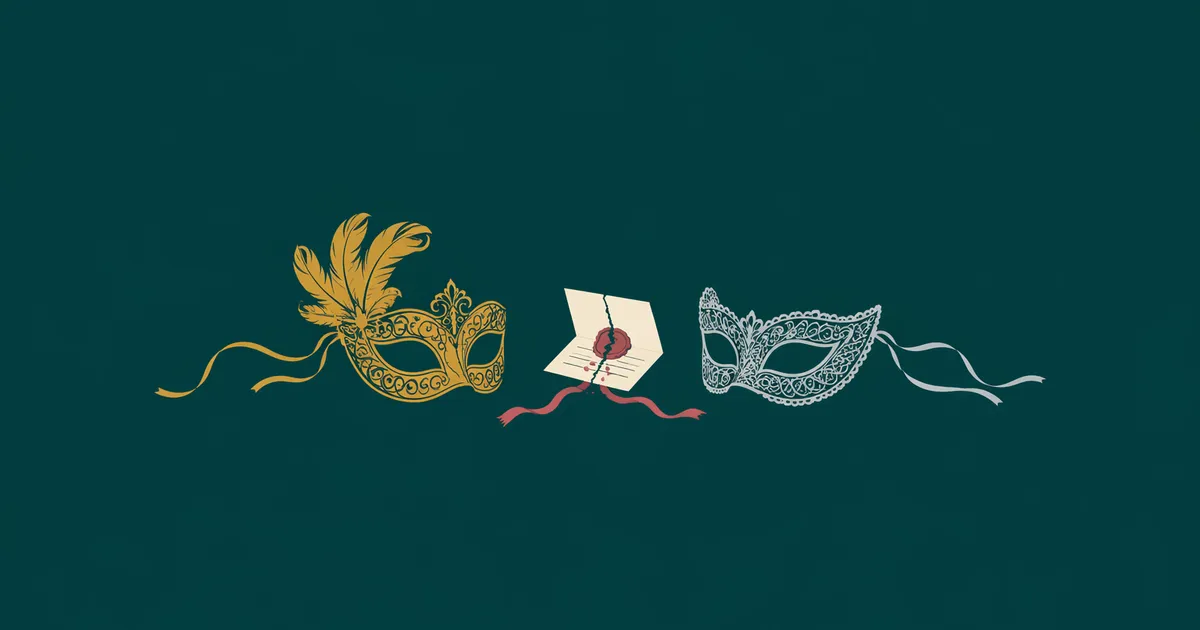
Almost every scene in Much Ado About Nothing is being performed for someone. The masked ball in 2.1 puts the entire court in disguise. The orchard and garden gullings are theater pieces with hidden audiences. Borachio's window scene is staged for two unseen witnesses. The friar's plan to fake Hero's death is itself a directed performance. The second wedding in 5.4 brings on a group of veiled women so Claudio can swear to marry one of them sight unseen. The play is obsessively interested in masks — literal ones, and the metaphorical ones characters wear and discard.
The accessible point is that the residents of Messina are constantly playing roles for one another, and the play asks what's underneath the role. Sometimes the answer is a more honest version of the same person. Sometimes it's nothing at all.
The masked ball in 2.1 sets the pattern. Don Pedro woos Hero in Claudio's identity and Claudio's voice; Beatrice mocks Benedick to his face inside a mask that she may or may not be using as cover; Don John deliberately pretends to mistake masked Claudio for Benedick to plant his first seed of doubt. The mask gives every character permission to say something they wouldn't say with their face uncovered, and what they say is, in each case, closer to the truth than their unmasked speech. Beatrice tells Benedick what she really thinks of him. Don Pedro reveals himself as a man who likes to do other men's wooing for them. Don John shows that he is willing to break the engagement before it has even been announced. Shakespeare is making an argument that disguise, paradoxically, is the place where Messina's people are most candid.
The window plot inverts the same logic. Margaret stands in for Hero by wearing her clothes and being called by her name — a costume rather than a mask — and her "performance" is what condemns Hero. The play is showing that the same theatrical machinery that frees the court at the ball is the machinery that destroys an innocent woman in her own bedchamber. Claudio doesn't see Hero. He sees a costumed performance of Hero, and the play makes clear that he never bothers to check. His credulity is not just the credulity of a young soldier; it's the credulity of an audience member who has stopped distinguishing between a sign and the thing it stands for.
The second wedding stages the play's theory of forgiveness as another performance. Claudio is not asked to recognize Hero or to apologize directly to her. He is asked to perform the same vow he botched the first time, this time blind. When Hero unmasks — "And when I lived, I was your other wife: / And when you loved, you were my other husband" — the play presents the recovery as a kind of theatrical reset. The mask comes off, the dead woman returns, and the comedy concludes. But the doubling of "other wife" and "other husband" is unsettling. Hero is not quite the same person she was; she has had to die and be reborn through male misperception, and the marriage that closes the play is between two people each of whom has been performing innocence for an audience that wronged them.
Even Benedick's transformation is staged as a costume change. After the orchard trick, he appears clean-shaven, perfumed, and hatless, and his friends mock him in 3.2 for looking like a man in love. Self-fashioning in the play is rarely deceit pure and simple; it is more often the visible sign of an internal conversion the character cannot yet articulate. The play's last image — Benedick calling for music and dancing, brushing aside the news of Don John's capture — is a final piece of self-fashioning. The merry man has won the day. The slander, the near-death, the broken trust between friends are all, for the moment, danced over. Comedy itself is the play's last and largest mask.