Themes & Motifs
Friendship Versus Romantic Love
The play is built on a collision that Renaissance audiences would have recognized instantly: the old ideal of male friendship — amicitia, the bond between two virtuous men — against the newer cultural obsession with heterosexual passion. Valentine and Proteus open the play as textbook best friends, teasing each other so affectionately that their banter about love ("He after honour hunts, I after love") sounds like a definition of a shared self. By Act 2, Proteus has thrown the friendship overboard for a woman he has seen once. By Act 5, Valentine — confronted with Proteus's attempted assault on Silvia — forgives him in two lines and then offers him Silvia as a token of restored friendship: "All that was mine in Silvia I give thee." The play is asking a blunt question: when these two loves conflict, which one wins, and at whose expense?
Shakespeare never quite answers. He sets the ideal of friendship high enough that Valentine's gesture reads, in Renaissance terms, as the ultimate proof of loyalty — the same logic as the medieval Titus and Gisippus story, where one friend hands his beloved to the other to seal their bond. But he also stages the gesture fast enough, and in front of a woman who has just been assaulted, that it cannot be swallowed whole. The play lets the amicitia tradition speak and then makes it look slightly obscene.
The friendship plot is structured as a series of tests, each one raising the cost. In 1.1 the friends part amicably; Proteus's opening soliloquy is already a small betrayal, confessing that he leaves "myself, my friends, and all for love." In 2.6 Proteus's solo accounting — "I to myself am dearer than a friend, / For love is still most precious in itself" — takes Montaigne's humanist friendship rhetoric and gives it to a man using it as cover for treachery. The word "friend" recurs through his soliloquy like an accusation: "Valentine I'll hold an enemy, / Aiming at Silvia as a sweeter friend." Proteus does not so much abandon friendship as repurpose it, rebranding erotic pursuit as a purer form of the bond he has just broken.
Silvia is the one who sees this clearly, and her refusal of Proteus in 4.2 is one of the sharpest moral voices in the play: "When I protest true loyalty to her, / She twits me with my falsehood to my friend." She treats his treachery against Valentine as inseparable from his treachery against Julia; for Silvia, there is no way to cheat a friend and remain a worthy lover. In the final scene she escalates this argument directly to Proteus: "Thou hast no faith left now, unless thou'dst two, / And that's far worse than none; better have none / Than plural faith, which is too much by one." Her syntax is almost mathematical — Shakespeare is making her the play's accountant of loyalty.
What makes Valentine's final offer so disorienting is that the play has already shown us Silvia applying exactly the moral logic Valentine ignores. She has been explaining, scene after scene, that romantic love cannot be built on broken friendship. Valentine then frames his own reconciliation with Proteus as the reverse: friendship restored by handing over the beloved. Julia's faint, prompted by those lines, does the dramatic work the text leaves unfinished — it registers the shock the men on stage do not. The play ends on "one feast, one house, one mutual happiness," but it has already shown the audience that the men's version of friendship is the thing that broke everything.
Inconstancy and Shape-Shifting
Proteus is named for the sea-god of Homer and Ovid who escapes capture by changing shape at will — a fish, a lion, a tree, a river — and the play treats the name as a diagnosis rather than a coincidence. The central idea of The Two Gentlemen of Verona is that some people cannot hold a single form: their loves, loyalties, and oaths reshape themselves to fit whatever they want in the moment. Proteus goes from worshipping Julia ("Sweet love, sweet lines, sweet life!") to calling her "a swarthy Ethiope" beside Silvia, inside a single act. He goes from Valentine's sworn friend to the man who informs on him to the Duke, inside a single scene. The play watches this happen and asks whether a person who shifts that freely has any self at all.
The clearest statement of the theme is Julia's line at the end: "It is the lesser blot, modesty finds, / Women to change their shapes than men their minds." The couplet is doing careful work. Julia has changed her shape literally — she has spent the last two acts dressed as the boy Sebastian — and she is arguing that her outward disguise is nothing beside Proteus's inward reversals. One is a costume, the other is a character.
Proteus's 2.6 soliloquy is the textbook case and worth dwelling on, because Shakespeare writes it as a sequence of shape-shifts he cannot stop. "To leave my Julia, shall I be forsworn; / To love fair Silvia, shall I be forsworn; / To wrong my friend, I shall be much forsworn": three oaths to break, and he breaks them by grammatical trick. "Love bade me swear, and Love bids me forswear." He refuses to name the contradiction and hides inside the same word. A line later he has upgraded himself from "tempted subject" to the man who exchanges a star for the sun: "At first I did adore a twinkling star, / But now I worship a celestial sun." The speech's final image is of someone literally canceling himself — "I cannot now prove constant to myself / Without some treachery used to Valentine" — a man who must betray to remain recognizable.
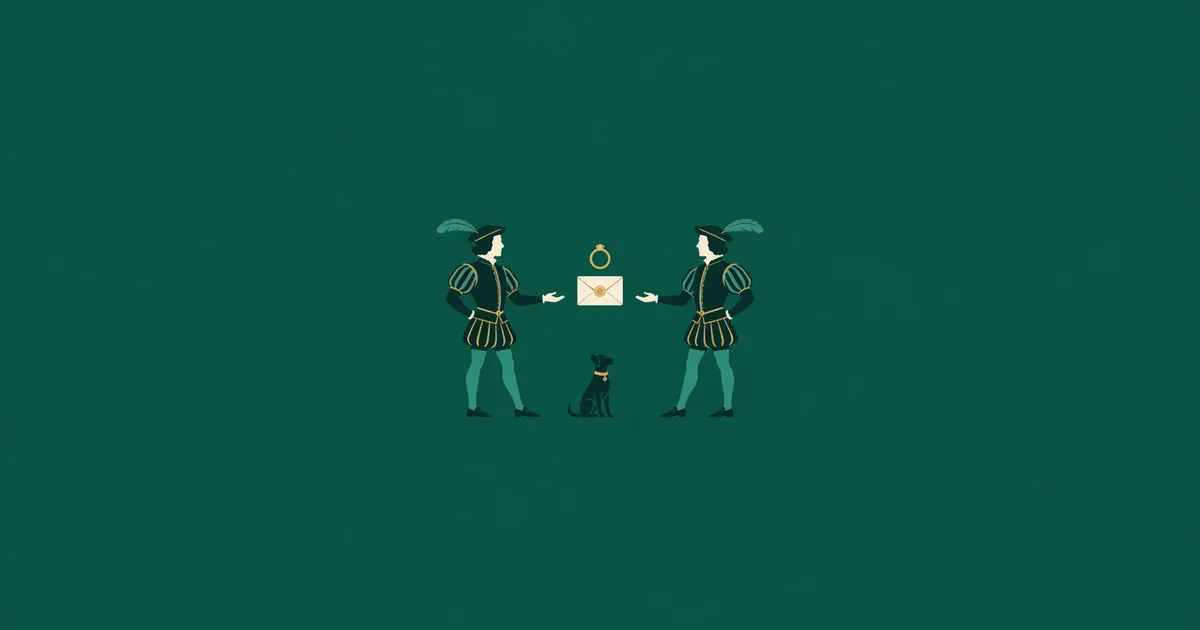
The play anchors this abstract idea in a physical object: the ring Julia gave Proteus at parting. In 4.4 he hands Julia-as-Sebastian that same ring and orders her to deliver it to Silvia, converting her token of constancy into a token of her replacement. The ring travels a long arc — Julia's finger, Proteus's departure, Proteus's betrayal, Silvia's refusal, back to Julia's hand at the disguise-reveal. Its journey is the journey of Proteus's inconstancy rendered physical. When Julia in 5.4 produces "the wrong ring" on purpose and then the right one, she is performing her reading of the whole play: Proteus's signs have been detaching from their meanings, and she is the one who can still tell them apart.
Inconstancy even infects the play's minor figures and raises the stakes of the pattern. The Duke flips from Valentine's patron to his banisher within minutes of finding the letter. Thurio, offered violence by Valentine in 5.4, instantly renounces the woman he was supposedly engaged to: "I hold him but a fool that will endanger / His body for a girl that loves him not." In a play this size, three men reversing their loves on a sentence's notice is not accidental. Shakespeare is sketching a Milanese court where constancy has no currency, and placing Julia in the middle of it as the one person whose outward shape hides an unmoved inner one.
Disguise and the Theatre of Identity
Julia's decision in 2.7 to cross-dress as the page Sebastian and follow Proteus to Milan is the single most generative move Shakespeare makes in this play, and he will return to it for the rest of his career. The disguise is not just a plot convenience; it turns Julia into both actor and audience. She watches Proteus serenade Silvia below her window while she stands beside him in boy's clothes. She carries his love letter and his ring to the woman who has replaced her. She hears Silvia pity "poor lady Julia" without knowing that poor lady Julia is the page in front of her. The play keeps asking: what does it mean to perform being someone else in order to see who your lover really is?
The theme reaches beyond Julia. Proteus, without a literal costume, disguises himself morally — to Valentine ("thy friend"), to the Duke ("my duty pricks me on"), to Silvia ("my pure heart's truth"). The play's title promises us two "gentlemen," and the word is its own disguise: both men spend long stretches behaving as the opposite.
The window scene in 4.2 is Shakespeare's earliest experiment with triangulated cross-dressing irony — the pattern he will perfect with Viola in Twelfth Night — and it works because disguise is doing three jobs at once. It lets Julia observe her own betrayal; it silences her so the betrayal can play out in full; and it forces her to collaborate in it. Her aside, "He plays false, father… so false that he grieves my very heart-strings," turns Proteus's serenade into a double text: a love song on the surface, a perjury beneath it, with Julia the only listener who hears both tracks at once. The Host misreads her sadness as melancholy for music; the audience sees her hearing the sound of her replacement.
The deepest stroke comes in 4.4, the scene in which Julia-as-Sebastian talks to Silvia about "Madam Julia." Shakespeare lets Julia describe herself in the third person: "About my stature… I was trimmed in Madam Julia's gown, / Which served me as fit, by all men's judgements, / As if the garment had been made for me." The line is a tissue of layered truth — the garment actually was made for her, she actually is her own size — and it demonstrates what the disguise has done to her. She can only tell the truth about herself by speaking as someone else. Then she says she played Ariadne weeping for Theseus's "perjury and unjust flight," an allusion whose application to Proteus is so close that the boundary between role and self dissolves. Silvia, undeceived by the disguise but moved by the grief beneath it, gives her a purse — a small, startling moment of female kinship across the barrier of a costume.
The play's final beat involves a reverse disguise. When Julia faints in 5.4 and reveals herself, she scolds Proteus with a line — "O Proteus, let this habit make thee blush. / Be thou ashamed that I have took upon me / Such an immodest raiment" — that turns her boy's clothes into a moral mirror. She wore the disguise; he was the disguise. Her act of theatre has exposed his. That inversion is the seed of every great cross-dressing plot Shakespeare would later write, and it's already doing serious work here.
Letters, Language, and the Unreliable Word
Language in The Two Gentlemen of Verona is almost always suspect. Letters, vows, love songs, serenades, written catalogues — the play teems with texts, and every one of them is somehow corrupted in transmission. Proteus's first letter to Julia is torn up and reassembled (1.2). Valentine's love-letter to Silvia, concealed with a rope ladder under his cloak, becomes the physical evidence that gets him banished (3.1). Proteus's serenade to Silvia ("Who is Silvia?") is sung to cover his betrayal of both Valentine and Julia (4.2). Silvia, when Julia delivers Proteus's latest letter in 4.4, tears it up unread — "I know they are stuffed with protestations / And full of new-found oaths, which he will break / As easily as I do tear his paper." The play loves its letters and distrusts them utterly.
The theme extends to spoken oaths. Proteus in 2.6 calls them "unheedful vows" that "may heedfully be broken." Julia, before her disguise, tells Lucetta that Proteus's "words are bonds, his oaths are oracles" — a line the play will systematically falsify. By the final scene, Silvia is telling Proteus that his faith has "descended into perjury" so thoroughly that he has no words left that mean anything.
Julia's scene with the torn letter in 1.2 is an early masterpiece of Shakespeare's writing about how people use language to lie to themselves. She rips Proteus's letter in Lucetta's presence to signal propriety, then scrambles after the pieces as soon as the maid is gone, kissing the name "Proteus" on the scraps and apologizing to it: "Poor forlorn Proteus, passionate Proteus, / To the sweet Julia." The scene argues that letters mean something different depending on who is watching; the performance of tearing a letter is a different text from the private act of piecing it back together. That doubleness — the gap between public speech and private feeling — is the engine of the whole play.
Valentine's banishment in 3.1 literalizes the idea that language can be physically incriminating. His letter to Silvia, hidden with the rope ladder, is the "engine" the Duke discovers. Words become contraband. Even more tellingly, the Duke's own interrogation of Valentine is itself a linguistic con: he pretends to need tutoring in how to woo a woman, extracts Valentine's seduction technique line by line ("Win her with gifts if she respect not words"), and weaponizes the advice against him. In the court of Milan, the most dangerous thing a man can do is speak honestly about what he wants.
Shakespeare then sets the clown's counter-voice against this whole apparatus. Launce's catalogue of his milkmaid's virtues and vices in 3.1 — "Imprimis, she can milk… Item, she hath no teeth… Item, she is curst" — is a parody of courtly letter-writing that lands precisely because it is not elevated. The gentlemen of Milan produce sonnets and serenades that mean the opposite of what they say; Launce produces a shopping list that means exactly what it says. When he adds, "Item, She is slow in words. O villain, that set this down among her vices! To be slow in words is a woman's only virtue," he is delivering the play's quietest verdict on the talkative men around him. In a play where the eloquent are liars, the slow-tongued maid is the ideal mate.
Female Agency and the Silence That Closes the Play
The women of The Two Gentlemen of Verona are, for most of its length, sharper and more self-directed than the men around them. Julia orchestrates her own pursuit of Proteus, plans her disguise with Lucetta, and travels across country to find him. Silvia refuses the man her father has chosen (Thurio), arranges her own escape with Eglamour in 4.3, and confronts Proteus to his face as "subtle, perjured, false, disloyal man" in 4.2. Even Lucetta, a waiting-woman, is the play's most consistently accurate reader — she diagnoses Proteus ("All these are servants to deceitful men") while Julia is still insisting his oaths are oracles. For four acts, these women make the choices that drive the plot.
Then the play shuts them up. Silvia has no lines after Proteus's attempted rape in 5.4 — not when he seizes her, not when Valentine forgives him, not when Valentine hands her over. For the final hundred lines of the play, the woman at the center of the action is silent. It is one of the strangest decisions in the Shakespearean comedies, and it is worth sitting with rather than explaining away.
Silvia's voice before 5.4 is remarkably independent for an early Shakespeare heroine. In 2.1, as Valentine's servant Speed keeps noting, she directs the courtship herself; the letter Valentine thinks he wrote for her was really a letter she manipulated him into writing to her. In 4.2, refusing Proteus from her window, she catalogues his failures with forensic precision — his dead Julia, his living friend, his broken oaths — and ends by mocking the idolatrous poetics of courtly love: "I am very loath to be your idol, sir; / But since your falsehood shall become you well / To worship shadows and adore false shapes…" The image is hers: Proteus is the kind of man who worships "shadows" because he cannot deal with substance. In 4.3 she commissions her own escort from Eglamour, borrowing the language of chivalry on her own behalf.
Julia's agency runs parallel but deeper. Her decision in 2.7 to follow Proteus is framed as a pilgrimage — "A true-devoted pilgrim is not weary / To measure kingdoms with his feeble steps" — and the language is deliberately spiritual. She is not chasing a man so much as testing whether her own faith has an object worth having. Once she arrives in Milan, she accepts the humiliation of carrying his ring to Silvia because she needs the evidence. Her aside in 4.4 — "I am my master's true confirmed love, / But cannot be true servant to my master / Unless I prove false traitor to myself" — is one of the earliest moments in Shakespeare where a disguised woman articulates the cost of her own disguise in precise moral terms.
Silvia's silence at the end is what has prompted the most searching feminist criticism of the play since the 1970s, and rightly so. The text does not give her a reaction to Proteus's assault, his forgiveness, or Valentine's offer. Directors have to invent something — a glance, a stillness, a flinch — because the page gives them nothing. Set beside her earlier eloquence, that silence reads less like modesty than like erasure: the moment the men's reconciliation plot kicks in, the play's most lucid moral voice stops speaking. Some readings argue the silence is dramaturgic, a way to focus attention on Julia's revelation. Others argue it is the play's most honest accidental statement about how Renaissance comedy treats its women — as centers of agency until the marriage machinery needs them pliant. Both readings leave the discomfort intact. The play ends with the Duke's promise of "one feast, one house, one mutual happiness," but the mouths that spoke most clearly against false oaths for four acts have gone quiet, and the play does not tell us what they are thinking.