Key Quotes
"It was almost December, and Jonas was beginning to be frightened. No. Wrong word, Jonas thought."
Speaker: Narrator (Chapter 1, opening lines)
The book's very first paragraph shows Jonas checking and re-checking his own vocabulary before the reader has even learned his name. He decides "frightened" is too strong and lands on "apprehensive" a few pages later. In plain terms, this is the novel telling us, right up front, that the community polices what its citizens are allowed to say, and that "saying the wrong word" registers as a moral error before it registers as a grammatical one.
Lowry structures the opening as a self-correction in real time, which is unusual for a third-person narrator and does specific work. The false start ("frightened. No.") lets the reader hear the community's rule — precision of language — already operating inside Jonas's private thoughts. The surveillance has been internalized. Lowry doesn't need to describe the loudspeakers, the discipline wands, or the Committee of Elders in the opening paragraph; she simply lets a twelve-year-old boy edit himself, and the reader immediately understands that this is a world where feelings are rationed by vocabulary. The moment also plants the novel's central irony: the community's proudest export, precision, produces the opposite of what it claims. Jonas has a real feeling, reaches for a real word, and replaces it with a smaller one — the first of dozens of interior amputations the book will catalogue. Every later revelation, from the meaning of "release" to the meaning of "love," follows this template: a word that looks exact is actually a trapdoor.
"I think it's true. I don't understand it yet. I don't know what it is. But sometimes I see something. And maybe it's beyond."
Speaker: Jonas, addressing the Chief Elder and the community (Chapter 8, his selection as Receiver)
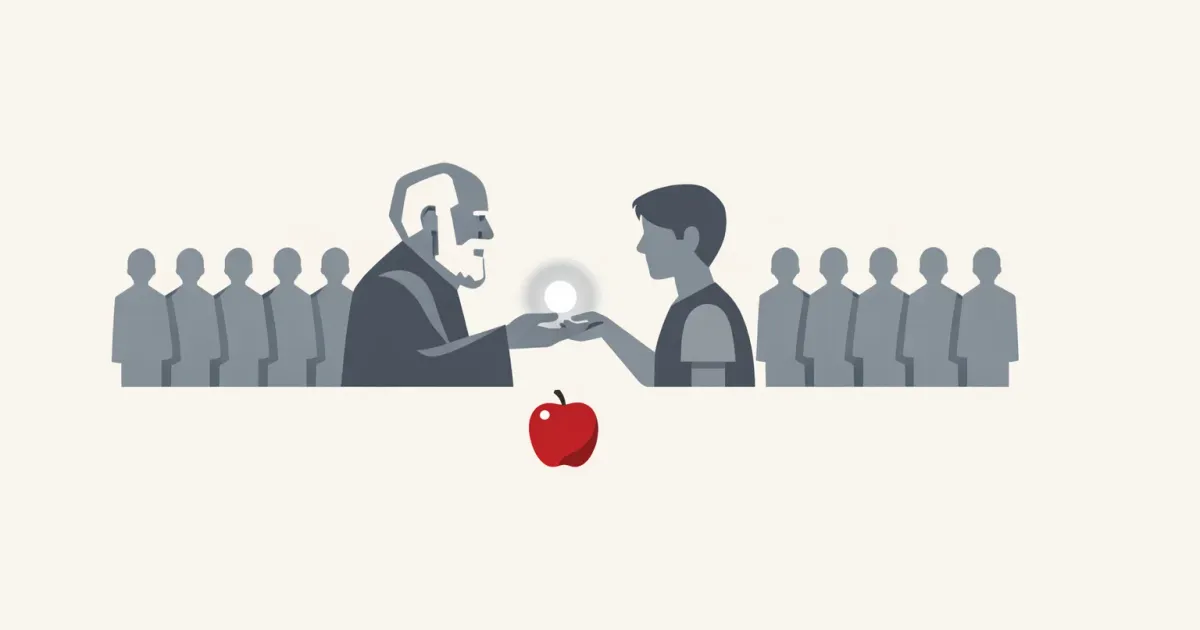
This is the moment Jonas accepts his Assignment. Standing in front of the whole community after being skipped at the Ceremony of Twelve, he's just been told the Receiver must possess something called the Capacity to See Beyond. He doesn't know what it means, but he remembers the apple's flash of color and the faces in the crowd briefly changing, and he tells the truth — halfway. The hesitations and the plain "maybe" are what make the line famous; it's a child claiming a gift he cannot name.
The syntax is doing almost all the work here. Four short sentences in a row, each one retreating from the one before it — "I think," "I don't understand," "I don't know," "maybe" — produce a tentative confession that is the moral opposite of precision of language. Jonas is publicly admitting that he has a perception for which the community has no vocabulary. Lowry places this speech at the only public ceremony in the book and has Jonas use the community's own pattern (careful qualification, measured phrasing) to express exactly what the community cannot tolerate: unverified knowledge. The "something" that he sees will later be revealed as color, and "beyond" will turn out to mean not just past the boundary of the community but past the boundary of Sameness itself. The line is the first time in the novel that Jonas uses language to reach toward, rather than away from, feeling — and it is the seed of every rebellion that follows.
"Our people made that choice, the choice to go to Sameness. Before my time, before the previous time, back and back and back. We relinquished color when we relinquished sunshine and did away with differences. We gained control of many things. But we had to let go of others."
Speaker: The Giver (Chapter 12)
Jonas has just asked why he is only now beginning to see color. The Giver's answer is the closest the novel comes to a formal statement of its thesis. In ordinary language: the community decided, generations ago, to trade variety for safety. Color, sunshine, weather, and difference itself were given up in exchange for predictability. The phrase "back and back and back" — a rhythm that recurs throughout the book — makes the decision sound both ancient and irreversible.
Lowry builds the speech on the verb "relinquished," which is gentler than "lost" and more active than "gave up." The community did not have Sameness imposed on it; it chose Sameness, and keeps choosing it by training every new generation to prefer it. That single word undoes the easy reading of the book as a story about totalitarian imposition — the citizens are complicit, not merely oppressed. The parallel structure ("relinquished color when we relinquished sunshine") also performs a quiet argument about the indivisibility of human experience: you cannot subtract one element of sensory life without subtracting the whole sensuous field it belongs to. "We gained control of many things. But we had to let go of others" is the book's most understated moral accounting, and it is deliberately unfinished — The Giver never lists what was lost, because the rest of the novel is that list.
"He might make wrong choices."
Speaker: Jonas (Chapter 13, in dialogue with The Giver)
The Giver has just finished explaining why the community eliminated color: if people could see red, they might also want to choose the color of a tunic, or a spouse, or a job. Jonas, still half-formed morally, tries out the community's logic in his own voice. He is genuinely frightened by the idea of choice, and his quick agreement — "We really have to protect people from wrong choices" — shows how deeply the conditioning still runs in him, even this late in his training.
The line is famous because it exposes the precise trade the community has made: freedom for safety, choice for comfort. Lowry writes Jonas's acquiescence without italics or irony, which is the point — he is not mocking the argument, he is repeating it, and he cannot yet hear what is wrong with it. The scene operates as a quiet rebuke to any reader who assumes that the desire for safety is always benign. The community's whole machinery — assigned spouses, assigned children, assigned jobs, assigned deaths — is built on the premise that choice produces suffering, and therefore suffering must be eliminated at the root. Jonas's tentative "Oh, I see what you mean" is the novel's clearest illustration of what Hannah Arendt called the banality of evil translated into a children's register: a kind, well-raised boy talking himself calmly into infanticide-by-default, because the alternative is the terrifying freedom to be wrong.
"The worst part of holding the memories is not the pain. It's the loneliness of it. Memories need to be shared."
Speaker: The Giver (Chapter 20)
The Giver is explaining to Jonas why they must devise an escape plan — and why he himself refuses to come along. The community has placed the entire burden of human experience on one old man, and the pain of the memories, he tells Jonas, is not the reason his life is unbearable. The reason is that no one else knows. In plain terms: a person's inner life is not fully human until another person can also see it.
Lowry makes this line the novel's ethical keystone and sets it near the end so its weight accumulates. Up to this point, the reader has watched Jonas receive memories in isolation and then try, unsuccessfully, to transmit them back to Lily, Asher, and his parents, all of whom feel nothing. The loneliness The Giver names is not sentimental; it is structural. A community that has outsourced its memory to a single Receiver has also outsourced its capacity for empathy, history, and moral judgment — all of which require shared knowledge to function. The line reframes the escape plan not as an act of personal salvation but as an act of return: when Jonas crosses the boundary, his memories will flood back to the community, forcing them into the shared human condition for the first time. Lowry's quiet insistence that "memories need to be shared" is also her working definition of love, culture, and conscience — three words the community has either banned or hollowed out.
"Do you love me?"
Speaker: Jonas, to his parents (Chapter 16, evening meal)
Having just received the memory of a holiday family gathering from The Giver and learned the word love for the first time, Jonas goes home and asks his mother and father, at the dinner table, whether they love him. His father chuckles. His mother corrects his grammar. They explain that "love" is a generalized, meaningless word and suggest he try "enjoy" or "take pride in" instead. Jonas tells them he understands — his first deliberate lie.
This is the scene that converts the novel from dystopian critique into something closer to tragedy, and Lowry achieves it with nothing more dramatic than a dinner-table conversation. She could have written Jonas's parents as cruel, and the book would be easier. Instead she writes them as gentle, slightly amused adults patiently instructing their son away from a feeling they no longer have access to. The horror is in their kindness. The parents are not suppressing love; for them, the concept is extinct, and the word has decayed into a grammatical error. Jonas's lie that follows — "Yes, thank you, I do" — is the first truly adult act he performs in the novel, because a lie requires two interior states at once, and the community's language was engineered to make that impossible. From this scene forward, Jonas is double-minded: a citizen of the community in his speech and a stranger to it in his feeling. That split is the precondition for everything he will do next, including the decision to flee.
"Bye-bye, little guy."
Speaker: Jonas's father, to the newborn twin he has just killed (Chapter 19)
This is the line that breaks the book. Jonas has asked to watch a release; The Giver, who knows what Jonas is about to see, plays him the recording. Jonas's mild, cheerful Nurturer father weighs two identical newborn twins, injects a lethal dose into the smaller one's forehead vein, watches him go still, drops the tiny body into a chute, and says "Bye-bye, little guy" as he leaves the room. Release, Jonas finally understands, is a euphemism for murder, and his father performs it casually, using baby talk.
Lowry has been priming this revelation since chapter one, when release was first mentioned as both celebration and punishment. Every occurrence of the word has been a small detonator set for this moment. The craft of the scene lies in how Lowry refuses to give the reader any reaction shot from the father — he doesn't flinch, doesn't hesitate, doesn't lower his voice. The endearment "little guy" is what makes the scene unbearable: the father has performed this killing dozens of times, and he feels toward the victim exactly what he would feel toward a puppy being put out for the night. The cheerful diction exposes the community's deepest fraud — that eliminating suffering from the vocabulary eliminates it from reality. In two words, Lowry condenses the whole argument of the book: a society that has outlawed the language of death has also outlawed the recognition of death, and therefore kills without grief. It is also, crucially, the scene where Jonas's childhood ends. The father he trusts has become, in the space of a recorded minute, a stranger he can never go home to.
"If you were to be lost in the river, Jonas, your memories would not be lost with you. Memories are forever."
Speaker: The Giver (Chapter 18)
The Giver is telling Jonas the story of Rosemary, the previous Receiver-in-training, who lasted five weeks before requesting release. When she died, her five weeks of memories rushed back into the community, and the people couldn't cope. The Giver uses the conditional — "if you were to be lost in the river" — to explain how the escape plan will actually work: Jonas's absence will return every memory to the community at once. It is a quiet line that sets the entire climax in motion.
Lowry's choice of metaphor — the river, the community's literal boundary — turns memory into something with physical properties, like water. Memories do not evaporate when a person dies; they overflow their container and spill back into the culture that shed them. That model reverses everything the community believes about its own design. The Elders thought memory was a burden that could be stored, like waste, in a single disposal site; The Giver knows it is a pressure that only the discipline of one Receiver is holding back. Rosemary's death is the novel's warning shot, and Jonas's disappearance is meant to be the full charge. The line also quietly redefines grief: in this community, where "release" is celebrated and names are erased from conversation, The Giver insists that memory persists regardless of whether anyone is willing to carry it. His assertion — almost a creed — that memories are forever is the moral counterweight to a society that has tried, and nearly succeeded, in making them disposable.
"This was something that he could keep. It was a memory of his own."
Speaker: Narrator, describing Jonas at the top of the hill (Chapter 23)
In the novel's final chapter, near-frozen and starving, Jonas climbs a long hill with Gabriel strapped to his chest and realizes, at the top, that what he is experiencing — the cold, the snow, the steepness — is not a memory The Giver has transmitted to him. It is his own, generated by his own body in a real place. Two sentences. The simplest prose in the book. The whole arc of the novel turns on them.
Lowry has spent twenty-two chapters establishing that Jonas's interior life is secondhand. Every feeling he has had, from sunburn to love, has been given to him by another person's past. The line "it was a memory of his own" is the first moment in the novel where Jonas is the author of his own experience, not its recipient. That is what becoming fully human means in this book: not receiving memory but making it. The sled waiting at the top of the hill — an object Jonas knows from the very first transmission in chapter 11 — has returned, but this time it is not a gift. It is the vehicle of his own agency. Lowry compresses the whole coming-of-age arc into one possessive pronoun. "His own" is the antonym of Sameness; it is also the novel's quietest, fiercest assertion that an individual self is worth whatever it costs to build one.
"For the first time, he heard something that he knew to be music. He heard people singing. Behind him, across vast distances of space and time, from the place he had left, he thought he heard music too. But perhaps it was only an echo."
Speaker: Narrator, the final paragraph (Chapter 23)
These are the last three sentences of the novel. Jonas, sledding down the hill toward the lights of a village where families celebrate love, hears music for the first time — and also believes he hears it behind him, from the community he has fled. The final word, "echo," refuses to resolve whether the community has begun to recover its memories or whether Jonas is hallucinating as he dies. Generations of students have argued about it; Lowry has declined to settle it.
The ambiguity is the point. A resolved ending would tell the reader whether Jonas's rebellion succeeded — whether Lily, Asher, Fiona, and his parents are, at this moment, feeling love for the first time, or whether Jonas's salvation is a dying boy's invention. Lowry's "perhaps" is what keeps the novel from flattening into either fable or tragedy. She has said in interviews that she believes Jonas arrived, but the book itself refuses to grant the reader that certainty, and the refusal matters. The community that raised Jonas taught him that certainty was safety; the novel ends by placing him in the exact condition the Elders have tried to eliminate for generations — hopeful, uncertain, and choosing anyway. "Echo" is also a musical term, which lets Lowry close on her central metaphor: music is shared experience propagating outward, and an echo is what happens when sound reaches the listener who is supposed to hear it. Whether that listener is the community behind him or no one at all is the question Lowry entrusts to the reader, and it is the most honest ending a book about memory and freedom could possibly have.