Summary
Overview
The Giver looks, at first, like a novel about a boy whose community has solved every human problem — no war, no hunger, no crime, no confusion about what anyone should do with their life. Then Lois Lowry spends two hundred pages quietly showing you the price tag. Jonas, an eleven-year-old in an unnamed future community, is selected for a strange job called Receiver of Memory, and through his training he discovers that his neighbors have traded color, weather, music, grandparents, animals, sexual desire, and love itself for the comfort of what they call Sameness. The more he learns, the less he can bear what he once thought of as home.
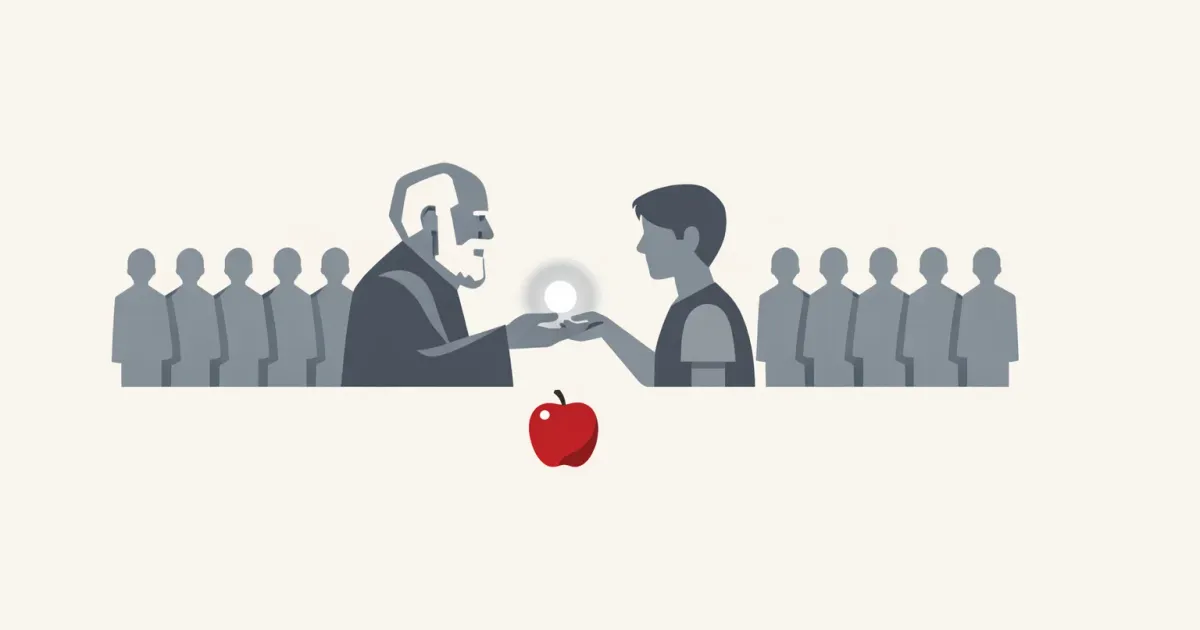
The book reads like science fiction but behaves like a fable. The community is small and bicycle-sized; the rules are laughably detailed (front-buttoned jackets at Seven, haircuts at Ten, bicycles at Nine); the language is scrubbed so clean that no one can tell the difference between impatience and rage. Inside that soft, orderly world, Jonas starts catching flashes of something strange — an apple that briefly isn't the same color as everything else, a friend's hair that flickers into red — and from there, the whole structure of his life begins to come apart. By the final chapters, what began as a careful coming-of-age story has become a flight through snow toward a destination the reader can't quite verify.
Published in 1993, The Giver won the Newbery Medal and effectively invented the modern middle-grade dystopia. Before Lowry, utopian fiction for young readers was rare; works like Brave New World and 1984 were adult property. Lowry borrowed their engine — a society that has traded freedom for control — and mounted it on a child's chassis, making the moral stakes legible to twelve-year-olds without softening them. Every YA dystopia that followed, from The Hunger Games to Divergent to Uglies, is downstream of this book, though none match its restraint. Lowry doesn't show us the totalitarian state's atrocities up front; she shows us a polite, cheerful place and lets the reader work out, alongside Jonas, which ordinary details are actually horrors.
Structurally, The Giver is built around a concealed revelation. Lowry withholds key facts — what color is, what love is, what "release" actually means — and releases them on a slow fuse, timed to Jonas's own discovery. This creates a double perspective that becomes the novel's engine: the reader sees the community through Jonas's innocent eyes at first, then watches him unlearn that innocence in real time. The famous, much-debated ending extends this structural choice to its logical end. Lowry refuses to confirm whether the sled ride down the hill carries Jonas and Gabriel to a real Elsewhere or to death, and she has said publicly that she prefers it that way. The ambiguity is the point: a boy who has been taught that certainty is safety ends his story by choosing to ride into something he cannot see.
Chapters 1-4: A Community Without Edges
Jonas, almost-Twelve, is apprehensive about the upcoming Ceremony of Twelve, when every child in his age group receives a lifelong Assignment chosen by the Committee of Elders. At the evening ritual of "telling of feelings," he tries out the word for what he feels. His sister Lily, his Nurturer father, and his Department of Justice mother all take their turns too; the ritual is as gentle and routine as brushing teeth. Jonas's father brings home a struggling newchild named Gabriel — an off-the-books act of extra nurturing — and Gabe has the same pale eyes Jonas does, a rare trait in a community where everyone looks basically alike. In his volunteer hours at the House of the Old, Jonas bathes an elderly woman named Larissa, who cheerfully describes a "release" ceremony the community held that morning, and Jonas asks, idly, where exactly released people go. Nobody knows.
Lowry's opening chapters perform a quiet bait-and-switch. The world looks friendly — family dinners, school, volunteer work, warm baths for the elderly — but the details don't quite add up. Bicycles are rationed by age. Mirrors are "rare." A Pilot who accidentally flies over the community is "released," and the word is spoken with a little ironic smile that Jonas chooses not to examine. Precision of language is enforced as a civic virtue, which should feel admirable, but Lowry keeps pairing it with its shadow — Asher was beaten with a "discipline wand" as a toddler for saying "smack" instead of "snack." By chapter three, when Jonas notices an apple briefly "changing" in mid-air, the reader already knows something is off even if Jonas doesn't; the apple incident is the first crack in the surface, a small wrongness that the community's surveillance apparatus immediately tries to smooth over with a public reprimand. The ordinary is being introduced as the problem, not the solution.
Chapters 5-8: The Ceremony of Twelve
Jonas wakes from a strange dream about wanting to bathe his friend Fiona, and his mother explains that he has experienced his first Stirrings — sexual feelings that are suppressed, from this age on, by a daily pill. He starts taking it. The Ceremony of Twelve arrives, two days of Assignments for every child in every age group, with parents watching from the audience. Jonas watches his friend Asher get Assistant Director of Recreation and Fiona get Caretaker of the Old. When it is his turn, the Chief Elder skips his number. The auditorium goes silent. Jonas sits humiliated until, after every other Twelve has been called, the Chief Elder announces that he has not been assigned but selected — chosen to be the community's next Receiver of Memory, an extraordinarily rare role. She warns him that the training will involve indescribable pain, that he will need immense courage, and that he possesses something called the Capacity to See Beyond. The community chants his name, welcoming him into his new identity.
The Ceremony of Twelve is the novel's first major hinge, and Lowry structures it as a public ritual of both initiation and exposure. The community's whole logic — that the Elders know each child better than the child knows themselves, that every life can be correctly sorted — is on theatrical display. What makes the scene unsettling is how well it works on most of the Twelves; Asher gets a good fit, Fiona gets a good fit, even Birthmother Inger seems content. The system is not incompetent. It is, in fact, terrifyingly competent at producing docile adults. Jonas's selection punctures that efficiency by naming, for the first time, a role the Elders cannot fully explain. The "Capacity to See Beyond" — foreshadowed by the changing apple and the faces in the crowd that briefly take on color — is the novel's first explicit signal that perception itself has been engineered. Something about Jonas's eyes, literal and metaphorical, lets him register what others cannot. The Chief Elder's warning about pain is not foreshadowing for the reader; it's the first time Jonas hears that a part of human experience has been walled off from him, and that he is the one assigned to feel it.
Chapters 9-13: Snow, Sunshine, and the Color Red
Jonas reads the rules in his Receiver folder and finds them alarming: he is forbidden to discuss his training, prohibited from dream-telling, exempt from medication, barred from applying for release, and — most shockingly — permitted to lie. He meets the current Receiver, a weary old man who instructs Jonas to call him The Giver. The Giver explains his job: to hold the memories of the entire world, "back and back and back," memories the community shed generations ago when it chose Sameness. He transmits, by placing his hands on Jonas's back, the memory of a sled ride down a snowy hill. Jonas experiences snow, cold, speed, downhill motion — none of which exist in his flat, climate-controlled world. He also experiences sunshine, then sunburn: his first taste of pain. Over weeks of training, he begins to see color, starting with red — the apple, Fiona's hair, geraniums outside the Hall of Open Records. The Giver explains that humanity gave up color when it gave up difference; the scientists still haven't completely eliminated Fiona's red hair. Jonas receives a devastating memory of poachers slaughtering an elephant and learns that flesh once came in many colors. He begins to feel a restless anger at his own community's shallow lives.
This is the section where the novel's governing metaphor — that memory is the thing human beings cannot live without and cannot bear to carry — becomes concrete. The transmission scenes are some of Lowry's best writing. She refuses to explain what snow is before Jonas feels it; she lets him discover sled, runner, hill as his body encounters them, which mirrors how memory actually operates and forces the reader into the same sensory re-education. Color arrives the same way, in glimpses that fade — "the flash of brilliant color, but gone again, returning to their flat and hueless shade." Lowry's decision to make Jonas's first pleasant memory also his first lesson in pain (sunburn, in chapter 11) is a masterstroke of compression: the novel's thesis is that pleasure and pain are the same gift, and Sameness is the refusal of both.
The elephant memory is the thematic turning point. Until now, Jonas has lost things — words, color, music — that he never had. With the elephant, he encounters something worse: a creature mourning another creature. Mourning, as a concept, has no place in his community's vocabulary. When he tries, that evening, to transmit the memory to Lily through her stuffed elephant comfort object, she feels nothing. Lowry uses that small failure to establish the novel's loneliest premise — that Jonas's knowledge cannot be shared with the people he loves, that becoming fully human has isolated him from everyone he grew up with.
Chapters 14-17: Pain, Love, and the Pill
The Giver begins transmitting harder memories. Jonas experiences a broken leg on an icy hill and begs for relief-of-pain, which he is forbidden. He experiences starvation, neglect, and finally — in the most devastating scene in this section — a battlefield, where he gives water to a dying teenage soldier and lies in the stench of corpses until he can bear it no longer. Alongside the pain, The Giver offers a favorite memory: a family at a holiday gathering, with firelight, candles, grandparents, wrapped gifts, a sleeping dog. Jonas asks what the feeling in the room is called, and The Giver tells him: love. That night Jonas asks his parents, "Do you love me?" They gently correct his imprecise language — do you enjoy me, do you take pride in my accomplishments — and he lies to them for the first time, saying he understands. The next morning, he stops taking his Stirrings pill. His feelings return. A month later, on an unscheduled holiday, he watches Asher and Fiona play a war game at the field, children pretending to be shot. Jonas walks into the middle of the game and cannot speak; his friends cannot understand him. He realizes his childhood is over and they are no longer reachable.
Lowry constructs this stretch of the novel as a deliberate contrast between two kinds of knowledge Jonas acquires — pain and love — and argues that the community has suppressed them both by the same mechanism. The pill is the engine of this argument. It is not described as a mood stabilizer or a sedative; it is a drug that eliminates "the wanting," the word Jonas used for his first stirring. Once Jonas stops taking it, every emotion in him sharpens, including the ones that have nothing to do with desire. Lowry is making a claim about human integration: you cannot amputate one feeling without amputating all of them. Lily's "anger" becomes, in Jonas's new understanding, mere "shallow impatience and exasperation"; his parents' "sadness" is a hollow performance word. Precision of language, the community's proudest export, has actually produced the opposite — a vocabulary so controlled that it cannot hold any real interior state.
The "Do you love me?" scene is where the novel earns its moral weight. Lowry could have written Jonas's parents as monsters, but she writes them as kind, slightly embarrassed adults gently correcting their son's grammar. That is far more frightening. Love, to them, is not a concept that has been banned; it is a word that has become meaningless. The war game in chapter 17 then pulls the same move in the opposite direction — Asher and Fiona are not cruel children, they are affectionate friends playing an activity they cannot recognize as a reenactment of slaughter. Jonas's grief at watching them is the novel's first full rehearsal of the insight that will drive him to flee: he cannot live in a place where the people he loves cannot love him back, because they have no word for what he means.
Chapters 18-20: Release
Jonas asks The Giver about release and learns the story of Rosemary, the previous Receiver-in-training, who lasted five weeks before asking to be released. The Giver — who reveals, much later, that Rosemary was his daughter — is clearly still devastated. When Jonas's father mentions that identical twins are being born tomorrow and he will have to "release" the smaller one, Jonas asks to watch. The Giver shows him the recording. Jonas watches his gentle father cheerfully inject a lethal dose into a newborn's forehead vein, drop the tiny body into a chute, and wave "bye-bye." Release, he finally understands, is killing. His father is a killer. Fiona, in her caretaker training, is learning to kill the Old. Rosemary requested a syringe and injected herself. Jonas collapses in the Annex, refuses to go home, and he and The Giver begin to plan an escape. The Giver will transfer Jonas every memory of courage and strength he can over the next two weeks, and on the night before the December Ceremony, Jonas will slip out of his dwelling, hide in The Giver's transport vehicle, and be carried toward Elsewhere. The Giver will stay behind to help the community survive the flood of memories that will return to them once Jonas is gone. The Giver confesses that his own gift, unlike Jonas's seeing-beyond, was hearing-beyond — he hears music, which he intends to keep until the end, when he will go to join his daughter Rosemary.
The release reveal is the novel's most notorious scene, and its craft is worth pausing on. Lowry has been priming it from chapter one, where release is mentioned as both punishment and celebration, spoken of with ironic smiles and ceremonial chants. Every chapter has contained the word in some form. When Jonas finally watches the recording, Lowry lets the horror build through his own denial: he keeps narrating to himself what he expects to see ("now he cleans him up and makes him comfy"), while the reader already understands what the syringe is for. The doubling of perspective — Jonas as innocent watcher, Jonas as belated mourner — is the engine of the scene's devastation. It's also the scene where the novel's moral structure snaps into place. The community is not merely constrained or medicated; it is a society in which infanticide and geriatric euthanasia are performed daily by gentle people using sweet voices. Sameness is not a neutral design choice. It is maintained by killing everything that doesn't fit.
The chapter's emotional counterweight is Rosemary. Lowry has been feeding her in as a rumor — an Eleven who was passed over, a name Not-to-Be-Spoken — and when The Giver finally reveals her as his daughter, the Receiver's grief acquires a private dimension the reader did not expect. It also deepens the stakes of the escape plan: The Giver is not simply freeing a boy, he is redeeming a failure and sending Jonas toward what Rosemary could not reach. His refusal to come along is not stoic martyrdom but something more specific — he plans to stay long enough to help the community bear the memories, and then join his daughter in whatever Elsewhere release actually is. Lowry allows the reader to wonder, and that wondering is where the novel begins its slow shift from social critique into something closer to parable.
Chapters 21-23: Elsewhere
The plan collapses at the evening meal the day before Jonas is supposed to leave. Jonas's father announces that Gabriel, who has not thrived at the Nurturing Center's overnight trial, will be released in the morning. Jonas flees that night, alone, with Gabriel strapped to the back of his father's bicycle. He crosses the bridge out of the community, pedals through a night, and enters a landscape that has no road crew and no schedule. He sleeps by day, rides by night, hides in shrubbery when search planes fly over with heat-seeking instruments — each time transmitting a memory of cold into himself and Gabriel so their body temperatures will not register. As days pass, the planes become less frequent. The landscape changes: hills appear, then trees, then birds, then wildflowers and a small reddish-brown creature Jonas cannot name. He has never seen any of it outside the memories. He and Gabriel grow desperately hungry. Jonas catches fish with a makeshift net, eats raw strips, weakens. His ankle is sprained from a fall, and snow begins to fall as they reach a long, steep hill. At the top, he finds a sled waiting. He climbs on with Gabriel, pushes off, and rides down toward lights he can see below — red and blue and yellow, twinkling from trees in rooms where families, he knows, are celebrating love. He hears music ahead. He thinks, perhaps, he hears music echoing behind him too. Or perhaps it is only an echo.
Lowry's ending has been argued about for thirty years, and the argument is the point. On one reading, Jonas has succeeded: the hill is real, the sled is real, he has reached a community that kept memory, music, color, and love, and Gabriel will live. On another reading, Jonas is dying of hypothermia at the top of an unnamed hill, the sled and the lights are hallucinations drawn from a memory The Giver once gave him, and the "echo" of music from behind is his mind's last gesture back toward a community he has saved by his own death. Lowry has said in interviews that she believes Jonas arrived; she has also said she wants readers to decide for themselves, and the three sequels she later wrote (Gathering Blue, Messenger, Son) eventually suggest a survival — but The Giver itself, as a self-contained novel, holds the ambiguity absolutely.
The structural brilliance of the ending is how it collapses the novel's central oppositions into a single image. The sled, which appeared in chapter 11 as Jonas's first pleasure, returns as his final vehicle — but now it is his own memory, not a transmitted one. ("This was something that he could keep. It was a memory of his own.") Jonas has moved from receiving memory to generating it, which is what becoming fully human means in this book. The hill he climbs is the same hill he has been trying to reach since his dreams after the first memory, when he always sensed "a something — he could not grasp what — that lay beyond the place where the thickness of snow brought the sled to a stop." He has been pointed toward this hill from the beginning.
The echo is what refuses to settle. If the music behind him is real, it means the community — Lily, Asher, Fiona, his parents, even his father — has begun to receive the returned memories and to feel. If it is only an echo, it means Jonas has imagined a salvation that is not coming. Lowry leaves both readings intact, and by doing so she argues that hope itself is not the same as certainty. Jonas chooses to ride down the hill before he knows whether anything waits at the bottom. That choice, not the outcome, is what the book has been building toward since he first asked himself what word to use for the feeling in his chest in December.