Exam & Discussion Questions
These are the questions most likely to come up in class discussion, on quizzes, and on exams — organized by book and chapter grouping, with model answers you can study from.
Book the First: Recalled to Life (Chapters 1–6)
1. What does the opening paragraph of the novel establish, and why does Dickens pair opposites so relentlessly?
The famous opening catalogues contrasting absolutes — "the best of times" and "the worst of times," "the season of Light" and "the season of Darkness" — to frame 1775 as an era of extremes that will shortly detonate into revolution. The technique does more than set atmosphere: it announces the structural logic of the whole novel, which will repeatedly work through pairs and doubles.
The opening of A Tale of Two Cities is one of the most recognizable paragraphs in Victorian fiction, and its relentless antithetical structure is not merely rhetorical decoration. Dickens constructs a sentence that cannot resolve — every positive term is immediately cancelled by a negative one — producing a formal state of suspension that mirrors the historical moment he is describing. England and France in 1775 are "going direct to Heaven" and "going direct the other way" at the same time, which is Dickens's way of saying that neither country has faced the consequences of its contradictions.
More importantly, the opening announces the novel's central preoccupation with doubling. The two cities of the title, the two men who share Lucie's orbit, the two trials Darnay faces, the two kinds of resurrection the book will stage — all of this grows from the antithetical seed planted in the first paragraph. When teachers ask about "the significance of the opening," the answer is not just "sets a dark tone" but rather "establishes the structural and thematic logic for everything that follows."
2. What is the symbolic significance of the spilled wine in Saint Antoine, and how does Dickens signal the bloodshed to come?
A wine cask shatters outside Defarge's shop, and the starving inhabitants of Saint Antoine lick it from the cobblestones. One man dips a finger in the lees and scrawls "BLOOD" on the wall. Dickens closes the scene with a blunt prophecy: "The time was to come, when that wine too would be spilled on the street-stones." The wine is red, and it stains — the connection to blood is unmistakable.
The spilled wine sequence in Book One, Chapter Five is the novel's first major set-piece of symbolic imagery. Dickens deploys it with unusual directness, declining to hide the allegory: he writes the word "BLOOD" on the wall for the reader as plainly as the joker writes it in the street. But what makes the scene more than a simple foreshadowing device is what it reveals about the people themselves. The inhabitants of Saint Antoine are not grim conspirators; they are playing, dancing, sharing — genuinely joyful over something as meager as spilled wine — and Dickens captures their "hunger" in a later passage where the word is repeated like a drumbeat, personified as the lord of the district.
This context makes the prophecy darker than it first appears. The people who will later become the mob are not bloodthirsty by nature; they have been made desperate by deprivation so severe that free wine in the street is cause for celebration. Dickens is careful not to let readers find the coming revolution incomprehensible or simply savage; the spilled wine scene establishes the historical cause before showing the historical effect.
3. How does Doctor Manette's condition when Lorry and Lucie find him reveal the psychological cost of his imprisonment?
Manette is discovered in a dim garret, making shoes at a low bench, unable to remember his own name. He identifies himself only as "One Hundred and Five, North Tower" — his cell number — and seems barely capable of sustained conversation. His eyes are "haggard" and his voice has "lost the life and resonance of the human voice." Dickens presents him as a man so thoroughly erased by captivity that survival itself has become a kind of death.
Book the Second, Chapters 1–6: The Old Bailey Trial (1780)
4. Why is Darnay acquitted at the Old Bailey, and how does the trial introduce the novel's doubling motif?
The prosecution's star witness claims to have identified Darnay as the spy who passed secrets to France. Sydney Carton, slouching at the defense table, draws Stryver's attention to the obvious resemblance between himself and the prisoner; the witness is unable to say whether he saw Darnay or Carton on the incriminating occasions, and the identification collapses. Darnay goes free because another man looks exactly like him.
The Old Bailey trial functions on two levels simultaneously. As plot, it acquits Darnay and introduces the physical resemblance that will drive the climax of the novel. As characterization, it establishes the contrasting trajectories of the two men. Darnay is in the dock, upright and composed, facing a death penalty he may not deserve; Carton sits nearby, disheveled, staring at the ceiling, contributing a crucial insight only as an afterthought. The implicit question — why has the sharper mind ended up as the lesser man? — will not be answered for another two books.
The trial also contains a quietly important moment of dramatic irony. The reader doesn't yet know Darnay's French surname; neither does the court. His real identity is the novel's buried second charge, and the acquittal here will look terribly provisional once Dickens reveals what Darnay is actually carrying — not just a French alias but an entire family history of aristocratic crimes.
5. What does Carton's conversation with Darnay after the trial reveal about his self-image?
Carton invites Darnay for a meal, then turns contemptuous and hostile almost immediately. He tells Darnay, "I am a disappointed drudge, sir. I care for no man on earth, and no man on earth cares for me." The remark is both an honest self-assessment and a form of preemptive rejection — Carton dismisses Darnay before Darnay can think less of him.
Book the Second, Chapters 7–9: The Marquis Saint Evrémonde
6. How does the scene of the Marquis running down a child establish the moral case for revolution?
The Marquis's carriage crushes a child in the Saint Antoine streets; he pauses only to toss a coin at the father, Gaspard. When Defarge throws the coin back into the carriage, the Marquis threatens to "ride over any of you very willingly, and exterminate you from the earth." The scene is Dickens's most compressed argument that the old regime deserved what came to it. Indifference to human suffering is not merely an aristocratic flaw here; it is presented as policy.
Dickens describes the Marquis's face as "a fine mask" — a recurring image that underscores the point. There is nothing authentic behind the aristocratic surface, no private human being capable of being reached by the death of a child. When the Marquis runs his eyes over the assembled crowd, Dickens writes that he looks at them "as if they had been mere rats come out of their holes." The dehumanization is total and entirely unselfconscious.
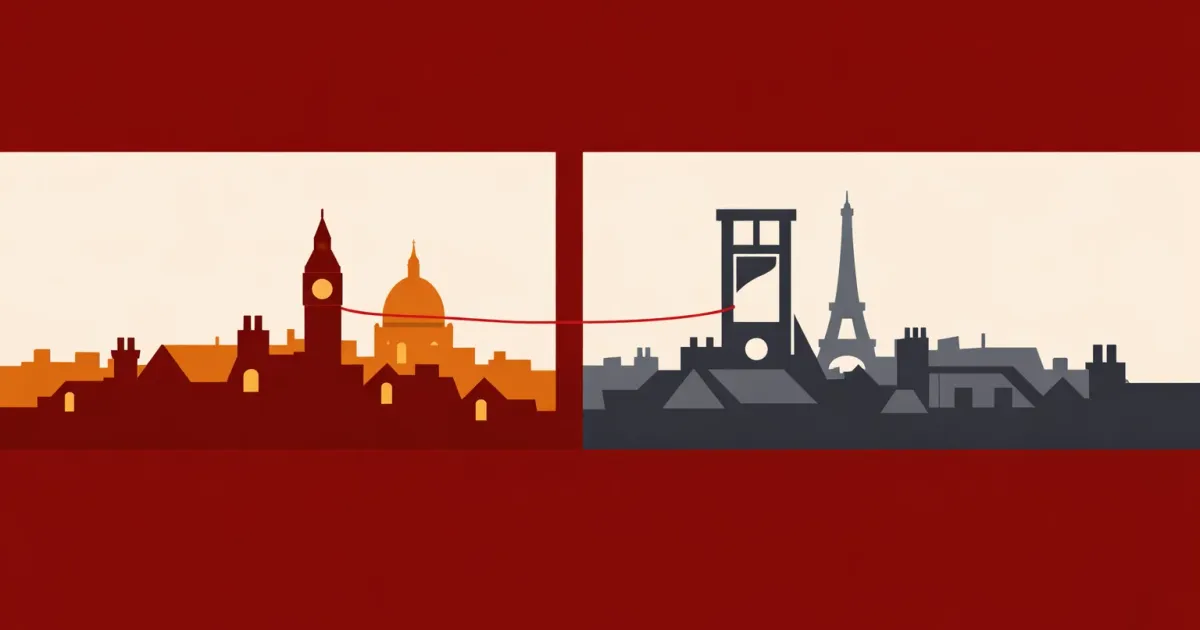
This scene also introduces the figure of Madame Defarge in a different key than the wine-shop scenes. While Gaspard falls to the ground in grief and Defarge tries to console him, Madame Defarge stands "knitting, and saw nothing" — the phrase that closes two separate passages. She is already the novel's most disciplined revolutionary intelligence, training herself to betray no reaction that could be used against her. The contrast between her control and Gaspard's naked grief is, in retrospect, a study in two different responses to oppression: one that spends itself in immediate pain, and one that converts pain into long patience.
7. What is the significance of Darnay's confrontation with the Marquis at the chateau, and what does he renounce?
Darnay tells his uncle that the family name is "more detested than any name in France," that their estate is "a crumbling tower of waste, mismanagement, extortion, debt, mortgage, oppression, hunger, nakedness, and suffering," and that he intends to renounce it and live by his own work in England. The Marquis responds with amusement and contempt, saying he will "die, perpetuating the system under which I have lived." Darnay is morally right and practically powerless.
Book the Second, Chapters 10–13: Lucie's Suitors
8. What is the significance of Carton's promise to Lucie Manette, and how does Dickens frame it?
In Book Two, Chapter Thirteen, Carton confesses his love to Lucie but tells her he asks nothing from her — he knows he will never be worthy. He then makes his vow: "For you, and for any dear to you, I would do anything. If my career were of that better kind that there was any opportunity or capacity of sacrifice in it, I would embrace any sacrifice for you and for those dear to you." The promise is phrased explicitly as conditional on a circumstance Carton cannot foresee; the novel spends two more books fulfilling it.
The Carton confession scene is the structural hinge of the entire novel. Critics sometimes fault it as sentimental, but Dickens plants the vow with such care — repeating it at key moments in Book Three, each time at greater cost — that by the end it reads less like a declaration of romantic feeling than a binding contract. Carton describes himself to Lucie as "like one who died young. All my life might have been." This formulation is crucial: he is not presenting himself as a man who has suffered unjust circumstance, but as one who has squandered every gift he was given. The sacrifice at the end of the novel is not merely a romantic gesture; it is presented as the one act that will finally make the "might have been" real.
The scene is also important because Dickens writes Lucie's response with precision. She does not love Carton, but she receives his confession with genuine compassion rather than pity. Her promise to "hold this secret" becomes part of the novel's network of private loyalties that the Revolution cannot reach or corrupt.
9. Why does Doctor Manette relapse into shoemaking after Darnay tells him his real name on the morning of the wedding?
When Darnay reveals that he is Charles Evrémonde, the name of the family that imprisoned Manette for eighteen years, the doctor's trauma reasserts itself. He spends nine days at the bench compulsively making shoes — his prison coping mechanism — before recovering. The relapse reveals that Manette's recovery has been psychological rather than structural: the past is still present inside him, and the knowledge of his daughter's husband can reactivate it without warning.
Book the Second, Chapters 14–17: The Register of the Dead
10. What does Madame Defarge's knitting represent, and how does the registry function in the novel?
Madame Defarge knits the names of the condemned aristocrats into her work in her own coded pattern — a register of those who will eventually be killed. The knitting transforms the most domestic of female activities into an instrument of political terror. It also functions as the novel's primary symbol of historical patience: the register has been growing for years before any blood is spilled.
The knitting register is Dickens's cleverest symbol in the novel. It works on several levels at once. As literal object, it makes the Revolution legible in a way that no public document can — it is hidden in plain sight, feminine and unthreatening to the eyes of the old regime. As metaphor, it figures the Revolution as something that has been patiently accumulating rather than suddenly erupting: every stitch is a name, every name a wrong that has not been answered. Madame Defarge has been knitting through the entire novel, through the Soho idyll, through Lucie's happiness, through Manette's recovery — the register grows regardless of what the English characters believe about the world's stability.
The reveal that the Darnay name has been added to the register after the spy John Barsad lets slip that Lucie is marrying an Evrémonde retroactively darkens every scene of English domestic contentment. The happiness in Soho was always already condemned in Paris.
11. What happens to the shoemaker's bench after Manette recovers from his nine-day relapse?
Mr. Lorry and Miss Pross secretly destroy the bench and all the shoemaking tools, at Manette's own request once he has recovered. The destruction of the bench is presented as the outward sign of Manette's recovery — a way of closing the door on the prison habit. The fact that it must be done secretly, and that Manette allows it rather than orders it, suggests his recovery is still fragile.
Book the Second, Chapters 18–24: Revolution and the Loadstone Rock
12. Why does Darnay return to France in 1792, and what does Dickens suggest about his motivation?
Darnay receives a letter from his old family steward Gabelle, who has been imprisoned by the revolutionaries and pleads for his former master's help. Darnay believes that his public renunciation of the Evrémonde name and his record as a friend to the peasants will protect him, and he feels personally responsible for Gabelle's imprisonment. He slips away without telling Lucie until after he is already gone.
The chapter is titled "The Loadstone Rock," and Dickens uses the image of a magnetic rock — which draws ships to destruction — to characterize Darnay's decision. The choice is presented as both noble and naïve: Darnay genuinely believes he can reason with the Revolution, that his moral history will count for something. What he cannot account for is that in the Revolution's logic, class origin is permanent regardless of personal conduct. "Charles Evrémonde" is the name in Madame Defarge's register, not "Charles the man who tried to be better."
The quiet tragedy here is that Darnay's moral seriousness — the same quality that made him renounce the title in the first place — is precisely what sends him back to France. A more cynical man would not have gone. The novel does not present this as stupidity; it presents it as the cost of principle operating in a world that has stopped functioning by principled rules.
13. How does the storming of the Bastille mark a tonal shift in the novel?
The Paris chapters in Book Two's final section move from the domestic warmth of the Soho household to scenes of Carlylean mob violence. The grindstone in Tellson's courtyard, with revolutionaries sharpening blades as blood runs off, is designed to unsettle the reader's earlier sympathy for the oppressed. Dickens refuses a simple moral alignment: the old regime was cruel, and the new regime is also cruel.
Book the Third, Chapters 1–6: La Force and the First Trial
14. Why is Darnay unable to protect himself at La Force despite his innocence?
Darnay is arrested as an emigrant aristocrat the moment he enters France — his renunciation of the family name carries no legal weight in revolutionary France, where the category of "Evrémonde" overrides any individual's choices. He has no standing to speak in his own defense. Doctor Manette, whose status as a former Bastille prisoner gives him revolutionary credibility, must petition on his behalf.
15. What does Darnay's first acquittal — and immediate re-arrest the same evening — accomplish structurally?
Dickens gives the family a single evening of reunion and relief, their first genuine happiness in Book Three, before Darnay is arrested a second time. The technique is classical tragedy: the protagonist is raised to apparent safety specifically to make the next fall more devastating. The re-arrest also delivers the withheld information that there are three denouncers, the third unnamed, which creates the novel's best-sustained mystery.
The structural cruelty of the evening sequence is calculated and precise. Dickens has Lucie and Darnay reunited, has them hold their child, has the reader feel the relief — and then sends soldiers to the door. The reversal is only possible because he has spent the preceding chapters establishing how much is at stake emotionally. If the reader had been kept at a clinical distance from the Darnay family, the re-arrest would be merely a plot mechanism; because Dickens has made the domestic happiness vivid, the destruction of it is genuinely painful.
The withheld name of the third denouncer is also handled with care. The reader, having spent two books watching Doctor Manette's fragility and the Evrémonde secret, can begin to assemble the answer; but Dickens delays the confirmation, extending the dread.
Book the Third, Chapters 7–11: The Letter and the Condemnation
16. What is the content of Doctor Manette's letter, and how does it function as the novel's structural trap?
The letter, scratched out with a rusty iron point using scrapings of soot and charcoal from the chimney mixed with his own blood during the tenth year of his captivity in the Bastille and hidden in cell One Hundred and Five, North Tower, describes how the two Evrémonde brothers abducted him in 1757 to treat two patients: a peasant woman dying of fever after being raped by one of the brothers, and her younger brother, dying of a sword wound received while defending her. Before dying, the boy cursed the Evrémonde family "to the last of their race." When Manette tried to report the crime, the brothers had him imprisoned. The letter ends by denouncing the entire Evrémonde line. Read aloud at Darnay's second trial, it condemns him within minutes.
The letter is the novel's master stroke of irony, and Dickens has spent two books building to it. Manette wrote it in genuine agony as an act of justice — a testimony against men who committed a grievous wrong and escaped accountability. But the letter has no author's control over its future uses. Defarge finds it in the chimney of the Bastille cell during the storming, and the Revolution repurposes it as precisely the kind of document it was never meant to be: not a witness statement seeking justice, but a death warrant to be executed by a mob court.
The deepest irony is that Manette's own words condemn the husband of his daughter. He wrote the curse on the Evrémonde family years before Lucie was born, years before Darnay renounced the family name, years before any of the events of the novel occurred. The Revolution does not invent Darnay's doom; it merely executes a sentence that already existed, authored by a man who had no idea the world would catch up with it in this particular way.
17. Who is revealed as the third denouncer, and why does this revelation matter?
The third denouncer, whose name has been withheld, is Doctor Manette himself — through his own written letter. Manette, who has used his revolutionary standing to defend Darnay, is revealed to have been the instrument of his condemnation all along. The revelation also confirms what the reader has suspected: Madame Defarge is the younger sister of the peasant girl from the letter, the one who was "hidden away" and survived. Her entire history with the Defarges, the register, the Revolution — all of it is the grown form of her brother's dying curse.
Book the Third, Chapters 12–15: Carton's Sacrifice
18. How does Carton obtain access to Darnay's cell, and what does he use to accomplish the substitution?
Carton recognizes the spy John Barsad, now working as a prison turnkey at the Conciergerie, from the Old Bailey trial in Book Two. He also identifies Roger Cly, previously reported dead, as still alive and working with Barsad. With this information — knowledge of Barsad's dual roles and Cly's false death — he blackmails Barsad into granting him one private visit to Darnay's cell on the day of the execution. Before visiting, Carton stops at a chemist's shop and purchases a compound the chemist warns must not be taken together.
The pragmatic mechanics of Carton's sacrifice are often underexamined in favor of the lyrical final paragraphs, but they matter considerably. Carton does not simply decide to die for Darnay and walk into the prison; he constructs the substitution like a legal argument — identifying his leverage over Barsad, securing the visit, obtaining the drug — with the same forensic intelligence that saved Darnay at the Old Bailey roughly thirteen years earlier. The sacrifice is not impulsive. The night Carton spends walking the Paris streets, repeating "I am the Resurrection and the Life," is a night of deliberate preparation, not spontaneous heroism.
This matters for how we read Carton's character. He is not redeemed by a sudden impulse of romantic feeling. He is exercising the full force of his intelligence — a gift he has wasted for most of his adult life — in the one act that will give it meaning. The "might have been" that he lamented to Lucie in Book Two is answered not by changed circumstances but by a single, complete use of what he actually had.
19. What happens between Miss Pross and Madame Defarge, and what does the encounter reveal about the novel's competing moral frameworks?
While the escape carriage carries Darnay north, Madame Defarge goes to the Manettes' lodgings to arrest Lucie and the child, intending to complete the destruction of the Evrémonde line. She is met by Miss Pross, who has stayed behind to cover the escape. The two women struggle; Madame Defarge's pistol discharges during the fight and kills her. Miss Pross is permanently deafened by the shot.
The collision between Miss Pross and Madame Defarge is Dickens's deliberate structural parallel to Carton's sacrifice, and it works differently from the scene at the guillotine. Carton's death is considered, theological, almost serene; Miss Pross's survival is clumsy, furious, driven entirely by her love for Lucie and little Lucie rather than by any principle. Yet Dickens presents both as equally valid answers to the Revolution's abstractions.
Madame Defarge comes to the lodgings not merely to arrest individuals but to execute a political logic — "the Evrémonde people are to be exterminated" — that has been building since her brother's dying curse. She is the novel's most formidable figure, consistently more disciplined and more dangerous than any male revolutionary character. That she is killed not by a soldier or by Carton but by the fiercest of private loyalties — an English nanny who will not move — is Dickens's argument that ideology, however coldly and patiently pursued, cannot finally overcome embodied human love. Miss Pross is deafened for life, which Dickens does not soften or explain away; the victory costs something real.
20. What is the significance of Carton's vision at the scaffold, and how does it resolve the novel's central questions?
As Carton rides to the guillotine, he imagines the future: the Darnays safe in England, a son born to them named Sydney, Lucie growing old, Lorry dying peacefully, a grandson eventually bringing a boy of his name to a Paris from which all trace of the Terror has faded. The vision closes with the famous lines: "It is a far, far better thing that I do, than I have ever done; it is a far, far better rest that I go to than I have ever known."
The vision at the scaffold is the novel's formal resolution of the resurrection motif that Dickens planted in Book One. "Recalled to life" — the message Lorry carried to Lucie — first applied to Manette's release from the Bastille. In the final pages it is claimed by Carton: the man who told Lucie he was "like one who died young" finds, at the moment of physical death, the life he could not find in living. His imagined future closes every open loop in the plot and does so with the specificity of a legal will — each person named, each fate assigned.
Whether the vision is presented as genuinely prophetic or as the consoling imagination of a dying man, Dickens leaves slightly open. What matters is that Carton reaches a state of peace at the scaffold that he never found in all his years of drinking and self-contempt. The seamstress beside him finds in his calm the courage to face her own death; his composure is his final gift. "They said of him, about the city that night, that it was the peacefullest man's face ever beheld there."
Thematic Questions
21. How does the motif of doubles and twinning operate throughout the novel, and what does it reveal about Dickens's understanding of identity?
Nearly every major element of the novel comes in pairs: two cities, two countries, two trials for Darnay, two men who share a face, two sisters wronged by the Evrémondes, two kinds of resurrection. The doubling is not merely a structural convenience; it forces the question of whether two people — or two social orders — that look alike are in fact the same.
The most significant doubling is between Carton and Darnay, and Dickens is careful to make it more than physical resemblance. Both men love Lucie Manette; both are associated with legal proceedings; both are products of their respective countries' educated classes. What separates them is not talent — Carton is repeatedly described as the sharper mind — but the direction in which they have aimed themselves. Darnay has used his freedom from the aristocratic system to build an honest life; Carton has used his freedom to waste himself.
The substitution at the end only works because the two men are interchangeable to the executioner's logic — which cannot distinguish between an individual and his name. But Dickens insists on the distinction: the man who dies at the guillotine and the man who escapes in the carriage are not the same person, even if they have the same face. Identity, in the novel's terms, is constituted by one's choices and loves, not by appearance or family name. The Revolution's fatal error — evident in the court's willingness to condemn Darnay for crimes committed before his birth — is precisely that it cannot make this distinction.
22. What is Dickens's argument about the relationship between oppression and the violence it produces?
The novel refuses to assign simple moral blame. The old regime's cruelty is documented in detail — the Marquis's carriage, the Evrémonde brothers, the empty luxury at Monseigneur's reception — but the Terror that replaces it is equally brutal. Dickens's argument, stated most plainly in the final chapter's opening paragraphs, is that violence is not an aberration but a harvest: "Sow the same seed of rapacious license and oppression over again, and it will surely yield the same fruit according to its kind."
Dickens takes an unusual position for a Victorian novelist sympathetic to reform. He does not present the Revolution as justified excess, nor as mindless savagery. The novel's Paris chapters in Book Three present the Terror as the logical end state of a system — the old regime — that had been accumulating unpaid debts for generations. Madame Defarge is not a monster; she is a woman with a legitimate grievance who has weaponized her grief into an instrument of mass murder. The tragedy is not that she is wrong about what was done to her family, but that her justice cannot distinguish between the guilty and the merely adjacent.
The grindstone scene, where revolutionaries sharpen blades as blood runs off, is the novel's most visceral moment of horror, and it comes just after the Bastille sequences that the reader has been prepared to celebrate. Dickens is deliberately complicating the reader's moral alignment: the people who stormed the prison are the same people whose faces now look "tiger-like" over the grindstone. The wine-stained face from Book One — the joker writing "BLOOD" on the wall — has become literal.
23. How does resurrection function as a unifying theme across all three books?
"Recalled to life" — the cryptic phrase Lorry carries in Book One — refers first to Manette's release from the Bastille. But resurrection is woven through the entire novel: Manette reclaiming himself through Lucie's love, Carton's spiritual resurrection in his final hours, Darnay literally restored to life by Carton's sacrifice, and even the vision of a future France "rising from this abyss." The theme connects private and historical transformation.
Dickens structures the resurrection motif with careful escalation. In Book One, resurrection is physical: a man buried in a prison is dug out and brought back to the world, though his identity is still largely gone. In Book Two, it becomes psychological: Manette's steady recovery, interrupted by the shoemaking relapses, traces the slow work of rebuilding a self after trauma. In Book Three, it becomes both theological and moral: Carton's citation of "I am the Resurrection and the Life" — repeated through his night walk until it is "in the echoes of his feet" — frames his sacrifice explicitly as a Christian act of substitutionary death.
The final vision extends resurrection to the historical scale: Carton imagines not just his personal redemption but France itself eventually reaching a state of peace, the violence burning itself out. The novel ends on an image of future generations who will carry his name forward, which means the sacrifice is not simply a private act but one that seeds the future. What was buried in the Bastille in Book One — a doctor, an identity, a family's happiness — is finally, in the last pages, restored.
24. How does Dickens use the contrast between London and Paris to develop the novel's political argument?
London appears as sluggish, corrupt, and often comic — the Old Bailey with its prisoners bringing gaol fever to the judges, Stryver's bullying pomposity, Jerry Cruncher's grave-robbing — but stable and domestic. Paris is vivid, beautiful, and catastrophically violent. The contrast is not simple praise for England; Dickens shows English complacency and class injustice throughout. But the London scenes do suggest that the English order, however imperfect, has not yet compressed its poor to the breaking point.
25. What does the novel suggest about the possibility of personal redemption within larger historical forces?
The novel's private stories — Manette's recovery, Carton's sacrifice, even Miss Pross's battle with Madame Defarge — are set against the impersonal machinery of revolutionary violence. Dickens seems to argue that individual moral acts matter even when they cannot change history: Carton cannot stop the Terror, but he can save the people he loves and die with integrity.
This is perhaps the novel's deepest and most ambivalent question. The Terror grinds on after Carton's death; the seamstress who rides beside him would have died with or without his comfort, and he saves only Darnay and the Darnay family, not the fifty-two condemned that day. Historical forces in the novel are presented as nearly geological in their scope and momentum — Dickens's imagery of mills, woodcutters, and farmers figures the Revolution as something that has been growing in French soil for decades before anyone understood it.
Yet the novel insists that individual acts of loyalty and sacrifice are not rendered meaningless by this scale. Carton's vision of the future, with his name carried forward in the son of the man he saved, is Dickens's argument that private goodness accumulates across time just as private injustice does. The Revolution is the harvest of generations of oppression; the peace Carton imagines for France is the eventual harvest of whatever acts of genuine love and justice are planted now. The pairing is deliberate: if cruelty compounds into catastrophe, then perhaps kindness compounds into redemption.
26. In what ways is Lucie Manette a stronger character than she is often given credit for, and what role does she actually play in the plot?
Lucie is often criticized as a passive romantic ideal, but she is in fact the emotional center of the novel and the source of its key redemptions. It is Lucie who reaches into the garret and brings her father back to himself; it is Lucie whose love for Darnay gives Carton the reason for his sacrifice; and it is Lucie's steadfastness during the Paris imprisonment that sustains her father's use of his revolutionary standing on their behalf.
The critical tradition's dismissal of Lucie as a Victorian angel figure misses how deliberately Dickens has constructed her function in the plot. She is not the protagonist — the novel's moral arc belongs to Carton — but she is the engine. The garret reunion in Book One, where she reaches for her father and he slowly focuses on her face, is the first resurrection the novel stages. Manette's recovery is not institutional or medical; it is relational, the direct result of Lucie's presence.
The same structure recurs in Book Two: Carton tells Lucie explicitly that it is the sight of her and her father together that "stirred old shadows that I thought had died out of me" and gave him "unformed ideas of striving afresh." She does not change him — he is honest about that — but she gives him the image of what a life could look like, which is what his final sacrifice requires. Without that image, there is nothing for him to die toward.
Dickens never presents Lucie as knowing any of this. Her goodness operates without calculation, which is precisely the point: she represents the kind of private, domestic love that the Revolution cannot systematize or destroy, only try to kill directly — which is what Madame Defarge attempts in the final chapters, and what Miss Pross prevents.