Summary
Overview
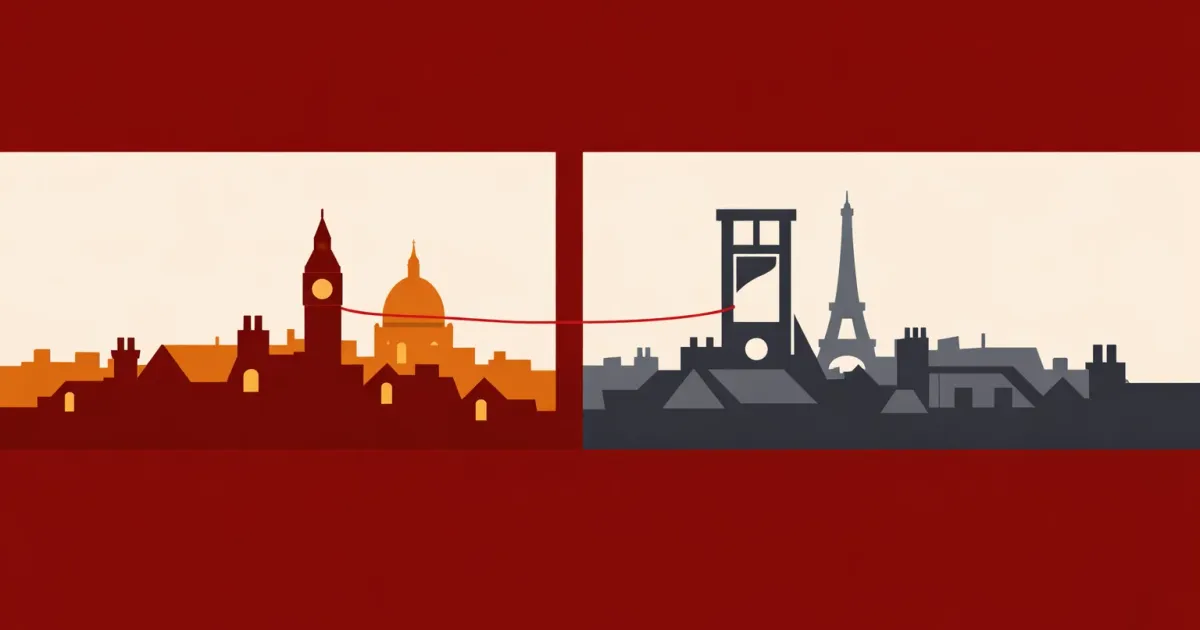
A Tale of Two Cities is Dickens's novel of the French Revolution, set between London and Paris in the two decades that lead up to the Terror of 1793. It opens in 1775 with a secret errand — a young Englishwoman named Lucie Manette is told that her father is not dead after all, but has just been released from eighteen years in the Bastille. From that first rescue, the story widens into something much larger: a double portrait of two cities, one sluggishly unjust and one about to detonate, and a group of ordinary people whose private loyalties get pulled into the machinery of history.
At the heart of the book are two men who look almost identical. Charles Darnay is a French aristocrat who has renounced his family name and settled in London to make an honest life. Sydney Carton is a brilliant, self-wasting English lawyer who drinks too much and believes he has nothing to live for. Both love Lucie Manette; she marries Darnay; and when the Revolution later hauls Darnay back across the Channel and sentences him to the guillotine, Carton offers the sacrifice that gives the novel its famous last line. Around that central triangle, Dickens assembles the vengeful Madame Defarge knitting her register of the condemned, the wine-shop Jacquerie plotting in Saint Antoine, the spy John Barsad, the loyal clerk Jarvis Lorry, the ferocious nanny Miss Pross, and a cast that seems small until you notice how tightly their histories are knotted together.
What the book keeps asking, through every reunion and every arrest, is what a person owes to the past — to inherited guilt, to old wounds, to the people who were crushed before we were born — and it answers that question twice, once in the coldness of Madame Defarge's revenge and once in the warmth of Carton's sacrifice. The result is a book that reads faster than most of Dickens, and hits harder at the end.
A Tale of Two Cities occupies an unusual position in Dickens's work. Published in weekly installments in his magazine All the Year Round in 1859, it is far shorter than Bleak House or Little Dorrit, and its tight, incident-driven plot reflects the weekly format — Dickens needed each installment to land a hook. He acknowledged in his preface lifting his historical framework from Thomas Carlyle's The French Revolution: A History (1837), and Carlyle's apocalyptic imagery of the mob as an elemental force pervades the Paris chapters. Unlike the loose, sprawling comic canvases of his earlier novels, A Tale of Two Cities is almost classically structured: a long, quiet first act, a rising middle filled with private happiness undercut by public menace, and a third book in which the trap closes with the precision of a tragedy.
Structurally, the novel's signature innovation is its use of doubling. Nearly every element comes paired — two cities, two countries, two trials (one in London, one in Paris), two men who look alike, two sisters wronged by the Evrémondes, two kinds of resurrection (Manette's from the Bastille and Carton's from moral dissipation). This scaffolding lets Dickens turn a historical pageant into something closer to myth: the Revolution is not only an event that happens to his characters but a mirror that keeps revealing who they really are. Within his larger body of work, the book is less comic and less digressive than usual, and it has sometimes been criticized for being thinner on the social-panorama observation Dickens does best. What it trades for that compression is velocity — and an ending whose melodrama still works on readers who pride themselves on resisting melodrama.
Book the First: Recalled to Life (1775)
The novel opens with its famous chorus — "It was the best of times, it was the worst of times" — and sets the scene in 1775, with England and France both cruising toward upheaval. Jarvis Lorry, a sober clerk at Tellson's Bank in London, is sent to Dover carrying a whispered message: "Recalled to life." He meets Lucie Manette, a seventeen-year-old orphan raised by the bank, and tells her the truth she has never known — her father is not dead. Doctor Alexandre Manette has just been released after eighteen years in the Bastille, and he is hidden above a wine-shop in the Saint Antoine district of Paris, kept by his former servant, Ernest Defarge. Lorry and Lucie travel to Paris to retrieve him. They find Manette half-broken, obsessively making shoes on a little bench, unable to remember his own name beyond the cell number "One Hundred and Five, North Tower." Lucie embraces him, and the first book ends with the three of them escaping Paris for England, the old man gradually, tentatively, being called back to life.
Read as a gothic prologue, Book One does almost none of the historical work the title promises. Almost nothing here depends on the specific facts of the French Revolution; what matters is the metaphor Dickens plants in the opening chapters — resurrection. The phrase "Recalled to life" will return at the end of the novel in Carton's imagined vision of the future, and the book's theology of sacrifice is already visible in miniature: a man buried alive, a daughter who loves him enough to reach into the grave. The Paris chapters also introduce the Defarges and the spilled cask of wine in Saint Antoine, which the crowd laps up from the cobblestones — a brief, horrifying image of blood to come. Dickens is setting up tonal poles he will hold for the rest of the book: domestic tenderness as refuge, revolutionary Paris as abyss, and the line between them thinner than it looks.
Book the Second, Chapters 1–6: The London Years and Darnay's Trial (1780)
Five years later, a young Frenchman named Charles Darnay stands trial for treason at the Old Bailey, accused of passing English secrets to France. Lucie and her father are witnesses. The prosecution's case collapses when defense counsel Mr. Stryver's disheveled associate, Sydney Carton, points out that Darnay looks nearly identical to him — making the spy's identification worthless. Darnay is acquitted. A loose social group forms afterward: Darnay, Carton, Stryver, Mr. Lorry, and the Manettes gradually become fixtures in each other's lives. Lucie and her father settle into a quiet corner of Soho, where Miss Pross, Lucie's fiercely devoted English companion, keeps house. Carton drifts in and out, brilliant and bitter; Darnay pays courteous, steady visits; and Dickens lets a year or two pass in a gentle montage of domestic happiness.
The Old Bailey trial is the novel's first formal set-piece, and it introduces the physical twinning that the plot will later turn on. But the deeper work of these chapters is characterization. Carton's slouching self-contempt after the trial — he tells Darnay, "I am a disappointed drudge, sir. I care for no man on earth, and no man on earth cares for me" — establishes him as the novel's one genuinely modern figure, a man with a convincing inner life of regret. Darnay, by contrast, is almost too virtuous to be interesting on his own; he works as a plot hinge rather than a psychology. Dickens is also beginning his long game with dramatic irony: the reader doesn't yet know Darnay's French surname, and the Soho idyll is being built on a secret that only Doctor Manette half-suspects.
Book the Second, Chapters 7–9: The Marquis Saint Evrémonde
The story crosses to Paris and to an almost cartoonishly cruel French aristocrat, Monseigneur, attended by servants whose titles outnumber their abilities. Dickens then zooms in on the Marquis Saint Evrémonde, whose carriage careens through Saint Antoine and crushes a peasant child to death. The Marquis tosses a coin at the father, Gaspard, and drives on; Defarge picks up the coin and flings it back into the carriage. That evening, at his chateau, the Marquis receives his nephew — Charles Darnay, whose real name is Charles Evrémonde. Darnay announces that he is renouncing the family, its wealth, and its name, disgusted by the oppression of his class. The uncle smiles coldly and sends him to bed. In the morning, the Marquis is found stabbed to death in his bed, a note pinned to the knife: Drive him fast to his tomb. This, from JACQUES.
"A dead child registers only as damage to his horses" — that is the Marquis, and Dickens refuses to soften him into a human being. The indictment of the old regime lands here because the target has been stripped of any interior life a reader might sympathize with. He is pure aristocratic principle: indifference so total that a dead child registers only as damage to his horses. When Darnay confronts him — the estate is "a crumbling tower of waste, mismanagement, extortion, debt, mortgage, oppression, hunger, nakedness, and suffering" — the reader is given the novel's moral argument in plain language. Gaspard's revenge, under the revolutionary alias "Jacques," is the first open act of violence in the book, and it functions as a structural pivot. From this point forward, the Revolution has begun to move, even if it won't officially erupt for another several years. The grim irony that Darnay will later be condemned in France for the Marquis's crimes is already being set.
Book the Second, Chapters 10–13: Three Men Who Love Lucie
Back in London, the story of Lucie's suitors unfolds. Darnay approaches Doctor Manette to ask permission to court his daughter. He tries to reveal his real name; Manette stops him and says the confession can wait until the morning of any marriage. The conversation clearly shakes the old doctor, who relapses for a night into his prison habit of shoemaking. Mr. Stryver also proposes — loudly, to himself and to Mr. Lorry, who gently talks him out of it. And then, most memorably, Sydney Carton visits Lucie alone and confesses that he loves her without hope. He knows he will never change, knows he can never be a man worth her life. But he makes her a promise: that he would do anything, embrace any sacrifice, for her or for anyone dear to her.
The Carton confession — "For you, and for any dear to you, I would do anything" — is the hinge the entire novel swings on. It is written in the register of a vow. Critics have often noted how Dickens uses it almost liturgically; the promise resurfaces at several crucial moments in the closing chapters, each time more costly. Structurally, these chapters also deepen Doctor Manette's fragility. The reader learns that Darnay's true identity is somehow bound up with Manette's trauma, though the full connection isn't revealed until Book Three. The relapse into shoemaking is Dickens's recurring signal that the past has not finished with him. It works as a narrative time bomb: every time Manette touches the bench, the reader feels the fuse shortening.
Book the Second, Chapters 14–17: Saint Antoine and the Quiet Before
In Paris, Gaspard is eventually captured and hanged over the village well of the Evrémonde chateau. The Defarges travel to the village, quietly enlist the road-mender, and return with more names for Madame Defarge's knitting — a register, stitched in her own coded pattern, of the aristocrats marked for death. Dickens introduces John Barsad, an English-born spy who drifts into the Defarges' wine-shop and lets slip that Lucie Manette is about to marry a member of the Evrémonde family. Madame Defarge receives the news in stony silence and adds the name to her register. Meanwhile, in London, Darnay and Lucie are married; on the morning of the wedding, Darnay finally tells Doctor Manette his real name. Manette sends the newlyweds off, then collapses into nine days of compulsive shoemaking. Lorry and Miss Pross nurse him through it and, at his urging once he recovers, destroy the shoemaker's bench in secret.
This long middle stretch of Book Two is Dickens at his most architectural. Every strand he tightens in these chapters will have to unwind in Book Three. Madame Defarge's knitting — a register that looks like ordinary housewifery — is one of the novel's most brilliant images of revolutionary bookkeeping: the kind of quiet, patient rage that waits fifteen years and then kills in a week. The scene where Doctor Manette, on learning Darnay's family name, silently unmakes himself into the shoemaker is one of Dickens's great psychological images. It asks the novel's sharpest question: can a good man forgive the family of the men who buried him alive? The smashing of the bench is the outward answer; the inward answer will take the rest of the book to discover.
Book the Second, Chapters 18–24: The Revolution Breaks and the Magnet Calls
Years pass quietly in London. Lucie and Darnay have a daughter, little Lucie. Sydney Carton is welcomed into the household as an odd, tender uncle; he is especially gentle with the child. Across the Channel, Paris finally ignites. The Defarges lead the storming of the Bastille on July 14, 1789; Defarge insists on being taken to cell One Hundred and Five, North Tower, where he searches the chimney and finds something hidden there. The revolutionary violence escalates — the aristocrat Foulon, who had reportedly told starving peasants to eat grass, is hauled out by the mob, hanged from a lamppost, his head paraded on a pike with grass stuffed in his mouth. Meanwhile, in 1792, Mr. Lorry prepares to travel to Paris on Tellson's Bank business. Darnay receives a desperate letter from his old family steward, Gabelle, who has been imprisoned by the revolutionaries and begs for help. Feeling himself honor-bound and confident the new France will recognize him as a friend, Darnay slips away to Paris without telling Lucie, leaving only letters of explanation.
These chapters are the novel's tonal fracture. The Soho idyll gives way, without much warning, to Carlylean mob scenes written at a pitch Dickens rarely attempts elsewhere. The image of the grindstone in Tellson's Paris courtyard, with revolutionaries sharpening their blades as blood runs off, is meant to horrify — and to complicate the reader's earlier sympathy for the oppressed peasantry. Dickens refuses the easy position: the old regime was monstrous, and the new regime is also monstrous. Darnay's decision to return to France is a moral one presented as almost inevitable, a gravitational pull, which is why Dickens calls the chapter "The Loadstone Rock." He has been named Evrémonde whether he likes it or not, and the past is now a magnet. From this point the novel accelerates; the ticking clock is audible on every page.
Book the Third, Chapters 1–6: Imprisonment, Manette's Return, and Darnay's First Trial
Darnay is seized at the frontier as an emigrant aristocrat and sent to the Parisian prison La Force. Lucie, little Lucie, Miss Pross, and Mr. Lorry hurry to Paris. Doctor Manette, who as a former Bastille prisoner has heroic standing with the revolutionaries, petitions the tribunal for his son-in-law. For a year and three months Manette uses his influence to keep Darnay alive. Finally, Darnay is brought to trial. Manette testifies powerfully on his behalf, witnesses confirm Darnay's renunciation of his family, and the tribunal acquits him amid cheers. That evening, Darnay and Lucie are briefly reunited — only for soldiers to arrive at the house hours later. Darnay has been re-denounced, by three people: Ernest Defarge, Madame Defarge, and a third whose name the officers will not yet speak.
The structural cruelty here is deliberate. Dickens gives the family a full evening of reprieve — the first genuine happiness in Book Three — before ripping it away. It is the classical technique of raising the protagonist to safety in order to make the fall farther. The withheld name of the third denouncer is the novel's best-managed mystery: the reader, with most of the clues on the table by this point, can begin to guess what the tribunal is about to reveal. Manette's confidence that he can protect his family through his prison-martyr status is shown to be a tragic overestimation. Revolutionary France has no use for private loyalties; the ex-prisoner is allowed to plead only so long as the tribunal finds it useful.
Book the Third, Chapters 7–11: The Letter and the Condemnation
Darnay is retried the next day. Defarge produces a paper he discovered in the chimney of cell One Hundred and Five, North Tower, during the storming of the Bastille — a letter written in Doctor Manette's own hand in the final year of his imprisonment. The letter, read aloud, tells the story Manette had spent eighteen years trying to forget. Years earlier, the two Evrémonde brothers — Darnay's father and uncle — had summoned the young Doctor Manette to their chateau to treat two patients: a peasant girl dying in a fever after being ravished by one of the brothers, and her younger brother, dying of a sword wound he had received trying to avenge her. The boy, before dying, cursed the Evrémonde family to its last descendant. The girl's remaining sister, he said, had been hidden away. When Manette tried to report the crime, the Evrémondes had him seized and buried in the Bastille. The letter ends by denouncing the Evrémonde line, "them and their descendants, to the last of their race." The courtroom erupts. Darnay is condemned to die within twenty-four hours. And the reader learns the last secret: Madame Defarge is the younger sister who was hidden away, now grown, now wielding her brother's curse as a knife.
Can a document written in 1767 kill a man in 1793? Dickens has been tightening that vise since Book One, and the letter from the chimney is where it finally closes. Manette's letter, written in agony, becomes the instrument that condemns the husband of his own daughter. The Revolution does not invent this doom; it simply executes a sentence Manette himself pronounced a quarter-century earlier, when he had no idea the curse would grow up and take his daughter with it. The structural symmetry is devastating: the same words that once cried out for justice against the Evrémondes are now being used to kill a man who renounced them. Madame Defarge's reveal is the payoff for hundreds of pages of knitting; her private wound has been the engine of the Paris plot all along. Dickens is making his bleakest argument here — that there are injuries so deep they keep generating violence even when the original perpetrators are long dead.
Book the Third, Chapters 12–15: Carton's Sacrifice
While Darnay waits in the Conciergerie, Sydney Carton arrives quietly in Paris. He encounters the spy John Barsad — now working as a turnkey at the prison — and recognizes him from the Old Bailey trial; he also recognizes the other spy, Roger Cly, once reported dead, still alive. With this leverage, Carton blackmails Barsad into granting him one private visit to Darnay's cell on the afternoon of the execution. Carton has, meanwhile, stopped at a pharmacist and purchased a substance that can render a man unconscious.
On the day of the execution, fifty-two prisoners are listed to die. Carton enters Darnay's cell, drugs him, exchanges clothes with him, and has Barsad carry the unconscious Darnay out to the waiting carriage where Lorry, Lucie, Doctor Manette, and little Lucie are ready to flee Paris. Madame Defarge, meanwhile, sets out to arrest Lucie and the child — she intends to finish the extermination of the Evrémonde line. She is met at the Manettes' lodging by Miss Pross, who has stayed behind to cover the escape. The two women fight; Madame Defarge's pistol discharges in the struggle and kills her, leaving Miss Pross permanently deaf from the shot. As the carriage carrying Darnay races north, Carton rides in the tumbril to the guillotine alongside a frightened young seamstress who has recognized that he is not Darnay. She finds in his quiet courage the strength to face her own death. At the scaffold Carton ascends the steps with a peace those around him will remember. In his imagined final vision he sees the Darnays safe, a son born to them bearing his name, and the long expiation of the Revolution's violence. The novel closes on his unspoken thought: "It is a far, far better thing that I do, than I have ever done; it is a far, far better rest that I go to than I have ever known."
Nowhere else does Dickens write so openly in the register of theology. Carton's sacrifice is explicitly Christological — the substitute who dies for another, the man who takes on a death he did not earn — and the last pages read almost like a liturgy. What rescues the ending from easy piety is the parallel collision Dickens stages elsewhere in Paris. Miss Pross, not a saint but a fiercely partial woman defending the child she loves, kills Madame Defarge not with ideology but with clumsy, brave fury. Dickens is arguing that the Revolution's cold abstractions — the curse on "the last of their race" — can only be answered by individual, embodied love: Carton laying down his life, Miss Pross refusing to let a woman pass. The vision Carton gives the reader at the scaffold also serves a formal purpose: it closes every open loop in the novel, imagining a son named for him carrying on the line, the good old man Lorry dying in peace, the Doctor restored and faithful in his healing office. "Recalled to life," the message Lorry carried in the first chapter, finally reaches its full meaning — not as a prisoner's body pulled from the grave, but as a soul pulled from wasted years into something like grace.