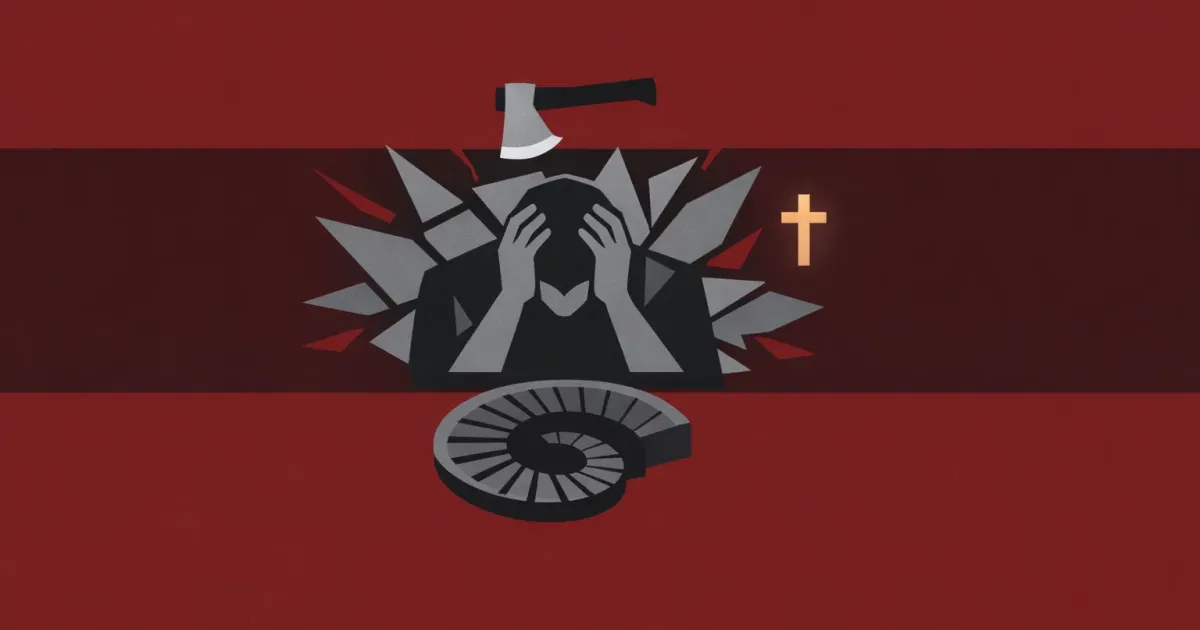
Exam & Discussion Questions
These are the questions that come up again and again in classrooms, on quizzes, and on literature exams. Each includes a model answer you can study from — some short and direct for comprehension checks, others developed enough to earn full marks on an analytical prompt.
Part I (Chapters 1–7)
1. What object does Raskolnikov pawn during his initial "rehearsal" visit to Alyona Ivanovna, and how much does she give him for it?
He pawns his father's old flat silver watch, and Alyona Ivanovna gives him one rouble and fifteen copecks — considerably less than what he considers fair. She deducts interest in advance from the already-low offer of a rouble and a half, leaving him almost nothing and reinforcing his contempt for her.
2. Who is Marmeladov, and why does his monologue matter to the novel's first chapter?
Marmeladov is a former government clerk whom Raskolnikov meets in a tavern — a broken, grandiloquent drunk who has squandered his family's last resources and whose daughter Sonia has taken a "yellow ticket" (a prostitute's permit) to keep them fed. His monologue plants the novel's central question: can a person be utterly degraded and still retain some claim on compassion? He also provides Raskolnikov's first encounter with the Marmeladov family, setting up the relationship with Sonia that will eventually pull a confession out of him.
3. What is the significance of the dream Raskolnikov has in Part I, and which figure in it shares a name with someone who later confesses to the murders?
Raskolnikov dreams he is a child watching a peasant named Mikolka beat a worn-out mare to death in front of a crowd. In the dream the child Raskolnikov weeps and tries to intervene, kissing the dead horse's face. The significance is multiple: it dramatizes the cruelty the novel associates with the world Raskolnikov inhabits, it splits his psyche into the helpless mourner and the brutal killer, and it foreshadows the murder by introducing an axe as the weapon of destruction. The peasant's name, Mikolka, echoes the name of Nikolay (Nikolka), the house-painter who later bursts in and makes a false confession to Porfiry Petrovitch — both being diminutives of "Nikolai" in the Russian original, which links the dreamed killer to the man who tries to take Raskolnikov's punishment for him.
The horse dream is one of the most carefully constructed passages in the novel because it does not function as simple foreshadowing. Dostoevsky places Raskolnikov simultaneously in three positions: the horrified child who cannot stop the beating, the mare herself whose only offense is being old and expendable, and — by structural implication — Mikolka, who kills because he can and calls it "my property." The child's final act, throwing himself on the dead horse and kissing its bloody face, anticipates Raskolnikov's later gesture of kissing the earth at the Hay Market before going to confess. Both are acts of penitence for violence he cannot undo.
The dream arrives at the precise moment Raskolnikov had persuaded himself the murder was a reasonable proposition. Dostoevsky's timing is deliberate: waking in horror, Raskolnikov cries out "Can it be that I shall really take an axe... Good God, can it be?" — and for a moment renounces the plan entirely. This temporary revulsion is significant because the novel tracks not just whether he will commit the crime, but whether he has any remaining capacity for moral feeling. The dream confirms he does. That confirmation does not prevent the murder; it makes the murder far more catastrophic when it happens, because Raskolnikov knows, at some level, exactly what he is doing.
4. How does Raskolnikov learn that Lizaveta will be away from Alyona Ivanovna's apartment at a particular hour, and how does Dostoevsky use this moment?
He overhears a conversation in the Hay Market between Lizaveta and a huckster and his wife, who invite her to visit them the following evening at seven o'clock. Raskolnikov was not seeking this information — he had just resolved to abandon the plan — and the chance meeting strikes him as a decisive sign. Dostoevsky presents this as Raskolnikov's "predestined turning-point": a trivial coincidence that feels, to a mind already feverish with the idea, like fate arranging itself on his behalf.
The overheard conversation is the structural hinge of Part I. Raskolnikov had left Petrovsky Island genuinely relieved — "Freedom, freedom!" he had thought, convinced he was done with the scheme. Dostoevsky then routes him through the Hay Market for no logical reason, and Lizaveta appears. The chapter notes that Raskolnikov "was always afterwards disposed to see something strange and mysterious" in this meeting, which is Dostoevsky's way of indicating how readily a determined mind converts coincidence into Providence. The information Raskolnikov receives is not difficult to obtain by other means — he had been trying to learn Lizaveta's schedule for weeks — but its accidental arrival at the moment of his intended abandonment makes it feel like a supernatural summons. The murder, in this reading, is not merely planned but felt to be fated, which is one reason Raskolnikov's theory cannot survive contact with its consequences: the "extraordinary man" acts by will, but this one acted on a stranger's casual errand.
5. How does Raskolnikov obtain the axe he uses in the murders, and why does this detail matter?
He had planned to take the axe from his landlady's kitchen while Nastasya was out, but Nastasya is unexpectedly home. In desperation he notices the porter's door is open and finds an axe under the bench in an unattended room. He takes it and slips away unnoticed. The detail matters because the "extraordinary man" who calculates everything is, from the very outset, improvising. His whole plan depends on foreseen circumstances; the fact that the first element collapses forces him into a reckless substitute, and the pattern of things going wrong at the last moment will define the entire aftermath.
6. Who are the two victims Raskolnikov kills, and how does the second death undermine his own theory?
Raskolnikov kills Alyona Ivanovna, the pawnbroker, with the blunt side of the axe and then kills Lizaveta, her half-sister, who returns unexpectedly and finds him mid-robbery. The second death destroys his theory almost immediately. Raskolnikov had constructed a utilitarian argument: kill one "louse" who harms society and free resources for humanity. Lizaveta was not part of this calculation — she was known to be gentle, exploited by her sister, and described by the student whose overheard speech had given Raskolnikov external validation. Killing her "accidentally" makes a lie of the extraordinary-man claim. The kill is unplanned, panic-driven, and directed at exactly the kind of person the theory was supposedly meant to protect.
Dostoevsky's description of Lizaveta's murder is deliberately stripped of the philosophical apparatus surrounding Alyona's. When Lizaveta appears in the doorway with her bundle, "white as a sheet," she does not cry out or fight; she backs against the wall and raises one hand "as little children do when they begin to be frightened." The axe falls "with the sharp edge just on the skull" — not the blunt edge Raskolnikov used on Alyona, not the controlled blow of a man carrying out an act of superior will, but a reflex action aimed at a woman who posed no threat. The contrast in method mirrors the contrast in moral status: Alyona's killing could (barely) be framed as the removal of a parasite; Lizaveta's cannot be framed at all. This is why the novel's psychological drama extends for five hundred pages after the murder rather than resolving: Raskolnikov cannot integrate the second death into his theory, and that inability is the novel's engine.
Part II (Chapters 1–7)
7. What causes Raskolnikov to faint when he is summoned to the police station after the murders, and what is the immediate result?
He is summoned over overdue rent, not about the murders — but when he hears the other officers discussing the Alyona Ivanovna case within earshot, he collapses. The immediate result is that the officer on duty marks him as ill and lets him go, noting his address. His fainting is observed but misread as physical weakness rather than guilt, buying him temporary safety at the cost of placing him on the police's radar.
8. What role does Razumihin play in Part II, and what does his character suggest about Dostoevsky's moral landscape?
Razumihin is Raskolnikov's university friend, an energetically decent young man who tracks Raskolnikov down, brings the doctor Zossimov, buys him clothes, and nurses him through his fever — all without being asked and while in modest circumstances himself. His function in the moral landscape is partly to serve as an embodied rebuke to Raskolnikov's theory: a man of limited means who works, helps others, and does not theorize about transcending conventional morality. Where Raskolnikov sees the world's injustice as a reason to step outside ordinary law, Razumihin sees it as a reason to be more generous to those around him.
9. Why does Raskolnikov return to the scene of the crime during his fever-recovery, and what does he do there that strikes the workmen as strange?
Still feverish and barely recovered, Raskolnikov goes back to Alyona Ivanovna's building, climbs the stairs to the fourth floor, and begins asking the workmen who are repainting the apartment about the blood stains. He even rings the bell and handles the lock. The workmen are alarmed and suspicious; one goes to fetch a porter. Raskolnikov flees. The episode is explicitly irrational — there is no practical reason to return — and Dostoevsky presents it as an unconscious gravitational pull toward exposure, a manifestation of the divided will that will repeat itself across the novel.
The return to the murder scene belongs to a pattern of near-confessions that structures Part II. Raskolnikov also taunts Zametov at the Crystal Palace tavern, effectively spelling out how the murder was committed while framing it as hypothetical speculation. Both episodes demonstrate what Porfiry Petrovitch will later articulate: Raskolnikov does not actually want to escape. The half of him that committed the murder to prove his extraordinary status is at war with the half that recognizes the theory has already failed. The compulsive return to the crime scene is the body expressing what the mind refuses to admit: that the act demands acknowledgment. Dostoevsky's insight — unusual for 1866 and still striking — is that guilt is not primarily a rational calculation about getting caught but a physiological and psychological pressure that the criminal cannot fully control.
10. Describe Marmeladov's death and Raskolnikov's response to it.
Marmeladov is run over by a carriage in the street during one of Raskolnikov's compulsive wanderings. Raskolnikov helps carry the dying man to his rooms, witnesses the chaotic scene of Katerina Ivanovna's grief and the terrified children, meets Sonia for the first time in her prostitute's clothes, and gives Katerina Ivanovna nearly all the money he has for funeral expenses. He arrives home to find his mother and sister waiting.
Part III (Chapters 1–6)
11. What is the substance of Raskolnikov's published article, and how does Porfiry Petrovitch use it in the first interview?
The article, published in the Periodical Review, argues that humanity is divided into two categories: "ordinary" people who must live in submission to the law, and "extraordinary" people — Raskolnikov names Lycurgus, Solon, Mahomet, and Napoleon — who have an inner right to transgress moral laws, including the prohibition against killing, if doing so serves a higher purpose. Porfiry uses it as an indirect interrogation tool: by asking Raskolnikov to explain and defend the theory, he leads him to articulate his own motive out loud without ever accusing him directly. Every claim Raskolnikov makes in defense of extraordinary men is simultaneously a statement of the rationale for the murders.
The first Porfiry interview is remarkable for how little Porfiry actually asserts. He poses questions in a spirit of philosophical curiosity — "surely you could not have helped fancying yourself just a little... an 'extraordinary' man?" — that force Raskolnikov into the position of either disavowing his own theory or confirming his motive. Raskolnikov's response is to defend the theory with increasing specificity: extraordinary men "have a right to commit any crime," history's great legislators "were all without exception criminals from the very fact that making a new law they transgressed the ancient one," and a man who suffers for stepping over a corpse thereby confirms he is only an ordinary man in disguise. None of this is a confession, and Porfiry knows he cannot use it. But the interview establishes the terms on which the rest of the novel operates: Raskolnikov's theory is not a private delusion but a position he must defend publicly, and in defending it he slowly dismantles it. Porfiry's final question — whether Raskolnikov, in writing the article, had fancied himself one of these extraordinary men — is the trap closing: "Quite possibly," Raskolnikov says, knowing he has just named himself a suspect.
12. What does Raskolnikov's second dream — in which he tries to kill the pawnbroker repeatedly and cannot — reveal about his psychological state?
He dreams that he is beating Alyona Ivanovna with the axe, but she will not die; she sits hunched under the blows, laughing at him, while a crowd gathers in the doorway and watches. The dream reveals that the murder has ceased to be a single past event and become a condition: something that happens whenever he tries to close his eyes. More specifically, the laughing old woman who cannot be killed suggests that his theory has been defeated, not confirmed, by the act — that he has not transcended anything but has been captured by it. The crowd watching signals his awareness of his own guilt before an audience he cannot escape.
Part IV (Chapters 1–6)
13. Who is Svidrigaïlov, and why does he appear at Raskolnikov's apartment at the beginning of Part IV?
Arkady Ivanovitch Svidrigaïlov is the former employer of Raskolnikov's sister Dounia, described in Pulcheria Alexandrovna's letter as a probable seducer and a man whose wife Marfa Petrovna has recently died. He has followed the family to Petersburg, ostensibly to offer Dounia ten thousand roubles in amends and to propose some other arrangement. Raskolnikov is immediately hostile and suspicious, and the encounter establishes Svidrigaïlov as the novel's dark mirror — an "extraordinary man" of a different kind, one who has transgressed every boundary not in service of an idea but purely from appetite.
14. Explain why Nikolay (Mikolka) confesses to the murders at the end of the second Porfiry interview, and what effect this has on Raskolnikov.
Nikolay is a peasant house-painter who worked in the building on the day of the murders — he had been discovered with a case of gold earrings stolen from the pawnbroker, placing him near the scene. His sudden confession is apparently motivated by a religious impulse: the desire to take on suffering, to "accept the cross." The effect on Raskolnikov is paradoxical. He is technically freed — Porfiry must suspend pursuit while Nikolay's confession stands — but he walks out unsure whether he has been genuinely released or simply given more rope. Porfiry's smile as he leaves suggests that the magistrate does not believe Nikolay for a moment.
15. What is the significance of the scene in which Raskolnikov asks Sonia to read the story of Lazarus from the New Testament?
Raskolnikov arrives at Sonia's room and asks her to find and read aloud the eleventh chapter of the Gospel of John — the raising of Lazarus. Sonia reads it with physical trembling, her faith making the words feel present and literal rather than historical. Raskolnikov listens with an expression Dostoevsky describes as complex: partly testing her, partly drawn by something he cannot name. The scene sets up his promise to return and tell her "who killed Lizaveta," and it introduces the Lazarus theme — resurrection from the dead — that will structure the Epilogue.
The Lazarus reading is the novel's emotional center because it places the question of resurrection — literal for Sonia, metaphorical for Raskolnikov — at the midpoint of the narrative. Sonia reads from the same New Testament that once belonged to Lizaveta, which connects the act of reading to the second victim, the one whose death Raskolnikov cannot justify even to himself. The detail is carefully planted: Sonia and Lizaveta had been friends; they had read together; Lizaveta gave Sonia the book. When Sonia reads "Lazarus, come forth" with tears running down her face, she is reading for Lizaveta as much as for Raskolnikov.
Dostoevsky slows the prose to biblical rhythm during this scene, refusing to editorializing about what it means. The chapter argues structurally: resurrection is possible, but it requires first consenting to have been in the tomb. Raskolnikov is not yet ready for this, and his "promise" to reveal who killed Lizaveta is still a game — he does not say "I killed her." But the scene marks the moment that Sonia becomes the person he must eventually speak the truth to, not because she can save him from prosecution, but because her faith represents the only alternative to the theory he has built out of despair.
Part V (Chapters 1–5)
16. What scheme does Luzhin carry out at Marmeladov's memorial dinner, and how is it exposed?
Luzhin, nursing his humiliation from the earlier confrontation with Dounia, summons Sonia to the dinner and then publicly accuses her of stealing a hundred-rouble note from him. He had planted the note in her pocket earlier in front of a witness. The scheme is exposed by Lebezyatnikov, his own progressive young roommate, who saw Luzhin slip the money into Sonia's pocket and says so clearly in front of the assembled boarders. Luzhin is destroyed in the room; Dounia's break with him is confirmed beyond repair.
17. Describe the scene in which Raskolnikov confesses to Sonia in Part V. What are the multiple explanations he offers for the murder, and why does this fragmentation matter?
Raskolnikov tells Sonia he committed the murders, but the confession comes in fragments and repeated reframings. He tells her he killed for money; then that he killed to prove he was a Napoleon; then that he killed not the old woman but himself. Each explanation is offered and then partially retracted. The fragmentation matters because it mirrors the actual structure of Raskolnikov's motivation — there is no single clean reason, and his inability to state one reveals that the "theory" was always a rationalization layered over something darker and less articulable than ideology.
The confession scene inverts the first Porfiry interview in a crucial way. In Part III, Raskolnikov defended the theory in front of a prosecutor with perfect fluency, in complete control of his irony and philosophical distance. In Sonia's room, the same theory dies in his mouth: "I wanted to become a Napoleon, that is why I killed her" comes out not as a claim of grandeur but as an admission of delusion. When he says "I only killed a louse," Sonia responds with a single line — "A human being — a louse!" — that does not refute the theory philosophically but simply refuses it as a description of reality, the way a person refuses a false account of someone they knew and loved.
What Raskolnikov finally comes closest to is this: "I wanted to find out then and quickly whether I was a louse like everybody else or a man. Whether I can step over barriers or not... whether I am a trembling creature or whether I have the right." The murder was not about the money, not about utility, not even about Napoleon — it was a test of will, and the test failed. Sonia's response — go to the crossroads, kiss the earth, confess publicly — is not a theological demand but a practical one: he must make real what he already knows. He takes the cypress cross but is not yet ready to wear it. Dostoevsky closes the scene by revealing that Svidrigaïlov has been listening through the thin wall of his rented room next door.
Part VI (Chapters 1–8)
18. Describe Porfiry Petrovitch's final visit to Raskolnikov's garret. How does this encounter differ from the previous two interviews?
Porfiry comes alone, without formal pretense, and drops the prosecutorial game entirely. He tells Raskolnikov plainly that he knows he committed the murders, that Nikolay's confession will not hold, and that he has no usable evidence — but that he does not need any, because Raskolnikov will bring himself in. He advises confession, predicts a reduced sentence given the disturbed mental state, and speaks almost as a well-wisher rather than an opponent. The interview differs from the previous two because Porfiry has abandoned the cat-and-mouse game: his patience has been an investment, and he cashes it here not by arresting Raskolnikov but by speaking plainly enough to make Raskolnikov understand he cannot escape internally.
19. What happens in Svidrigaïlov's final hours, and what do his last actions — giving money to Sonia, his fiancée, and the Marmeladov children — reveal about his character?
After learning that Dounia has left his room and will not be compelled, Svidrigaïlov spends his last evening distributing money to Sonia (three thousand roubles in bonds), to the orphaned Marmeladov children, and fifteen thousand roubles to his teenage fiancée. He sleeps in a squalid hotel haunted by nightmares — a drowned girl, a five-year-old child whose face becomes obscene — and at dawn tells a watchman he is "going to America" before shooting himself with a revolver. His last acts of apparent generosity reveal that conscience is not absent in him but has been compressed into a final accounting: he pays debts he never acknowledged and purchases nothing with the payments.
Svidrigaïlov's suicide is the novel's dark mirror for Raskolnikov's confession, and Dostoevsky places the two events in immediate sequence to make the choice explicit. Like Raskolnikov, Svidrigaïlov is intelligent, philosophically liberated from conventional morality, and capable of genuine charm. Unlike Raskolnikov, he has spent years acting on his appetites without the guilt that makes the extraordinary-man theory unsustainable. His nightmare of the drowned girl — a teenager whose ruin he apparently caused — and the five-year-old who transforms from a sleeping child into something obscene, are the repressed conscience asserting itself the only time his guard is down. The money he distributes is described not as repentance but as settlement: he tips the scales before exiting, the way a man who cheats at cards might leave an extra payment on the table. It purchases nothing because he cannot believe in the possibility of being forgiven, which is precisely the capacity Sonia represents and he lacks. Raskolnikov could not believe it either — until Sonia's patience wore him down. Svidrigaïlov simply ran out of time.
20. How does Raskolnikov finally confess, and what gesture does he make at the Hay Market before entering the police station?
He goes to Sonia, takes the cypress cross she had offered him earlier, and walks to the Hay Market — the crowded public square. There he kneels and kisses the filthy earth, as Sonia had instructed him. A woman in the crowd assumes he is drunk. He then proceeds to the police station and confesses. The kneeling and kissing of the earth is a folk-Orthodox ritual of public penitence, and it completes the arc begun in Part I, when his first act of moral impulse was leaving money on Marmeladov's windowsill: both gestures involve Raskolnikov giving something in a public space without being able to explain why.
Epilogue
21. What is Raskolnikov's emotional state during his early time in the Siberian labor camp?
He is not genuinely repentant. He resents the sentence not because he believes he committed a moral wrong but because he failed — and failure, in his terms, means he was an ordinary man all along. He is cold to Sonia, hostile to the other prisoners, and still mentally re-arguing his theory. The other convicts dislike him; a group of religious prisoners threatens to kill him for being "an infidel." He falls ill. His suffering is not the productive suffering of guilt but the sterile suffering of wounded pride refusing to yield.
22. Describe the trichinae dream Raskolnikov has during his convalescence, and explain its function in the novel.
He dreams of a plague of microscopic trichinae — microbes endowed with intelligence — that infect human beings with absolute certainty in their own judgments. Those infected become convinced their reasoning is infallible and that all who disagree are fools; they kill one another, destroy cities, abandon crops. Only a few pure individuals are spared to renew civilization. Raskolnikov wakes from this dream and, shortly after, experiences the first genuine emotional break toward Sonia. The dream's function is to externalize and universalize the Napoleonic idea: when every person acts on the conviction that his own judgment overrides all other claims, the result is mutual slaughter. The dream shows Raskolnikov his own theory at scale, and it is unbearable enough to break his pride.
The trichinae dream is Dostoevsky's answer to those readers who find the Epilogue too conventionally redemptive. Raskolnikov does not weep at Sonia's feet because religion has converted him or because suffering has purged his intellect; he weeps because the dream has shown him what the extraordinary-man theory produces when taken seriously by everyone simultaneously. The plague is not presented as a failure of reason but as its terrifying success: in Dostoevsky's words, the infected "considered themselves so intellectual and so completely in possession of the truth" as never before. This is the Napoleon theory running without the restraints of social pressure or personal attachment. Raskolnikov had congratulated himself on being willing to follow an idea to its conclusion. The dream shows him the conclusion, and it is indistinguishable from the apocalypse. The crack in his pride is not theological but logical: he finally sees, from the outside, what his interior conviction looked like. Sonia's arrival the next morning — patient, faithful, uncorrected by theory — is the alternative the novel has been building toward for six hundred pages.
Thematic Questions
23. How does Dostoevsky use the setting of St. Petersburg to externalize Raskolnikov's mental state?
Petersburg in the novel is not scenic backdrop but psychological co-conspirator. The July heat, the narrow canals, the yellow wallpaper of cheap apartments, the Hay Market crowds, and the pervasive smell of fish and tobacco work on Raskolnikov's already overstrung nerves. Dostoevsky frequently synchronizes the city's oppressiveness with the peaks of Raskolnikov's delusion: the stifling streets push him toward the pawnbroker, the fever that follows the murders mirrors the city's diseased overcrowding, and the eventual kiss of the earth at the Hay Market — the dirtiest, most public space in the novel — is also the moment of genuine human contact.
Dostoevsky trained as an engineer before turning to fiction, and his spatial imagination is precise. The novel's geography tracks Raskolnikov's interiority with documentary accuracy: 730 steps from his garret to Alyona Ivanovna's building (he counted them), the empty flat on the second floor that saves him as he flees, the canal where Marmeladov dies. Petersburg is a city built on swamp and sustained by poverty and bureaucracy, and the novel uses this historical reality — the city was known for floods, disease, and desperate inequality — as objective correlative for the protagonist's psychology. When Raskolnikov looks at the Neva and feels tempted (as Svidrigaïlov is by the Little Neva), the river represents not just death but the dissolution of individual consciousness into something larger. The city does not cause his crime, but it provides the material conditions — isolation, poverty, intellectual ferment — that make his particular form of self-destruction possible.
24. How does the figure of Sonia challenge or qualify Raskolnikov's "extraordinary man" theory?
Sonia is, on the theory's own terms, an "ordinary" woman — poor, uneducated, forced into prostitution, sustained by religious faith rather than rational calculation. But she has also transgressed moral law, and done so repeatedly. Raskolnikov recognizes this and asks her directly why she has not killed herself, why she goes on. Her answer — the children need her, God will not abandon her — is irrational by any utilitarian standard. Yet she survives, and more than survives: she retains a coherence of self that Raskolnikov, who theorized his way into murder, completely loses. The novel's implicit argument is that Sonia's "irrational" transgression — sacrificing herself for others rather than stepping over others to serve herself — is not weaker than the Napoleon theory but incomparably stronger.
The structural pairing of Sonia and Svidrigaïlov as the novel's two alternatives to Raskolnikov's position is one of Dostoevsky's most controlled formal decisions. Both have transgressed conventional morality. Svidrigaïlov's transgressions serve appetite; Sonia's serve others. Both know Raskolnikov's secret. Svidrigaïlov uses the knowledge as leverage; Sonia receives it as a burden to share. Svidrigaïlov ends at a fire-tower with a revolver; Sonia ends at a Siberian river bank, watching Raskolnikov weep. The extraordinary-man theory posits that those willing to "step over" barriers are the ones who matter historically. Dostoevsky counters this with the novel's final image: not Napoleon looking down from a column, but a thin woman in a worn shawl, loved by an entire prison camp of convicted criminals, who write their families' letters and whom they call "little mother."
25. What role does confession play in the novel, and how does Dostoevsky distinguish between different kinds of confession?
The novel contains at least three distinct acts of confession: Nikolay's false confession in Part IV (motivated by religious desire to suffer for guilt he didn't earn), Raskolnikov's partial confessions to Sonia and in the near-confessions to Zametov and the police (motivated by a divided will), and his formal confession to the police at the end of Part VI (motivated by love and exhaustion rather than legal pressure). Dostoevsky distinguishes between them by what each one costs: Nikolay's costs nothing because it is fraudulent; the partial confessions cost Raskolnikov's peace of mind without resolving anything; only the genuine, public, voluntary confession carries moral weight because it requires him to abandon the last piece of his theory — the belief that he was right and merely unlucky.
26. How does the "ordinary vs. extraordinary man" theory ultimately fail on its own terms within the novel?
The theory fails in at least three specific ways. First, it fails practically: the murder does not yield resources or freedom of action but only fever, paranoia, and estrangement. Second, it fails morally: Lizaveta's death, which the theory cannot accommodate, reveals that the "extraordinary man" cannot actually control outcomes the way Napoleon (in Raskolnikov's idealized version) could. Third, and most damagingly, it fails psychologically: the theory predicts that a true extraordinary man would feel no guilt — would not even notice the body as anything but an obstacle removed. Raskolnikov's persistent, consuming guilt is therefore, by his own theory's logic, proof that he is ordinary. He cannot escape the trap: to feel guilt is to concede the murder was wrong; to refuse guilt is to remain imprisoned by it. Only the confession, which acknowledges the moral claim of the "ordinary" people he had despised, breaks the circuit.
Porfiry understands this dynamic better than Raskolnikov does, and he articulates it in the third interview: "What you need now is fresh air, fresh air, fresh air!" The point is not that fresh air is pleasant but that the theory has consumed all the oxygen in the room. Porfiry explicitly advises Raskolnikov not to flee — "a runaway is always a suspect" — but more to the point, he notes that a forced arrest would ratify the theory by making Raskolnikov a martyr to a hostile state, which is how the extraordinary-man narrative always ends in heroic myth. A confession freely given, on the other hand, cannot be integrated into the Napoleon story: it is an admission that ordinary moral law has a claim on extraordinary people, which is precisely what the theory denies. Dostoevsky uses Porfiry's insight to flip the novel's apparent stakes. The reader has been watching a manhunt; it turns out the chase has always been internal, and the only meaningful capture is self-surrender.
27. What does the relationship between Raskolnikov and his family — particularly his mother Pulcheria Alexandrovna and sister Dounia — reveal about the cost of his theory?
His mother and sister have organized their lives around him: Dounia has suffered in the Svidrigaïlov household, then accepted Luzhin's controlling engagement, all to secure money and social position for Raskolnikov's benefit. His crime and eventual confession unravel both women's plans and, in Pulcheria Alexandrovna's case, her sanity. She cannot accept the truth about her son and dies during a fever in which she invents fantasies about his brilliant future. Raskolnikov's theory presents itself as serving humanity in the abstract; the novel systematically shows the specific human beings — his mother, sister, Sonia, Razumihin — who are damaged by his absorption into the idea, and does not let him escape into the abstraction.
28. How does Dostoevsky use the motif of thresholds and doorways throughout the novel?
Doorways and thresholds — literal and metaphorical — mark almost every crisis in the novel. Raskolnikov sneaks past his landlady's door in the opening sentence. Alyona Ivanovna opens her door a crack before admitting him. He hides behind the door of the empty flat as Koch and the young law student argue outside, and the hook on the door nearly betrays him. Sonia's room has two locked doors leading to adjacent flats. Svidrigaïlov listens through the wall (the thinnest possible partition) to the confession that Raskolnikov believes is private. At the confession itself, he physically crosses the threshold of the police station. Each threshold marks a point of irreversible decision, and Dostoevsky's attention to them reflects the novel's obsession with the moment before action — the moment when theory becomes act, when privacy becomes public, when one life ends and another might begin.