Themes & Motifs
The Extraordinary Man Theory and Its Self-Destruction
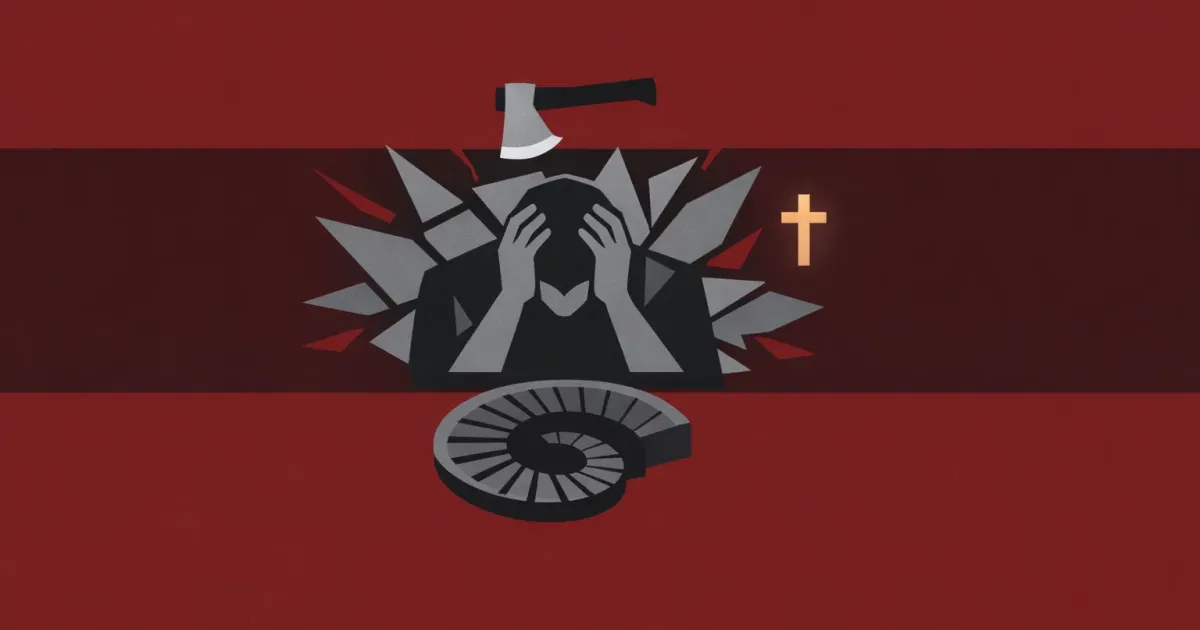
Raskolnikov's central idea is that humanity splits into two classes: the "ordinary" mass who must obey moral law, and the "extraordinary" few — the Lycurguses, Solons, Mahomets, and Napoleons — who are entitled to step over a corpse if doing so serves a larger historical purpose. He published the theory in a magazine article months before the novel begins, and Dostoevsky's interest is not in whether the theory is true but in what happens to a young man who tries to live inside it. The murder of Alyona Ivanovna is meant to be Raskolnikov's audition for the second category. Within forty-eight hours of swinging the axe he has fainted in a police office at the mention of paint, hidden the stolen valuables under a stone without ever opening the purse, and lapsed into a fever that the rest of the novel will not fully break.
The theory does not fail because Raskolnikov is caught. It fails because the act of testing it is what disqualifies him from passing. A real Napoleon, by Raskolnikov's own definition, would not need to ask whether he was Napoleon.
Dostoevsky engineers the theory's collapse at three structural points, each more devastating than the last. The first is the killing of Lizaveta in Part I. Raskolnikov has carefully calculated the hour at which the gentle half-sister will be out of the apartment, but she walks back in mid-robbery and he kills her with the sharp edge of the axe almost as a reflex. The "extraordinary man" was supposed to step over one carefully chosen body in the service of humanity; instead he murders the soft-witted woman his ideology was nominally constructed to defend. Sonia later notes — without commentary, which is the most damning kind — that he and Lizaveta wore the same cypress crosses. The theory does not survive the second corpse.
The second collapse occurs during the first interview with Porfiry Petrovitch in Part III. The magistrate, with the playful mock-solemnity of a man who already knows the answer, asks Raskolnikov whether he really believes his own article: "Tell me, how is one to distinguish those extraordinary people from the ordinary ones?... How then would they distinguish themselves? In what way?" Raskolnikov, baited by intellectual vanity, defends the theory aloud — and every defense functions as a confession. The trap of the scene is purely formal: any sincere statement of the theory, made in front of a magistrate investigating an axe murder, is itself the motive he was trying to keep hidden. Dostoevsky has discovered something subtle here about ideology — that it cannot be kept private, because the mind that holds it eventually needs witnesses.
Running alongside these waking confrontations is a parallel dream-track in which the theory is being prosecuted from below. The mare dream of Part I, in which a child Raskolnikov watches the peasant Mikolka whip and finally bludgeon his exhausted nag to death with an iron crowbar, is interpretively saturated. Read straight, it is a memory of childhood compassion; read against the murder it foreshadows, it splits Raskolnikov's psyche into three roles he is about to play simultaneously — the helpless child weeping for the victim, the brutal Mikolka swinging the weapon, and the broken creature being killed. The boy in the dream begs his father to intervene, and the father can only answer, "Come away, come away! it is not our business." The dream encodes the deepest unspoken fear of the "extraordinary man" project: that the moral law has been abandoned by the fathers and the mares are being killed in broad daylight while reasonable men walk past. Later, in Part III, Raskolnikov dreams himself back in Alyona's apartment, hammering her with the axe while she sits in her chair quietly laughing at him and a crowd watches in silence. The image inverts the mare dream — there he was the helpless child, here he is the killer who cannot make the killing stick — and announces something terrible about the act itself: the murder is no longer a discrete event in July, it is a permanent psychological state. The pawnbroker, whom the theory had reduced to a "louse," returns to him alive and amused, refusing to be dehumanized.
The third collapse is verbal and happens in Sonia's room in Part V. Raskolnikov tries to recite the theory one last time as an explanation: "I've only killed a louse, Sonia, a useless, loathsome, harmful creature." Sonia answers, "A human being — a louse!", and the entire architecture caves in on a single noun. He keeps trying to reframe the killing — for money, for his mother and sister, to prove he could "dare" — and finally arrives at the truer formula: "I murdered myself, not her." The theory was supposed to elevate him above conventional morality; in practice it has hollowed him out from inside. By the time the trichinae dream of the Epilogue arrives, the theory has already been exposed as something worse than wrong. It is contagious. The dream imagines a plague in which every infected person believes "their decisions, their scientific conclusions, their moral convictions" to be infallible, and the world tears itself apart in a war of private absolutes. The "extraordinary man" idea, scaled to the species, is an apocalypse. Dostoevsky's argument is not that Raskolnikov was uniquely vain to hold it but that any rationalism severed from a moral law outside the self drifts inevitably toward this end.
Suffering as a Path Rather Than a Punishment
In a less honest novel, Raskolnikov's eight years of Siberian hard labor would arrive as the just penalty for his crime. In Crime and Punishment, suffering is not the punishment at all — it is the thing the punishment is finally supposed to make possible. Sonia, Marmeladov, Katerina Ivanovna, and Mikolka the painter (who falsely confesses to the murders precisely because he wants to suffer) all carry suffering as a kind of vocation. The novel's most provocative claim is that pain is not an obstacle to a meaningful life but the ground on which one becomes possible.
The clearest expression comes from the broken Marmeladov in the tavern of Part I, who insists with drunken certainty that his wife Katerina Ivanovna will be saved on the last day "because she has suffered." Raskolnikov listens, gives away money he cannot afford, and walks out unable to dismiss the speech as the rambling of a drunk.
Dostoevsky distinguishes carefully between two kinds of suffering, and the distinction is the moral spine of the novel. Sonia's suffering is sacrificial — she has put herself on the "yellow ticket" to keep her stepmother and her stepmother's children from starving — and it has not coarsened her; it has clarified her. Katerina Ivanovna's suffering, by contrast, is consumed by aristocratic pride and fantasies of vindication; she dies declaiming her schoolgirl French and refusing the priest, and the novel mourns her without endorsing the path. Marmeladov drinks "in order to suffer," which is the parodic version of the gospel he half-remembers. Mikolka the painter offers a forged confession because he was raised in a sect that prizes "taking suffering upon oneself" and cannot tell the difference between earned and unearned penance. Around Raskolnikov, the novel arrays an entire spectrum of relationships to pain, and the question it puts to its protagonist is which one he is going to choose.
Raskolnikov's own suffering for most of the book is unproductive — paranoid fever, bursts of physical revulsion, theatrical near-confessions to clerks and bartenders. None of it is the suffering Sonia means when she tells him to go to the crossroads, "bow down, first kiss the earth which you have defiled and then bow down to all the world and say to all men aloud, 'I am a murderer!'" That ritual is not legal punishment; it is voluntary public abasement, the antithesis of the "extraordinary man" who stands above the crowd. The fact that he cannot do it for another hundred pages is itself a measure of how thoroughly the theory still owns him. When he finally does kneel in the Hay Market and kisses "that filthy earth with bliss and rapture," the gesture matters precisely because it is not yet repentance — he confesses with bitterness still intact, and arrives in Siberia resentful at having been caught rather than sorry for what he did.
The Epilogue makes the argument explicit by withholding the conversion the reader expects. Raskolnikov is in the prison hospital months into his sentence, and the narrator notes coolly that he had "expected punishment of all kinds" except this one — the slow, ordinary suffering of being himself in a place where his theory means nothing. The trichinae dream is what finally reorganizes him, and Sonia's quiet vigil at the gates is what catches him afterward. Dostoevsky's claim is not that suffering is good in itself but that it is the only solvent strong enough to dissolve a self that has been corrupted by an idea. The novel ends with seven years of the sentence still to run, and the narrator refuses to dramatize the renewal because the renewal is the patient thing suffering does over time, not the ecstatic thing it does in a paragraph.
The Doppelgänger Architecture: Raskolnikov, Svidrigaïlov, Luzhin
The novel is built around a triangle of doubles, and once a reader sees it the structure becomes impossible to unsee. Svidrigaïlov is what Raskolnikov could become if he were truly liberated from conscience; Luzhin is what Raskolnikov could become if he dressed his self-interest in respectable clothes. Both men shadow Raskolnikov physically — they live in the same neighborhoods, court his sister, intrude into his rooms, and seem to know him before he knows them. Dostoevsky uses them as living arguments, two completed versions of the road Raskolnikov is still walking.
The clearest single sign of the structure is the wall in Part VI. Svidrigaïlov reveals that he has been renting the room directly next to Sonia's and has overheard, through the partition, Raskolnikov's confession of the murder. The architecture is the metaphor: the "extraordinary man" theory has only a paper wall between it and the predator next door.
Luzhin is the bourgeois rationalization of Raskolnikov's crime. He does not kill anyone; he simply marries a starving girl half his age in order to keep her grateful, gives a learned little speech about how a properly run economy of self-interest produces general welfare, and tries to frame Sonia for theft when his ego is bruised. His "scientific" individualism is the same logic Raskolnikov has dressed up in Napoleonic costume — the conviction that one's own advantage, properly managed, is also the public good. Razumihin sees through him at once; Dounia sees through him with humiliated effort. Dostoevsky is making a quietly brutal point: the Russian middle class has already absorbed a pasteurized version of Raskolnikov's theory and built drawing rooms inside it. The serial killer in the garret is only the visible extreme of a respectable disease.
Svidrigaïlov is the more terrifying double because he has actually been there. Murmurs in the novel attribute to him the death of his wife Marfa Petrovna, the suicide of a teenage servant girl, the corruption of a deaf-mute child. He smiles, charms, settles money on the Marmeladov orphans, and arranges for Sonia's rescue without expecting gratitude. The horror is that he is genuinely intelligent, genuinely capable of generosity, and genuinely empty. When Dounia fires the revolver at him in the rented room and then drops it, refusing to fire again, he reads in her face the only verdict he respects: she will not love him and will not even hate him. He releases her and spends the night in a filthy hotel where rats scurry behind the wallpaper and he dreams in succession of a five-year-old girl with the corrupted face of a prostitute and a teenage girl drowned in a puddle. By dawn he has walked to a fire-tower, told the Jewish watchman, "I am going to America," and put a bullet into his temple. America in the novel is shorthand for the void — the place beyond the moral law where Svidrigaïlov has actually lived and discovered that nothing is there.
Dostoevsky stages the suicide hours before Raskolnikov's confession on purpose. The two men are at a fork in the same road, and Svidrigaïlov demonstrates where the unconfessed branch ends. The choice is not between guilt and freedom; it is between Sonia's road, which leads through public abasement to the riverbank in Siberia, and Svidrigaïlov's road, which ends with a revolver and a watchman. Raskolnikov goes to the Hay Market within the hour. The structural symmetry is unmistakable, and it is the strongest evidence that the Epilogue is not a sentimental afterthought but the novel's intended landing.
The City as Co-Conspirator
Petersburg is not a setting in this novel; it is a presence. Dostoevsky places the action in the airless first weeks of July, when the canals smell of tar and rotting fish, paint fumes leak from every renovation, and the staircases of the tenements are described in colors — yellow wallpaper, yellow ticket, yellow stains, the "yellowish" complexion of the pawnbroker — until yellow itself becomes a moral quality. Raskolnikov's coffin-sized garret six floors up under the eaves is a physical fact and a metaphor. He is suffocating before he ever picks up the axe.
The city's geography is so insistent that critics and readers have walked Raskolnikov's route from his lodgings to the pawnbroker's apartment with the novel in hand and confirmed that the seven hundred and thirty steps Dostoevsky gives are accurate. Petersburg is mapped onto the action with a specificity that turns the urban environment into a character.
Dostoevsky's Petersburg is the engineered Petersburg of Peter the Great — a Western, rationalist city built on a swamp, designed to be the capital of an Enlightened empire. Inside it, by the 1860s, lives a population that has been pulled in from the countryside, crammed into rented rooms, and fed on cheap vodka and unpaid IOUs. The novel's argument is that this particular city manufactures Raskolnikovs. The garret is too low to stand upright in; the streets are so narrow that conversations carry between strangers; tavern doors open into apartment doors; the boundary between private thought and public utterance is mechanically violated by the architecture itself. Raskolnikov overhears the student in the tavern saying aloud everything he has been privately thinking about the pawnbroker because the room is built so that he cannot help but overhear. Svidrigaïlov hears the confession to Sonia because the partition is made of paper. The city literally gives him no private space in which to keep his idea.
The streets do moral work too. After the murder, Raskolnikov is unable to stay home — he wanders compulsively, drawn back to the scene of the crime, drawn out toward the Crystal Palace and the islands and the bridges. Petersburg is the only confessor he can stand for most of the book, and even then it is a confessor that nearly betrays him. He climbs the staircase to the pawnbroker's empty apartment and asks the workmen about the bloodstains because the building itself is pulling him back. The Hay Market, a square notorious in 1860s Petersburg for its prostitutes and pawnshops and drunks, is where he finally kneels and kisses the ground; it is the most "fallen" public space in the city, and that is precisely why Sonia sends him there. Public confession in the Hay Market, not in a clean church, is what the novel demands.
Dostoevsky's vision is the inverse of the picturesque urban realism of his French contemporaries. Where Balzac's Paris is a vast machine of opportunity, Dostoevsky's Petersburg is a fever-incubator. The city does not merely reflect Raskolnikov's psychology; it produces it. When Porfiry, in the third interview, leans across the table and tells him, "What you need now is fresh air, fresh air, fresh air!", the prescription is meant literally. Siberia in the Epilogue is, among other things, the first place in eight hundred pages where a window opens onto distance — "the wide solitary river" outside the prison, the steppe, the air. The book's geography ends where its theme requires: in a landscape large enough to dwarf an idea.
The Sacrificed Daughter
A pattern surfaces early and never lets up: the novel keeps showing women being sold, traded, or destroyed to keep men afloat. Sonia is on the "yellow ticket" so her drunkard father can drink and her stepmother's children can eat. Dounia has accepted Luzhin's marriage proposal — a man she does not love and quickly comes to despise — to rescue her brother from poverty. Dounia previously took the governess position with the Svidrigaïlovs, and the price of that "position" turned out to include surviving Svidrigaïlov's harassment. Katerina Ivanovna, herself a former officer's daughter with educational pretensions, is being eaten alive by consumption while she works to keep up appearances for the same children Sonia is hooking to feed. The novel's economy runs on women's bodies, and Dostoevsky never lets the reader forget it.
The pattern is so thick it almost reads as a thesis: the theory of the "extraordinary man" is materially financed by the suffering of "ordinary" women.
Dostoevsky stages Pulcheria Alexandrovna's letter in Part I as a kind of detonator precisely because it forces Raskolnikov to recognize the pattern in his own life. His mother writes with painful cheerfulness about Dounia's engagement to Luzhin, and Raskolnikov reads through the surface immediately: his sister is selling herself to a respectable middle-aged lawyer to fund her brother's law degree. The structural twin to Alyona Ivanovna's pawnshop is Luzhin's marriage offer — both are transactions in which a woman is the collateral. Raskolnikov's first reaction to the letter is to compare Dounia's situation to Sonia's and conclude that they are the same arrangement at different price points. His decision to murder the pawnbroker is, on one level, a furious refusal of the system that has put both women on the auction block. The terrible irony of the novel is that the murder makes everything worse for everyone — including, especially, the women he meant to protect.
Sonia's character is the novel's most radical inversion of the "fallen woman" type that nineteenth-century fiction had already exhausted. She is on the yellow ticket but is not eroticized for the reader; Dostoevsky describes her as small, pale, almost colorless, dressed in cheap finery that looks worse on her than ordinary clothes would. Her power in the book is moral, not sexual, and it derives precisely from the fact that her transgression of the moral law was committed for someone else. Where Raskolnikov's transgression sought to elevate the self over others, Sonia's hollows the self out for others. They are mirror images, and the novel's most provocative theological move is to suggest that her form of transgression is closer to grace than his attempt at greatness.
Katerina Ivanovna's death is the novel's most pitiless treatment of the pattern. She dies in the street, blood on her chest, screaming, "The wretched horse is foundered!" — a line that explicitly echoes the dream of the beaten mare in Part I. The dying woman casts herself as the broken horse, and the analogy completes a chain Dostoevsky has been building for hundreds of pages: the mare is whipped to death by men who pay nothing for the privilege, and the women of Petersburg are whipped to death by an economic order that pays nothing for their labor either. Svidrigaïlov, in his final hours, settles money on Sonia, the Marmeladov children, and his teenage fiancée — last-minute reparations to all the women whose lives have been shaped by men of his class. The gestures are too late and they save no one but the children, but they confirm the pattern: even the predator, on his way to the revolver, can see what the system has cost. The novel's hardest claim is that no theoretical Napoleon and no respectable Luzhin can finally answer for it. Only Sonia's silent walk to Siberia behind her murderer can.