Exam & Discussion Questions
These are the kinds of questions your teacher is most likely to ask about The Catcher in the Rye — in class discussions, on quizzes, and on exams. Each comes with a model answer you can study from and adapt.
Chapters 1-3 (Pencey Prep)
1. Why does Holden visit Mr. Spencer before leaving Pencey?
Holden visits Mr. Spencer because he genuinely likes the old man and wants to say a proper goodbye. Despite being expelled, Holden still craves connection with people he respects. The visit goes badly — Spencer lectures him and reads his failed history essay aloud — but Holden went voluntarily, which reveals that underneath his indifference is a person who cares about departures and about the people he's leaving behind.
2. What does Holden's position on the hilltop during the football game suggest about his character?
Holden watches the big Pencey-Saxon Hall game from a hill far above the field rather than sitting in the stands with everyone else. This physical separation mirrors his emotional position throughout the novel — he wants to observe life from a safe distance rather than participate directly. He claims he's up there because he just got back from a fencing trip, but the image of Holden isolated above a crowd he could easily join sets up the pattern of self-imposed exclusion that defines his three days in New York.
The hilltop scene works as a visual thesis for the entire novel. Holden is literally above the action, watching, and he frames this position as accidental rather than chosen. This is a strategy he'll repeat — every time he removes himself from a social situation, he provides a rational explanation that obscures the emotional truth. Salinger stages the scene with quiet precision: the football game represents exactly the kind of communal experience (school spirit, shared excitement, belonging) that Holden claims to find phony but that his isolation suggests he also envies. The dual perspective — contempt for the crowd and longing to be part of it — is compressed into a single image.
3. How does Holden's attitude toward Ackley reveal contradictions in his character?
Holden describes Ackley in unflattering physical terms — bad skin, terrible hygiene, no social awareness — and seems genuinely annoyed by him. But he keeps letting Ackley into his room and seeks him out when he needs company on Saturday night. This contradiction shows that Holden's stated feelings and his actual behavior don't match. He claims to find Ackley repulsive, but loneliness pulls him toward the one person who will tolerate his company, suggesting that Holden's need for human connection overrides his critical judgments more often than he admits.
4. What does Mr. Spencer's lecture accomplish, and what does Holden's reaction to it tell us?
Mr. Spencer means well — he wants Holden to take his future seriously — but his approach backfires completely. Reading the failing history essay aloud humiliates Holden without teaching him anything, and his cliches about "life being a game" ring hollow. Holden's reaction is a mix of guilt (he feels sorry for Spencer), impatience, and a familiar helplessness: he can see that Spencer genuinely cares but delivers that care in a way that's impossible to receive. This sets up the novel's recurring pattern — adults who try to help but can't bridge the gap between their intentions and Holden's actual needs.
Chapters 4-7 (Stradlater and Departure)
5. Why does Holden write about Allie's baseball mitt instead of a room or a house for Stradlater's composition?
Holden can't write a descriptive essay about a conventional topic because nothing conventional matters enough to him to generate real feeling. The mitt — covered in poems Allie wrote in green ink so he'd have something to read in the outfield — is the one object that carries genuine emotional weight in Holden's life. He writes about it because it's the only thing he can write about honestly. That Stradlater rejects the essay as off-topic captures a central tension in the novel: what matters to Holden is invisible to the people around him.
The mitt is a loaded symbol operating on multiple levels. It's a physical object that connects Holden to his dead brother, making it a kind of secular relic. The poems written on it in green ink represent Allie's creativity and individuality — he transformed a piece of sports equipment into a work of art, which parallels what Holden wants to do with language (transform the expected into something personal). Stradlater's rejection of the composition mirrors the world's rejection of what Holden values. The assignment asked for a description of a room or a house — something external and physical — but Holden gives an interior, emotional response instead. This is the novel in miniature: the world asks for surfaces and Holden can only offer depths, and the mismatch causes him pain every time.
6. What triggers Holden's fight with Stradlater, and why does it matter more than a typical roommate argument?
The surface trigger is Stradlater's dismissive response to the composition and his evasive smirk about his date with Jane Gallagher. But the real trigger is Holden's fear that Stradlater has violated something sacred. Jane isn't just a girl Holden has a crush on — she's someone he associates with genuine, unconstructed intimacy (the checkers games, the way she kept her kings in the back row). Stradlater's casual treatment of her represents everything Holden hates: the world's ability to consume authentic things without recognizing their value.
7. Why does Holden yell "Sleep tight, ya morons" as he leaves Pencey?
The line captures Holden's emotional state at the moment of departure — anger, sadness, bravado, and loneliness compressed into a single gesture. He's insulting the people he's leaving, but the insult has an almost affectionate quality. He wants a reaction. He wants someone to hear him go. This connects to his earlier statement about wanting to "feel some kind of a good-by" — Holden needs departures to be felt, and if nobody is going to feel his leaving, he'll force them to notice it.
8. How does Jane Gallagher function in the novel despite never appearing on the page?
Jane is one of the most important characters in the novel, and she never speaks a single line. Holden remembers her vividly — their checkers games, the way she kept her kings in the back row, the time she cried and he kissed her all over her face — but he never calls her, despite picking up the phone multiple times. Jane exists in the novel as a preserved memory, an image of authentic connection that Holden is afraid to test against present reality. She represents what he's lost and what he can't face losing again.
Chapters 8-14 (New York: Hotel and Encounters)
9. What does Holden's conversation with the cab drivers about the Central Park ducks reveal?
Holden asks two different cab drivers what happens to the ducks in Central Park when the lagoon freezes over. Neither gives a satisfying answer — one gets irritated, the other talks confusingly about fish. On the surface, it's a strange question from an anxious kid. Underneath, Holden is asking about himself: what happens to vulnerable, displaced things when the environment can no longer sustain them? The ducks, like Holden, have lost their place, and nobody he asks can reassure him that displacement is temporary.
10. What does the Edmont Hotel reveal about Holden's state of mind?
Holden specifically chooses a cheap, seedy hotel instead of a respectable one, which reflects both his desire to separate from his family's expectations and his self-destructive streak. From his window, he watches guests engaging in behavior he finds simultaneously fascinating and disturbing — a man cross-dressing, a couple spitting water at each other. He's repelled but can't look away. The hotel places Holden in an adult world he isn't equipped to navigate, and his choices there (calling Faith Cavendish, agreeing to let Maurice send Sunny) show him testing boundaries he's not ready to cross.
11. Why can't Holden go through with his encounter with Sunny?
Holden agrees to have a prostitute sent to his room but then can't go through with anything physical. When Sunny arrives, he tells her he just wants to talk. On the surface, this is about sexual inexperience and nervousness. But more fundamentally, Holden can't perform the transaction because it requires a kind of emotional dishonesty he's incapable of. Hiring a prostitute means pretending that sex is a commodity, that intimacy can be purchased, and Holden — for all his lying in other contexts — can't fake this particular kind of detachment. He notices that Sunny is young, that she says "like" a lot, that she seems like a regular person, and those observations make the commercial framing impossible for him.
The Sunny episode is one of the novel's most carefully constructed scenes. Holden describes feeling "more depressed than sexy," which inverts the expected trajectory of the encounter. Salinger uses the scene to demonstrate that Holden's problem isn't prudishness or morality in any conventional sense — it's that he can't stop seeing people as people. Sunny isn't an abstraction or a service; she's a specific young woman with a green dress and a nervous manner. Holden's inability to objectify her is presented as both a strength and a liability: his empathy is genuine, but it paralyzes him. The scene also parallels his inability to call Jane Gallagher — in both cases, Holden is more comfortable with the idea of a person than with the actual person in front of him. Proximity forces recognition of complexity, and complexity overwhelms him.
12. How does the Maurice incident change the tone of the novel?
Until Maurice punches Holden in the stomach and takes his money, the novel's threats have been emotional — loneliness, rejection, sadness. The Maurice scene introduces real physical violence. Holden's response is revealing: he lies on the floor and imagines himself as a tough movie character who's been shot, then admits the fantasy is stupid. This moment crystallizes how Holden uses movies and imagination to process experiences he can't handle directly. The violence is real, but his first instinct is to fictionalize it, to retreat into a narrative where getting hurt has dramatic meaning rather than just being painful and humiliating.
13. Why does Holden lie to Mrs. Morrow on the train, and what kind of lying is this?
Holden meets Ernest Morrow's mother on the train and tells her a series of elaborate lies — that his name is Rudolf Schmidt, that Ernest is one of the most popular boys at Pencey, that the reason he's leaving early is a brain tumor operation. The lies aren't malicious; they're performative. Holden is entertaining himself, testing out a version of himself that doesn't carry his real burdens. With Mrs. Morrow, he can be anyone, and he chooses to be someone generous and charming. The scene reveals that Holden's lying is less about deception than about escape — for a few minutes, he gets to be a person without a history.
Chapters 15-20 (Sally, Nuns, Museum, and Spiral)
14. What makes Holden's conversation with the two nuns stand out from his other social interactions?
The nuns are one of the few encounters that Holden doesn't sabotage. He enjoys talking to them about Romeo and Juliet, appreciates their genuine interest, and feels comfortable enough to be himself — no lies, no fake names, no performance. What makes the scene uncomfortable for him isn't the nuns themselves but the contrast between their modest lives and his privilege. He worries about his expensive suitcases and feels guilty about giving them only ten dollars. The encounter works because the nuns ask nothing of him socially and offer nothing phony in return — they're simply present and engaged, which is all Holden ever wanted from anyone.
15. Why does Holden's date with Sally Hayes end so badly?
Holden takes Sally to a play, then to ice skating, and the date is going reasonably well until he suddenly proposes that they drop everything and move to a cabin in Vermont or Massachusetts. Sally's sensible refusal triggers a disproportionate rage — he calls her "a royal pain in the ass." The blowup happens because Holden confuses Sally's inability to share his fantasy with a lack of authenticity. Sally isn't being phony when she says no; she's being practical. But Holden needs someone to validate his escape plan so desperately that anyone who refuses becomes an enemy.
The Sally Hayes scene is the novel's clearest demonstration of how Holden's desire for connection destroys the connections he has. The proposal escalates in real time from pleasant conversation to existential plea to insult within a few pages. Salinger paces it as a controlled detonation: Holden is charming, then intense, then frantic, then cruel. Sally's reactions are entirely reasonable at each stage, and Holden's inability to see this — his conviction that she's shallow because she won't run away with him — reveals the gap between his self-perception and reality. He thinks he's the authentic one, offering genuine escape from a phony world. From Sally's perspective, he's a boy she likes who just ruined a perfectly nice afternoon by demanding she abandon her life on the basis of a thirty-second fantasy.
16. Why does the Carl Luce encounter fail, and what pattern does it follow?
Holden calls Carl Luce, an older former schoolmate, hoping for real conversation, but the meeting at the Wicker Bar goes badly. Holden asks intrusive personal questions about Carl's sex life, and Carl grows increasingly impatient and leaves. The encounter follows the novel's standard pattern: Holden initiates contact, can't modulate his intensity, pushes too hard, and drives the other person away. What makes the Luce scene distinctive is that Carl explicitly names the problem — he tells Holden to see a psychoanalyst — and Holden deflects it. The advice is probably correct, but coming from someone Holden perceives as condescending, it can't land.
17. What is the significance of the broken record Holden bought for Phoebe?
Holden buys a record called "Little Shirley Beans" for Phoebe, then drops it and it shatters into pieces. He keeps the broken pieces in his pocket rather than throwing them away. The broken record works as a symbol of Holden's relationship to everything he loves — he acquires things for the people he cares about, but his own instability keeps damaging what he touches. That he holds onto the shattered fragments rather than discarding them mirrors how he holds onto memories of Allie and childhood: the thing is destroyed, but he can't let go of the pieces.
18. What is the significance of Holden's visit to the Museum of Natural History?
The museum represents Holden's desire for a world that doesn't change. He recalls loving the exhibits as a child because they were always the same — the Eskimo was always fishing, the deer were always drinking. "The only thing that would be different would be you," he reflects, grasping that the world is static but people aren't. The museum is Holden's Eden — a place of permanent innocence — and his decision not to go inside suggests he knows, on some level, that the fantasy of changelessness can't survive contact with reality.
19. What happens during Holden's drunk night in Central Park, and why is it a turning point?
After Carl Luce leaves, Holden stays at the bar and gets very drunk. He calls Sally Hayes to apologize, fails, then walks to Central Park to look for the ducks. He sits on a bench in the freezing cold, imagining his own funeral and worrying about Phoebe finding out he died. This is the novel's lowest point — Holden is physically endangered (it's winter and he's wet and cold), emotionally depleted, and thinking about death. The fact that his thoughts turn to Phoebe, and specifically to her grief, is what drives him to sneak home. Even at his most self-destructive, his protective instinct for his sister overrides his withdrawal from the world.
Chapters 21-26 (Phoebe, Antolini, Resolution)
20. What is the significance of Phoebe's question, "You don't like anything that's happening"?
Phoebe's accusation is devastating because it's accurate and because Holden can't refute it. When she demands he name one thing he likes, his only answers are Allie (who is dead) and being with her in this moment (which is temporary). The exchange forces both Holden and the reader to confront the full scope of his negativity — it's not targeted criticism but a blanket rejection of the present. Phoebe, who is ten, diagnoses Holden more precisely than any adult in the novel manages to do.
21. What does the "catcher in the rye" fantasy reveal about Holden?
Holden imagines himself standing at the edge of a cliff near a field of rye where children play, catching them before they fall off. The fantasy reveals his desire to protect innocence — specifically, to freeze children in a state before they have to face the corruption, loss, and phoniness of adulthood. It's his answer to "what do you want to be," and it's telling that his ideal job doesn't exist. He wants to prevent the exact kind of loss that Allie's death represents, but he's imagining a solution to a problem that has no solution.
The fantasy's power comes partly from its impossibility and partly from its origins. Holden is misquoting Robert Burns — the poem says "if a body meet a body," not "catch a body." He's built his most cherished self-image around an error. The original poem has sexual overtones (two people meeting secretly in a field), which Holden transforms into a narrative of pure protection. This distortion is the novel's deepest irony: Holden's noble vision of himself is literally founded on a misreading. The spatial logic matters too — Holden imagines himself at the cliff's edge, meaning he's already outside the field of childhood innocence. He can't go back. He can only stand at the border and try to keep others from crossing, which is a position of permanent exclusion disguised as guardianship. The fantasy is grief given a job description: since he couldn't catch Allie, he'll spend his life catching everyone else.
22. How does Mr. Antolini's advice connect to the novel's ending?
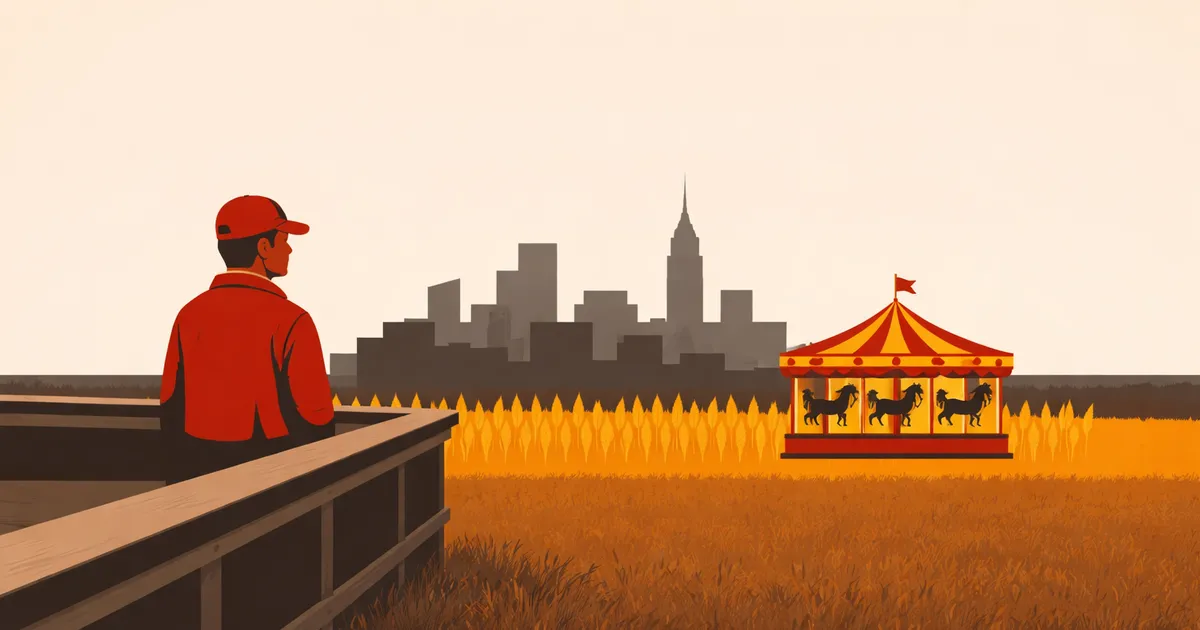
Antolini tells Holden he's heading for "a special kind of fall" and gives him the Stekel quotation about the immature man wanting to die nobly versus the mature man wanting to live humbly. Holden doesn't fully understand this advice in the moment, and the hair-stroking incident disrupts any chance of processing it. But the carousel scene enacts what Antolini described: instead of a grand gesture (running away, being the catcher), Holden sits on a bench and watches his sister ride a wooden horse. It's a humble act. It's living, not dying nobly. Whether Holden consciously connects Antolini's words to his own experience is unclear, but structurally, the novel links them.
Antolini's speech is the novel's most direct piece of thematic instruction, and Salinger complicates it by placing it in a compromised context. Antolini has been drinking, the conversation happens at three in the morning, and the encounter will end with a gesture that makes Holden flee in confusion. The wisdom is sound — Holden IS falling, and education COULD help him — but the vessel is imperfect. This is characteristic of how the novel handles adult guidance: it's never purely trustworthy. Spencer's advice is well-intentioned but condescending. Antolini's is perceptive but tainted by the ambiguous gesture. Holden's parents are absent. The novel argues, implicitly, that nobody can tell you how to grow up — the instruction manual doesn't exist, and the people who offer guidance are themselves compromised. Holden has to arrive at the carousel insight on his own, and even then, the insight is less intellectual than emotional: not "I understand," but "I was damn near bawling."
23. Why does Phoebe showing up with a suitcase change everything for Holden?
When Phoebe appears at the museum carrying a packed suitcase and announces she's coming with him, Holden's entire plan collapses. He gets angry, then starts crying, then abandons the idea of running away. This is the moment where Holden's self-destruction meets a wall: he can damage himself, but he can't damage Phoebe. The suitcase forces him to see his fantasy from the outside — it's not romantic independence, it's abandonment — and the person making him see it is the one person whose judgment he can't dismiss.
24. What is the significance of the profanity Holden finds written on the walls at Phoebe's school?
Holden discovers "Fuck you" scrawled on a wall at Phoebe's elementary school and is deeply upset — he imagines Phoebe and the other children seeing it and having to think about what it means. He tries to rub it off. Later, he finds the same words scratched into a wall at the museum, where it can't be erased. The progression — from writing that can be removed to writing that can't — enacts the novel's core anxiety: innocence is constantly being exposed to the adult world's ugliness, and there's no way to fully protect anyone from it. Holden can't erase every "Fuck you" in the world, just as he can't catch every child before they fall.
25. Why does Holden cry at the carousel, and what does the scene represent?
Holden watches Phoebe ride the carousel and reach for the gold ring — an act that risks a fall — and he doesn't try to stop her. "The thing with kids is, if they want to grab for the gold ring, you have to let them do it, and not say anything." He stands in the rain crying, and he doesn't know why. The scene represents Holden's first step away from the catcher fantasy. He's accepting that he can't protect Phoebe from risk, that growing up involves reaching for things you might not get, and that the impulse to protect someone from life is itself a kind of damage. His tears are the release of something he's been holding since Allie died.
26. What does the final line of the novel mean?
"Don't ever tell anybody anything. If you do, you start missing everybody." Holden delivers this as a warning, but it contradicts itself — he's just told us everything about everybody. The line means that narrating his experience brought all these people back to life for him, made them vivid and present, and now that the story is over, he'll feel their absence. It's an admission that caring about people is unavoidable, even the people you claimed to dislike. The novel opens with Holden refusing to tell his story and closes with him regretting that he told it, because telling it made him feel connected to people he'll never be able to dismiss as phonies again.
27. What is the significance of the frame narrative — Holden telling this story from a facility?
Holden narrates from what appears to be a psychiatric or rest facility in California, looking back on events that are roughly a year old. This frame matters because it means every word of the novel is a reconstruction — Holden is choosing what to tell us, what to emphasize, and what to leave out. The frame also raises a question the novel refuses to answer: has Holden changed since these events? He mentions a psychoanalyst, a new school in the fall, and the fact that he misses everybody. But he also delivers the closing warning — "Don't ever tell anybody anything" — which suggests that the vulnerability the story required is something he regrets. The frame creates a Holden who has already lived through the story and a Holden who is reliving it, and the distance between them is never clarified.
Thematic Questions
28. How does Salinger use Holden's red hunting hat to develop his character?
The red hunting hat functions as a portable identity marker. Holden puts it on when he's alone, feeling vulnerable, or needs confidence — and takes it off in social situations where it would attract attention. The hat is the same color as Allie's red hair, though Holden never makes this connection explicitly. He gives it to Phoebe during their midnight conversation and she returns it later, making it a token that circulates between the two characters who are most important to each other. The hat represents Holden's desire to be uniquely himself while also connecting him to the brother he lost.
The hat's appearances follow a precise emotional logic. Holden wears it after the fight with Stradlater (wounded, alone), during his walk through Central Park (cold, depressed), and at other low points. He removes it when he's trying to be socially acceptable — on dates, in restaurants, meeting acquaintances. This on-off pattern charts his fluctuations between authentic selfhood and social performance. That the hat is a hunting hat is itself ironic — Holden is a "people shooting hat," as Ackley calls it, but the only person he's hunting for is himself. The transfer to Phoebe and back creates a circuit of care: Holden protects Phoebe by giving her his talisman, and Phoebe protects him by returning it. The hat's final appearance, when Phoebe puts it back on his head in the rain, completes the novel's emotional arc — Holden is covered again, not by his own effort but by someone else's love.
29. Does the novel present Holden's breakdown as a failure or as a necessary step toward recovery?
This is genuinely ambiguous, and the novel provides evidence for both readings. Holden is telling the story from a psychiatric facility, which suggests the breakdown required professional intervention — a failure of self-management. But he also tells us he's going to a new school in the fall and that he misses everybody, including people he claimed to hate. The carousel scene, where he cries while watching Phoebe, looks less like collapse than release. The novel doesn't answer the question because Salinger isn't interested in recovery narratives — he's interested in the texture of consciousness under pressure.
The frame narrative complicates any straightforward reading. Holden addresses a "you" from the facility, mentions a psychoanalyst asking about whether he's going to "apply himself" at the new school, and says "How do you know what you're going to do till you do it?" This response resists the therapeutic framework being imposed on him — he won't promise to get better because he doesn't know what "better" means. Some readers see this as persistent immaturity; others see it as hard-won honesty. The novel refuses the recovery arc that American culture tends to demand from its breakdown narratives. Holden doesn't emerge transformed. He emerges slightly more aware — he misses people, he's willing to try another school — but the fundamental tensions haven't resolved. Whether that constitutes progress depends on whether you believe that awareness, without resolution, is worth anything. The novel seems to suggest it is.
30. How does the theme of death and mortality shape Holden's worldview?
Death is the novel's hidden engine. Allie's death from leukemia is the event that, more than any other, explains Holden's behavior — his protectiveness, his fear of change, his fixation on preserving innocence. But Salinger keeps it mostly beneath the surface. Holden mentions Allie throughout the novel but rarely discusses the death directly. He talks to Allie ("Allie, don't let me disappear") while crossing streets. He remembers punching out garage windows the night Allie died. He visits the Egyptian mummies at the museum, fascinated by preservation beyond death. These scattered references form a pattern that the reader assembles gradually: Holden is a person for whom death arrived too early, without warning, and who now sees the possibility of loss in every relationship and every moment.
Salinger distributes the death theme through images rather than statements. The ducks in Central Park — where do they go when the lagoon freezes? — are about what happens to living things when the environment turns hostile. The Museum of Natural History preserves dead things behind glass, making them permanent at the cost of making them lifeless. The catcher in the rye catches children before they fall — preventing a metaphorical death, the death of innocence. Even the scene with Sunny carries death overtones: Holden imagines himself dying like a movie character after Maurice hits him. Each of these moments connects back to Allie without naming him, creating a subterranean river of grief that runs beneath the novel's surface narrative of a teenager wandering around New York. The reader who tracks this pattern understands something Holden himself may not: that his entire three-day odyssey is an extended grief response, a restless search for something that can make loss bearable, and that nothing he finds — not bars, not girls, not teachers, not museums — can do the job. Only Phoebe, alive and reaching for the gold ring, comes close.
31. What role does social class play in Holden's experience?
Holden comes from wealth — private schools, a Manhattan apartment, enough pocket money to check into hotels and buy drinks for strangers — but he's uncomfortable with his privilege in ways he can't fully articulate. He feels guilty about his expensive suitcases around the nuns. He's embarrassed by his family's position when talking to people from different backgrounds. He mocks the Pencey headmaster for treating wealthy parents differently. Yet he also benefits constantly from his class position: he can afford three days of aimless wandering because he has money. His rebellion against phoniness is funded by the very system he criticizes.
The suitcase passage is the novel's most direct engagement with class. Holden recalls a former roommate at Elkton Hills who had cheap suitcases and eventually moved them under the bed out of shame, then started criticizing other students' expensive bags. The memory sticks with Holden because it captures how class warps relationships — "the thing is, it's really hard to be roommates with people if your suitcases are much better than theirs." This is unusually perceptive social analysis for a seventeen-year-old, and it complicates the reading of Holden as purely self-absorbed. He sees how money creates invisible barriers. But Salinger also shows the limits of Holden's class consciousness: he feels guilty about his suitcases around the nuns but doesn't connect this guilt to any systemic understanding. His discomfort is personal, not political. The novel suggests that Holden's privilege is both a buffer (he can afford his breakdown) and a blindfold (he mistakes his personal alienation for a universal condition, not recognizing that his freedom to reject society is itself a luxury most people don't have).
32. How does Salinger use recurring motifs — ducks, museums, movies — to develop the novel's themes?
Each of these motifs carries a specific thematic weight, and together they form a symbolic vocabulary for Holden's inner life. The ducks represent his anxiety about impermanence and loss — where do vulnerable things go when conditions turn hostile? The museum represents his desire for a world that stays frozen and safe. Movies represent the false narratives he both despises and unconsciously retreats into when reality becomes too painful. These motifs recur throughout the novel not as decorative symbols but as the terms in which Holden thinks — they're the images his mind reaches for when direct expression fails.
The motifs interact in ways that reward close tracking. The ducks and the museum are related but opposite: the ducks are natural and free but vulnerable to seasonal change, while the museum is artificial and protected but dead. Holden wants to find a way of living that combines the ducks' aliveness with the museum's permanence, and the novel's argument is that no such combination exists — you get one or the other. The movie motif cuts across both: after Maurice hits him, Holden imagines himself as a movie hero, which is a museum-like response (freeze the painful moment into a controlled narrative) applied to a ducks-like reality (unpredictable, dangerous, alive). The carousel at the end synthesizes all three: it's a mechanical thing (museum-like, repetitive, safe) with a living child on it (duck-like, reaching, at risk), and Holden watches it instead of narrating a movie version. For the first time, he stays in reality.