Themes & Motifs
Alienation and Isolation
Holden Caulfield spends the entire novel trying to reach people and failing. He calls old girlfriends, takes taxis to nightclubs, visits former teachers, takes a date to the theater — and every single encounter leaves him more alone than he was before. His alienation isn't the brooding, romantic kind. It's the frantic kind. He's a person standing in a crowded room making phone calls, and the phone keeps ringing without anyone picking up. The word "phony" functions as his explanation for why he can't connect — the world is full of fakes, and you can't have a real conversation with a fake person — but the reader gradually realizes that the phoniness is more excuse than diagnosis. Holden is isolated because he can't tolerate the compromises that social life requires.
The loneliness has a physical quality that Salinger renders with uncomfortable precision. Holden gets cold. He wanders through Central Park at night until he's shivering. He sits alone in hotel rooms. He walks blocks and blocks through Manhattan with no destination. The city — teeming with people, lit up, noisy — becomes a landscape of his solitude. He's never more alone than when he's surrounded by crowds.
Salinger structures the novel as a cascade of failed connections, and the pattern is relentless enough to constitute an argument. Holden reaches out to Mr. Spencer (who lectures him), Ackley (who can't provide real companionship), Sally Hayes (who can't follow his desperation to its logical extreme), Carl Luce (who finds him immature), and finally Mr. Antolini (whose ambiguous gesture sends Holden running). Each failure has a different surface cause, but the underlying dynamic is constant: Holden wants a depth of engagement that the social world either can't provide or that he can't sustain.
The interesting wrinkle is that Holden contributes to his own isolation as actively as the world does. He lies about his identity to Mrs. Morrow on the train, creating a barrier of fiction between himself and a woman who is being genuinely friendly. He provokes Sally into rejecting him by accelerating from a pleasant date to a proposal to run away within minutes. He peppers Carl Luce with intrusive questions he knows will drive Carl off. There's a self-destructive logic to these encounters: Holden tests relationships to the point of failure, then uses the failure as proof that connection is impossible. Whether this is a conscious strategy or a compulsion born of grief — Allie's death having taught him that the people you love most can disappear without warning — is a question the novel leaves unresolved.
The one relationship that doesn't follow this pattern is his bond with Phoebe. She doesn't let him run the conversation off a cliff. She pushes back. She asks the hard questions. And crucially, she shows up — at the museum with her suitcase — in a way that forces Holden to confront the real-world consequences of his flight. Phoebe doesn't cure his isolation, but she interrupts the pattern long enough for something else to happen.
Phoniness versus Authenticity
"Phony" is the word Holden uses more than any other, and it covers a vast territory — from the Pencey headmaster who shakes hands differently depending on a parent's wealth, to the actors at a Broadway show who are too aware of being good, to his own brother D.B. who "prostituted" his literary talent by writing for Hollywood. For Holden, phoniness is the fundamental condition of adult life. Growing up means learning to perform — learning to say things you don't mean, act interested when you're bored, and pretend that the rituals of social life matter when they obviously don't.
What makes Holden's hatred of phoniness interesting rather than tedious is that he's complicit in it. He lies more than almost anyone in the novel. He invents a fake name on the train. He pretends to be older at bars. He tells Sally he loves her when he doesn't, or does, or doesn't know. The gap between his stated values and his actual behavior is the novel's richest source of irony and its most compassionate observation: Holden hates phoniness because he can't escape it. It's not something that only other people do. It's the price of participating in social life at all.
The novel gives Holden a vocabulary for his dissatisfaction — "phony" — but deliberately withholds a vocabulary for what he actually wants. Holden can identify falseness with surgical precision, but when Phoebe asks him to name something he genuinely likes, he goes blank. He mentions Allie (dead) and watching Phoebe (a passive appreciation, not an active engagement). His vision of the good life — the catcher in the rye — is defined entirely by negation: not a world where anything good happens, but a world where nothing bad happens. This asymmetry between Holden's critical intelligence and his constructive imagination is the novel's deepest characterization of adolescent alienation. He knows what's wrong but has no idea what right would look like.
The novel complicates the phony/authentic binary through characters who don't fit neatly into either category. The nuns Holden meets at breakfast are genuine, and he recognizes this, but the interaction makes him uncomfortable because their authenticity highlights his own privilege and hypocrisy (he worries about his expensive suitcases). Mr. Antolini is both sincere in his concern and performing the role of wise mentor — his speech about the fall, however true, has a rehearsed quality, as though he's delivered it before. Even Phoebe, Holden's model of authenticity, is a performer — she writes plays, acts out scenes, changes her middle name. She's authentic not because she refuses to perform but because her performances come from genuine enthusiasm rather than social obligation. This suggests that the distinction Holden draws between phoniness and authenticity is too rigid, that performance and sincerity can coexist, and that Holden's real problem isn't the world's fakeness but his inability to tolerate ambiguity.
Innocence and the Fear of Growing Up
Holden wants to be the catcher in the rye — the person who stands at the edge of a cliff and catches children before they tumble into the adult world. The image captures his central terror: that growing up means losing something irreplaceable. He sees adulthood as a process of corruption, a slow accumulation of compromises and performances that gradually replaces whatever was genuine in you with something socially acceptable but fundamentally hollow. Childhood, in Holden's mind, is the only state in which people are fully real.
The evidence for this is everywhere. Phoebe, who is ten, is authentic and joyful. Allie, who died at eleven, is preserved forever as a good, innocent person. The children singing "if a body catch a body coming through the rye" make Holden feel momentarily happy. The Museum of Natural History appeals to him because nothing in it ever changes. Meanwhile, every adult and teenager Holden encounters seems to have already fallen — already learned the scripts, already started performing. Even Jane Gallagher, whom he idealizes, is someone he can't call. He can remember the girl who kept her kings in the back row, but he can't face whoever she's become.
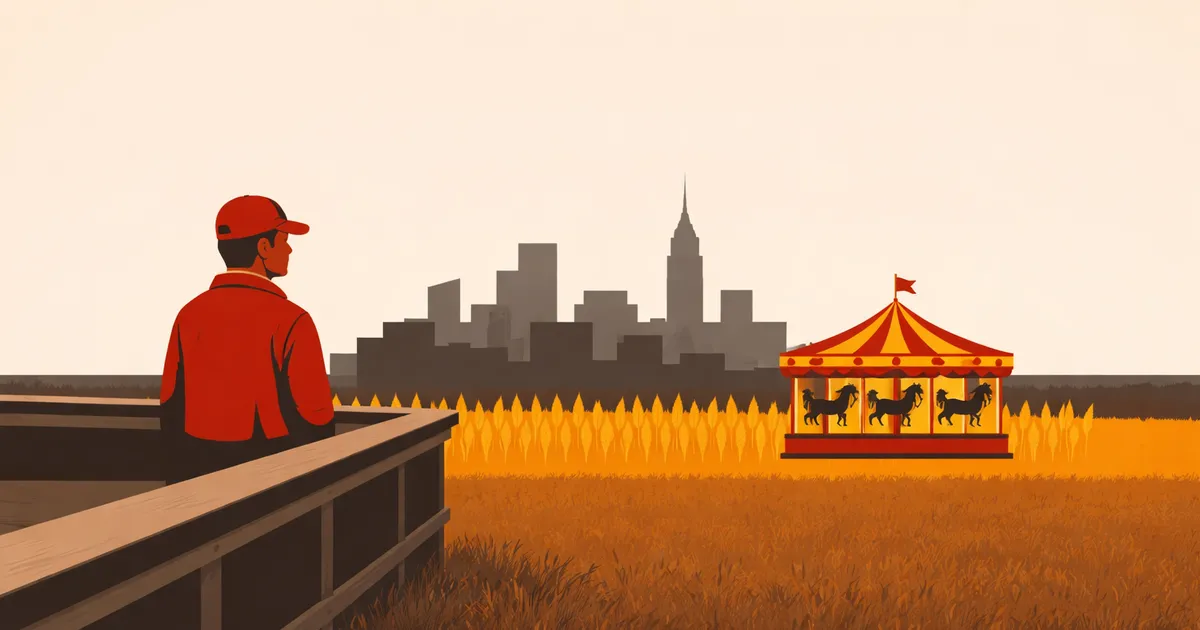
The innocence theme is built through a careful architecture of images. The frozen figures in the museum, Allie's mitt with its green-ink poems, the carousel in Central Park, the ducks that disappear from the lagoon in winter — all of these are variations on the same preoccupation: what happens to vulnerable, beautiful things when conditions change? The ducks question, which Holden poses to two different cab drivers, is overtly about animals migrating, but its emotional content is about death, absence, and whether the things you lose come back. That no one can answer the question satisfactorily — one cabbie gets angry, another tells a confused story about fish — reinforces Holden's sense that the adult world has no comfort to offer.
The novel's critical insight is that Holden's desire to protect innocence is itself a form of denial. He wants to freeze time because he can't face what time has already done — specifically, it killed Allie. The catcher fantasy is not forward-looking but backward-looking: Holden isn't imagining a future role for himself so much as trying to retroactively prevent a loss that has already occurred. He couldn't catch Allie. Leukemia isn't something you can stand at the edge of a cliff and stop. The fantasy is a grief response disguised as a vocation, and its impossibility is the point. When Holden finally lets Phoebe reach for the gold ring on the carousel — accepting the risk of her falling — he's not overcoming his fear of growing up. He's making the first tentative acknowledgment that his fear has been governing his life, and that governance has cost him nearly everything.
Identity and the Performance of Self
Holden spends the novel trying on identities the way someone might try on clothes in a store, never buying any of them. He tells Mrs. Morrow his name is Rudolf Schmidt (the janitor's name). He pretends to be older to get served at bars. He imagines himself as a movie hero bleeding from a gunshot wound. He fantasizes about being a deaf-mute so he wouldn't have to talk to anyone. Each performance is an escape from a self he can't stand to inhabit, and each one collapses under its own weight. He can't sustain any role because he's too aware of the gap between the performance and the person performing it — which is precisely the awareness that makes him call everyone else phony.
The red hunting hat is his most sustained experiment in self-fashioning. He puts it on when he's alone or feeling vulnerable, takes it off in social situations, gives it to Phoebe, gets it back. It's not a disguise so much as a portable identity — a way of declaring himself different without having to articulate how or why.
The identity theme connects to the novel's formal structure through Holden's narration. He's telling this story from a therapeutic facility, looking back, and the act of narration is itself an identity performance. He's constructing "Holden Caulfield" for us — choosing what to emphasize, what to downplay, what to lie about, and what to confess. The self we encounter in the novel is a curated self, and the moments where the curation slips — when grief overwhelms his ironic distance, when he cries without understanding why — are the moments that feel most real.
Salinger complicates matters by making Holden's search for identity inseparable from his grief. The question "who am I?" is entangled with "who am I without Allie?" Holden defines himself almost entirely through negation (not phony, not like Stradlater, not like Ackley, not an adult) because the positive definition he had — Allie's older brother, the kid who played baseball in the outfield while Allie wrote poems on his mitt — has been destroyed. His identity was relational, built around a person who no longer exists, and every attempt to construct a new one feels like a betrayal.
The deaf-mute fantasy in Chapter 25 is the logical endpoint of this pattern. Holden imagines moving to a cabin (echoing his proposal to Sally) and pretending to be unable to speak. If he can't find an identity that's genuine, he'll eliminate the need for one entirely. That this fantasy collapses almost immediately — Phoebe shows up and demands his attention — suggests that identity, in the novel's view, isn't something you can construct in isolation. You become who you are through the people who refuse to let you disappear.