Summary
Overview
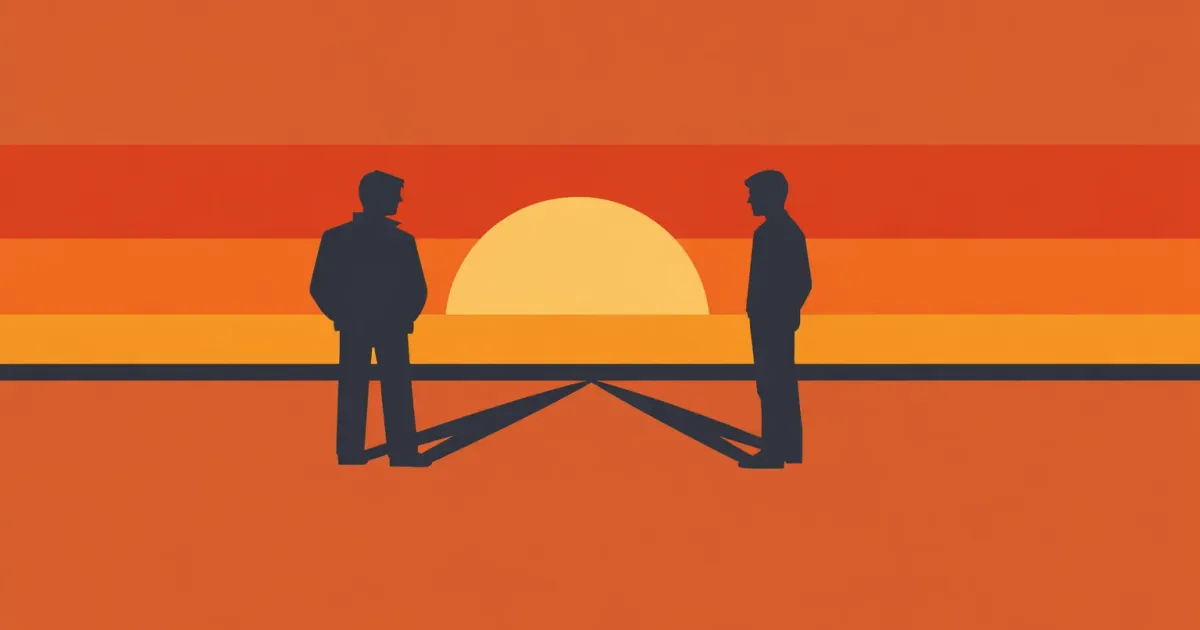
The Outsiders is S. E. Hinton's 1967 novel about a two-week stretch that destroys a fourteen-year-old kid's illusion that the world splits neatly into people who deserve what they get and people who don't. Ponyboy Curtis, the narrator, is a greaser in 1960s Tulsa — long hair, leather jacket, orphaned, living with his two older brothers on the poor East Side. Across town, the Socs drive Mustangs and Corvairs and jump greasers for kicks. The book opens with Ponyboy getting cornered walking home from a movie and ends, twelve chapters later, with two of his friends dead and Ponyboy writing the very book we've been reading. In between, the plot pivots on one act of self-defense: Johnny Cade, the gang's nervous pet, knifes a drunk Soc named Bob Sheldon to keep him from drowning Ponyboy in a park fountain.
Hinton was sixteen when she wrote it, which matters. She was sick of teen novels where well-dressed kids worried about prom, and she wanted to show the guys she actually went to school with — the ones who carried switchblades because they'd been jumped once too often, and cried about it later in vacant lots. The book's central claim, delivered through Ponyboy's slow awakening, is that both sides of the class line hurt, lie to themselves, and lose people — "things are rough all over," as the Soc cheerleader Cherry Valance tells him. What endures, past the dated slang and the Paul Newman references, is the voice. Ponyboy sounds like a real fourteen-year-old trying to make sense of something too big for him, and that honesty is why the book still lands with middle schoolers who have never seen a rumble in their lives.
Structurally, the novel is a frame tale: the book is Ponyboy's English assignment, his way of testifying for every kid who got written off because of how his hair looked. That framing is revealed only in the final paragraph, which loops back to the opening sentence, so the whole narrative retroactively becomes an act of witness rather than just a coming-of-age yarn. It also makes the prose's first-person roughness a feature, not a flaw — the occasional grammatical drift and the slangy rhythm are the voice of a kid writing his way out of grief, not a stylist polishing sentences. Within the young-adult canon, The Outsiders was the book that inaugurated YA as we know it. Before Hinton, adolescent fiction was mostly sanitized and adult-approved; after her, it could involve real violence, parental failure, and class rage without apology. Later YA writers like Robert Cormier, Walter Dean Myers, and Chris Lynch are unthinkable without the door she kicked open.
Within Hinton's own work, The Outsiders is the origin of a loose Tulsa cycle — That Was Then, This Is Now, Rumble Fish, and Tex all share the same imaginative geography, and Tim and Curly Shepard drift through more than one book. What distinguishes this novel from its siblings is its investment in the romance of the gallant outsider, channeled through the Robert Frost poem "Nothing Gold Can Stay" and the Gone with the Wind passages about Southern gentlemen riding into death. Hinton lets Ponyboy be sentimental about his friends, and the book never apologizes for that sentimentality. It is one of the reasons the novel still moves readers who have long since outgrown it.
Chapters 1–3: Two Worlds, One Curb
The novel opens with Ponyboy walking home from a Paul Newman movie and getting jumped by a Corvair full of Socs who threaten to cut his throat; his brother Darry and the rest of the gang arrive in time to scare them off. The first chapter functions as a thumbnail sketch of Ponyboy's world — the three orphaned Curtis brothers (Darry, twenty, working two jobs; Soda, the movie-star-handsome high school dropout; Ponyboy, the "brainy" one), their four gang members (Two-Bit Mathews, Steve Randle, Dallas Winston, and the skittish, often-beaten Johnny Cade), and the feud with the rich West-side Socs. The following night, Ponyboy and Johnny go to the drive-in with Dally and end up sitting with two Soc girls, Cherry Valance and Marcia, whose boyfriends have stranded them. Dally gets chased off after talking dirty; Two-Bit shows up; and Ponyboy and Cherry discover, to Ponyboy's surprise, that she watches sunsets too. Walking the girls home, the greasers run into the girls' boyfriends — Bob Sheldon and Randy Adderson — in a blue Mustang, the same car Johnny recognizes from the night he was savagely beaten. The girls leave with their boyfriends to avoid a fight, and Cherry quietly tells Ponyboy she could fall in love with Dally Winston. Back at home, Ponyboy is two hours late; Darry, frantic, slaps him. Ponyboy bolts, finds Johnny in the lot, and the two of them walk to the park.
The drive-in conversation between Ponyboy and Cherry is the book's ideological pivot — every major theme that the later chapters develop is introduced there. Cherry's line "Things are rough all over" reframes the whole Soc–greaser conflict: it isn't money, she argues, it's feeling. "You greasers have a different set of values. You're more emotional. We're sophisticated — cool to the point of not feeling anything." That diagnosis travels the full length of the novel and resurfaces, almost word for word, when Ponyboy meets Randy at the Tasty Freeze in Chapter 7. Hinton also plants the symbolic architecture here: Cherry's remark that she and Ponyboy see the same sunset, which will be echoed in Ponyboy's plea at the end of Chapter 8 that she can see sunsets from the West Side too, and in Johnny's dying letter telling Ponyboy to stay gold. The slap from Darry at the end of Chapter 3 functions as the inciting incident proper — not because it is particularly violent, but because it sends Ponyboy out into the park at exactly the wrong hour, which in turn pushes the plot toward the fountain.
Chapters 4–6: The Fountain, the Church, and the Fire
In the park in the small hours, a drunk carload of Socs — Randy, Bob, and three friends — corners Ponyboy and Johnny. One Soc holds Ponyboy's head under the fountain until he nearly drowns. Johnny, who has carried a switchblade since the beating that left the scar on his cheek, stabs Bob, who dies. The two boys flee to Buck Merril's place, where Dally, grimly competent in a crisis, gives them a loaded gun, fifty dollars, and instructions to hop the 3:15 freight to Windrixville and hide in an abandoned church on top of Jay Mountain. They spend roughly a week there — bleaching and cutting their hair to fit the descriptions in the paper, eating baloney sandwiches, reading Gone with the Wind aloud. Watching a sunrise, Ponyboy recites Robert Frost's "Nothing Gold Can Stay" to Johnny, who seems to understand the poem better than he does. Dally arrives on the fifth day with news that Cherry has become their spy and will testify the killing was in self-defense; Johnny, against Dally's advice, decides to turn himself in. As they leave the church they find it on fire — a school group is picnicking, children are trapped inside, and Ponyboy and Johnny climb in through a window to pull them out. Dally drags Ponyboy out before the roof caves in. Johnny is pinned by a falling timber and suffers third-degree burns and a broken back. At the hospital, Darry and Sodapop find Ponyboy, and Darry, who has never visibly cried in Ponyboy's memory, is crying now. Ponyboy realizes for the first time that Darry loves him.
These three chapters form the engine of the novel's moral argument. Bob's killing is carefully engineered to be indefensible from the Socs' point of view and unavoidable from Johnny's — Ponyboy is drowning, five Socs outnumber two boys, and Johnny has already been brutalized by this exact group of kids. Hinton wants the reader to feel the killing as a tragedy, not an act of villainy, and she wants Johnny — who earlier tells Ponyboy he sometimes wants to kill himself — to be pushed into a version of manhood he never asked for. The church episode is the book's clearest symbolic hinge. Ponyboy and Johnny, coded as delinquents in the first three chapters, become literal saviors; the fire purifies them in the eyes of the respectable world, even as it kills Johnny's body. The Frost poem is the interpretive key the novel keeps handing the reader: gold is youth, innocence, the capacity to look at a sunset and see something, and the novel is tracking its loss in real time. Darry's tears in the hospital also matter technically: they rewrite every scene in the first three chapters, retrospectively transforming Darry's nagging from coldness into fear. The reader has been reading a first-person narrator who was wrong about his own brother, and Hinton is showing us the moment Ponyboy realizes it.
Chapters 7–9: Heroes, the Rumble, and "Stay Gold"
The morning after the fire, the papers call the boys heroes — "Juvenile Delinquents Turn Heroes" — and the story notes that Ponyboy and Sodapop may be placed in a boys' home if the court finds Darry an unfit guardian. Ponyboy and Two-Bit visit Johnny and Dally in the hospital. Johnny's back is broken; the doctor tells the Curtis brothers that even if he lives he will be crippled. Ponyboy runs into Randy in the parking lot of the Tasty Freeze; Randy, shaken by Bob's death, tells him he's skipping the planned rumble because he's sick of the fighting and because Bob's parents had failed their son by never saying no to him. Cherry confirms she'll serve as a witness but refuses to visit Johnny: he killed her boyfriend. The big rumble happens that night in the vacant lot — twenty greasers (the Curtis gang, Tim Shepard's outfit, and a Brumly crew) against twenty-two Socs, fists only. Darry faces off against Paul Holden, a college friend who now looks at him with pity and contempt. Dally, escaped from the hospital with Two-Bit's switchblade, arrives mid-fight. The greasers win. Dally immediately hauls a half-conscious Ponyboy into Buck's T-bird and speeds them to the hospital, where Johnny tells Ponyboy to "Stay gold" and dies. Dally breaks, slams his fist into the wall, and bolts.
Chapter 7's conversation with Randy, rhymed against the earlier conversation with Cherry, is the point at which Ponyboy's view of the Socs snaps into its mature form. Both Cherry and Randy reveal an interior life the greasers aren't supposed to grant them — fear, guilt, grief, boredom with the rich-kid script — and both push Ponyboy to articulate, for the first time, that individuals and their labels are not the same thing: "'Greaser' didn't have anything to do with it," he tells Randy. "It's the individual." That sentence quietly undoes the book's entire opening. The rumble itself is the novel's ironic climax: it's the event everyone has been building toward and it solves nothing. The greasers win and are still greasers; the Socs lose and are still Socs; Johnny dies anyway. Hinton uses the fight to disenchant Ponyboy with the whole logic of the turf war — he notices, mid-rumble, that Tim Shepard's boys and the Brumly gang are "future convicts" he doesn't actually want to stand next to. Johnny's final words, delivered in the hospital before the real climax, carry the book's ethical charge: "stay gold" is both a plea and a command, directed past Ponyboy to any reader who still has the chance to choose who they're going to be.
Chapters 10–12: Dally, the Hearing, and the Theme
Dally calls the Curtis house to say he's robbed a grocery store and the police are chasing him. The gang runs to the vacant lot just in time to see Dally, under a streetlamp, raise an unloaded gun at the cops. They shoot him down. Ponyboy understands, even as it happens, that Dally has engineered his own death because Johnny — the one thing Dally loved — is gone. Ponyboy collapses from exhaustion, shock, and the concussion he suffered in the rumble, and spends several days delirious. He convinces himself, in his sickness, that Johnny isn't dead and that he himself, not Johnny, killed Bob. When Randy visits him at home, Ponyboy insists he had the knife; Randy leaves troubled. At the hearing, the judge, tipped off by the doctor that Ponyboy is emotionally fragile, asks him no questions about the killing and acquits him. The Curtis brothers stay together. But Ponyboy is failing school, losing shoes, and nearly breaks a Pepsi bottle against three Socs in a parking lot — starting to harden into the very hood Dally warned him away from. Soda, breaking under the pressure of Ponyboy and Darry's constant fighting and a returned love letter from his girlfriend Sandy, runs out of the house. The three brothers chase him to the park and reconcile. That night, reading Johnny's copy of Gone with the Wind, Ponyboy finds the letter Johnny left him — the dying boy insists saving the children was worth it and urges Ponyboy to stay gold and to tell Dally there's still good in the world. Ponyboy resolves to write his English theme about everything that has happened, starting with the sentence that began the book: "When I stepped out into the bright sunlight from the darkness of the movie house, I had only two things on my mind: Paul Newman and a ride home…"
Dally's death is the structural counterweight to Johnny's, and Hinton wants the reader to feel the difference. Johnny dies gallant, like the Southern gentlemen in Gone with the Wind he has come to admire; Dally dies violent and young under a streetlamp, and no one writes editorials for him. The twinning is deliberate — "two friends of mine had died that night: one a hero, the other a hoodlum" — and the novel's sympathy is with the hoodlum, because Ponyboy has learned that the labels are lies. Dally's death also completes the book's argument about toughness as a survival strategy that eventually kills you. He told Ponyboy in Chapter 9 to get tough, look out for himself, and nothing could touch him; the novel's answer is that nothing could touch him because nothing was left.
Ponyboy's near-hardening in the parking lot scene with the three Socs is the book's quiet near-miss — for a moment he holds the broken bottle the way Tim Shepard holds a switchblade, and the reader feels him becoming Dally. It is Johnny's letter, not the hearing or the reconciliation with Darry, that finally pulls him back. The final move — turning the entire novel into Ponyboy's English theme — is the book's most formally daring gesture. It rescues the violence from meaninglessness by making Ponyboy's narration itself an act of advocacy for "hundreds and hundreds of boys living on the wrong sides of cities." It is also why the novel ends with its own opening sentence: the story isn't over, it's about to begin, because the witness has finally decided to speak.