Themes & Motifs
The Line Between Greasers and Socs Is Smaller Than Either Side Wants to Admit
The most obvious theme in The Outsiders is also the one the novel works hardest to complicate. On the surface the book is about a class war: poor East Side greasers in leather jackets versus rich West Side Socs in Mustangs and madras shirts. But Hinton's real argument is that the two groups are separated less by what they have and more by what they're allowed to feel. Money buys the Socs a different uniform, not a different interior life. The greasers cry in vacant lots; the Socs numb themselves at drive-ins. Both sides keep losing people.
The book puts this argument on Cherry Valance's lips in Chapter 2 when she tells Ponyboy, "Things are rough all over." It's a throwaway line that turns out to be the book's thesis statement. By the final chapters, even the guys throwing the punches have started to suspect the feud is a story the adults around them have been telling about themselves for a long time.
Hinton builds this theme through a string of structurally paired scenes. The first is the drive-in conversation in Chapter 2, where Cherry explains the difference between the groups in feeling rather than finances: greasers are more emotional, Socs cool to the point of not feeling anything. That claim sounds, at first, like the kind of thing a Soc cheerleader would say to flatter herself. The novel spends the next ten chapters proving her right and wrong at the same time. Right, in that the greasers cry openly while Bob Sheldon's friends freeze over. Wrong, in that the numbness she describes is itself a form of suffering — the same suffering that drives Bob to pick fights he doesn't need to pick.
The second paired scene is Ponyboy's conversation with Randy outside the Tasty Freeze in Chapter 7. Randy is the Soc equivalent of Ponyboy, and his confession — that Bob's parents destroyed him by never saying no, that the fighting has stopped meaning anything — rhymes with Cherry's earlier diagnosis and locks the theme in place. It is here that Ponyboy finally articulates the insight the whole book has been building toward: "'Greaser' didn't have anything to do with it... It's the individual." The sentence quietly dismantles the book's own opening premise.
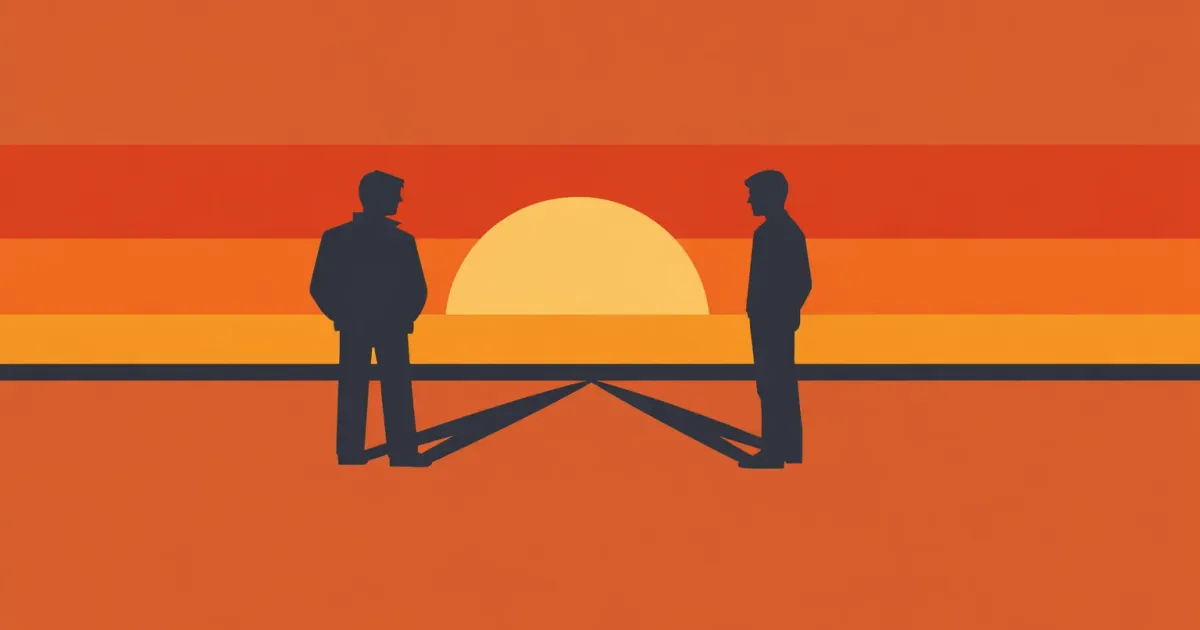
Hinton also threads the theme through small observations that are easy to miss. Ponyboy notices in Chapter 3 that he and Cherry watch the same sunset, "the two different worlds we lived in weren't so different." Darry, the most unmistakably greaser of the Curtis brothers, turns out to have had a Soc friend named Paul Holden in high school — a friend who now looks at him during the rumble with pity. Even Bob, the dead Soc, had liked Cherry for the same reasons Ponyboy does: she saw through him. The class war the book opens with is real, but by the end it reads less like a conflict between two peoples than like a single adolescent pain that has been sorted, arbitrarily, into two uniforms.
Family You Choose, Family You Survive With
The Curtis brothers have no parents — Darry is twenty, already working two jobs, legally responsible for Ponyboy and Sodapop after a car wreck killed their mother and father. The gang they've folded themselves into has no parents either, or parents who drink or hit or are simply not there. What holds these boys together isn't blood; it's a decision, renewed every day, to show up for each other. The Outsiders is one of the earliest YA novels to take seriously the idea that a chosen family can be as real as a biological one, and to show how much work it takes to keep one intact.
The theme lives in the small domestic textures of the Curtis house — Soda and Darry fighting over the newspaper, Dally walking in without knocking, Two-Bit raiding the fridge — and it surfaces most painfully in Darry's tears at the hospital, the moment Ponyboy realizes his oldest brother has been scared, not cold, the whole time.
Hinton's decision to frame the novel around three brothers rather than one isolated hero is the structural spine of this theme. Ponyboy spends the first third of the book convinced that Darry doesn't love him, that he'd be happier without him, that the only real warmth in his life comes from Soda and the gang. That reading is wrong, and the novel knows it. The slap Darry gives Ponyboy at the end of Chapter 3 — the slap that drives the whole plot into motion — is reread by the end as an act of panic, not cruelty. Darry has already lost a mother and father; what he cannot survive is losing a brother. The novel makes the reader re-examine Darry's every earlier scene in that new light.
The gang operates as an extended version of the same unit. Johnny is the clearest case: his actual parents beat and ignore him, and the gang becomes the family that keeps him alive. When Ponyboy and Two-Bit visit Johnny's mother in the hospital and she is more interested in airing grievances than in seeing her son, the book makes its harshest judgment in the plainest language — she is "a selfish woman," and the boys in the waiting room are the people who actually love him. Dally, for his part, has constructed his entire identity around not needing anyone, and the novel's cruelest irony is that the one person he loves — Johnny — is the one the world takes from him. His suicide-by-cop in Chapter 10 is the book's argument that chosen family, when it dies, can kill you as surely as blood.
The theme also explains the book's ending. The scene in the park where the three Curtis brothers reconcile after Soda breaks down isn't a neat resolution; it's an acknowledgment that staying together will require constant effort and that Ponyboy has to stop using his brothers as a stand-in for the parents he lost. Hinton is unusually clear-eyed for a novelist her age about what it actually takes to keep a family functioning — not love as a feeling, but love as a discipline.
Staying Gold
The most lyrical strand in The Outsiders is its meditation on innocence — on what Ponyboy has that he's about to lose, and on what Johnny wants him to keep. Hinton pulls two outside texts into the novel to carry this theme: Robert Frost's "Nothing Gold Can Stay," which Ponyboy recites on the church roof at sunrise, and Margaret Mitchell's Gone with the Wind, which Johnny reads with increasing fascination as his dying turns him sentimental about Southern gentlemen riding gallantly into doomed battles. Both texts are about the short half-life of beauty. Both get absorbed into Johnny's dying words: "Stay gold, Ponyboy. Stay gold."
The phrase is easy to sentimentalize. It's also the book's most serious ethical demand. Johnny is not asking Ponyboy to stay innocent in the sense of naive; he's asking him not to let what has happened turn him mean.
The Frost poem enters the book in Chapter 5, in the church on Jay Mountain, when Ponyboy and Johnny watch the sun come up over the valley. Ponyboy recites the poem from memory. Johnny, who has never given any indication of being a reader, understands it better than Ponyboy does. "I never noticed colors and clouds and stuff until you kept reminding me about them," he says a few pages later. The moment is carefully placed: it comes just before the fire, the burns, the hospital, the rumble, the dying. The novel wants the reader to see Ponyboy at his goldest, precisely at the moment the gold is about to start tarnishing.
Johnny's deathbed line — "Stay gold, Ponyboy. Stay gold" — is then reinterpreted through his letter in Chapter 12, which Ponyboy finds tucked inside Johnny's copy of Gone with the Wind. Johnny writes that staying gold means keeping the capacity to see a sunset, to be moved by a poem, to notice that the world is beautiful even when it is cruel. He is rewriting Frost's elegy as a command rather than a lament — yes, nothing gold can stay, but that's exactly why you have to fight to stay gold anyway. It is the most earnestly romantic gesture in a novel that is not afraid of its own earnestness.
The theme also lets Hinton diagnose what happens when people lose their gold and don't fight to get it back. Dally is the book's worked example. He tells Ponyboy in the hospital that if you get tough enough, nothing can touch you — and the novel quietly notes, in Ponyboy's narration, that nothing touching you is the same thing as being dead already. Dally has been un-gold for years, and his violent end is the cost. Ponyboy's near-miss in the parking lot scene with the three Socs — the moment he holds a broken Pepsi bottle the way a hood would — is the book's warning that this fate is available to him too, and that only deliberate work will keep it from happening. Staying gold isn't a passive condition. It's a choice renewed against evidence.
Violence Is a Dead End
The turf war between greasers and Socs drives almost every plot event in The Outsiders, and Hinton is scrupulous about making that violence feel real rather than cinematic. People get hurt. People die. Nothing is resolved. The rumble in Chapter 9 is the climactic fight the whole book has been building toward, and it solves precisely nothing — the greasers win, Johnny still dies, Dally still gets killed under a streetlamp, and the class line between East Side and West Side is exactly where it was in Chapter 1. The book's quiet but insistent argument is that toughness, as a life strategy, is a trap that eventually closes on the person using it.
Dally is the emblem of this trap. He is the gang's best fighter, its most fearless member, and the one Ponyboy admires most at the start. By the end he is dead because he cannot imagine any other way to be.
Hinton pairs two pieces of advice across the novel to make her case. In Chapter 9, Dally tells the concussed Ponyboy that you've got to get tough, look out for yourself, and nothing can touch you. In Chapter 12, Two-Bit — usually the comic relief — tells Ponyboy the opposite: don't get tough, you're not like the rest of us, don't try to be. The novel's sympathies are with Two-Bit, and the evidence for that is Dally's corpse. Dally has followed his own advice to its logical endpoint, and the endpoint is a streetlamp at night with police spotlights on him. His death is not punishment for being bad; it's the natural conclusion of believing that invulnerability is achievable and that achieving it is worth the price of everything else.
The novel also works hard to complicate the killing at its center. Johnny stabs Bob Sheldon in self-defense — five Socs, two boys, Ponyboy drowning in the fountain — and the narrative is clear that Johnny had no other move to make. But Hinton refuses to let self-defense be a clean category. Johnny is a child who has been beaten so thoroughly by this exact group of Socs that he carries a switchblade everywhere, and the switchblade is the thing that ends up killing someone. The book's suggestion is that a world in which a frightened kid has to arm himself to walk through a park is already a world in which violence has won, even before the blade comes out. Bob's death is tragic for Bob, tragic for Johnny, and tragic for Ponyboy, who spends the rest of the book half-convinced he was the killer.
The rumble seals the argument. Ponyboy notices, standing in the lot with Tim Shepard's outfit and the Brumly crew, that these are people he doesn't actually want to be next to — "future convicts," he thinks, kids who fight because it's the only thing they know how to do. The greasers win the rumble and the reader is given no reason to feel good about it. The violence that's supposed to prove something proves nothing; the violence that could have been prevented — Bob's death, Johnny's burns, Dally's suicide — can't be undone. By the end of the novel, Hinton has quietly stripped the glamor off every fight in the book, including the ones she lingered on in the first three chapters. The reader who started out rooting for the greasers in a schoolyard brawl ends up watching a sixteen-year-old die in a hospital bed.
The Novel as Testimony
The Outsiders is, structurally, a book within a book. The final paragraph reveals that everything the reader has just finished is Ponyboy's English theme — an assignment he took on to speak for the boys the newspapers and the police and the school counselors don't listen to. The novel's last sentence loops back to its first, and the whole narrative becomes an act of witness rather than a conventional coming-of-age story. This is a motif as much as a theme: storytelling itself as a kind of moral action, a way of refusing to let dead friends disappear into statistics.
The frame-tale is what rescues the novel from hopelessness. Johnny is still dead. Dally is still dead. Bob is still dead. But Ponyboy has done something with the dying — he has made them mean.
Hinton plants the seeds for this structural reveal earlier than most first-time readers notice. The opening sentence — "When I stepped out into the bright sunlight from the darkness of the movie house, I had only two things on my mind: Paul Newman and a ride home" — is strikingly specific and remarkably controlled for a narrator who, throughout the book, seems to be telling the story in real time. When Chapter 12 closes by returning to that exact sentence, the reader understands retroactively that every scene has been shaped by a narrator who already knows how it ends. That is why Darry's early harshness reads differently on a reread, why Johnny's quietness feels like foreshadowing, why Cherry's "things are rough all over" lands as a thesis rather than a throwaway. Ponyboy has been telling us the story he was ready to tell only after the worst had happened.
The novel also sets up the English-theme framing narratively. Ponyboy is failing English at school, his teacher offers him a chance to pull his grade up with an autobiographical essay, and he spends the last third of the book unable to start it. What finally unlocks the writing is Johnny's letter, with its insistence that there's still good in the world and that someone should tell Dally so. Ponyboy can't tell Dally — Dally is dead — so he tells the reader instead. The book we have been reading is the letter the dead boy asked him to write, passed forward to an audience Johnny never got to meet.
That gesture is why the novel has outlived its dated slang and its Paul Newman references. Hinton, who was sixteen when she wrote the book, understood something most adult novelists have to learn: that storytelling for young people about young people can be, at its best, a form of advocacy. Ponyboy ends the novel speaking for "hundreds and hundreds of boys living on the wrong sides of cities" — boys who don't get eulogies, who get mugshots. The novel-within-the-novel is Hinton's argument that writing their story counts as doing something about it. That is an audacious claim for a YA book to make, and The Outsiders has been making it, to successive generations of fourteen-year-olds, for close to sixty years.