Essay Prompts
1. The Three Scaffold Scenes as Moral Architecture
Question: Hawthorne stages three scenes on the same scaffold — Hester's shaming in Chapter 2, Dimmesdale's midnight vigil in Chapter 12, and the final revelation in Chapter 23. Do these scenes function as a coherent moral argument, and if so, what does that argument say about confession, penitence, and community?
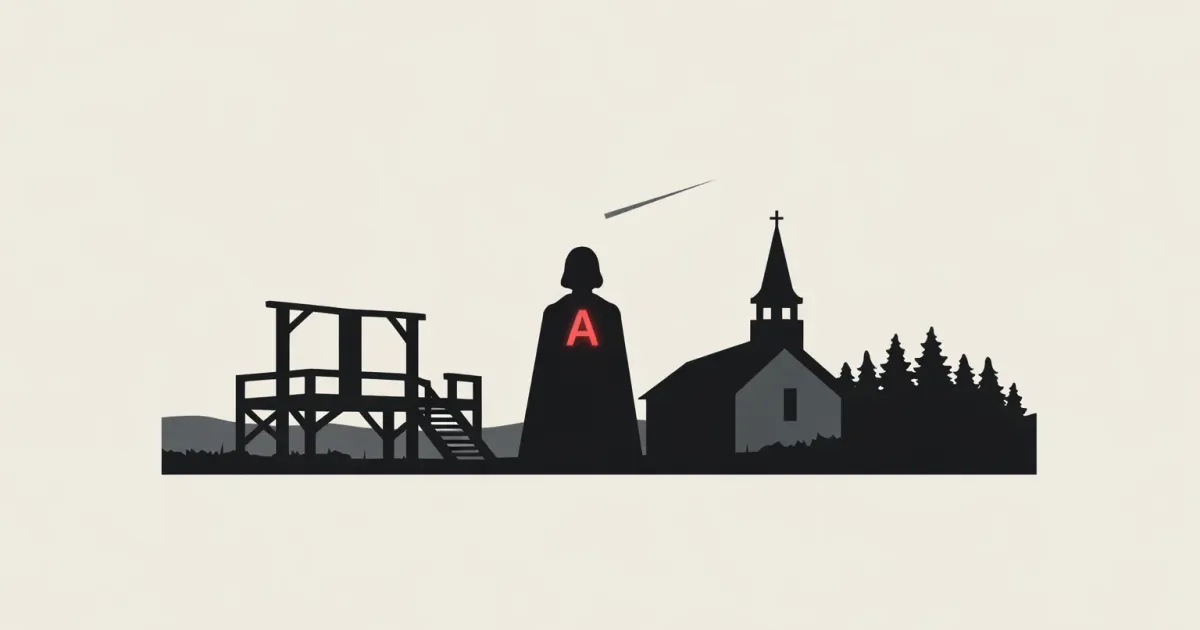
A good starting move is to treat the three scaffolds as a graded sequence rather than a series of parallels. In the first scaffold, Hester stands alone under hostile daylight; in the second, Dimmesdale stands alone in the dark; in the third, all four principals stand together in daylight, and confession is finally spoken aloud. Track what changes between them — who is present, who is absent, who is watching, who is punished. A solid thesis might argue that Hawthorne uses the repetition to stage a case against private penance: that suffering kept secret is simply suffering, and only public acknowledgment turns pain into moral clarity. Use the narrator's own phrase "mockery of penitence" from Chapter 12 as your pivot.
The more sophisticated version of this argument resists the tidy reading that the book endorses public confession. It does not quite. The Puritan public is never shown to be a reliable moral audience — the townspeople in Chapter 2 read the letter as shame, the townspeople of later chapters read it as "Able," and the witnesses at the final scaffold disagree about whether Dimmesdale's chest bears any mark at all. If the community cannot read what it sees, then public confession is not vindicated by public understanding. A nuanced thesis might argue that the three scaffolds trace not a movement from concealment to revelation but a movement from one failed reading to another, with Dimmesdale's final ascent functioning less as moral victory than as a private act of self-integration performed in a public space that does not really comprehend it. Evidence to consider: the sexton's interpretation of the Chapter 12 meteor as a tribute to Governor Winthrop; the competing accounts of the final scene Hawthorne deliberately offers in Chapter 24; Chillingworth's cry of "Thou hast escaped me!" — a line that frames Dimmesdale's confession as flight from a private tormentor rather than submission to a public tribunal. The deepest form of this essay argues that Hawthorne is not advocating confession at all. He is demonstrating that the choice between concealment and disclosure is less important than the choice of whom one confesses to — and that the Puritan state is never the right audience.
2. Pearl as Symbol, Pearl as Child
Question: Is Pearl a realistic child, a living symbol, or something the novel refuses to resolve — and how does that instability shape our reading of Hester and Dimmesdale?
A straightforward approach begins with the evidence on both sides. Pearl behaves in recognizably childlike ways — she throws tantrums, she makes up games, she clings to her mother. But she is also repeatedly described in language that makes her inhuman: an "elf-child," an "airy sprite," a creature whose moods mirror the scarlet letter itself. A workable thesis proposes that Pearl is deliberately written to resist a single reading, and that the novel's refusal to resolve her is central to its method. Focus on three scenes: Pearl's fascination with the A in the brook's reflection (Chapter 16), her refusal to cross the brook until Hester replaces the letter (Chapter 19), and her kiss of Dimmesdale on the final scaffold, which the narrator says breaks the "spell" that held her (Chapter 23).
A more ambitious version of this essay treats Pearl as a formal problem Hawthorne sets himself: how to write a character whose symbolic function is so dense that realism becomes almost impossible, yet whose emotional life is essential to the novel's moral stakes. The argument should notice that Pearl is the only character who consistently perceives the truth hidden from everyone else — she asks Dimmesdale at the midnight scaffold why he will not stand with her family in daylight, and she refuses any version of her mother that omits the letter. That intuitive accuracy is what makes her a symbol (she is, functionally, the scarlet letter rendered animate) but also what makes her a rebuke to the adults around her, who all practice concealment of some kind. A sophisticated thesis might argue that Pearl's humanization at the final scaffold — "a spell was broken" — is the novel's most quietly devastating sentence, because it implies she has been an instrument of judgment for the preceding twenty-two chapters and only becomes a child once the judgment has been delivered. The counter-argument worth engaging: some critics read Pearl as a failure of characterization, a girl who functions too purely as allegory to work as a person. The strongest essays would not dismiss this objection but reframe it, suggesting that the tension between Pearl-as-symbol and Pearl-as-child is the formal cost Hawthorne pays for making her the novel's moral center.
3. Chillingworth as Dimmesdale's Dark Mirror
Question: To what extent are Roger Chillingworth and Arthur Dimmesdale morally parallel figures rather than opposed ones — and what does Hawthorne's treatment of their relationship suggest about the difference between sin and damnation?
A clear framing compares the two men as practitioners of concealment. Dimmesdale hides his adultery; Chillingworth hides his identity and his intention. Both live under assumed versions of themselves, and both are corroded by the lie. The accessible thesis: Chillingworth is not the moral opposite of Dimmesdale but his shadow, an image of what the minister might become if secrecy were permitted to harden fully into purpose. Strong evidence includes Chillingworth's own admission to Hester in Chapter 14 that he has become "a fiend," his increasingly demonic physical descriptions as the novel progresses, and the physician-patient intimacy that makes their cohabitation feel like a grotesque marriage. Note also that Chillingworth dies within a year of Dimmesdale — as though the two men shared a single life between them.
The richer version of this argument examines what actually distinguishes the two men in Hawthorne's moral universe, since the parallel only matters if the verdict on them differs. Dimmesdale's sin is passional — an act committed out of love, or at least desire, followed by years of self-punishment. Chillingworth's sin is deliberative: a methodical invasion of another person's soul, conducted under the guise of healing. Hawthorne places the novel's sharpest judgment on this question in Dimmesdale's own mouth during the Chapter 17 forest meeting: "We are not, Hester, the worst sinners in the world. There is one worse than even the polluted priest! That old man's revenge has been blacker than my sin. He has violated, in cold blood, the sanctity of a human heart." That the claim is voiced by a character, not the narrator, is itself significant — it gives Hawthorne a hierarchy of sins without forcing him to fully endorse it, and it turns the comparison into an argument the reader has to weigh rather than simply accept. A nuanced thesis can argue that the novel proposes a taxonomy of transgression in which warmth, however illicit, is morally recoverable, while calculated cruelty is not — and that Chillingworth's disintegration after Dimmesdale's death is the novel's structural proof. Counter-arguments to consider: some readers see Dimmesdale's self-flagellation as its own form of calculated harm, directed at himself rather than outward, which would collapse the warmth/calculation distinction. Another angle worth pursuing is the Faustian cast of the Chillingworth-Dimmesdale pairing — the leech as devil, the minister as soul under examination — and the way Hawthorne uses that old literary pattern to dramatize a very modern idea, that a person can be destroyed not by their sin but by being watched too closely while trying to live with it.
4. The Forest and the Town
Question: How does Hawthorne use the symbolic geography of forest and town to frame the novel's questions about selfhood, authority, and what is possible for a woman like Hester?
A useful entry point is to treat the two landscapes as competing moral jurisdictions. The town is the space of law, hierarchy, and visibility — the meeting-house, the scaffold, the governor's mansion. The forest is the space of privacy, intuition, and old New England folklore, where Hester and Dimmesdale can speak to each other without being watched and where Mistress Hibbins hints at a witchcraft the town officially denies. A solid thesis might argue that Hawthorne uses the forest as the only setting in which his characters briefly become themselves — Hester unpins the letter, lets down her hair, and speaks of "a surer ground of mutual happiness" — before the geography of town reasserts itself on Election Day and crushes the plan.
A more advanced essay will notice that Hawthorne's forest is not simply a romantic counter-space but a morally unstable one. The trees offer freedom, but they also offer the Black Man's book that Mistress Hibbins alludes to, and the narrator is careful to blur the line between liberation and temptation. When Hester tells Dimmesdale "What we did had a consecration of its own," she is speaking in a register the town's law cannot hear — but Hawthorne does not straightforwardly endorse her claim either. The forest permits the utterance without validating it. A nuanced thesis can argue that Hawthorne is interested in the forest precisely because it is where unauthorized sentences can be said out loud, even if those sentences turn out to be wrong. The strongest evidence comes from the end of the forest meeting: Pearl, standing across the brook, refuses to cross. The child, reading the scene from the town's side of the water, registers immediately that the Hester without her letter is a Hester her daughter does not recognize. This moment — which ends the forest idyll before the ship has even been boarded — suggests that Hawthorne sees the forest's freedom as provisional, dependent on an audience of two, and incapable of surviving contact with the social world that Pearl, even at seven, already carries inside her. Consider also how the Election Day procession physically reclaims the symbolic territory, with the ministers and magistrates moving in formation through the market-place while Hester stands still beside the scaffold. The town does not need to defeat the forest; it only needs to resume.
5. Hester's Radical Thought and the Limits of Hawthorne's Feminism
Question: Is Hester Prynne a proto-feminist heroine, and does Hawthorne's treatment of her thinking support that reading or quietly undercut it?
A clear approach notices that Hester, through her years of isolation, becomes a genuine intellectual. The narrator tells us in Chapter 13 that she "assumed a freedom of speculation" considered more dangerous than the scarlet letter itself, and that she imagines "the whole system of society is to be torn down and built up anew." The closing chapter returns to this note, with Hester counseling women who come to her in grief and hinting at a future of more honest relations between the sexes. A workable thesis might argue that Hawthorne presents Hester as a woman whose mind outgrows the community that punishes her, making her one of the earliest recognizable feminist figures in American fiction.
A sharper essay will note what Hawthorne gives with one hand and takes back with the other. The narrator characterizes Hester's speculative thinking with unmistakable approval, yet the plot never allows her radical thoughts to issue in radical action. The forest plan is her most direct bid for self-determination, and it collapses within hours. At the end of the novel, she does not lead a movement; she counsels grieving women and defers the prophecy of social change to "some brighter period, when the world should have grown ripe for it" — and specifies that the prophet, when that time comes, will be "a woman, indeed, but lofty, pure, and beautiful," not someone marked by sin like herself. A sophisticated thesis can argue that Hawthorne is simultaneously drawn to and unsettled by Hester's intellectual power: willing to show that her solitude has made her think more clearly than her judges, but unwilling to stage her triumph within the novel's own timeline. Counter-arguments worth taking seriously: some readers hold that Hester's final return, voluntarily resuming the letter as a kind of unofficial clergy credential, is itself a radical act — she has transformed a brand into an office. Others argue that Hawthorne, writing in 1850, is constrained by what his mid-nineteenth-century audience could accept, and that the suppression of Hester's radicalism is a marketplace compromise rather than an authorial judgment. The strongest essays stake a claim about which Hawthorne is in control of the ending — the one who admires Hester's mind, or the one who cannot quite let a woman's mind be the book's resolution — and supports that claim with close attention to the final chapter's carefully qualified prophecy.
6. "The Custom-House" and the Problem of the Frame
Question: Why does Hawthorne preface a novel about seventeenth-century adultery with a long, semi-autobiographical sketch about his nineteenth-century job at a customs house, and what does that frame do to the story it introduces?
A starting position treats "The Custom-House" as a deliberate provocation. The sketch is satirical, political, and often funny — Hawthorne mocks his dozing coworkers, complains about his dismissal from the surveyorship, and half-jokingly claims to have found the scarlet letter itself among old papers in the building's attic. A workable thesis might argue that Hawthorne uses the frame to position his novel as a found object rather than an invention, borrowing the authority of historical document while preserving the freedom of fiction. Focus on the moment he describes touching the cloth letter and feeling "a burning heat" — a sentence that hands the novel's central symbol to the reader as something already strange, already charged, before the story proper begins.
The deeper version of this essay treats the frame as a genuine formal choice rather than an artifact of nineteenth-century publishing conventions. The sketch does several things at once: it establishes Hawthorne's lineage of Puritan judges (including the great-great-grandfather who presided at the Salem witch trials), it stages a quarrel with the commercial present that makes the Puritan past feel morally vivid by comparison, and it invents a paper trail — Surveyor Pue's manuscript — that allows the novel to claim a kind of evidentiary status it does not actually have. A sophisticated thesis argues that "The Custom-House" is not merely an introduction but a meditation on what kind of truth fiction can tell: historical truth, moral truth, or the more unstable truth of a symbol that glows in a reader's hand. Evidence to pursue includes Hawthorne's self-description as a writer "standing in the shadow" of his ancestors, who he imagines condemning him for becoming a mere storyteller; the explicit transfer of authority from Pue's manuscript to the narrator's reconstruction; and the famous passage on the "neutral territory" of moonlight, where the actual and imaginary can "meet" and exchange qualities. A counter-argument worth addressing: some modern readers skip or resent the frame, reading it as an indulgent preamble. The best essays answer this by showing that without the Custom-House, the novel loses its crucial double time-signature — 1640s events narrated by a nineteenth-century sensibility that cannot quite look away from its Puritan inheritance. The frame is what makes the novel historical fiction in the full sense: not a reconstruction of the past, but a confrontation between a present that wants to be done with the past and a past that keeps seeping into the present through strange objects kept in attic drawers.