Key Quotes
"had so early borne the black flower of civilised society, a prison."
Speaker: Narrator (Chapter 1, "The Prison-Door")
This is Hawthorne's opening verdict on the world of his novel. He has just described the weeds growing by the Boston jail, and now he pivots from literal plants to a metaphor: of all the things this new colony could have built first, it built a jail. Calling the prison a "black flower" lets him admit that punishment is a natural outgrowth of any human community — but the adjective "black" quietly insists that the bloom is rotten. The line frames everything that follows, because before we meet a single character, Hawthorne has told us what kind of soil they are growing out of.
The "black flower" is the first and most important pairing in a book built on pairings — it sets up the wild rose-bush that blooms on the next page, and the pairing of those two blossoms (one cultivated by civilization, one offered by "sainted Ann Hutchinson" or simple Nature) becomes the novel's governing contrast between institutional judgment and organic mercy. The metaphor also performs a sleight of hand that defines Hawthorne's narrative method: he seems to offer a clear symbol, then loads it with contradictions. Flowers are generous, beautiful, innocent; the "black flower of civilised society" is none of those things. A reader trained on sermon literature would expect the prison to be justified as necessary; Hawthorne lets the word "flower" do the argumentative work, inviting us to notice that Puritan justice has the same inevitability as rot. The sentence is also a structural promise. By opening with the prison rather than the church, Hawthorne announces that this will be a novel about how a society's first instinct toward its own members is restraint.
"On the breast of her gown, in fine red cloth, surrounded with an elaborate embroidery and fantastic flourishes of gold thread, appeared the letter A."
Speaker: Narrator (Chapter 2, "The Market-Place")
This is the reader's first look at the A itself, and every word matters. Hester has been sentenced to wear a mark of public shame. What she has actually produced, with her needle, is a piece of luxury embroidery — red cloth, gold thread, "fantastic flourishes." She has taken the instrument of her humiliation and turned it into art. The townswomen in the crowd have already noticed this and are furious about it; they can see, even if the magistrates cannot, that Hester has quietly refused the terms of her punishment.
The sentence is the novel's symbolic engine in miniature. A mark designed to flatten Hester into a single meaning ("adulteress") arrives on the page already carrying three or four at once — penance, defiance, craftsmanship, vanity, even a kind of regal display. Hawthorne's method across twenty-four chapters is to keep loading that single object with incompatible meanings until the community's attempts to interpret it collapse under the weight. Formally, the detail that the embroidery is Hester's own handiwork is crucial: the punishment has been authored by the state, but its execution has been authored by her. That division of labor — they name her sin, she decides what it looks like — previews the novel's deeper argument that the meaning of any public mark depends on what the marked person does with it. By the time the townspeople are calling the A an "Able" in Chapter 13, the transformation signaled by this first image is complete.
"I charge thee to speak out the name of thy fellow-sinner and fellow-sufferer!"
Speaker: Reverend Arthur Dimmesdale, to Hester (Chapter 3, "The Recognition")
Dimmesdale, standing on the balcony above the scaffold, is publicly pleading with Hester to name the father of her child. What no one in the crowd knows is that he is pleading with her to name him. The moment is the novel's first great irony — the adoring congregation hears a holy minister do his duty; Hester hears her lover begging her to expose him while pretending not to. The speech is unbearable because Dimmesdale almost certainly means both things at once. Part of him does want to be dragged into the light, and the other part is relying on Hester's silence to keep him safe.
Hawthorne constructs the speech so that every sentence works double duty. "Fellow-sinner and fellow-sufferer" sounds to the crowd like generic pulpit language; to Hester it is a hidden self-identification. The subsequent hypothetical — "though he were to step down from a high place, and stand there beside thee, on thy pedestal of shame, yet better were it so than to hide a guilty heart through life" — is the novel's thesis stated twenty chapters before the final scaffold scene will prove it. Dimmesdale is already telling himself, from the pulpit, what he will eventually have to do. The tragedy is that he cannot do it yet, and will spend seven years hiding under the very sermons in which he keeps almost confessing. The speech also establishes the grammar of Dimmesdale's particular kind of hypocrisy: he never lies outright. He speaks literal truth, and lets the public mishear it as piety. That pattern — truth weaponized as concealment — is what eventually destroys him.
"Thou and thine, Hester Prynne, belong to me. My home is where thou art and where he is. But betray me not!"
Speaker: Roger Chillingworth, to Hester in the prison (Chapter 4, "The Interview")
Chillingworth has arrived in Boston on the day of his wife's public shaming, walked into her jail cell calling himself a physician, and is now negotiating his future in the settlement. The line is chilling because he is not asking for her fidelity as a husband — he is asserting ownership. He claims Hester, her child, and her lover as his property, and the purpose he will build his life around is not reconciliation but pursuit. The "but betray me not" turns the whole speech into an oath he extracts from her under duress: keep my name secret, and I will keep yours.
The speech reveals Chillingworth's character in one stroke and also previews the novel's central perversion of the marriage bond. A Puritan husband's legal claim to his wife was comprehensive, but Chillingworth is extending that claim past the point of intelligibility — "no matter whether of love or hate," he says a few lines earlier, "no matter whether of right or wrong." He is building a case that ownership survives affection, consent, even justice itself. What Hester has done to him is finite; what he is about to do to Dimmesdale will be seven years of slow-motion spiritual murder. The line also does structural work: by binding Hester to silence, Chillingworth creates the novel's central plot machine. Dimmesdale's undiscovered identity, Hester's isolation, the physician's free access to his patient — all of it is downstream of this single imperative sentence. Hawthorne will later have Dimmesdale name this as a worse sin than adultery, and the groundwork for that verdict is laid here.
"I, your pastor, whom you so reverence and trust, am utterly a pollution and a lie!"
Speaker: Reverend Arthur Dimmesdale, in his pulpit (Chapter 11, "The Interior of a Heart")
Dimmesdale has done this more than once now. He mounts the pulpit determined to confess, and what emerges is technically a confession — "I am a pollution and a lie" — that his congregation receives as humble piety. The more honestly he describes his own corruption, the more saintly they think him. The moment captures the central trap of his life: in a community that equates eloquent self-condemnation with holiness, telling the literal truth about yourself is indistinguishable from preaching.
Hawthorne's sentence design is surgical here. The sequence of titles — "I, your pastor, whom you so reverence and trust" — accumulates exactly the kind of authority that would make a confession devastating, and then collapses it with "a pollution and a lie." In any normal rhetorical context, that collision should produce scandal. Instead, the congregation's Puritan hermeneutic converts it into reassurance: if the minister sees himself that way, how holy he must really be. The passage is Hawthorne's most explicit diagnosis of a community that has mistaken performed humility for actual virtue. It also shows why Dimmesdale cannot confess in private and cannot confess effectively in public; every available form of speech has been preempted by his own reputation. His eventual solution — ascending the scaffold, tearing open his ministerial band, and letting the body itself speak — becomes legible as the only confession his society has left him capable of making.
"What we did had a consecration of its own. We felt it so! We said so to each other."
Speaker: Hester Prynne, to Dimmesdale in the forest (Chapter 17, "The Pastor and His Parishioner")
This is the most radical sentence in the novel, and the one students most often miss. Dimmesdale, having just learned that Chillingworth is Hester's husband, has asked whether their adultery can ever be forgiven. Hester does not answer theologically. She says their love was holy — "a consecration of its own" — and that they both knew it at the time. In 1850, putting that sentence in the mouth of a sympathetic woman was a genuine act of literary courage. Seven years of punishment have not broken her belief that what she and Dimmesdale shared was, on its own terms, sacred.
Hawthorne is careful not to endorse the line; he also does not have Dimmesdale or any other character contradict it. The word "consecration" is theological — it means setting something apart as holy — and Hester is using it to describe an act her community has defined as the opposite of holy. The effect is a private counter-church of two, conducting its own sacraments in the forest. Notice what follows: Dimmesdale can only whisper "Hush, Hester!" He does not argue. The book's moral argument has slipped out from under its Puritan characters and onto ground neither of them can fully occupy yet. The sentence also crystallizes the novel's strange theology of sin. Hawthorne's worst sinner is not Hester, who loved, or even Dimmesdale, who lied — it is Chillingworth, who violated "in cold blood, the sanctity of a human heart" (as Dimmesdale says a few sentences earlier in the same scene). In Hawthorne's moral economy, passion that honors another person can be a consecration; cold revenge that invades another person's interior is the unforgivable thing.
"A mortal man, with once a human heart, has become a fiend for his especial torment."
Speaker: Roger Chillingworth, to Hester (Chapter 14, "Hester and the Physician")
Chillingworth is describing himself. Hester has confronted him on the seashore about what he has done to Dimmesdale, and for the first time he tells the truth about his own transformation: he used to be a man, and he is no longer one. The line is startling because Chillingworth delivers it without self-pity and without any intention to stop. He has diagnosed himself with exactly the clarity he uses on his patient, and finds the diagnosis interesting rather than tragic.
Hawthorne has been preparing this moment since Chapter 4, where Chillingworth first described his search for his wife's lover in the cold, precise language of natural philosophy. The scholar's intellect has been turned into an instrument of hell, and the character himself now recognizes that the instrument has consumed the operator. What makes the line great is the construction "once a human heart" — the novel's deepest question has always been what it means to have a human heart, and Chillingworth announces that he has lost his in the act of probing Dimmesdale's. The sentence inverts the book's other great revelation scene. Where Dimmesdale's confession will be a reclamation of humanity, Chillingworth's is a coroner's report on its loss. The two men function as mirror images: one hides a sin until it almost kills him, the other pursues a sin until it succeeds in killing him from the inside out. Hawthorne's final verdict, offered in the closing chapter, is that when Dimmesdale dies the physician simply collapses, because there is nothing of him left outside the torment he was administering.
"Be true! Be true! Be true! Show freely to the world, if not your worst, yet some trait whereby the worst may be inferred!"
Speaker: Narrator (Chapter 24, "Conclusion")
This is Hawthorne stepping out from behind the curtain to tell the reader what he thinks the book was about. Of all the morals he could have drawn from Dimmesdale's seven-year collapse, he picks the plainest one: don't hide. The triple imperative — "Be true! Be true! Be true!" — is the most unguarded sentence in the novel, and its directness is exactly the point. The whole book has shown what elaborate concealment costs; the lesson is allowed to be simple.
The qualification that follows — "if not your worst, yet some trait whereby the worst may be inferred" — is the Hawthornean twist that keeps the moral from being simplistic. He is not asking for full public disclosure. He is asking for enough honest self-presentation that an attentive observer could reconstruct the rest. That is precisely what Hester has done for seven years: she has not published her interior life, but she has worn a letter that lets the community infer the truth. Dimmesdale, who offered the community nothing to infer from, is the counter-example. The maxim therefore proposes a middle path between total confession (which Hester models) and total concealment (which destroys Dimmesdale), and locates moral integrity in the willingness to be legible rather than the willingness to be exhibited. It is one of the few passages in the book where Hawthorne allows his narrator to speak unironically, and it is placed — not accidentally — just after the minister's death, as if the meaning of Dimmesdale's whole life had been compressed into this instruction for the reader.
"Had either of these agonies been wanting, I had been lost for ever! Praised be His name! His will be done!"
Speaker: Reverend Arthur Dimmesdale, on the scaffold (Chapter 23, "The Revelation of the Scarlet Letter")
Dimmesdale is dying in Hester's arms after publicly naming himself as Pearl's father. The "agonies" are the double torture he has just enumerated — the secret guilt that has eaten him from within, and the unmasked Chillingworth whose presence sharpened that guilt into a blade. Having spent the novel begging to be delivered from both, he now thanks God for both. It is one of the most theologically severe moments in American literature: the sufferer has decided, at the last possible instant, that the suffering was the mercy.
The speech is formally a prayer of thanksgiving, which means Dimmesdale is ending his life inside the grammar of his profession. He has been unable to preach honestly for seven years; he can, at last, pray honestly for thirty seconds. Notice that Hester does not share this reading of the situation. A few lines later, when he tells her they may not meet hereafter because they "violated our reverence each for the other's soul," she pushes back — "Shall we not meet again?" The novel refuses to settle which of them is right, and the ambiguity is essential. Hawthorne has constructed a death in which a Puritan reading (punishment has produced salvation) and a romantic reading (punishment has wasted a life) are both fully available in the same words. That openness is why the book still produces classroom debate: students naturally divide along this line, and the text supports both camps because Hawthorne built it to. Dimmesdale's "Farewell!" is also the last word he speaks, completing a pattern in which every major event of his life has occurred on this same scaffold.
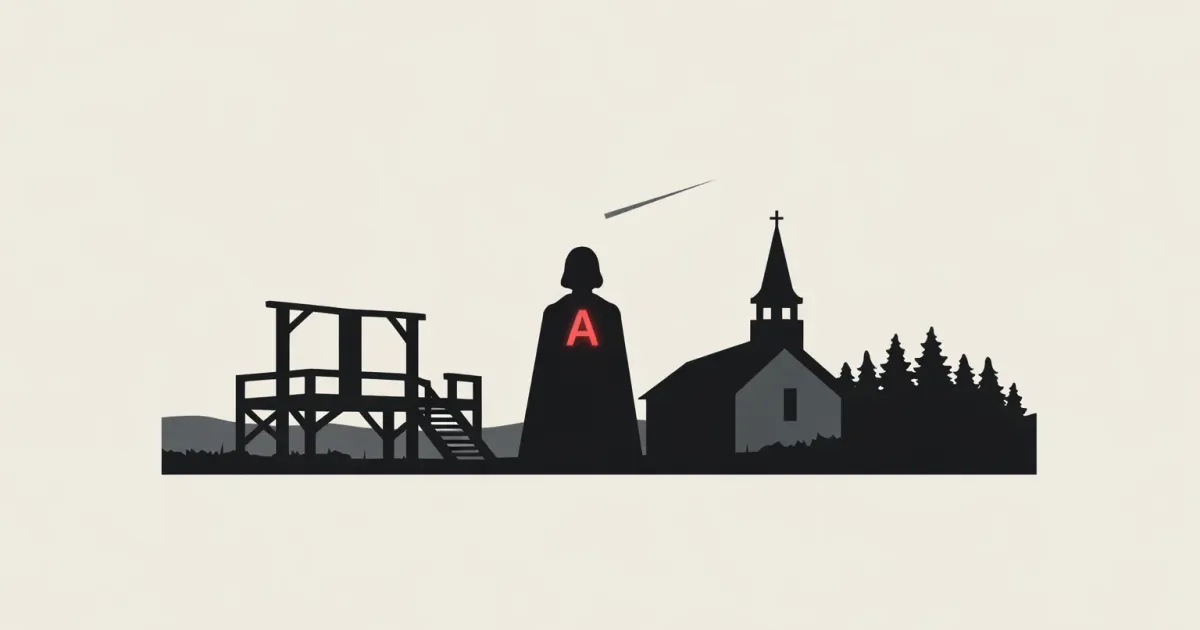
"ON A FIELD, SABLE, THE LETTER A, GULES."
Speaker: Narrator, quoting Hester's tombstone (Chapter 24, "Conclusion")
The novel ends on a heraldic motto. Rendered from formal blazon into plain English, it reads: "On a black field, the letter A, in red." It is the inscription on the single slab that covers both Hester's grave and Dimmesdale's. The letter that branded her as an outcast has become, centuries later, the coat of arms they share.
Hawthorne's final image is a compression of the entire novel into six words of medieval heraldry. The shift into blazon is pointed: heraldry is the language of lineage, honor, and permanence — exactly the things Puritan Boston refused Hester in life. By giving her a coat of arms, the book retroactively ennobles her without softening the facts. The sable field still means mourning; the red A still means the transgression that set her life in motion. But the two are now arranged into a composed, legible sign, the way any aristocratic family's crest is composed. The image also closes the novel's long argument about the meaning of symbols. Over twenty-four chapters the A has passed through a dozen readings — Adulteress, Able, Angel, the inexplicable mark on Dimmesdale's chest, the meteor in the midnight sky. The tombstone does not pick a winner. It fixes the letter in its most basic visual form and leaves the meaning, as the book has done from the beginning, to the reader standing over it. The motto's most radical implication is the one Hawthorne lets the reader discover alone: in the end, the letter is not a punishment or a virtue. It is a name.