Themes & Motifs
The Two Incompatible Geographies: Rome vs. Egypt
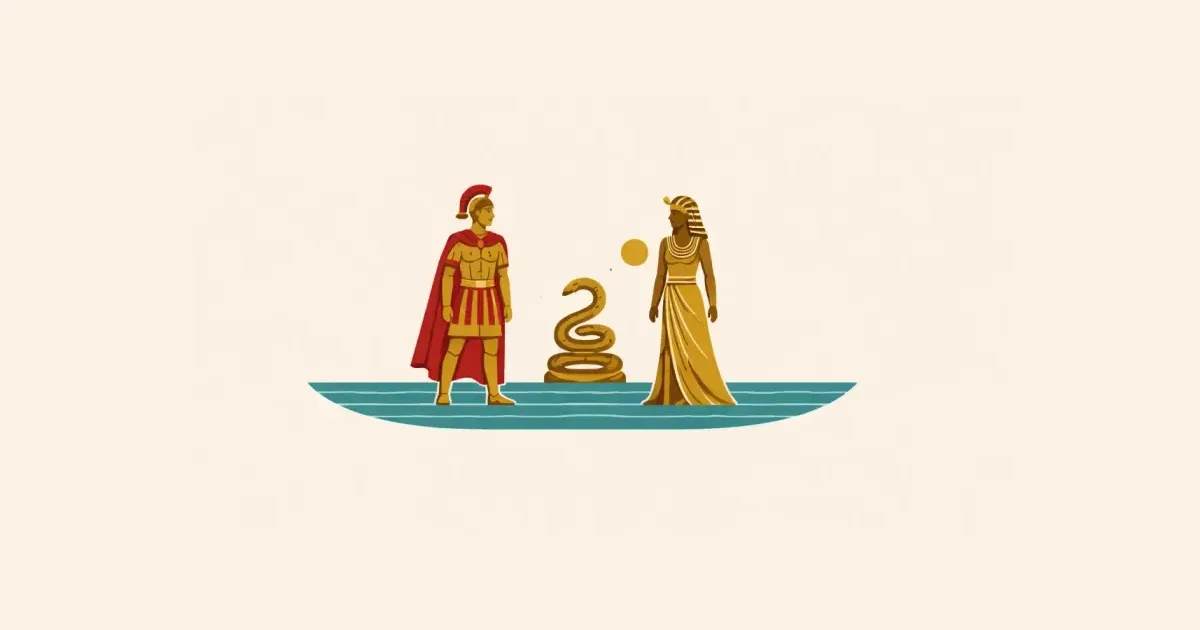
The play's deepest argument is that Rome and Egypt are not two countries but two mutually exclusive ways of being a person. Rome is duty, measurement, reputation, the cold arithmetic of power. Egypt is appetite, theatricality, overflow, the refusal to keep accounts. Antony is the only character who tries to live in both, and the play is the record of how that attempt tears him in half. Every scene change — and there are nearly forty of them — throws one value system against the other and asks the audience which they believe in more.
The clearest example is Antony's opening outburst: "Let Rome in Tiber melt, and the wide arch / Of the ranged empire fall! Here is my space." He isn't just choosing Cleopatra; he's rejecting the whole Roman architecture of "the ranged empire" — the ordered, measurable, hierarchical world — in favor of a "space" that can't be mapped. Two acts later he has to go back and beg for permission to live as a private citizen in that same empire. The geography keeps winning against his feelings about it.
Shakespeare builds the Rome/Egypt opposition into the texture of the verse itself. Roman scenes tend toward monosyllables, concrete nouns, and political bookkeeping. Caesar reports his grievances against Antony as an itemized list: "He hath given his empire / Up to a whore," "in Alexandria… / I' th' marketplace, on a tribunal silvered, / Cleopatra and himself in chairs of gold / Were publicly enthron'd." Egyptian scenes pour out in excess — Cleopatra demands mandragora to "sleep out this great gap of time," imagines Antony's horse as "happy" to bear his weight, speaks in exaggerated superlatives. The two prosodies can't be blended. When Antony is in Rome, he speaks Rome; in Egypt, Egypt. His language shifts with his coordinates, which is already a warning that he has no stable self underneath.
Enobarbus is the character Shakespeare uses to test the opposition, because Enobarbus is a Roman soldier who has lived in Egypt long enough to love it and understand its rules. His Cydnus speech — "The barge she sat in, like a burnished throne, / Burned on the water" — is delivered to Roman men in Rome, and it works as a kind of cross-cultural translation, rendering Cleopatra's aesthetic into language hardened Roman captains can hear. The speech's great line — "Age cannot wither her, nor custom stale / Her infinite variety. Other women cloy / The appetites they feed, but she makes hungry / Where most she satisfies" — is doing more than praising a woman. It is naming the single principle Egypt operates on: an economy of desire in which satisfaction produces more hunger, not less. Rome's economy is the opposite. Rome deals in debts paid, treaties signed, provinces inventoried. When Cleopatra in Act 5 hands over an inventory of her treasure and then has it exposed as half-concealed, she is briefly playing Rome's game — and she is doing it as a performance precisely because she knows Caesar reads only that language.
The geography also determines what kinds of deaths are possible. A Roman death is Brutus's — deliberate, sparse, explained in a speech that references precedent. Antony's attempted suicide, hybrid to the end, is a Roman act attempted by a man whose body is no longer fully Roman: he botches the sword thrust, has to be carried to a woman's monument, and dies hoisted up through a window by maids. Cleopatra's death, by contrast, is pure Egypt — robed, ceremonial, the asp at her breast imagined as "my baby at my breast / That sucks the nurse asleep." It is also, crucially, the only death in the play that entirely succeeds. The play's final argument is that when forced to choose, Egypt wins on its own terms even while losing on Rome's. Caesar takes the empire; Cleopatra takes the ending.
The Erosion of Heroic Masculinity
This is a tragedy about a man who was once the kind of soldier armies told stories about, and who is now — at the moment the play opens — already past that. Shakespeare isn't charting Antony's fall from greatness; he is watching the aftermath of a fall that happened before Act 1. The first line of the play is Philo complaining that "this dotage of our general's / O'erflows the measure." The second image is of Antony's "captain's heart… become the bellows and the fan / To cool a gipsy's lust." The heroic Antony exists mostly in other people's memories — what he used to be on the retreat from Modena, how he drank the stale of horses and ate strange flesh. The Antony we see is a man in the wrong era of his own life.
The theme matters because it turns the usual tragic structure inside out. In Macbeth or Othello, the hero is at the height of his powers and then falls. Here the hero has already fallen; the play is about whether he can invent a new kind of greatness to replace the old one, and the answer is a complicated yes. His final day of land victory, his long dying in Cleopatra's arms — these are not the Antony of Philippi. They are something else: a greatness that has had to make peace with humiliation.
Shakespeare loads Act 1 with language that registers Antony's masculine authority as something borrowed or receding. Cleopatra mocks him as "this Herculean Roman" — half tribute, half irony, since the reference flags exactly the lineage he is struggling to live up to. In Act 4, on the night before the final battle, common soldiers hear strange music "under the earth" and one of them names what is happening: "'Tis the god Hercules, whom Antony loved, / Now leaves him." Shakespeare builds the desertion of the guardian god into a stage moment, complete with offstage music, so that the audience can feel a specific kind of masculine identity physically withdrawing from the character. The scene has no plot function. Its only job is to register the loss.
What is replacing that withdrawn heroism is harder to name but just as carefully tracked. In Act 4 Antony tells Cleopatra, after Actium, "I have offended reputation, / A most unnoble swerving." That line is the old code still operating. Two scenes later, after his one victorious day of fighting, he greets Cleopatra with "O thou day o' th' world, / Chain mine arm'd neck. Leap thou, attire and all, / Through proof of harness to my heart, and there / Ride on the pants triumphing" — language so sensual and extravagant that no Roman general in Shakespeare's other plays could plausibly have spoken it. Antony is beginning to operate in a register the Roman code doesn't recognize. When he dies, he asks Cleopatra not to mourn his "miserable change" but to "think / On my former fortunes, / Wherein I liv'd the greatest prince o' th' world, / The noblest." He wants the old frame back for the final portrait. Cleopatra obliges by going even further: "His legs bestrid the ocean; his rear'd arm / Crested the world." She is inflating him to mythic scale at the exact moment his body has been exposed as mortal, botched-suicide flesh.
The botched suicide itself is the play's cruelest critique of Roman masculinity. Antony asks Eros to kill him with reference to sworn oaths and Roman precedent; Eros kills himself instead, which means Antony has to follow a servant's example rather than command a servant's obedience. "Thrice nobler than myself," Antony says, and takes the sword. Then he misses the mortal wound. The Roman masculine script — clean death by the sword, on one's own terms — collapses in his hands. Shakespeare gives his protagonist an ending in which the greatest warrior of the age has to be instructed in how to die by a freed slave and carried, bleeding, into a woman's tower. The play is willing to love Antony, but it is not willing to let him go out with his code intact. The only way to achieve a heroic ending in this play is to reinvent what heroism means — which is Cleopatra's job, not his.
Performance, Theatricality, and the Self as Staged Art
Cleopatra never simply does anything. She performs every action, and she knows she is performing. This is not a character flaw Shakespeare asks the audience to judge; it is the play's theory of how the self works. In a world where Caesar will write the official history, the only resistance is to compose yourself as a rival artwork — to become a performance so complete it cannot be edited or absorbed by the victor's narrative. The play is finally about the question of who controls your story, and Cleopatra's answer is: whoever stages it first and best.
The theatricality motif surfaces in tiny domestic moments and in the great set-pieces alike. Cleopatra tells Charmian that if Antony is sad she should seem merry, and if he is merry she should seem sad, to keep him off-balance — a practical acting lesson in Act 1. By Act 5 the same instinct has scaled up to her decision to meet death "in my best attires" with "my crown" on, staging her suicide as a second Cydnus. The whole arc of her character is the same impulse widening in scope.
Shakespeare writes the theatricality theme into the language of "becoming." The word recurs with unusual frequency and always carries a double meaning — both "suiting" and "transforming into." Cleopatra's captain's heart, Philo says, has "become the bellows and the fan." Antony observes of Cleopatra that she is one "whom everything becomes — to chide, to laugh, / To weep." Her own farewell to Antony in Act 1 notes how "the violence of either thee becomes." In Act 2, Antony's changeable temper is praised because "it nothing ill becomes thee." The verb keeps linking the ethical question (does this suit you?) to the ontological one (what are you turning into?). Both lovers live inside this verb. They are never a fixed thing; they are always becoming, always in performance.
The play's most audacious self-aware moment is Cleopatra's line in Act 5 imagining her capture and Roman triumph: "The quick comedians / Extemporally will stage us… Antony / Shall be brought drunken forth, and I shall see / Some squeaking Cleopatra boy my greatness / I' th' posture of a whore." Shakespeare is having a boy actor — because all female roles were played by boys in 1606 — speak the line in a boy's voice, refusing to be represented that way. It is a breathtaking gamble. The theatrical frame becomes visible for a second, and the character uses that visibility to insist on a different staging than the one Rome will impose. Her suicide that follows is the staging she prefers, executed to the letter. She dies robed, crowned, with Charmian adjusting the crown one last time after her mistress is gone. "Your crown's awry," Charmian says, and straightens it. The final image of the protagonist is a stage picture composed down to its smallest detail, and that detail — the crooked crown corrected — is the play's last argument that art, more than power, is what survives.
This is also why the clown scene immediately before Cleopatra's death is not a failure of tone but its masterstroke. Shakespeare drops a rustic fig-seller into the most elevated moment in the play, letting him chatter about "a very honest woman, but something given to lie" and "the worm is not to be trusted but in the keeping of wise people." The mundane reality of death — a snake in a basket, a country man telling bad jokes — is shown in its ordinary form, and then Cleopatra transfigures it. "Give me my robe, put on my crown; I have / Immortal longings in me… I am fire and air; my other elements / I give to baser life." The transformation of the common scene into high art is the theme made literal. Performance is not a pretense layered over reality; in this play, performance is the only thing that makes reality bearable, or meaningful, or permanent.
The Unreliability of Observation and the Instability of Truth
Almost every important event in the play reaches the audience through someone else's description, and the descriptions frequently contradict each other. Antony is introduced via Philo's contemptuous speech and almost immediately shows up behaving nothing like Philo described. The battle of Actium is not staged — it is reported by Enobarbus and Scarus watching from the hills, and their language is so reductive (Cleopatra as a cow, Antony as a "doting mallard") that no other account of the battle is ever offered. Cleopatra's death is witnessed by two women who are themselves dying. The play keeps asking: whose version do you trust, and how would you know?
This is not a minor structural feature. It is the mechanism by which Shakespeare dramatizes a world in transition from the chaotic, rumor-driven Republic to the centralized Empire that will soon have an official record. In that transitional moment, everyone is competing to be the narrator, and the play shows us how the contest is decided.
Consider how information reaches Antony in Act 1. Fulvia's war against his brother Lucius, Labienus's Parthian conquests across Asia, Fulvia's own death, Pompey's command of the seas — all four arrive through messengers in quick succession, and Antony's response is to revise his self-understanding in real time: "What our contempts doth often hurl from us, / We wish it ours again." The play is teaching us early that characters don't know who they are until a messenger tells them, and by then the message may be out of date. In Act 3 the messenger who brings Cleopatra news of Antony's marriage gets struck, threatened with a knife, and then interrogated about Octavia's physical details until he learns to flatter. The episode is played partly for comedy, but its argument is serious: information in this world is shaped by what the listener can bear to hear.
The most extended study of observational unreliability is the Antony-Eros cloud scene in Act 4. Antony, ruined, asks Eros to look at the evening sky: "Sometime we see a cloud that's dragonish, / A vapor sometime like a bear or lion, / A tower'd citadel, a pendent rock, / A forked mountain, or blue promontory / With trees upon't that nod unto the world / And mock our eyes with air." Then the turn: "My good knave Eros, now thy captain is / Even such a body. Here I am Antony; / Yet cannot hold this visible shape, my knave." Shakespeare has him diagnose his own dissolution in terms of an optical illusion. Antony is a cloud that his contemporaries have called dragonish or bearish; now the shape won't hold. The speech is a meditation on identity as collaborative fiction — real only as long as observers can agree on what they are seeing. The moment Actium happened, that agreement collapsed.
Cleopatra's great tribute in Act 5 — "I dreamt there was an Emperor Antony… His legs bestrid the ocean; his rear'd arm / Crested the world" — prompts Dolabella's gentle pushback: "Gentle madam, no." Cleopatra answers with a line that the play treats as philosophically serious: "But if there be, or ever were, one such, / It's past the size of dreaming. Nature wants stuff / To vie strange forms with fancy, yet t' imagine / An Antony were nature's piece 'gainst fancy, / Condemning shadows quite." She is claiming that her imagined Antony — the mythic, ocean-striding figure — is more real than Caesar's soon-to-be-written Antony, the defeated adulterer. The argument is not sentimental. It is epistemological. When the historical record is about to be monopolized by the victor, the defeated party has to stake their claim that the inner, imagined version was the truer one. The play's final scene — Caesar composing his public eulogy over the lovers' bodies, "their story is / No less in pity than his glory" — shows us history being written in real time. Shakespeare lets us watch the official version take shape and simultaneously remember what we, the audience, actually saw. That gap between versions is the play's most durable gift.
The End of One Age and the Birth of Another
The play is set at the precise historical hinge where the Roman Republic dies and the Roman Empire begins. It ends with Octavius Caesar — soon to be Augustus — standing alone atop a pacified world. Shakespeare knows what his audience knows: Augustus's reign will be the age of the Pax Romana, and a few decades later a child will be born in one of its eastern provinces who will reshape the world again. The play is haunted by this incoming future, and its treatment of Antony and Cleopatra is inseparable from the sense that they are the last inhabitants of a world about to end.
The theme is most compact in Caesar's line during Act 4: "The time of universal peace is near. / Prove this a prosp'rous day, the three-nooked world / Shall bear the olive freely." Caesar is not a villain; he is the administrator of a new order. Antony and Cleopatra are not villains either; they are the spectacular, wasteful last flare of the order that is passing.
Shakespeare encodes the historical shift in the contrast between how the two camps talk about the future. Caesar thinks in dynasties, treaties, inventories, and long patience. When Octavia leaves him for Athens he weeps — but Agrippa mocks the tears, and Enobarbus's aside suggests they are political rather than personal. Caesar's mind is always in the next decade. Antony and Cleopatra, by contrast, can barely think past the next night. "There's not a minute of our lives should stretch / Without some pleasure now," Antony says in Act 1. Cleopatra sleeps out Antony's absence with mandragora because she cannot tolerate duration. The two modes are incommensurable, and the play's historical argument is that the Caesarian mode is the one the future belongs to.
Cleopatra's final speeches register this awareness with unusual clarity. "The odds is gone, / And there is nothing left remarkable / Beneath the visiting moon," she tells her maids over Antony's corpse. The line reads initially as grief, but "the odds" is a specific word — it names the differential, the margin by which the extraordinary exceeds the ordinary. With Antony gone, she says, that differential has collapsed. The moon is still visiting, the earth is still here, but the scale has been flattened. What Shakespeare is staging is not merely the death of a lover but the compression of an entire range of human possibility into the single, measured, administrative register Caesar represents. Cleopatra's suicide is an attempt to exit before that flattening is complete. "Now no more / The juice of Egypt's grape shall moist this lip," she says — refusing the new world's wine.
The play's very last lines give Caesar the administrative voice of the incoming empire: "She shall be buried by her Antony. / No grave upon the earth shall clip in it / A pair so famous. High events as these / Strike those that make them; and their story is / No less in pity than his glory / That brought them to be lamented. Our army shall / In solemn show attend this funeral, / And then to Rome." The speech is, on its surface, generous. Underneath, every phrase is a bureaucratic act: the bodies are inventoried ("a pair"), the grave is commissioned, the show is scheduled, the army is redeployed ("And then to Rome"). This is how the new world absorbs even the lovers who defied it — by burying them with honors and moving on to its next appointment. Shakespeare's final irony is that the play we have just watched exists only because Caesar's order allowed it to be written down. The lovers lost the war. But the play's existence is evidence that Cleopatra's bet — that a performed ending could outlast a political victory — has paid out, at least on the stage.