Essay Prompts
1. Iago's Motivation
Question: Is Iago driven by a specific grievance, or is his villainy fundamentally unmotivated — and does the answer change how we understand the play?
Start by cataloguing Iago's stated reasons for hating Othello: the promotion passed over to Cassio, the suspicion that Othello slept with Emilia, the possible desire for Desdemona. Notice how these reasons accumulate without any single one feeling sufficient. A strong thesis might argue that the multiplicity of motives is itself the point — Iago is a character who needs to destroy and then finds reasons to justify it. Focus on his soliloquies in Acts I and II, where he tries out different explanations as if testing which one fits best.
A more sophisticated argument would engage with Coleridge's concept of "motiveless malignity" and push back against it. You might argue that Iago's motives are real but irreducible to any one cause — that he represents a kind of evil that arises from the convergence of social resentment, narcissistic injury, and intellectual ability without moral direction. Consider how Iago's class position matters: he is a skilled soldier passed over for a man he considers his inferior, in a military system that rewards connections ("letter and affection") over merit ("old gradation"). This is a recognizable grievance, not a cosmic abstraction. The strongest essays would also address Iago's final silence — "Demand me nothing. What you know, you know" — and what it means that Shakespeare refuses to let Iago explain himself. You could argue that this silence is the play's acknowledgment that evil exceeds any explanatory framework we bring to it, or alternatively that Iago's silence is his last act of control — he refuses to be understood on anyone's terms but his own.
2. Race and Othello's Tragic Fall
Question: To what extent is Othello's downfall caused by racism, and to what extent by his own psychological vulnerabilities?
This question asks you to navigate between two interpretive extremes. One view holds that Othello falls because he has internalized the racist attitudes of Venetian society, making him susceptible to Iago's suggestion that Desdemona's love for a Black man is "unnatural." Another view focuses on Othello's individual character — his intensity, his absolutism, his need for certainty — as the source of his vulnerability. A balanced thesis acknowledges that these aren't really separable: Othello's psychological vulnerabilities are themselves partly products of living as a racial outsider.
Strong essays on this topic will grapple with Othello's Act III soliloquy: "Haply, for I am black, / And have not those soft parts of conversation / That chamberers have." This is the play's clearest evidence that Othello has internalized racial inferiority, and it comes at exactly the moment when Iago's insinuations are taking hold. You could argue that Iago's genius is not in creating doubt from nothing but in activating a pre-existing doubt that Venice's racism has already planted. Counter-arguments might note that Othello's absolutism — his "I'll see before I doubt; when I doubt, prove; / And on the proof, there is no more but this" — is a personality trait that would make him vulnerable to manipulation regardless of race. The most ambitious essays would argue that Shakespeare deliberately makes it impossible to separate the racial from the personal, because the play's entire point is that racism doesn't just prejudice a society against outsiders — it reshapes the outsider's own psychology, making the boundary between social pressure and individual character meaningless.
3. Desdemona: Agency and Victimhood
Question: Is Desdemona a passive victim of male violence, or does she exercise meaningful agency throughout the play — and how does your answer affect the play's meaning?
Begin by noting that Desdemona defies her father, chooses her own husband, and insists on traveling to a war zone — all acts of significant independence. Then trace how her agency diminishes as the play progresses: by Act IV, she is reduced to bewildered protests and the Willow Song. A workable thesis might argue that the play dramatizes the systematic destruction of female agency within patriarchal structures — that Desdemona begins as one of the most self-possessed characters onstage and is progressively stripped of the power to act on her own behalf.
Engage with the critical debate around Desdemona's dying words: "Nobody; I myself." Some critics read this as a final act of agency — Desdemona choosing to protect Othello even in death, asserting her love over his violence. Others read it as a last, devastating instance of the self-blame that patriarchal culture demands of women — even in death, she takes responsibility for male violence. Your essay could productively put these readings in tension without resolving them, arguing that Shakespeare creates a deliberately ambiguous moment that reveals the impossibility of separating genuine choice from internalized oppression. Consider also Emilia's role as a foil. Her speech in Act IV about husbands and wives — "Let husbands know / Their wives have sense like them" — articulates a proto-feminist position that Desdemona explicitly rejects. The contrast suggests that Desdemona's goodness, while genuine, also reflects her acceptance of a patriarchal framework that will ultimately kill her.
4. The Handkerchief: Symbol and Object
Question: How does the handkerchief function simultaneously as a real object and a symbol, and what does the gap between its material reality and its symbolic meaning reveal about the play's larger concerns?
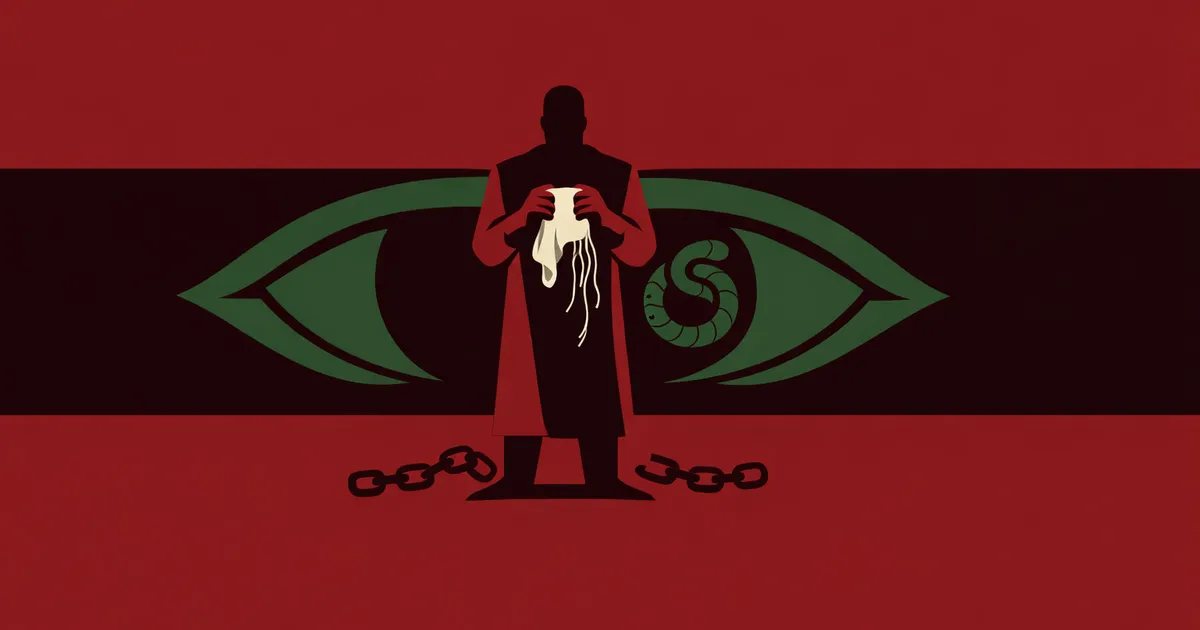
Note the handkerchief's dual life. As an object, it follows a straightforward path: Othello gives it to Desdemona; Desdemona drops it; Emilia picks it up; Iago gets it; Cassio gives it to Bianca. As a symbol, it means completely different things to different characters: for Othello, it represents fidelity and love; for Iago, it's a prop in a deception; for Emilia, it's a way to please her husband; for Bianca, it's evidence that Cassio has another woman. A good thesis would argue that the handkerchief dramatizes how meaning is constructed — the same object can carry any meaning depending on who is looking at it and what story they need it to tell.
The strongest essays on this topic will examine the competing origin stories Othello gives for the handkerchief. In Act III, Scene 4, he tells Desdemona it was given to his mother by an Egyptian charmer — a magical object whose loss means the loss of love. In Act V, he says his father gave it to his mother — a family heirloom without supernatural properties. These contradictions matter. Either Othello is lying in one instance, or Shakespeare is signaling that the handkerchief's meaning is unstable, shifting to match whatever emotional narrative Othello needs at the moment. You could argue that this instability is the point: in a play about how reality is distorted by interpretation, even the central piece of "evidence" turns out to have no fixed meaning. Connect this to the play's epistemological themes — Othello demands "ocular proof," but the handkerchief demonstrates that proof is meaningless without a framework for interpreting it, and frameworks can be manipulated by anyone with sufficient skill and motive.
5. Honest Iago: Trust and Its Consequences
Question: Why does every character in the play trust Iago, and what does their trust reveal about the relationship between honesty and appearance in Shakespeare's world?
Track the use of the word "honest" throughout the play — it appears over fifty times, almost always applied to Iago. Othello calls him honest, Cassio calls him honest, Desdemona calls him honest. No character questions Iago's integrity until the final scene. A thesis might argue that the play exposes the fundamental weakness of social trust: people believe what they see, and Iago understands that the performance of honesty is indistinguishable from honesty itself.
A sophisticated approach would argue that "honest" means different things in different contexts — military bluntness, sexual fidelity, social plainness — and Iago exploits each meaning strategically. With Othello, "honest" means a soldier who speaks uncomfortable truths (so his insinuations about Desdemona seem courageous rather than malicious). With Cassio, "honest" means a loyal friend (so his advice to seek Desdemona's help seems generous). With Desdemona, "honest" means a straightforward man (so his consolation of her in Act IV seems kind). Shakespeare suggests that the concept of honesty is itself a kind of fiction — a social performance that creates the conditions for trust without guaranteeing anything. The play's final irony is that the only truly honest acts — Emilia's revelation of the handkerchief scheme, Desdemona's unwavering fidelity — are either disbelieved or arrive too late. You might conclude that Shakespeare's vision is deeply pessimistic: in a world where performance is indistinguishable from reality, genuine honesty has no special authority.