Themes & Motifs
Jealousy as Self-Destruction
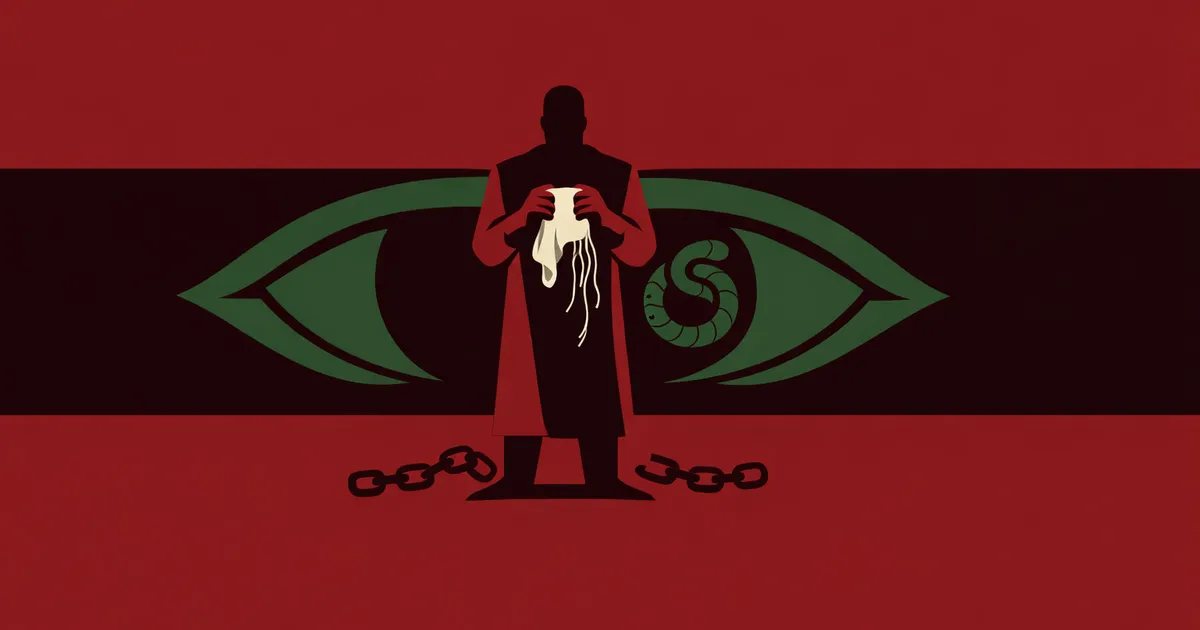
Jealousy in Othello is not a response to evidence — it's a disease that manufactures its own symptoms. Iago describes it as "the green-ey'd monster which doth mock the meat it feeds on," and the metaphor is precise: the monster doesn't just consume its victim, it toys with him. Othello doesn't discover infidelity and then become jealous. Instead, Iago plants a suspicion so small it could be dismissed, and jealousy does the rest — inflating every innocent action into proof, every silence into confession. By Act IV, Othello is interpreting Desdemona's kindness to Cassio as evidence of her guilt, her tears as manipulation, her very beauty as a trap. The jealousy feeds on whatever is placed in front of it, and nothing can satisfy it short of destruction.
What's particularly devastating is that Othello recognizes the danger before he succumbs to it. In Act III, he tells Iago that he won't "make a life of jealousy" — that he'll demand proof and act decisively one way or the other. He sees himself as too rational for jealousy. That self-assurance is precisely what Iago exploits: by the time Othello realizes what's happening to him, the monster already has its teeth in.
Shakespeare structures the play to show jealousy not as an emotion but as an epistemological crisis — a breakdown in how a person interprets the world. Before Iago's intervention, Othello reads reality accurately: he understands the political situation in Venice, assesses military threats correctly, and judges character with reasonable accuracy. After the temptation scene, his interpretive framework collapses. He begins reading innocent events through a lens of suspicion that transforms their meaning entirely. Cassio's quick departure becomes guilty flight. Desdemona's advocacy becomes proof of intimacy. The handkerchief's absence becomes evidence of sexual betrayal.
Emilia provides the play's most incisive commentary on jealousy when she tells Desdemona that "jealous souls will not be answer'd so; / They are not ever jealous for the cause, / But jealous for they are jealous: 'tis a monster / Begot upon itself, born on itself." This description — jealousy as self-generating, needing no external cause — contradicts Othello's belief that his response is rational and evidence-based. Emilia understands what Othello cannot: that jealousy is a prior condition that creates its own evidence, not a rational response to discovered facts. The play validates her analysis completely. Othello's "proofs" — a dream Iago invented, a handkerchief Iago planted, a conversation Othello misheard — are manufactured fictions that jealousy transforms into certainties.
Race, Otherness, and Belonging
Othello is one of the earliest and most complex explorations of race in English literature. Othello is Black in a white society, and Shakespeare never lets the audience forget it. The play opens with racist slurs — Iago's "old black ram," Brabantio's horror that his daughter has gone "to the sooty bosom / Of such a thing as thou." Even the Duke's compliment is backhanded: "Your son-in-law is far more fair than black." Othello exists in a Venice that values him for what he can do (lead armies) while being deeply uncomfortable with who he is.
For the first two acts, Othello navigates this tension with remarkable grace. He responds to insults with dignity, tells his own story with eloquence, and refuses to be reduced to the stereotypes others impose on him. But Iago's manipulation works partly because it activates the racial anxiety that Venice has been whispering all along. When Iago suggests that Desdemona's love for Othello is unnatural — a deviation from "her own clime, complexion, and degree" — he is voicing what Brabantio has already said and what Venetian society already believes.
The play's treatment of race operates on multiple levels that resist simple summary. On one level, Shakespeare constructs Othello as a rebuke to racist stereotypes: he is dignified, eloquent, and morally serious in ways that put the play's white Venetians to shame. On another level, the play dramatizes how those stereotypes can become self-fulfilling prophecies. Iago's strategy depends on pushing Othello toward the very behavior that Venice's racism expects of him — irrationality, violence, uncontrolled passion. When Othello strikes Desdemona in Act IV, Lodovico's shock registers the collapse: the "noble Moor" has become the dangerous Black man that racist Venice always feared he might be.
Othello's own internalization of racial thinking is the play's most psychologically complex element. His soliloquy in Act III — "Haply, for I am black, / And have not those soft parts of conversation / That chamberers have" — reveals a man who has absorbed his society's contempt as self-doubt. He measures himself against a standard of white Venetian masculinity and finds himself wanting. This internalized racism is what makes Iago's lies plausible to Othello: he is already predisposed to believe that Desdemona might prefer a man of her own race and class. Shakespeare does not present Othello's racial vulnerability as weakness — he presents it as the inevitable psychological consequence of living as an outsider in a society that offers conditional acceptance at best. The tragedy is that Othello has spent his life proving himself worthy of that acceptance, and it takes only one determined liar to strip it all away.
Manipulation, Performance, and the Limits of Knowledge
Othello is a play about people performing for each other and the catastrophic consequences of misreading those performances. Iago's entire strategy is a sustained act of theater: he plays "honest Iago," the blunt soldier who speaks uncomfortable truths, so convincingly that every character in the play trusts him. He performs reluctance when planting suspicion. He performs grief when reporting Cassio's brawl. He performs loyalty while engineering destruction. His art is so complete that even at the end, Othello calls him "honest" while describing the man who destroyed his life.
But Iago isn't the only performer. Othello performs composure before the Senate while his marriage is under attack. Desdemona performs cheerfulness in Cyprus while worrying about Othello's ship. Cassio performs sobriety while losing his grip on it. The play is saturated with the gap between appearance and reality, and the characters who survive are those who eventually stop performing — most notably Emilia, who breaks out of her role as obedient wife to tell the truth.
Shakespeare uses the language of performance and spectatorship throughout the play with deliberate precision. Iago is repeatedly described as honest — the word "honest" appears over fifty times in the text — and each repetition deepens the irony. The word becomes meaningless through overuse, which is exactly Iago's point: in a world where everyone performs, honesty is just another performance. His statement "I am not what I am" is the play's thesis in miniature: identity is a mask, and the mask can hide anything.
The eavesdropping scene in Act IV makes this theme literal. Iago stages a conversation for Othello to overhear, directing Cassio to discuss Bianca while Othello believes they're discussing Desdemona. Othello becomes an audience member watching a play-within-the-play, and he misinterprets it completely because he's been given the wrong program. Shakespeare is arguing that knowledge is always mediated — we know what we're told, what we see from our particular angle, what our assumptions allow us to perceive. Iago understands this principle and exploits it ruthlessly. The play's larger epistemological point is that certainty is always a construction, and the person who controls the construction controls the truth. Othello demands "ocular proof" — evidence he can see with his own eyes — and Shakespeare shows that even seeing isn't believing when the viewer's frame of interpretation has been corrupted.
Reputation, Honor, and Male Identity
Reputation in Othello is both everything and nothing, depending on who's talking. Iago tells Cassio that "reputation is an idle and most false imposition, oft got without merit and lost without deserving" — advice designed to manipulate Cassio into seeking Desdemona's help. But Iago himself tells Othello that reputation is "the immediate jewel of their souls," knowing that Othello's sense of honor will make the handkerchief's loss feel like the loss of everything. Iago shifts his philosophy to match his audience, which reveals that he believes in nothing — a nihilism that makes him dangerous because he has no values that can be appealed to.
For Othello, reputation is not abstract. It's the thing that keeps a Black man safe in a white city. His military record is his social passport. When he believes Desdemona has betrayed him, the injury is not merely personal but existential — if his wife has made a fool of him, his entire public identity collapses. Cassio understands this instinctively when he cries out after his disgrace: "Reputation, reputation, reputation! O, I have lost my reputation! I have lost the immortal part of myself."
Shakespeare maps reputation onto gendered terrain in ways that expose the double standards of the play's patriarchal world. For men, reputation is about martial honor and public standing — Othello's "service to the state," Cassio's fitness for command. For women, reputation is exclusively sexual — Desdemona's "honor" means her chastity, and the moment Othello doubts it, she becomes "that cunning whore of Venice" in his mind. There is no female equivalent of military glory in this world; women's reputations exist only as appendages of their sexual relationships with men.
This gendered asymmetry drives the tragedy. Othello's response to perceived cuckoldry is not just emotional but social — he believes he has been publicly humiliated, that the entire island knows ("'Tis the plague of great ones"). The murder of Desdemona is, in his distorted reasoning, an act of justice that restores his honor. He calls it a "sacrifice," not a murder, because he has reframed her death as a public duty rather than a private crime. Shakespeare exposes how honor culture transforms intimate relationships into power struggles where someone must be punished for any perceived transgression. The play does not excuse Othello's violence but it explains the cultural machinery that enables it — a world where a man's identity depends on controlling a woman's body, and where losing that control is understood as worse than death.
The Weaponization of Goodness
One of Othello's most disturbing arguments is that goodness can be turned into a lethal weapon. Iago's plan succeeds not by corrupting good people but by exploiting their virtues exactly as they are. Desdemona's kindness to Cassio is genuine and admirable — she advocates for him because she's compassionate and believes in second chances. Othello's trust in Iago is genuine and admirable — he values honesty and rewards it with confidence. Cassio's respect for Desdemona is genuine and admirable — he greets her warmly because he's courteous and he admires his general's wife. None of these people do anything wrong. Yet the collective effect of their goodness, refracted through Iago's lies, is catastrophe.
Iago articulates this strategy explicitly: "So will I turn her virtue into pitch, / And out of her own goodness make the net / That shall enmesh them all." The image is precise. He doesn't need anyone to behave badly. He just needs to control how their good behavior is interpreted.
This theme reaches its most concentrated expression in Desdemona's persistent advocacy for Cassio. Each time she brings up his name to Othello, she is being a good friend and a generous person. Each time, she is also — unknowingly — adding fuel to Othello's jealousy. Shakespeare constructs the scenes so that Desdemona's pleas become more insistent precisely as Othello's suspicion deepens, creating an agonizing feedback loop: the harder she tries to help, the more damage she does. When she says "His bed shall seem a school, his board a shrift; / I'll intermingle everything he does / With Cassio's suit," the audience winces because they know how Othello will interpret this relentless mention of another man's name.
The play's theological overtones reinforce this theme. Iago describes his own method as "Divinity of hell! / When devils will the blackest sins put on, / They do suggest at first with heavenly shows." Evil in Othello doesn't look evil — it looks like good advice, honest concern, friendly loyalty. This is a deeply pessimistic vision of human social life: if the devil can mimic goodness perfectly, then there is no reliable way to distinguish friend from enemy, sincerity from manipulation. Othello's world is one where the very instincts that should protect people — trust, generosity, willingness to see the best in others — become the means of their destruction. Shakespeare offers no solution to this problem. He simply shows it working, and lets the horror accumulate.