Summary
Overview
Richard II is Shakespeare's study of a king who loses everything — and only begins to understand himself once it's gone. The play follows Richard, an anointed monarch who rules England with extravagance and poor judgment, as he's gradually stripped of his crown, his country, and his life by his politically shrewd cousin, Henry Bolingbroke. What makes Richard fascinating is that he's a terrible king but a brilliant poet; the worse his situation gets, the more eloquent he becomes. Shakespeare gives us a protagonist who can turn his own destruction into some of the most gorgeous verse in the English language, and then asks whether beautiful words are worth anything when you've lost the power to back them up.
The central conflict isn't really a military contest — Bolingbroke's takeover is almost bloodless. The real drama is psychological: Richard's slow, agonized reckoning with what it means to be a king who is no longer king. He clings to the divine right of kingship even as it's being ripped away, and his speeches oscillate wildly between grandiose defiance and abject self-pity, sometimes within the same breath. Meanwhile, Bolingbroke says remarkably little about his own ambitions. He claims he's only returned for his stolen inheritance, but every scene pushes him closer to the throne, and Shakespeare never lets us know for certain whether that was his plan all along.
Richard II holds a unique place in Shakespeare's canon as the opening chapter of the second tetralogy — the sequence of four history plays (Richard II, Henry IV Parts 1 and 2, Henry V) that traces the long political consequences of deposing an anointed king. Everything that follows — Hotspur's rebellion, Falstaff's chaos, Henry V's triumphant reinvention of English kingship — grows from the original sin committed here. The play is also unusual in being written entirely in verse, with no prose scenes at all, which gives it a lyrical, almost operatic quality that sets it apart from the Henry IV plays.
Shakespeare drew heavily on Raphael Holinshed's Chronicles but made deliberate changes that sharpen the dramatic stakes: he aged down Richard, made the Queen an adult rather than the child she historically was, and compressed years of political maneuvering into what feels like weeks. The result is less a chronicle of events than a meditation on political legitimacy. Can a king be deposed if he's God's anointed? Can a usurper rule justly if his claim rests on injustice? The play refuses to answer these questions cleanly — Richard is clearly unfit to govern, but Bolingbroke's seizure of the crown is clearly wrong. That unresolved tension made Richard II politically dangerous in its own time; the Essex faction commissioned a performance of the play the night before their 1601 rebellion, and Elizabeth I reportedly said, "I am Richard II, know ye not that?"
Act I: Accusations and Banishment
Act I establishes the political powder keg that will detonate the rest of the play. Richard presides over a dispute between his cousin Henry Bolingbroke and Thomas Mowbray, Duke of Norfolk. Bolingbroke accuses Mowbray of embezzling royal funds and — more explosively — of orchestrating the murder of their uncle, the Duke of Gloucester. Mowbray denies the charges, and neither man will back down. Richard first tries to reconcile them, then schedules a trial by combat at Coventry. But when the combatants are armed and ready, Richard abruptly halts the fight and banishes both men — Bolingbroke for ten years (later reduced to six) and Mowbray for life. The act ends with Richard coldly noting that Bolingbroke's father, John of Gaunt, is gravely ill, and hoping Gaunt will die soon so Richard can seize his wealth to fund a war in Ireland.
A brief but powerful scene between Gaunt and the Duchess of Gloucester reveals what everyone suspects but no one can say publicly: Richard himself was behind Gloucester's murder. Gaunt refuses to act against the king, insisting that vengeance belongs to God alone when the offender is God's anointed. The Duchess, furious at this passivity, departs to die in grief.
Richard's decision to stop the trial by combat is the first of several moments where his political instincts prove catastrophically wrong. He likely halts the fight because a verdict either way would be dangerous — if Bolingbroke wins, Mowbray might reveal Richard's role in Gloucester's death; if Mowbray wins, Richard loses a popular cousin. Banishing both seems like a solution, but it satisfies no one and creates a martyr in Bolingbroke, whose dramatic farewell to England wins the crowd's sympathy. Richard watches this performance with unease, noting how Bolingbroke courts "the common people" with "humble and familiar courtesy," doffing his cap to oyster-wenches and draymen "as were our England in reversion his." The observation is perceptive — Richard can see the threat — but he does nothing about it beyond petulance.
The Gaunt-Duchess scene (I.ii) is structurally crucial because it establishes the play's deepest anxiety: what happens when the law's ultimate authority is also its greatest violator? Gaunt's argument — that a subject cannot raise a hand against "God's substitute, / His deputy anointed in His sight" — is the same argument Richard will later use to defend himself against Bolingbroke. But the audience already knows that Richard has violated his own sacred office by ordering a kinsman's murder. The divine right of kings, the play suggests from its opening act, may be a principle that protects the unworthy.
Act II: Gaunt's Death and Bolingbroke's Return
Act II opens with one of the play's most famous passages: the dying John of Gaunt's prophetic speech about England as "this sceptered isle... this blessed plot, this earth, this realm." But Gaunt's lyrical patriotism is actually a lament — he's describing what England should be in order to condemn what Richard has made it. When Richard arrives, Gaunt turns his wordplay into a direct attack: "Landlord of England art thou now, not king." Richard responds with fury, and Gaunt is carried out to die offstage. Within moments, Richard seizes Gaunt's entire estate — the inheritance rightfully belonging to the banished Bolingbroke.
The Duke of York, the last surviving uncle, warns Richard that stealing Bolingbroke's inheritance undermines the very principle of hereditary succession that makes Richard king. Richard ignores him, appoints York as regent, and departs for Ireland. Almost immediately, Northumberland, Ross, and Willoughby begin plotting. Northumberland reveals that Bolingbroke is already sailing back to England with three thousand men. Meanwhile, the Queen, left behind, is consumed by a nameless dread she cannot explain. The act closes with the Welsh Captain disbanding his forces, convinced that omens — withered bay trees, bloody moons, fearful meteors — signal Richard's fall. Salisbury watches the allies scatter and sees Richard's glory "like a shooting star / Fall to the base earth from the firmament."
Richard's seizure of Gaunt's estate is the play's point of no return. York's warning is both legally precise and politically prophetic: "Take Hereford's rights away, and take from Time / His charters and his customary rights; / Let not tomorrow then ensue today; / Be not thyself; for how art thou a king / But by fair sequence and succession?" York is telling Richard that hereditary right is not a principle you can invoke selectively — if you can steal an heir's inheritance, then any heir's inheritance can be stolen, including the crown itself. Richard's inability to hear this argument reveals his fatal weakness: he believes divine right operates independently of political reality, that being God's anointed exempts him from the rules that bind everyone else.
The structural contrast between Richard's departure for Ireland and Bolingbroke's arrival in England is deliberate. Richard leaves the stage, and the political vacuum immediately fills. Shakespeare never shows us Bolingbroke deciding to come back for the crown — he says he's come only "for Lancaster," to reclaim his inheritance. Whether this is sincere or strategic ambiguity is one of the play's great interpretive puzzles. York, left to manage an impossible situation, embodies the agony of a man caught between two legitimate claims: "Both are my kinsmen. / Th' one is my sovereign, whom both my oath / And duty bids defend; th' other again / Is my kinsman, whom the King hath wronged."
Act III: Richard's Fall
Bolingbroke consolidates power rapidly. He executes Bushy and Green — Richard's favorites whom he accuses of corrupting the king and mistreating the queen — and moves toward Flint Castle, where Richard has taken refuge after returning from Ireland to find his Welsh support evaporated and his uncle York siding with Bolingbroke.
Act III contains Richard's most extraordinary speeches. Returning to English soil, he greets the earth like a mother reuniting with her child, commanding it to produce spiders and nettles against his enemies. When Salisbury reports the Welsh army's desertion, Richard's confidence collapses almost instantly: "For God's sake, let us sit upon the ground / And tell sad stories of the death of kings." This speech — the "death of kings" soliloquy — is one of the great set pieces in Shakespeare, a meditation on the hollow crown in which "Death his court" keeps, "scoffing his state and grinning at his pomp." At Flint Castle, Bolingbroke kneels and claims he wants only his inheritance, but Richard reads the situation clearly: "What you will have, I'll give, and willing too; / For do we must what force will have us do."
The act ends with the remarkable garden scene (III.iv), where a Gardener and his servants use the metaphor of tending a garden to discuss Richard's failures as king. The Queen, overhearing, curses the Gardener for speaking the truth.
Richard's transformation in Act III is the emotional center of the play. He arrives from Ireland still claiming divine protection — "Not all the water in the rough rude sea / Can wash the balm off from an anointed king" — and within a hundred lines, he's sitting on the ground contemplating mortality. The speed of this collapse is the point. Richard has always located his identity entirely in the idea of kingship rather than its practice, so when the idea cracks, there's nothing underneath to hold him up. His "death of kings" speech is not just beautiful self-pity; it's a genuine philosophical insight. Richard sees, perhaps for the first time, that the "hollow crown / That rounds the mortal temples of a king" is a prop, and that the king inside it "live[s] with bread like you, feel[s] want, / Taste[s] grief, need[s] friends."
The garden scene functions as a political allegory delivered by characters who have no political power. The Gardener's comparison — a well-tended garden versus Richard's neglected kingdom — is pointed but also compassionate. He calls Richard "the wasteful King" but plants rue "in the remembrance of a weeping queen." Shakespeare gives the clearest political analysis in the play to a working man, not a lord, suggesting that common sense can see what courtly rhetoric obscures.
Act IV: The Deposition
Act IV is a single long scene in Westminster Hall where Richard is brought before the assembled lords to formally resign the crown. Before Richard enters, the lords quarrel over who was responsible for Gloucester's death, throwing down gages in a near-farcical cascade. The Bishop of Carlisle delivers a passionate speech against deposing an anointed king, prophesying that England will become "the field of Golgotha and dead men's skulls" — a prophecy that will come true across Shakespeare's next three history plays. Northumberland arrests Carlisle for treason.
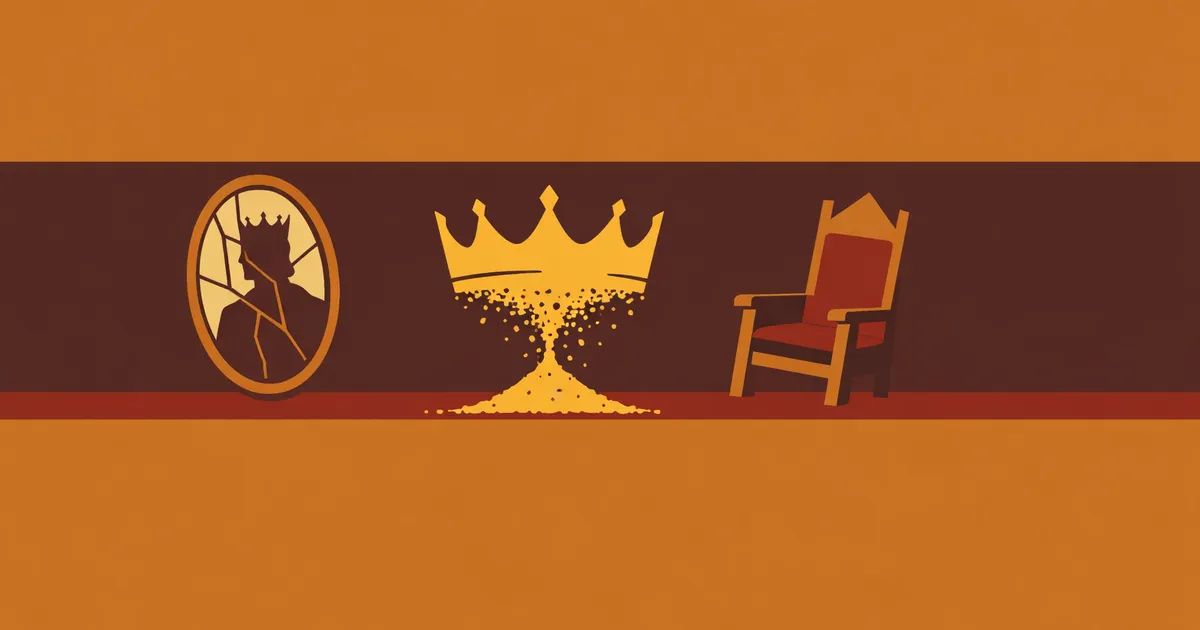
When Richard finally appears, he transforms what should be a bureaucratic transfer of power into an elaborate performance of grief. He holds the crown between himself and Bolingbroke, compares them to two buckets in a well — one rising as the other sinks — and methodically "undoes" himself: "With mine own tears I wash away my balm, / With mine own hands I give away my crown, / With mine own tongue deny my sacred state." When Northumberland presses him to read a list of his crimes, Richard instead calls for a mirror, gazes at his own face, and then shatters the glass on the ground. Bolingbroke, characteristically terse, observes that the "shadow of your sorrow hath destroyed / The shadow of your face" — and Richard seizes even this as material for further self-analysis.
The deposition scene is Richard's greatest performance precisely because it is a performance. He cannot prevent Bolingbroke from taking the crown, but he can control the narrative of how it happens. By turning the ceremony into a spectacle of suffering, Richard forces every lord in the room to witness — and thereby become complicit in — the destruction of an anointed king. His comparison of himself to Christ betrayed by Judas is audacious and self-aggrandizing, but it lands: "Did they not sometime cry 'All hail!' to me? / So Judas did to Christ." The mirror scene crystallizes the play's obsession with the gap between appearance and reality. Richard asks whether his face shows the suffering he feels, discovers it does not, and breaks the glass — destroying the "brittle glory" of a reflection that told him comfortable lies.
Bolingbroke's role in this scene is revealing for what he doesn't say. He speaks in short, practical sentences — "Are you contented to resign the crown?" — while Richard spins elaborate conceits around him. This contrast might suggest that Bolingbroke is the pragmatic realist and Richard the self-indulgent poet, but Shakespeare complicates that reading. Bolingbroke's brevity could also be read as discomfort: he knows what he's doing is wrong, and he has no language for it. Richard, by contrast, has too much language — he can articulate his own destruction with devastating precision but cannot prevent it. The scene leaves the audience with an unresolvable question: is Richard more admirable for turning loss into art, or more pathetic for using art as a substitute for action?
Act V: Prison and Murder
The final act scatters the action across multiple locations, tracking the consequences of the deposition. Richard and his Queen share a farewell scene of aching tenderness before being separated — he to Pomfret Castle, she to exile in France. Richard prophesies to Northumberland that the alliance between him and Bolingbroke will collapse: "The time shall not be many hours of age / More than it is ere foul sin, gathering head, / Shall break into corruption." This prophecy, too, will prove accurate across the Henry IV plays.
A domestic scene at the Duke of York's household turns from comedy to crisis when York discovers that his son Aumerle is part of a conspiracy to assassinate King Henry at Oxford. York rides to warn the king; the Duchess rides after him to beg her son's pardon. The scene at Windsor, with York demanding punishment while the Duchess kneels and pleads, has an almost farcical energy — Henry himself notes, "Our scene is altered from a serious thing, / And now changed to 'The Beggar and the King'" — but it ends with genuine mercy: Henry pardons Aumerle while ordering the other conspirators hunted down.
Richard's prison soliloquy at Pomfret (V.v) is the play's final meditation on identity, language, and time. Alone, he tries to populate his cell with thoughts, playing king and beggar alternately until he arrives at a bleak conclusion: "Nor I nor any man that but man is / With nothing shall be pleased till he be eased / With being nothing." A groom visits, telling Richard that Bolingbroke rode his beloved horse Barbary at the coronation. Then Exton arrives with armed men. Richard fights back — killing two attackers before Exton strikes him down — and dies declaring, "Mount, mount, my soul! Thy seat is up on high, / Whilst my gross flesh sinks downward, here to die."
The play ends with Henry receiving Richard's corpse and repudiating Exton: "I hate the murderer, love him murdered." Henry vows a pilgrimage to the Holy Land to wash the guilt from his hands — a voyage he will never complete.
Richard's prison soliloquy represents the logical endpoint of the self-examination that has been the play's dominant mode since Act III. Stripped of crown, kingdom, wife, and freedom, Richard is finally alone with the one thing he has left: his mind. The speech is an attempt to create a world through language — "My brain I'll prove the female to my soul, / My soul the father, and these two beget / A generation of still-breeding thoughts." But even this private world offers no peace. His thoughts of divinity produce theological contradictions; his thoughts of ambition are defeated by prison walls; his thoughts of contentment dissolve into awareness that contentment itself is a delusion. The soliloquy is Shakespeare's most sustained exploration of a consciousness with nothing left to be conscious of except itself.
Richard's death, when it comes, is unexpectedly violent and brave. The same man who surrendered his crown without physical resistance kills two of Exton's men before being struck down. This final burst of action has been read as Richard finally becoming the warrior-king he never was — too late, and in a context where courage changes nothing. Henry's response to the murder — accepting the political benefit while rejecting the murderer — establishes the pattern of guilty pragmatism that will define his reign. His promise to visit the Holy Land becomes the unfulfilled wish that haunts the Henry IV plays. The cycle of political violence that began with Gloucester's murder and continued through Richard's deposition now extends to Richard's own assassination, and Shakespeare's closing image — a king mourning over a coffin he ordered filled — is the play's final portrait of power's moral cost.