Themes & Motifs
The Divine Right of Kings and Its Limits
Richard II is built around a question that had no safe answer in Elizabethan England: can a divinely anointed king be legitimately deposed? Richard claims his authority comes directly from God — "Not all the water in the rough rude sea / Can wash the balm off from an anointed king" — and under the political theology of Shakespeare's time, he's right. Coronation anointing was a sacrament. To depose an anointed king was, in theory, to defy God. But the play also shows, with brutal clarity, that divine right doesn't make a king competent. Richard murders his uncle, steals his cousin's inheritance, bankrupts the treasury, and alienates every ally he has. If God protects bad kings, then divine right protects injustice.
Shakespeare sets up the strongest possible case for both sides and refuses to arbitrate. The Bishop of Carlisle's speech against the deposition is passionate and prophetically accurate — England will suffer decades of civil war. But Carlisle is arrested for saying it, and the play offers no mechanism for holding a sacred king accountable short of rebellion. Gaunt articulates the paralysis directly in Act I: since the king who ordered Gloucester's murder is "God's substitute, / His deputy anointed in His sight," revenge must be left to heaven. The audience watches heaven do nothing.
The divine right argument in Richard II operates on two levels simultaneously. On the surface, it's a political doctrine — the claim that monarchs derive their authority from God and cannot be judged by subjects. But Shakespeare also treats it as a psychological phenomenon: divine right is something Richard believes about himself, and that belief shapes his behavior in specific, damaging ways. Because Richard locates his identity entirely in his anointed status, he never develops the practical skills of governance. Why learn to manage nobles or balance budgets when God guarantees your throne? The moment that guarantee is tested — when Bolingbroke arrives with an army — Richard has nothing to fall back on.
The play's most sophisticated treatment of divine right comes through York's warning in Act II. When York tells Richard, "How art thou a king / But by fair sequence and succession?" he's pointing out that divine right and hereditary right are entangled. Richard's crown rests on the principle that inheritance is sacred — the same principle he violates by seizing Gaunt's estate from Bolingbroke. York is saying, essentially, that you cannot invoke a principle selectively. If the king can override hereditary right when it suits him, then hereditary right cannot protect the king when it doesn't. This argument is more dangerous than Bolingbroke's army, because it turns Richard's own legitimating principle against him. Richard ignores it, which tells us something important about how divine right functions psychologically: it's not a reasoned position but an article of faith, and faith doesn't respond to logic.
Identity and the Performance of Kingship
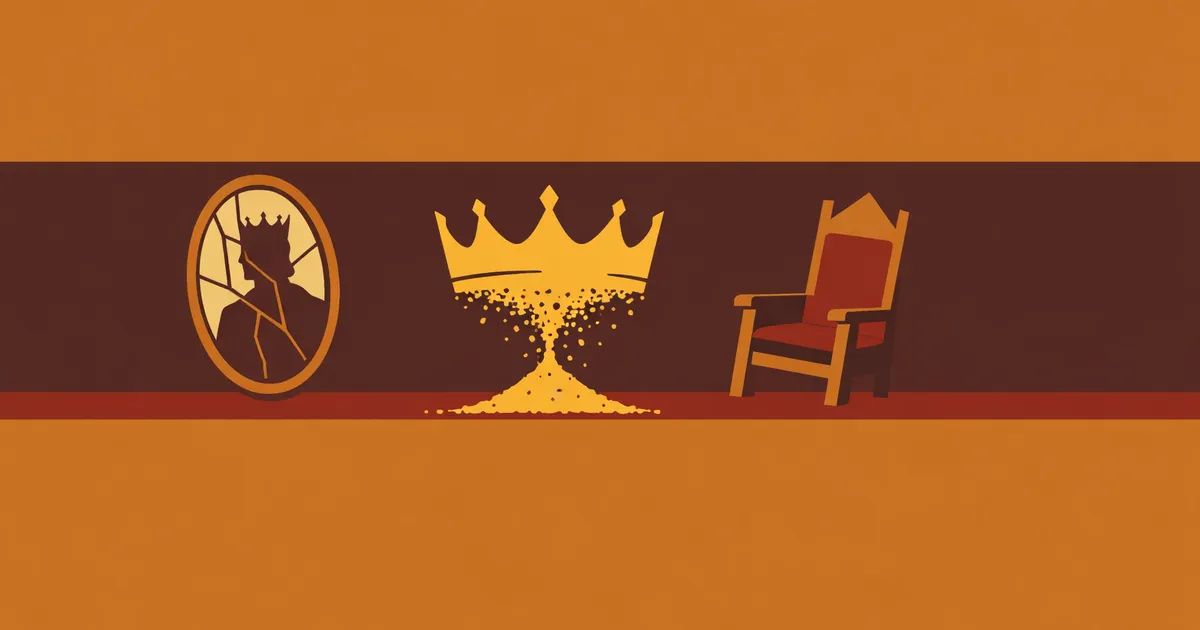
The play obsessively asks what a king is when you strip away the trappings of kingship — the crown, the sceptre, the ceremonies, the title. Richard's answer keeps shifting. In Act III, he insists that "the King's name" is worth "twenty thousand names." By the end of the same act, he's asking, "How can you say to me I am a king?" In Act IV, he systematically undoes every marker of his royal identity — washing away his balm, giving away his crown, denying his sacred state — and then stares into a mirror to see what's left. The answer, he discovers, is a face that looks the same as it always did. Nothing visible has changed, but everything has.
This crisis of identity isn't just personal; it's philosophical. If Richard is no longer king, then what was the thing that made him king? Was it the anointing oil? The crown? The obedience of his subjects? All of these have been removed, but Richard — the person, the consciousness — remains. The play suggests that kingship is fundamentally performative: it exists only as long as everyone agrees to treat it as real.
Shakespeare structures Richard's identity crisis through a series of mirror images and doubles. The deposition scene makes this literal when Richard calls for an actual mirror, but the doubling operates throughout the play. Richard and Bolingbroke are cousins, both grandsons of Edward III, both with plausible claims to authority — one by anointing, the other by competence. The play repeatedly places them in parallel positions: both make ceremonial gestures (Richard with his mirror, Bolingbroke with his knee), both compare themselves to natural elements (Richard to the sun, Bolingbroke to water), and both end the play trapped by their own choices (Richard in prison, Bolingbroke in guilt).
The bucket metaphor in Act IV captures this doubling perfectly: "Now is this golden crown like a deep well / That owes two buckets, filling one another, / The emptier ever dancing in the air, / The other down, unseen, and full of water." Richard's rise as a poet-philosopher is inseparable from his fall as a political actor. The more he loses in the material world, the more he gains in the world of language and self-knowledge. The play's darkest suggestion is that these two gains are causally connected — that genuine insight into the human condition may require the destruction of everything that insulates you from it. Richard begins to understand himself only after he has lost every external marker of who he was supposed to be.
Language as Power and Consolation
Richard II is Shakespeare's most language-obsessed play, and its characters know it. Words in this play are not neutral instruments of communication — they are weapons, props, spells, and substitutes for action. Richard tries to conjure military protection through rhetoric ("Is not the King's name twenty thousand names? / Arm, arm, my name!"). Gaunt tries to console Bolingbroke with linguistic tricks ("Think not the King did banish thee, / But thou the King"). Bolingbroke rejects verbal consolation entirely ("O, who can hold a fire in his hand / By thinking on the frosty Caucasus?"). Each character's relationship to language reveals something fundamental about who they are.
The play's central irony is that the character with the most powerful language has the least political power, and vice versa. Richard's speeches grow more magnificent as his situation deteriorates; Bolingbroke's speeches remain terse and functional as his power increases. By the deposition scene, Richard can fill the stage with dazzling conceits about crowns and mirrors and buckets while Bolingbroke can barely manage a complete sentence. Who, the play asks, is actually winning this exchange?
The relationship between language and power in Richard II inverts the usual Shakespearean pattern. In most of Shakespeare's plays, the most articulate characters are also the most powerful — think of Henry V's Agincourt speech or Prospero's command over language and nature simultaneously. Richard II breaks this equation. Richard's eloquence is explicitly compensatory: he finds words because he has lost everything else. "I'll give my jewels for a set of beads, / My gorgeous palace for a hermitage, / My gay apparel for an almsman's gown" — the beauty of this catalogue depends on the loss it describes. Remove the loss, and the language has no material.
Bolingbroke's silence operates as its own form of power. By speaking as little as possible, he avoids committing himself to positions that might later prove inconvenient. His most revealing linguistic moment comes when he tells Richard, "The shadow of your sorrow hath destroyed / The shadow of your face." This is the play's single most intellectually aggressive line — Bolingbroke is telling Richard that his grief is an act, that even his suffering is performative. It's also one of the few moments where Bolingbroke meets Richard on linguistic grounds, and significantly, Richard is so startled that he seizes the phrase and turns it over, fascinated: "Say that again." For one instant, the man of action has out-argued the man of words, and both of them know it.
England as a Body Under Threat
The play treats England itself as a character — a living entity that can be nurtured or neglected, healed or wounded. Gaunt's "sceptered isle" speech personifies England as a garden, a fortress, a womb. The garden scene in Act III makes the metaphor explicit: the Gardener tends his plot with the care Richard should have given the kingdom, and the neglected garden becomes an image of political decay. Richard addresses the English earth as a mother when he returns from Ireland; Bolingbroke promises to water it with blood if his demands aren't met.
This motif gives the political conflict a visceral, bodily dimension. Deposing a king isn't just a legal event — it's a wound to the land itself. Carlisle's prophecy that England will become "the field of Golgotha and dead men's skulls" treats the country's future suffering as a physical consequence of political sin, as if the earth itself will bleed.
The garden scene (III.iv) is the play's most concentrated use of the England-as-body motif, and its placement is deliberate. It comes immediately after Richard's surrender at Flint Castle, when the audience needs a moment to process what has happened. Shakespeare gives that processing to characters who are completely outside the political class — a gardener and his servants. Their analysis is sharper than anything the nobles produce: "He that hath suffered this disordered spring / Hath now himself met with the fall of leaf." The Gardener compares good governance to horticultural practice — pruning excess growth, rooting out parasitic weeds, wounding the bark to prevent "too much riches" from causing the tree to "confound itself." This is the political wisdom Richard never learned, expressed in terms any audience member would understand.
The motif also connects to the play's blood imagery. England is repeatedly described as a body whose blood is being spilled: Bolingbroke threatens to "lay the summer's dust with showers of blood / Rained from the wounds of slaughtered Englishmen." Richard's murder at Pomfret becomes the literal wounding of England's body politic — the king's blood stains "the King's own land." Henry's closing vow to wash "this blood off from my guilty hand" with a pilgrimage to the Holy Land acknowledges that the body has been damaged. The pilgrimage is also a confession that the damage cannot be undone domestically — purification requires leaving England entirely, as if the land itself has been contaminated by what happened on it.
Time and Its Destructive Power
Time in Richard II is not a neutral backdrop — it's an active force that destroys, judges, and exposes. Gaunt's dying speech frames Richard's reign as a race against time that Richard is losing: "His rash fierce blaze of riot cannot last, / For violent fires soon burn out themselves." Richard's most famous prison line — "I wasted time, and now doth time waste me" — presents time as a reciprocal relationship: neglect time, and time will neglect you. The Welsh Captain's omens — "these signs forerun the death or fall of kings" — treat time as something that announces its intentions through natural phenomena, as if the universe itself keeps a political calendar.
Characters experience time differently depending on their power. For Bolingbroke, exiled for six years, each winter feels like ten. For Gaunt, watching his son banished, the remaining years of his life compress into nothing — "My oil-dried lamp and time-bewasted light / Shall be extinct with age and endless night." For Richard in prison, time becomes a clock he embodies: "My thoughts are minutes, and with sighs they jar / Their watches on unto mine eyes."
Shakespeare uses Richard's relationship with time to track his psychological disintegration. In Acts I and II, Richard acts as if time is irrelevant — he can banish a rival for a decade, seize an inheritance, and leave the country at a moment's notice because he assumes his power is timeless. The phrase "time-honoured Lancaster" in the play's opening line already contains an irony Richard doesn't see: Gaunt is honored by time, but Richard treats time as something he can override. The pivot comes in Act III, when Richard discovers that time has been moving without him. The Welsh army disbanded "one day too late"; York switched sides while Richard was crossing the sea. Richard's entire political collapse happens during a temporal gap — the time between his departure for Ireland and his return.
Richard's prison soliloquy transforms time from a political theme into an existential one. He imagines himself as a clock — his thoughts are minutes, his sighs mark the hours, his groans strike the bell of his heart. But the clock metaphor reveals a deeper insight: "my time / Runs posting on in Bolingbroke's proud joy, / While I stand fooling here, his Jack o' the clock." A "Jack o' the clock" is the mechanical figure that strikes the hours — Richard has become an automaton, marking time he no longer controls. The image is precise and devastating: a king reduced to a machine, ticking away in someone else's kingdom. It's also Shakespeare's most explicit statement about the relationship between power and temporality. To have power is to make time serve you; to lose power is to discover that time was never yours to begin with.