Summary
Overview
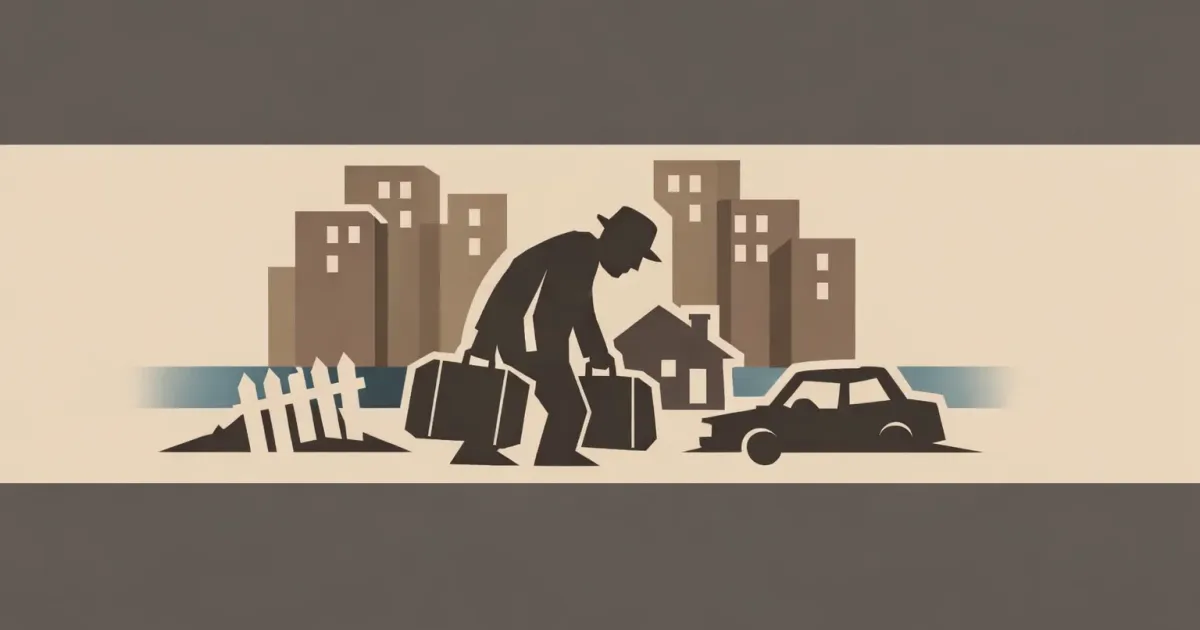
Death of a Salesman is Arthur Miller's 1949 tragedy about Willy Loman, a sixty-something traveling salesman from Brooklyn who is running out of road. Over the span of about twenty-four hours, Willy cracks open. He can't finish a sales trip, can't pay the last few bills, can't stop arguing with his grown son Biff, and can't keep the past from bleeding into the present. The play is set in a New York of the late 1940s that has closed in on the Lomans — apartment buildings loom over their small house, the elms Willy used to love are gone, and the cheerful certainties he sold himself thirty years ago don't match anything outside his front door.
The central conflict is between Willy and Biff, the once-golden high-school football star who flamed out and never recovered. Willy needs Biff to become the success he always promised, and Biff, home from another failed stretch out West, needs Willy to finally let him off the hook. Orbiting them are Linda, Willy's wife, who protects her husband's illusions with ferocious tenderness; Happy, the younger son, a lothario and corporate hanger-on who swears he'll make good; Charley, the plain-spoken neighbor who keeps Willy afloat with fifty-dollar loans; and the ghost of Willy's older brother Ben, who strides in and out of Willy's mind carrying the memory of a fortune made in the African jungle. Miller built the play out of those shifting layers — kitchen, bedroom, past, present, dream — so that by the end, an audience has watched Willy's mind collapse from the inside.
The play has lasted because it put an ordinary man in the place usually reserved for kings. Miller argued, in an essay published alongside the premiere, that the common man was as fit a subject for tragedy as any monarch, and Willy Loman became the proof. Salesmen, teachers, middle managers, retirees watching their pensions shrink — audiences kept recognizing him. The play is also, bluntly, an indictment of the American Dream as a sales pitch: the promise that being "well liked" and working hard will automatically produce a house, a car, two successful sons, and a dignified old age. Willy believed the pitch his whole life. The play is about what happens when the pitch turns out to be a lie, and the salesman who sold it to himself has to live with the bill.
Miller originally wanted to call the play The Inside of His Head, and that working title is a better guide to its form than the final one. Rather than stage events in order, Miller cuts between a realist present and Willy's involuntary memories, with scene changes triggered by a stray phrase, a flute motif, or the appearance of a figure who stepped out of 1928. The stage directions specify a house that is partly transparent, with characters obeying wall-lines in the present but walking through them in the past. This was not a flourish. It was a formal solution to the problem of dramatizing a mind that has stopped being able to hold past and present apart. When Ben arrives onstage carrying a valise, Willy is both in his kitchen with Charley and back on the porch with his long-dead brother. The audience experiences dementia, or something close to it, from the inside.
Placed in Miller's body of work, Death of a Salesman sits between the compact social realism of All My Sons (1947) and the historical allegory of The Crucible (1953). It borrows Ibsen's method of excavating a family's buried guilt across a single day and marries it to an expressionist vocabulary Miller likely absorbed from Tennessee Williams and Elia Kazan, who directed the original production. The result was the first American tragedy to win the Pulitzer Prize, the Tony, and the New York Drama Critics' Circle Award in the same season, and it permanently widened the definition of tragic protagonist in the English-language theater. Charley's eulogy in the Requiem — "A salesman is got to dream, boy. It comes with the territory" — is often quoted as the play's moral center, but the line only lands because Miller has spent two acts showing what the dream costs when the territory itself has changed underneath the man still walking it.
Act One
The play opens at night. Willy has come home early from a sales trip to New England, unable to make it past Yonkers — he keeps drifting off the road, lost in memory. Linda coaxes him into the kitchen and urges him to ask his young boss, Howard Wagner, for a non-traveling job in New York. Upstairs, their grown sons are visiting: Biff, thirty-four, back from a ranch out West, and Happy, two years younger, working a dead-end job in the city. Listening to Willy mutter downstairs, they trade memories of their father's greatness and hatch a loose plan — Biff will ask a former employer, Bill Oliver, to back him in a sporting-goods business, and Happy will throw in with him. Downstairs, Willy's mind slips. The kitchen dissolves and suddenly it is fifteen years earlier: the boys are teenagers, simonizing the red Chevy, Biff has just captained the football team, and Willy is promising them the world. The boy next door, Bernard, pleads with Biff to study for his math Regents. Willy brushes him off — Bernard may get the grades, but Biff is "well liked." A gentler memory curdles into a darker one: the faint laughter of a woman in a Boston hotel room bleeds through, and Willy, shaken, resurfaces in the present to find Charley at the kitchen table offering him a card game and a job. Willy refuses the job, insults Charley, and then hallucinates his dead brother Ben striding in with an umbrella and a fortune. When he was seventeen, Ben says, he walked into the jungle; when he was twenty-one he walked out, and he was rich. The act closes with Linda confronting her sons: Willy has been trying to kill himself. She has found a short length of rubber pipe in the cellar, with a new gas nipple fitted to the water heater. She demands they treat their father with respect. Biff, chastened, agrees to see Oliver in the morning. Willy, buoyed by the restaurant plan the boys have floated, goes to bed talking about the bright future ahead.
Act One establishes the play's dual timeline and, more importantly, establishes which memories Willy is still able to access and which he is censoring. The kitchen present is shabby and cramped; the past is green, summery, full of promise. Miller uses lighting — "leaves" projected over the house — to mark the shift, and the flute motif returns whenever Willy's father or the frontier past surfaces. That contrast is the engine of Willy's delusion: his best self lives in a backyard that no longer exists. Notice what he will not let himself remember. Boston is a flicker, quickly suppressed. The laughter of the Woman is already intruding, but Willy folds it back into a memory of Linda mending stockings, and the act moves on. This is the play's central dramatic irony: the audience knows before Willy consciously does that some specific wound in Boston is the hinge on which Biff's life turned. Act One dangles it without naming it.
The act also plants the play's three escape hatches and quietly shows that Willy has been reaching for each. Ben offers the fantasy of frontier wealth — Alaska, Africa, diamond mines — an exit Willy turned down decades ago and can now replay only as regret. The rubber hose Linda discovers is the exit he is secretly preparing. And the Oliver pitch that Biff and Happy cook up is the exit Willy latches onto with almost manic hope: if the boys can still make good, he does not have to. By ending the act on that shared illusion, Miller sets up the structural symmetry Act Two will demolish. Every hope is placed on the table so it can be knocked off.
Act Two
The next morning opens bright and false. Willy eats breakfast in the kitchen with Linda, buoyant about the day ahead. She tells him Biff and Happy want to take him to dinner at Frank's Chop House that night. Willy leaves to see Howard Wagner and ask to be taken off the road. The meeting is a quiet disaster. Howard, distracted by his new wire recorder and a reel of his young daughter reciting the state capitals, barely listens; Willy loses his composure, invokes the legendary old salesman Dave Singleman, who died "the death of a salesman" in his green velvet slippers with buyers from a dozen states at his funeral, and ends up fired. Reeling, he visits Charley's office to borrow money. In the waiting room he meets Bernard, now a grown lawyer on his way to argue a case before the Supreme Court, and finally asks the question that has haunted him for years: what happened in Boston that summer that made Biff quit? Bernard remembers it exactly. Biff had flunked math, was planning to retake the course, and then came back from a trip to see Willy in Boston and gave up on school for good. He burned his sneakers lettered "University of Virginia" in the basement furnace. Willy deflects. Charley comes out, gives him fifty dollars — and, when Willy admits he cannot even pay his insurance, writes him a check for the shortfall and offers him a job again. Willy, too proud, refuses.
At Frank's Chop House, Happy has already sweet-talked a young woman named Miss Forsythe into joining them, and soon a friend of hers named Letta. Biff arrives shattered. He waited six hours to see Bill Oliver; Oliver did not remember him and walked past without recognition; on impulse, in the empty office afterward, Biff stole Oliver's fountain pen. He has come to the restaurant to finally tell his father the truth about who he is and is not. Willy, terrified of the truth, refuses to hear it. The restaurant dissolves into memory — the Boston hotel room, young Biff on his way up to surprise his father, the laughter of the Woman in the bathroom, Biff at the door understanding what he is seeing, Willy pleading, the Woman walking out clutching the new stockings Willy had given her instead of sending them home to Linda. Happy, embarrassed, tells the girls that Willy is "not my father — he's just a guy," and leaves with them. Biff runs out after his father. When Willy surfaces from the flashback, he is alone in the restaurant bathroom, his sons gone. Stanley the waiter steadies him on his way out the door. He makes his way home carrying a packet of seeds and, in a moonlit backyard scene, tries to plant carrots and lettuce by flashlight while holding a last imagined consultation with Ben. The twenty-thousand-dollar life-insurance policy, he tells Ben, would give Biff the capital he has never been able to give him in life. Biff comes out to say goodbye. The argument that follows is the fight the whole play has been circling. Biff confesses he is a "dime a dozen" and so is Willy; he shoves the rubber hose in Willy's face; he breaks down sobbing in his father's arms. Willy is stunned into a different kind of delusion — that boy, he marvels, is going to be magnificent. Alone in the kitchen he speaks aloud to Ben, decides on the sacrifice, and drives the car away at full speed. A crash, a cello string, and the Requiem begins. At the graveside, only the family, Charley, and Bernard are present; no customers, no old accounts. Linda cannot cry. She has made the last payment on the house and does not understand why the man it was built for is not there. Biff says his father "had the wrong dreams. All, all wrong." Happy, refusing to accept it, vows to stay in the city and win for him. Charley, quietly, delivers the play's defense of the man they are burying: nobody, he says, is allowed to blame this man. Linda kneels by the grave and tells Willy, again and again, that they are free and clear.
Act Two is organized as a sequence of doors closing. Howard closes the door on Willy's career. Bill Oliver closes the door on Biff's fantasy. Bernard, simply by being successful, closes the door on Willy's theory that being "well liked" is what matters. The Boston flashback, finally released from suppression, closes the door on Willy's version of himself as a good father — and because Miller has delayed that revelation until the restaurant scene, the betrayal lands with the force of something Willy has been running from for the entire play. Structurally, the most important dramatic choice in the act is that Miller collapses Willy's professional, paternal, and psychic failures into a single afternoon. Being fired and losing Biff become the same event, because in Willy's value system a son's success is the only commission that finally matters.
The ending splits the play's meaning across four voices, and Miller refuses to rank them. Happy, tragically, learns nothing: he has watched his father die for a dream and responds by recommitting to it. Biff, for the first time, can name what went wrong — his father never knew who he was. Linda, who has loved Willy more clearly than anyone, still cannot find a framework for what he did; her repeated "We're free" is the play's most devastating line, because the freedom she is describing is financial, and her husband is the price. Charley gives the eulogy that has become the play's signature, but it is worth hearing what he actually argues: a salesman lives on a smile and a shoeshine, and when the world stops smiling back, there is nothing to break the fall. The Requiem does not redeem Willy; it refuses to condemn him. Miller wanted the ordinary man taken seriously as a tragic figure, and the form of the ending — a funeral with almost no mourners, a widow who cannot cry, a son who understands and a son who does not — is his argument that the stakes of an ordinary life are as high as any king's.