Themes & Motifs
The American Dream as a Sales Pitch
Miller's most famous theme is not simply that the American Dream fails — it's that the Dream is itself a product, and Willy Loman is both its salesman and its most loyal customer. The version Willy has internalized is specific and period-shaped: the postwar promise that a personable man with a smile, a shoeshine, and the right contacts will earn a house, a car, and two sons headed for greater things than his own. Willy has been selling that package his entire life, first to clients on the New England road and then, more fatally, to himself. When it turns out the package was oversold, he does not lose faith in the pitch. He loses faith in himself for failing the pitch.
The play's clearest shorthand for this is Willy's obsession with being "well liked." He tells Biff that Bernard can get the grades, but "the man who creates personal interest is the man who gets ahead." Personality, in Willy's gospel, is the lever that moves the world. By Act Two, the world has stopped responding to the lever, and the gospel has become a trap — Willy cannot abandon it without admitting he gave his life to a mistake.
Miller layers the theme across three generations so that no one character has to carry it alone. Willy's father, glimpsed only through Ben's recollection, was an itinerant flute-maker whose fortune came from frontier mobility — walking into wilderness and pulling something out of it. Ben inherits a cruder version: "I walked into the jungle, and when I was twenty-one I walked out. And by God I was rich." Willy, stranded between frontier and skyscraper, translates that inheritance into a salesman's version: the jungle becomes New England, the machete becomes a shoeshine, and the diamonds become commissions. The ideological move is subtle but crucial. The Dream Willy believes in is already a domesticated, corporate rewrite of the older one, and the play's horror is that even the domesticated version no longer pays.
The scene with Howard Wagner exposes the sales pitch as a sales pitch. Willy invokes Dave Singleman, the old salesman who "could go, at the age of eighty-four, into twenty or thirty different cities, and pick up a phone, and be remembered and loved and helped by so many different people." Singleman's green-velvet-slippered death among friendly buyers is Willy's secular heaven. Howard's reply — a soft, distracted firing conducted while he fiddles with a wire recorder — is Miller's answer: the salesman-as-beloved-figure was always a sentimental story, and the postwar corporation has no use for sentimental stories. The wire recorder is a small technological miracle that will, over the next two decades, make Willy's entire profession obsolete. Miller stages it as a toy Howard will not put down.
The Requiem finishes the argument without moralizing. Charley's eulogy — "A salesman is got to dream, boy. It comes with the territory" — is usually read as a defense of Willy, and it is, but read closely it also concedes the indictment. A salesman is required to dream; the territory demands it; therefore the dream is not a personal aspiration but an occupational cost of doing business. Capitalism sold Willy a product called optimism, charged him interest on it for forty years, and repossessed everything at the end. Biff, alone among the mourners, has figured this out. "He had the wrong dreams," he says. The tragedy is not that Willy failed to achieve the Dream. It's that the Dream, as sold, could never have been achieved by anyone Willy's size.
Being Well Liked vs. Being Good at Something
Running underneath the American Dream theme is a sharper, smaller argument about what actually produces a life worth having. Miller stages a quiet competition throughout the play between two theories of success. Willy's theory is that personality wins — charm, appearance, the firm handshake, the ability to make buyers smile. The competing theory, embodied by Charley and Bernard, is that competence wins — knowing the math, learning the trade, doing the work whether anyone notices or not. For most of Act One, Willy is confident that his theory is right and that Charley's is the consolation prize of men too dull to understand how the world really operates.
Act Two is the cold rebuttal. Bernard, the "anemic" boy Willy mocked for studying too hard, is now a lawyer arguing a case before the Supreme Court and does not feel the need to mention it. Charley, the neighbor Willy calls unmanly, is quietly the richest man in the play and the only friend Willy has left. Willy's sons, raised on personality, have produced exactly what personality produces in a commercial world: Happy's empty flirtations and Biff's petty thefts.
Look at how Miller staggers the evidence. The "well liked" doctrine arrives in Act One as Willy's confident pedagogy: Bernard can get the best marks in school, "but when he gets out in the business world, you are going to be five times ahead of him." The line is delivered over the teenage Biff polishing the Chevy, and the staging gives it the aura of a father's folk wisdom. Miller lets the audience hear it as charming before he lets them hear it as false. By the time Willy repeats variations of the doctrine to Ben and to Linda, the repetition itself has begun to feel anxious — a man rehearsing an argument he has started to doubt.
The counter-evidence accumulates through small, almost throwaway moments. Charley plays cards and refuses to be impressed by Willy's boasting. He offers Willy a job not once but repeatedly, and each refusal costs Willy more. Bernard, grown up, asks Willy a single devastating question in the law office waiting room — "What happened in Boston, Willy?" — and the question is devastating precisely because Bernard does not need an answer. He has already built a life that does not depend on Willy's approval. The revelation is that "well liked" was always a system for people who had no other power, and the people Willy mocked had quietly been building the other kind.
Biff's arc is where the theme does its hardest work. He is Willy's masterpiece, the son engineered for likability, and he spends two acts trying to explain that likability is not a skill he can sell. The theft of Bill Oliver's fountain pen is the theme's grim punchline. Biff entered Oliver's office on the strength of the old theory — he assumed he would be remembered, welcomed, advanced on the basis of personal impression — and when the theory collapsed (Oliver did not even recognize him) Biff's only improvisation was a pointless, impulsive crime. Miller is arguing that a generation raised on charm, when charm stops working, has no second move. Biff's breakthrough in the final confrontation ("I'm a dime a dozen, and so are you") is the moment he abandons the theory entirely. Willy cannot follow him. Willy dies still selling.
The Inheritance Passed Between Fathers and Sons
Death of a Salesman is structured around four father-son pairs — Willy and Biff, Willy and Happy, Willy's absent father and Willy, Charley and Bernard — and it uses the repetition to argue that fatherhood in America transmits more than affection or resources. It transmits a theory of what a man is. Willy's theory, assembled from his own father's flute music and Ben's jungle story, is that a man is someone who goes out and conquers something and comes back with proof. He raises his sons in that theory and is then shattered when they cannot live inside it.
The play's most concentrated image of the inheritance is Willy's insistence, throughout the memory-scenes, that Biff and Happy will be "like Adonises" — magnificent, well-built, destined. He is not really describing his sons. He is describing the self he wanted to be and has projected forward a generation. The tragedy is that Biff, who might have become any number of people, spent his youth trying to become Willy's projected self and has spent his adulthood trying to escape it.
Notice the strange absence at the center of Willy's paternity. His own father left for Alaska when Willy was small, and Willy's entire sense of inherited manhood comes from Ben's secondhand account — "Father was a very great and a very wild-hearted man." The flute motif that threads through the play is the only trace of him Miller allows onstage. Willy has built his theory of fatherhood out of a ghost, and he has then tried to father two sons as if that ghost were a real inheritance. Ben's repeated refrain, "William, when I walked into the jungle, I was seventeen. When I walked out I was twenty-one. And, by God, I was rich!" — is the only coherent paternal lesson available in Willy's memory, and it's a lesson Willy cannot actually apply. Ben offers him a job in Alaska; Willy turns it down. The frontier closed. The lesson was already unusable when he received it, and he passes it on anyway.
The Boston flashback is the precise moment the inheritance breaks. Biff arrives at the hotel having failed math, expecting his father to intervene with the teacher — expecting, in other words, that Willy's doctrine of personal charm will extend far enough to cover him. What he finds instead is his father in a bathrobe with a strange woman and a pair of silk stockings meant for her instead of Linda. Miller is careful with the symbolism: Biff calls Willy "a fake" and "a phony little fake," and the words land because Biff has spent sixteen years being taught that fakeness is not a danger — that personality is enough. The moment he discovers his father is made of personality all the way through, with no underlying substance, the doctrine collapses and the son walks out of his own future. The burned University of Virginia sneakers in the basement furnace are what inheritance looks like when a son refuses to carry it.
Miller completes the pattern with Charley and Bernard, the quiet counter-example next door. Charley does not teach Bernard anything ideological about manhood; he barely seems to pay attention to him. And Bernard turns out well — a competent adult with a wife, children, and a career. Miller is not sentimental about this. The implication is almost crueler than a direct indictment: perhaps the best thing a father can pass on is space. Willy, who loved his sons more intensely than Charley loved his, destroyed them with the intensity. The last thing he gives Biff is the twenty-thousand-dollar insurance payout, a final attempt to hand down something substantive — and Biff's refusal to accept the suicide as a legacy ("He had the wrong dreams. All, all wrong") is the play's most mature moment. One son, at last, breaks the inheritance. The other, Happy, vows at the graveside to continue it. Miller gives us both.
The Performance of Success
A quieter theme, easy to miss on a first read, runs through the play's surface textures: the Lomans are a family of performers, and almost every exchange between them is partly an act staged for an imagined audience. Willy does not just hope to be successful; he narrates himself as successful, constantly, to anyone who will listen. He tells his sons he "knocked 'em cold in Providence" and "slaughtered 'em in Boston." He tells Linda he made commissions he did not make. Happy has inherited the habit and refined it — he tells women in the Chop House that he is a salesman when he is a clerk, that his father is "not really my father" when the father is sitting twelve feet away. Even Linda, the most honest person in the house, performs the role of a contented wife to keep Willy upright.
The theme matters because it explains the play's form. Miller's expressionist staging, with its dissolving walls and bleeding timelines, is not just a picture of Willy's mental state. It is the formal consequence of a life lived as performance. When a man has been acting the same role for forty years, and the audience has finally stopped clapping, the set itself stops holding together.
Read the Chop House scene as pure theater-within-theater. Happy pretends to Miss Forsythe that he sells champagne. Biff arrives having just lived through the collapse of his own long-running performance — the "big shot" Bill Oliver was supposed to welcome back — and carrying the stolen fountain pen that is the only physical object he managed to extract from the audition. Willy walks in determined to hear a success story; Biff is determined, for the first time, to deliver a true one. The scene fragments because Miller will not let the family finish the performance. The Boston laughter bleeds in. The waiter Stanley becomes the only one still playing his role properly. Happy flees with the women. The restaurant, which was supposed to be a venue for the next act of the Loman show, becomes the stage where the show is finally exposed as one.
The motif extends to Willy's relationship to language itself. Watch how often he reverses his own statements within a single speech — Biff is a "lazy bum," then "there's one thing about Biff, he's not lazy"; the Chevy is "the greatest car ever built," then it's "the goddam Chevrolet, they ought to prohibit the manufacture of that car." Critics sometimes treat these reversals as signs of Willy's mental decline, and they are, but they are also the natural speech of a salesman whose entire vocational training is in adjusting the pitch to the room. When there is no room, only his own kitchen, the pitches contradict each other. Miller's achievement is writing a character whose dialect is so fully shaped by selling that he cannot stop selling even when he is alone.
The Requiem is the point where the performance theme pays its final cost. Willy has spent the play imagining his funeral — "that funeral will be massive!" he tells Ben, picturing buyers from Maine and New Hampshire and Vermont. The actual funeral draws five people. No customers come. The audience Willy spent his life performing for was never listening. Miller, in staging a grave with almost no mourners, delivers the play's bluntest verdict on a life organized around being seen: the seeing was the illusion, and the man who built his identity on it has to be buried by the handful of people who loved him in spite of it.
Nature, the Yard, and the Apartments Closing In
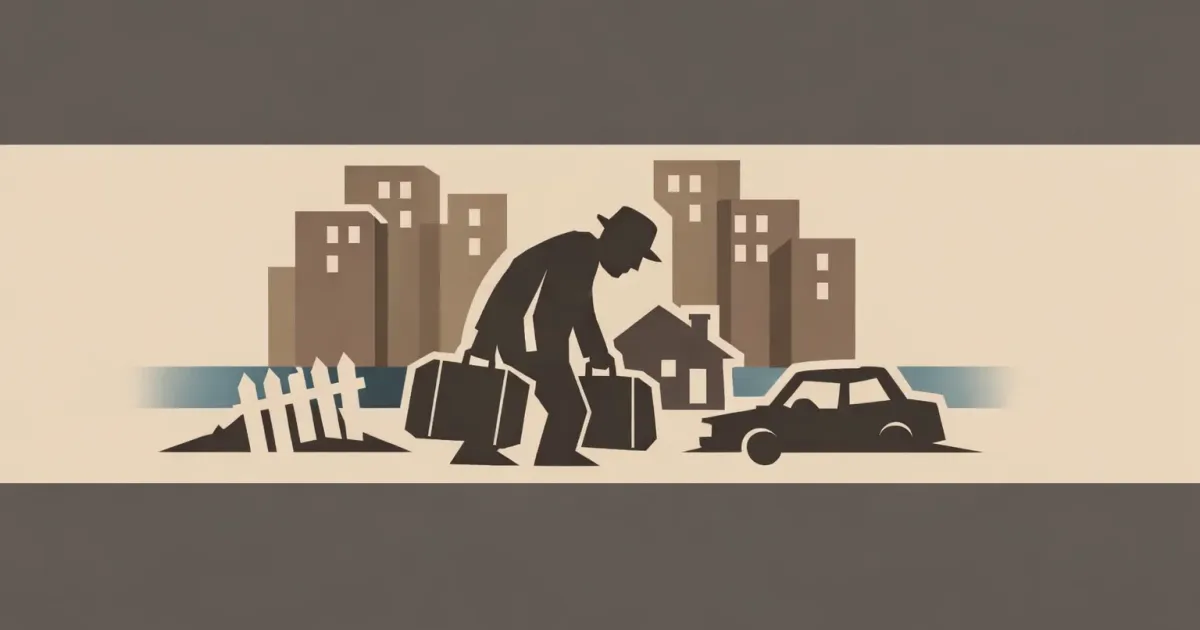
Miller's stage directions open the play with an image that never lets up: the Loman house is a small wooden structure "surrounded by a solid vault of apartment houses," with an "angry glow of orange" leaking between the towers. The physical setting does more work than a symbol — it is the theme made architecture. Willy remembers a backyard with two elms and enough sun to grow carrots and lettuce. That yard is gone, paved over by the construction boom reshaping Brooklyn in the late 1940s, and Willy keeps trying to plant in it anyway.
The seeds Willy buys in Act Two and frantically tries to plant by flashlight are the play's most compressed image of the theme. Nothing will grow in that soil. Nothing has grown there for years. Willy is kneeling in a yard the sun no longer reaches, trying to put down something permanent on the night he has already decided to kill himself.
The nature-versus-city opposition is Miller's way of making a historical argument visible onstage. The Willy who was happy existed in a pre-war, pre-zoning America of small houses and open yards, and even that Willy, the play suggests, was partly a fiction — the frontier he imagines via Ben and his wandering father had already closed by the time he inherited the dream. The present-tense Willy lives in a Brooklyn where "you can't raise a carrot" because the apartment houses have blocked the light. The encroaching buildings read as capital itself, in physical form, literally overshadowing the small domestic plot where the Loman version of the American Dream was supposed to take root.
The motif doubles in Ben's imagery. Ben's fortune came from jungles and diamond mines, which is nature as raw wealth, the opposite of the cramped Loman yard. Willy's own father, in the play's furthest memory, made flutes by hand as he traveled — "selling the flutes that he'd made on the way." Every version of the good life in Willy's imagination requires open space, freshness, something growing or being extracted from the earth. The Loman yard, with its darkening rectangle and its stolen sunlight, is the inverse of every pastoral image he carries. Miller is not nostalgic about the frontier; he is clear-eyed that it has been replaced by something smaller and harsher, and he will not pretend the replacement is habitable.
Watch the seeds scene closely. Willy has just been abandoned by his sons at the Chop House. He comes home carrying packages of seeds and announces, almost in a trance, that he has to "get some seeds, right away. Nothing's planted. I don't have a thing in the ground." The line is literal and metaphorical at once. He has nothing in the ground. He has produced no lasting crop — no secure son, no saved career, no money behind him. Planting at night, by flashlight, in soil the sun has not touched in a decade, Willy is performing the last domestic rite of a dream that has no remaining place to happen. The seeds will never sprout. The insurance money he is about to generate, by crashing the car, is the only "planting" he has left — a final, terrible attempt to put something into the ground that Biff might one day harvest. Miller's image of the yard, crowded by apartment towers and starved of light, is the whole argument of the play compressed into a single stage picture: in this America, at this moment, the old ways of growing a life no longer fit the lot they were supposed to grow on.