Characters
Huckleberry Finn
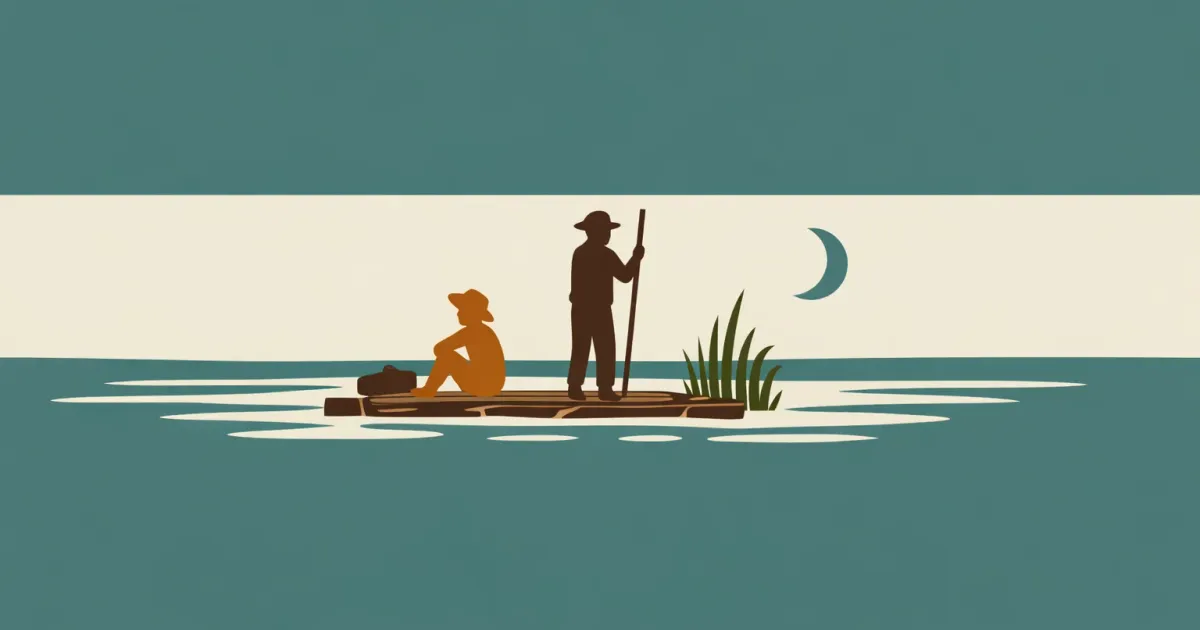
Huck is a thirteen-year-old boy from a Missouri river town who sleeps in a sugar-hogshead when he can get away with it, reads a little, lies a lot, and tells this entire book in his own voice. His father is a drunk, his mother is dead, and the two respectable women trying to raise him have made it their mission to scrub the wildness out of him. He escapes the widow's parlor for the same reason he eventually escapes his father's cabin — he cannot breathe in either one. What makes Huck unusual among American protagonists is how little he thinks of himself. He has absorbed the idea that he is low, ignorant, and probably damned, and he carries that opinion around like a fact about the weather.
That low self-estimate is exactly what frees him to see clearly. Because Huck does not assume he is right about anything, he actually notices what is in front of him: the coffin-worshipping culture of the Grangerfords, the fraudulence of the king and the duke, Jim's intelligence, his own father's cruelty. Where other characters in the novel perform — piety, gentility, royalty, even childhood adventure — Huck is almost the only one who looks at what he sees and tries to report it honestly.
Huck's arc is a conversion story told by a narrator who never realizes he has converted. The pivot is the torn letter in Chapter 31. Having written to Miss Watson to betray Jim, Huck pauses, remembers Jim in specific human scenes — "I see Jim before me all the time: in the day and in the night-time, sometimes moonlight, sometimes storms" — and chooses the person over the principle: "All right, then, I'll go to hell — and tore it up." Twain's craft in that passage is doing something almost no other nineteenth-century novelist attempts. The reader is asked to hold two moral frameworks at once: Huck's, which says he has just damned himself, and the author's, which says he has just saved himself. The gap between those two readings is the whole moral engine of the book.
What makes Huck a great character rather than merely a useful one is that he never articulates his own conversion. He does not grow into an abolitionist; he does not even understand that his decision at the Phelps farm makes him braver than any of the grown men in the novel. His ethics run on instinct and memory — Jim calling him honey, Jim standing his watch in the fog, Jim grieving for a dead child who turned out to be deaf and dumb. When the society around him puts on its performances, Huck's default response is to lie his way out and keep moving, but when confronted with specific human suffering (the Wilks sisters, Jim in chains, the doomed robbers on the Walter Scott), he acts. Critics have argued for a century about whether Huck is a moral hero or a morally passive drifter. Twain's answer, if the book has one, is that the difference does not much matter. What matters is what Huck does when the choice falls on him, and what he does is almost always more decent than the world he was raised in taught him to be.
His closing sentence is the book's final joke at civilization's expense: "I reckon I got to light out for the Territory ahead of the rest, because Aunt Sally she's going to adopt me and sivilize me, and I can't stand it. I been there before." Huck's rejection of respectability is not adolescent rebellion. It is a considered verdict on the society the reader has just watched him travel through.
Jim
Jim is the slave of Miss Watson at the book's opening and a free man by its end, though he spends most of the four hundred pages in between legally somebody's property, constantly at risk of being sold down the river, and regularly treated by the adolescent boys around him as a problem to be managed rather than a person. He is a husband and father separated from his wife and children. He runs because he overhears Miss Watson negotiating to sell him to a trader for eight hundred dollars. Over the course of the journey he becomes Huck's protector, partner, and closest friend. He is the novel's most quietly competent character — he reads weather, handles snakebite, pilots the raft, manages their supplies, and in Chapter 9 recognizes a floating corpse as Huck's father and conceals that fact for the rest of the book to spare the boy.
Jim's warmth is plain on the surface. He calls Huck honey. He weeps when he thinks Huck has drowned. He tells the story of striking his deaf daughter before he understood she could not hear him — "Oh, Huck, I bust out a-cryin' en grab her up in my arms" — and the reader is meant to understand exactly what kind of father has been denied his own children. Twain wants the humanity to be impossible to miss.
Jim is the most critically contested character in American fiction, and pretending otherwise would be dishonest. He is rendered in phonetic dialect; he is the butt of Tom Sawyer's pranks; he believes in witch signs and reads the future from a hairball; he spends the final ten chapters of the book as a passive prisoner while a white child stages an elaborate theatrical evasion on his behalf. A reader familiar with 1880s minstrel-show conventions — the stock figure of the superstitious, credulous, foolishly loyal Black man — can find pieces of that tradition on the page, and generations of critics have wrestled with why Twain used them. The argument for the defense, which is the one this guide finds most persuasive, is that Twain borrows those conventions to subvert them. The superstitions Jim takes seriously keep proving accurate. His folk knowledge is more reliable than the book's white institutions. The moment the reader is invited to laugh at Jim (the dream trick in Chapter 15) is the precise moment Jim lands the novel's sharpest rebuke: "Dat truck dah is trash; en trash is what people is dat puts dirt on de head er dey fren's en makes 'em ashamed." Huck, the narrator, responds by doing something he tells us it took him fifteen minutes to bring himself to do — he apologizes to a Black man, and he is not sorry afterward.
The stronger case for Jim's depth is his role as Huck's true parent. The book has three candidates for that role — Pap, the widow, Jim — and only one of them actually behaves like a father. Jim stands Huck's watches so the boy can sleep. He conceals the dead body in the floating house. He feeds him, keeps him safe in storms, and on the one occasion he chooses his own freedom over Huck's comfort, Twain frames it as Huck's failure of imagination, not Jim's betrayal. When Tom is shot at the end and the escape is blown, Jim refuses to run — "I doan' budge a step out'n dis place 'dout a doctor; not if it's forty year!" — and chooses a white boy's life over his own liberty. Huck's response ("I knowed he was white inside") is one of the most wrenching lines in the novel, because it shows that even Huck, who loves Jim, has no moral vocabulary for Jim's goodness that is not borrowed from whiteness.
What happens to Jim at the Phelps farm is the book's most painful stretch, and it is painful on purpose. Jim is reduced to a prop in Tom Sawyer's adventure-novel fantasy because that is precisely what the society around him has always done — it has treated his life as raw material for somebody else's story. The Phelps farm is not a failure of Twain's vision of Jim. It is Twain forcing the reader to watch, in slow motion, how respectable white people turn a grown man's freedom into a children's game. Jim bears it. He is patient, and when the chance comes to walk away from a wounded boy, he stays. Any reading of the novel that treats Jim as simple has not reckoned with that choice.
Tom Sawyer
Tom appears briefly at the start of the book — recruiting Huck into a gang of imaginary robbers, attacking a Sunday-school picnic under the impression it is an Arab caravan — and then vanishes for thirty chapters. When he shows up again at the Phelps farm, the novel he wandered in from looks very different than it did when he left. Tom is the boy whose adventures fill the previous book by Twain. He lives inside the pages of Alexandre Dumas and Baron Trenck, and he judges every real-world situation by whether it can be made to resemble one of his favorite prison-escape novels.
Where Huck asks whether something is decent, Tom asks whether it is stylish. He is charming, endlessly energetic, and, by the book's end, genuinely monstrous.
Tom's true character is not revealed until the Phelps farm section, and it is the key reason that section is in the book at all. Tom discovers on arrival that Miss Watson has died and freed Jim in her will — he knows from the first day that Jim is legally a free man. He then spends weeks engineering a pointlessly elaborate "evasion" that requires Jim to eat off a tin plate, sleep with rats and snakes in his cabin, write his memoirs in blood on a shirt, and carve a coat of arms onto a grindstone, all because Tom has read that this is how prisoners escape in books. When the plan finally runs and Tom is shot in the leg and Aunt Polly arrives to expose everything, his explanation is a single line that damns him completely: "I wanted the adventure of it; and I'd a waded neck-deep in blood to —."
That line is the novel's verdict on a whole category of Americans. Tom is not cruel in the way Pap is cruel. He does not hate Jim. He likes Jim well enough. But he is willing to torture a man for the sake of a good story, and he does not understand — at thirteen, and the book suggests he will never understand — that the man's life is not a story. Tom is the figure the book has been building toward all along: the respectable, educated, well-read white boy who turns another human being's suffering into an entertainment and feels satisfied with himself afterward. The Grangerford feud, the Royal Nonesuch, the Wilks con, and Tom's evasion are the same moral pattern at different volumes. Hemingway told readers to stop reading at the point where Jim is sold, but Tom's return is the point. Without Tom, the book is a lovely fable about a boy and a river. With Tom, it becomes a book about what America keeps doing to the Jims.
Pap Finn
Pap is Huck's father and, for a long stretch of the early chapters, his captor. He is a drunk, illiterate, physically terrifying, and persistently convinced that the world is conspiring to deprive him of what he is owed. He reappears in Chapter 5 furious that his son has learned to read and has money in the bank, kidnaps Huck, locks him in a cabin across the river, and beats him at whim. During one delirium-tremens episode he chases Huck with a clasp-knife, calling him the Angel of Death, before passing out. He is one of the most frighteningly rendered bad fathers in nineteenth-century fiction, and he is also funny in a way that makes the horror worse.
Pap functions in the novel as the nightmare double of white respectability. Whenever the book is about to argue that Southern civilization is built on rot, Pap walks on stage to demonstrate the rot with no decorative foliage. His most famous scene is the drunken tirade in Chapter 6 against "the govment" — specifically against a "free nigger" from Ohio who can vote, own property, and speak in Latin. Pap's grievance is that he, a white man, is being underserved by a country that allows an educated Black man to exist. "Thinks I, what is the country a-coming to?" he says, and the reader is asked to notice how tidily Pap's private outrage tracks the public ideology of his neighbors. The widow wears a silk bonnet over the same belief.
Huck's relationship to Pap is a study in damaged love. Huck does not hate his father — he is bored by him, afraid of him, relieved when he is gone — but he does not mourn him either. Twain keeps Pap's death off the page for almost the entire novel; Jim sees the corpse in the floating house in Chapter 9 and does not tell Huck until the final paragraphs. That structural withholding is not a trick. It is a comment on what Pap was to Huck: someone whose absence is the gift, whose death is a fact to be noticed and set aside. The father Huck actually has by the end of the book is the runaway slave who covered the dead man's face to spare him.
The Widow Douglas and Miss Watson
The Widow Douglas is the well-meaning Christian woman who has taken Huck in as her son at the book's opening and is gently, persistently, unsuccessfully trying to civilize him. Her sister Miss Watson lives with her, is sharper-tongued and more devout, and owns Jim. Together they represent the female wing of respectable St. Petersburg — the pew side of a town whose cellar contains what Pap embodies. They pray before meals, teach Huck to read, and make him wear clean clothes. The widow cries when he runs off and calls him a poor lost lamb. Miss Watson drills him on spelling and threatens him with the bad place.
Twain's portrait of these two women is one of the novel's most quietly devastating pieces of work, because he does not make them hypocrites in any obvious sense. The widow is a genuinely kind woman. She means Huck well, and she means Jim well to the extent her category for him allows. Miss Watson is stricter and more censorious but not cruel. What the book notices is that their goodness cohabits effortlessly with an economic arrangement in which Miss Watson plans, over dinner, to sell Jim to a New Orleans trader for eight hundred dollars, which would separate him from his wife and children forever. Jim runs because he overhears that conversation. The widow is not appalled by the plan. The book trusts the reader to see what its narrator does not say out loud — that polite Christian womanhood in the antebellum South is the social infrastructure on which the slave trade runs.
The revelation in the final chapters that Miss Watson freed Jim in her will is more complicated than a redemption. It comes too late to matter — Jim has already been sold once, hunted, chained at the Phelps farm, and put through Tom Sawyer's ordeal. And it arrives precisely when the reader is wondering whether Huck's moral agony in Chapter 31 has been retroactively cheapened. Twain's point, as best it can be read, is that a last-minute manumission is not the same thing as a life lived justly. Miss Watson's will does not pay for what she almost did, and the book does not let her off.
The Duke and the Dauphin
Two con men whom Huck rescues from an angry pursuing crowd early in their acquaintance and who promptly take over the raft. The younger, slimmer one claims to be the rightful Duke of Bridgewater, wronged heir to an English estate; the older, baldheaded one trumps him by claiming to be the lost Dauphin of France, Louis XVII. Within a day, Huck has both men figured out — "these liars warn't no kings nor dukes at all, but just low-down humbugs and frauds" — but decides that naming them would only start a fight. They spend the middle third of the book running scams on river towns: a phony temperance lecture, a pirate testimony at a camp meeting, a butchered production of Shakespeare, "The Royal Nonesuch" burlesque, and finally the Wilks impersonation, which is genuinely evil because its victims are three orphaned young women.
The duke and the king are not primarily comic figures, though they are often very funny. Their actual function is thematic. Every authority figure Huck has encountered — the widow's providence, Pap's paternal rights, the Grangerford gentry's "honor," the revival preacher's salvation — has been a performance. The duke and the king simply perform more openly. They put on their costumes in front of Huck and Jim and do not pretend their claims are real. The scam they run at the Wilks house succeeds not because they are clever but because the town wants to believe them — exactly the mechanism Sherburn's speech names a few chapters earlier. When the doctor sees through them, the crowd shouts the doctor down. When the real English brothers arrive, the town's response is not shame but a coffin-digging mob scene.
Twain lets the king, in particular, turn genuinely cruel at the Wilks farm. He splits a slave mother from her children for a quick sale. He weeps crocodile tears at Peter Wilks's funeral. When the king finally betrays Jim to Silas Phelps for forty dollars in Chapter 31, Huck's moral crisis begins, and it is important that the betrayal comes from the king and not from, say, a slave-catcher. The king is the book's proof that the performers Huck has been shadowing are not harmless. Fraud on this scale is what a society organized around performance eventually produces. When the duke and the king are last seen — tarred, feathered, ridden out of town on a rail — Huck's reaction is not triumph. "Human beings can be awful cruel to one another," he says, and the sentence lands hard because he is talking about the mob, not the frauds.
Colonel Sherburn
Sherburn is a cold-eyed Arkansas gentleman who shoots a harmless drunk named Boggs in the street in broad daylight while Boggs's teenage daughter runs toward him screaming. The town witnesses the killing. A mob forms and marches on Sherburn's house to lynch him. Sherburn meets them on his porch with a shotgun and a two-page speech, and the mob disperses without firing a shot. He then disappears from the novel entirely.
Sherburn is in the book for a total of maybe ten pages and is one of the most important characters in it, because his speech is the only place Twain lets an adult say out loud what the rest of the novel shows. "The average man's a coward," Sherburn tells the mob. "Your newspapers call you a brave people so much that you think you are braver than any other people — whereas you're just as brave, and no braver." He argues that juries acquit murderers because they are afraid, that lynchings are always led by half a man backed up by a hundred cowards, that the most pitiful thing in the world is a mob. He is, of course, the murderer himself, and the speech is his way of escaping consequences. The scene is not meant to make him admirable. It is meant to make him right.
Sherburn's function is structural. He gives the reader the thesis the book has been demonstrating — that the culture Huck is drifting through is organized around collective cowardice dressed up as honor — and he gives it from the least sympathetic possible speaker. Twain had to use a murderer to say it because nobody else in the book is honest enough. That is the joke, and the joke hurts.
Mary Jane Wilks
Mary Jane is the eldest of the three Wilks sisters whom the king and the duke set out to defraud. She is nineteen, red-haired, and the first adult woman in the novel whom Huck genuinely admires. Her family has just buried their father, Peter Wilks, whose remaining fortune the con men are preparing to steal along with the estate and the family's slaves. Huck, moved by her kindness and by the sight of the enslaved family being split up at auction, tells her the whole truth and sends her to a neighbor's house so that her face will not give the game away.
Mary Jane matters far out of proportion to her page count. She is the only major character in the book — other than Jim — who is rendered without irony. Huck describes her to himself in frank, uncharacteristic language: "in my opinion she had more sand in her than any girl I ever see; in my opinion she was just full of sand." Twain almost never lets Huck praise anyone directly, and the repeated word ("sand," meaning grit) is Huck reaching for a register he does not normally have access to. She is the test case for a question the novel keeps asking: can Huck ever tell the truth to an adult? With Mary Jane, for the first and almost the only time, the answer is yes. The scene where he confesses the fraud to her is the book's one clean encounter between Huck and a decent member of respectable white society.
Structurally, Mary Jane is the proof that Huck's moral instincts work in the absence of Jim. Up to this point, his good choices have been driven by loyalty to a specific friend. With the Wilks sisters he acts on behalf of people he has just met, partly because Mary Jane is kind to her slaves, partly because she is crying, partly because something in her candor matches something in him. That generalization of his compassion — from Jim to three strangers — is the quiet groundwork that makes the Chapter 31 decision possible. By the time Huck sits down to tear up the letter, he has already practiced being decent to people he does not have to be decent to.
Buck Grangerford
Buck is Huck's own age, lives in the Kentucky mansion where Huck washes ashore after the raft is rammed by the steamboat, and is the closest thing to a peer Huck has in the novel apart from Tom. He is friendly, cheerful, and casually armed. He explains the family feud to Huck without being able to remember what started it — "Well, I should reckon! it started thirty year ago, or som'ers along there. There was trouble 'bout something, and then a lawsuit to settle it; and the suit went agin one of the men, and so he up and shot the man that won the suit" — and shortly afterward he is shot to death in the river by a Shepherdson.
Buck is important because he is a version of what Huck could have been if Huck had been born into respectability. He is decent, educated, hospitable, and trapped inside a code that requires him to kill strangers over a grievance nobody can name. His death is one of the most undercut moments in American fiction. Huck watches from a tree as the Shepherdsons gun down Buck and his cousin in the water; he pulls the bodies ashore and covers Buck's face and cannot bear to describe what he sees. "I ain't a-going to tell all that happened; it would make me sick again if I was to do that. I wished I hadn't ever come ashore that night to see such things. I ain't ever going to get shut of them." The refusal to narrate is the narration. Twain trusts the silence to say what his boy-narrator cannot.
The Grangerford chapters are Twain's indictment of a certain kind of Southern aristocratic self-image — the culture that goes to church with loaded rifles under the pews and calls itself honorable — and Buck is the collateral. He is a sweet kid who has been handed a gun and a grudge and asked to die for them. His death teaches Huck something the book will keep teaching: that the grown-up world's performances are paid for in children.
Silas and Sally Phelps
Silas Phelps is a small-time farmer and part-time preacher who purchases Jim from the king for forty dollars in Chapter 31 and holds him chained in a shed. His wife, Aunt Sally, runs the household. Both are presented as warm, hospitable, entirely well-meaning people. Aunt Sally welcomes Huck into her home as if he were her own nephew, worries over his safety, weeps when she thinks he has been hurt, and is exactly the kind of Christian Southern woman the widow would approve of.
The Phelpses are the final and most troubling iteration of a pattern the book has been tracing from Chapter 1. They are not villains. They are not hypocrites in any theatrical sense. Aunt Sally is funny and affectionate; Uncle Silas reads his sermons to anybody who will listen. They also keep a human being chained in an outbuilding and do not find this incompatible with the grace they say before meals. When the doctor vouches for Jim at the end of the book, their response is softening relief — they are willing to be decent to Jim now that a white professional has told them he is a good one.
Twain uses the Phelpses to complete his map of Southern whiteness. Pap is the cellar. Miss Watson and the widow are the parlor. The Grangerfords are the aristocratic wing. The Phelpses are the middle, where most of the country actually lived — kindly, churchgoing, unreflective, and perfectly compatible with the institution the book has been exposing all along. The horror of the Phelps farm section is not that the Phelpses are monsters. It is that they are recognizable relatives. Aunt Sally's offer at the very end, to adopt Huck and "sivilize" him, closes the novel by threatening to drop Huck back exactly where he started. Huck's response — to light out for the Territory — is his verdict on what kindly Christian civilization actually costs.