Summary
Overview
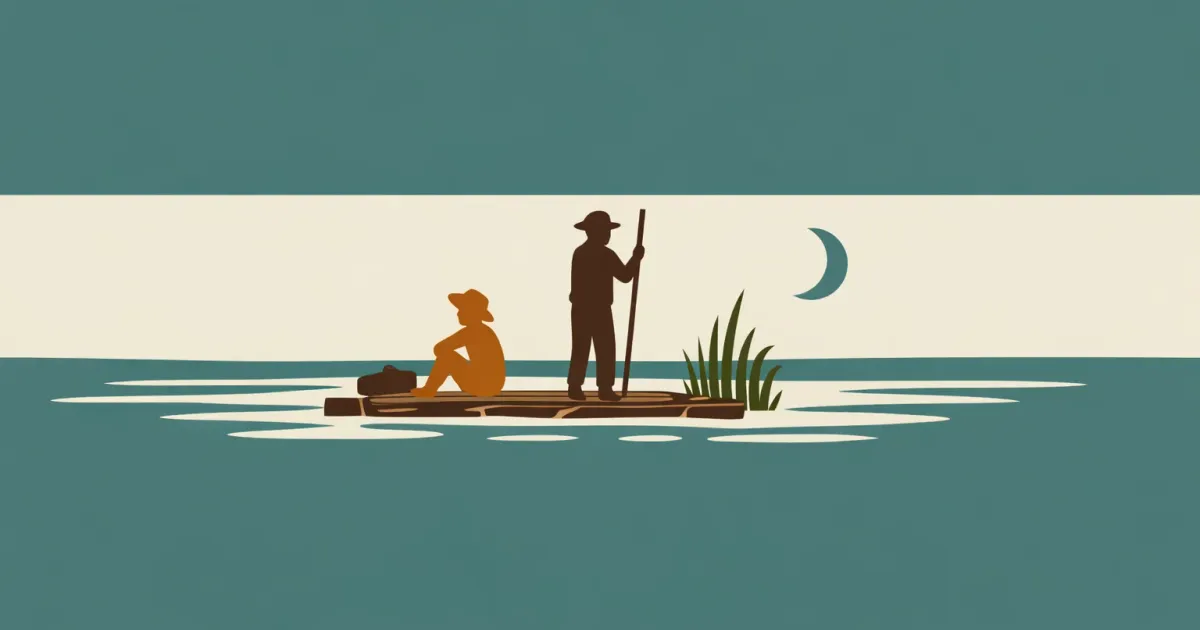
The Adventures of Huckleberry Finn is a novel about a boy running from his life and a man running for his. Huck Finn, a barely-schooled thirteen-year-old from a Missouri river town, fakes his own murder to escape a violent father and drifts down the Mississippi on a raft with Jim, a grown man fleeing the woman who planned to sell him south. The river carries them through one American tableau after another: a blood feud between gentleman aristocrats, a small-town killing, a pair of con artists masquerading as European royalty, and a slaveholder's farm where the story turns into elaborate farce. Behind the comedy is the hardest question Mark Twain ever asked a young protagonist to answer, which is whether a white Southern boy should help a Black man get free when everything he has ever been taught tells him it is a sin.
The book is narrated by Huck himself in the country dialect he actually speaks, which was almost unheard of for a novel in 1884 and which still gives the writing its distinctive pulse. Twain turns ungrammatical prose into a tool of astonishing precision, and Huck's matter-of-fact voice lets the reader notice the cruelty and hypocrisy around him without the narrator ever quite naming it. The central drama happens inside Huck's head. He has been raised to believe that helping Jim escape is a crime and a damnation, and each time he has a chance to turn Jim in he weighs what his society calls his conscience against what he actually feels for the man who calls him honey and stands his watches. The book becomes a record of a conscience slowly turning over, of a boy choosing his friend over his religion.
Huckleberry Finn occupies a strange position in American literature: it is often called the first great American novel, and it is also the book that more school districts have tried to take off reading lists than almost any other. Ernest Hemingway's line, that "all modern American literature comes from one book by Mark Twain called Huckleberry Finn," overstates the case but points at something real. Before Twain, American fiction still tended to reach for British literary diction; after Twain, it could speak in a native voice. The vernacular narrator, the episodic river journey, the skeptical view of adult authority, the moral weight carried by a young protagonist who cannot articulate what he has learned — all of these become part of an American tradition that runs through Hemingway, Faulkner, Salinger, Ellison, and Toni Morrison.
Structurally, the novel is more ambitious than its reputation as a "boy's book" suggests. Twain wrote it over eight years, shelving it, picking it up, abandoning it again. The result is less a tight plot than a picaresque sequence of shore excursions linked by the river, with the river itself functioning almost as a second protagonist — the only place in the book where Huck and Jim can be fully themselves. The novel is also a sequel to Tom Sawyer, and that matters: Twain begins with a boy already famous for adventure stories and spends four hundred pages showing what adventure looks like when the stakes are real. The final Phelps farm section, in which Tom Sawyer reappears and turns Jim's liberation into a week of elaborate playacting, has divided critics for more than a century — some argue it wrecks the book, while others see it as the point Twain was driving at all along.
Life with the Widow and Pap (Chapters 1–7)
The book opens shortly after the events of The Adventures of Tom Sawyer. Huck and Tom have found a cache of robbers' gold, and Judge Thatcher is investing six thousand dollars of it for Huck at interest. The Widow Douglas has taken Huck in and is trying, as she puts it, to "sivilize" him, with help from her sister Miss Watson, whose slave is Jim. Tom recruits Huck into a gang of imaginary robbers who attack a Sunday school picnic under the impression it is a caravan of Arab merchants. Then Huck's father — Pap, who is sometimes rumored drowned — returns, drunk and furious that his son can read and has money. Pap kidnaps Huck and locks him in a cabin across the river on the Illinois side, beating him whenever the liquor is in him. During one delirium-tremens fit Pap chases Huck with a knife and finally passes out. Huck saws his way out of the cabin, stages his own murder with pig blood and an axe, and takes a stolen canoe down to Jackson's Island.
These opening chapters set up the two kinds of authority Huck spends the rest of the novel rejecting. The widow's version is respectable and well-meaning and utterly at odds with how Huck actually wants to live; Pap's version is violent and unaccountable and makes a mockery of the law's insistence that a father's claim on his son trumps a child's safety. Twain is careful to make neither cage metaphorical. Huck has to escape each one in literal physical terms — slipping out the window to join Tom, sawing out of the locked cabin with a rusted wood-saw. The staged murder scene, where Huck drags a blood-soaked sack to the river and leaves a meal trail toward a distant lake, is also Huck learning something the novel will return to: that the world can be made to believe almost anything if the props are convincing enough. Pap's drunken tirade against the "govment" that lets a Black professor from Ohio vote is one of Twain's most devastating short pieces of satire — a speech that tells the reader exactly what kind of white manhood the book is measuring Huck against.
Jackson's Island and Escape Downriver (Chapters 8–11)
On Jackson's Island, Huck hides from the ferryboats that are dragging the river for his body. He discovers he is not alone: Miss Watson's Jim has also run, having overheard her planning to sell him to a New Orleans trader for eight hundred dollars. Huck swears not to turn him in, though he knows the town will despise him as a "low-down Abolitionist" if the truth ever comes out. The two live comfortably on the island for days, catching catfish, riding out a summer flood, and salvaging supplies from a frame house that drifts past in the high water — a house in which Jim discovers a dead man shot in the back but keeps Huck from looking at the face. Huck dresses as a girl and paddles across to the mainland for news. A woman named Judith Loftus unmasks him within an hour but tells him the townspeople now suspect Jim of killing him and are preparing to search Jackson's Island that night. Huck races back, and he and Jim load their raft and shove off.
The island interlude is one of the novel's quiet turning points. Before Jackson's Island, Huck's moral world is still the town's world, just seen from the window instead of the pew. On the island, something shifts — the two fugitives become partners with complementary skills, and Jim's folk knowledge (reading weather in the flight of birds, handling snakebite, interpreting signs) is presented not as superstition but as a genuine competence the novel respects. The drifting house is the first of many floating omens. Jim knows who the dead man is and keeps it from Huck, a protective withholding the reader will not understand until literally the last page of the book. Twain is already setting up a pattern in which Jim's care for Huck is more paternal than Pap's ever was, and in which Huck, who thinks he is leading, is constantly being looked after.
Down the River with Jim (Chapters 12–16)
Huck and Jim drift south, hiding during the day and traveling at night, planning to reach Cairo, Illinois, where the Ohio River meets the Mississippi. From Cairo, Jim can take a steamboat up into the free states. Along the way they board a wrecked steamboat, the Walter Scott, and stumble into a murder plot among robbers; Huck tricks a ferry captain into going out to the wreck, though by then the thieves are almost certainly drowned. A long fog separates the raft and Huck's canoe, and when Huck finds Jim again he tries to convince Jim the whole ordeal was a dream. Jim figures out the trick and tells Huck he was "trash" for playing with the feelings of a friend who feared him dead; Huck apologizes — to a Black man, which in his world is unthinkable. They realize they have passed Cairo in the fog. A steamboat then rams the raft, and Huck is separated from Jim again.
Chapter 15 is the moral hinge of the book's first half. Huck's apology to Jim — "I done it, and I warn't ever sorry for it afterwards, neither" — is not framed as a victory; Huck reports that it took him "fifteen minutes" to work himself up to "humble myself to a nigger." The phrasing is ugly and meant to be, because Twain is showing the reader exactly what Huck has to push against to do the decent thing. Chapter 16 then raises the stakes. Jim starts talking about buying his wife and stealing his children from their owner, and Huck's "conscience" (meaning the internalized voice of St. Petersburg) starts grinding him so hard he decides to paddle ashore and turn Jim in. Two slave-hunters row up, ask if the man on the raft is white or black, and Huck — unable to say the word — invents a story about a father with smallpox that sends them fleeing. The boy who cannot bring himself to betray his friend is still certain he has done something wrong, and the scene ends with him concluding that he might as well stop trying to learn to do right, since wrong is easier and "the wages is just the same." Twain is deliberately inverting the moral vocabulary — the reader is supposed to see that Huck's "sin" is in fact his only moment of grace.
The Grangerford Feud (Chapters 17–18)
After the steamboat wrecks the raft, Huck washes ashore at the home of the Grangerfords, a prosperous family of Kentucky gentry who take him in under the name George Jackson. Huck befriends Buck Grangerford, a boy his own age, and is fascinated by the family's parlor art and the sentimental poetry of Emmeline Grangerford, a daughter who died young. He also learns the family is locked in a generations-old feud with the Shepherdsons over a reason nobody can quite remember. When Miss Sophia Grangerford elopes with young Harney Shepherdson, the feud erupts. From a tree, Huck watches the Shepherdsons gun down Buck and his cousin in the river. He pulls the bodies to shore, covers Buck's face, and flees back to the raft — where Jim, it turns out, has been hiding and repairing the wreckage with the help of other slaves.
The Grangerford episode is Twain's first full-strength attack on the culture he grew up in. The Grangerfords are everything the antebellum South considered admirable — "well born," courteous, devout, hospitable. They attend church with loaded rifles between their knees, listen to a sermon on brotherly love, and ride home to murder one another. Emmeline's comically morbid funeral poetry, which Huck preserves reverently in his narration, extends the critique: a culture that sentimentalizes death this enthusiastically has prepared itself to produce a lot of it. Buck's death is one of the most undercut moments in American fiction. Huck cries while covering Buck's face and then immediately changes the subject, refusing to describe what he saw — "I ain't a-going to tell all that happened; it would make me sick again if I was to do that." The silence does the work. Twain trusts his narrator's refusal more than any explicit condemnation.
The Duke and the Dauphin Arrive (Chapters 19–23)
Back on the raft, Huck and Jim enjoy a brief stretch of peace before Huck rescues two men fleeing angry townspeople. The younger claims to be the rightful Duke of Bridgewater; the older one-ups him by claiming to be the lost Dauphin of France, Louis XVII. Huck sees through them within a day — they are two small-time swindlers — but decides to play along to keep peace on the raft. The duke and the king work a series of scams on river towns: a phony temperance revival, a fake pirate testimony at a camp meeting that nets eighty-seven dollars, a mangled Shakespearean performance, and finally "The Royal Nonesuch," a three-night burlesque in which the king prances naked and painted and the duke collects admissions from men lured by a sign reading "Ladies and Children Not Admitted." The first two audiences agree to keep quiet so the rest of the town will be fooled. Meanwhile Huck and Jim witness the shooting of a drunk named Boggs by a cold-blooded colonel named Sherburn, and then watch Sherburn face down a lynch mob with a speech about how cowardice is the defining trait of the average man.
The duke and the king are not just comic relief — they are the novel's argument that fraud is the normal operating mode of the society Huck is drifting through. Every authority figure Huck has encountered (the widow's providence, Pap's paternal rights, the Grangerford gentry, the revival preacher) has been some version of a performance, and the two rapscallions on the raft simply perform more openly. Sherburn's speech to the lynch mob is where Twain steps briefly out from behind his narrator and lets a character say out loud what the book has been implying — that the average man is a coward, that juries acquit murderers because they are afraid, that the thing called Southern honor is really just a cover for mob cruelty. The scene is structurally important because it sets up the moral baseline against which the king and the duke's next con — one that victimizes young women rather than loafers — will look genuinely evil.
The Wilks Fraud (Chapters 24–30)
The king learns of the recent death of a wealthy tanner named Peter Wilks and of the arrival of Wilks's two English brothers, who have never met their American nieces. He and the duke decide to impersonate them. They arrive at the Wilks house weeping theatrically, are embraced by the three orphaned Wilks sisters — Mary Jane, Susan, and Joanna — and quickly take possession of six thousand dollars in gold and plans to sell the estate and the family's slaves. Huck, who has grown attached to Mary Jane, cannot bear it. He steals the gold and hides it in Peter Wilks's coffin. When the king hastily sells the family's slaves and splits a mother from her children, Huck decides he has to act: he tells Mary Jane the truth and sends her to a neighbor's house. The real Harvey and William Wilks then arrive, and in a graveyard confrontation by lantern-light the town digs up Peter's coffin to settle which pair of brothers is genuine. The gold is found on the corpse; in the chaos Huck runs for the raft, only to have the king and the duke paddle up behind him moments later, having also slipped away.
The Wilks fraud is the longest sustained episode in the novel and the one that pushes Huck closest to open rebellion. For the first time, he acts decisively against adults in authority — not to save himself or Jim, but to protect three young women and an enslaved family he barely knows. His conversation with Mary Jane, in which he tests out telling the truth to a good person and finds it works, is the closest the novel comes to letting Huck articulate a moral principle. Twain uses the Wilks con to dramatize something he cares deeply about: the con succeeds not because the frauds are clever but because the crowd wants to believe them. The doctor who sees through the king is shouted down; the lawyer's handwriting test convinces no one; only a tattoo and a buried coffin can force the town to face what its own eyes have been telling it. The crowd's willingness to be fooled, and its fury once it isn't, is exactly what Sherburn's speech predicted.
Pikesville and the Letter (Chapter 31)
South of the Wilks episode, the frauds' cons begin failing, and they grow desperate. In a village called Pikesville, the king slips off with Jim and sells him to a local farmer, Silas Phelps, for forty dollars. Huck returns to an empty raft and learns from a stranger that Jim is being held as a runaway. He is torn. His upbringing tells him Jim is Miss Watson's property and that helping him further will send Huck to hell. He writes a letter to Miss Watson telling her where Jim is, and feels, for a moment, "washed clean of sin." Then he sits with the letter and finds himself remembering the trip — Jim standing his watches, Jim's grief in the fog, Jim calling him the best friend he ever had. He tears the letter up. "All right, then, I'll go to hell," he says, and resolves to steal Jim out of slavery.
Chapter 31 is the scene the whole novel has been building toward, and it is one of the most concentrated passages of moral writing in American fiction. Twain's achievement is that Huck's decision, in Huck's own understanding, is a decision to damn himself. He is not moved by abolitionist principle — he has none — or by any theory that says slavery is wrong. He is moved by specific, remembered acts of love from a specific man, which his culture's categories cannot accommodate. The reader, who holds the opposite moral framework, sees that Huck has in fact just chosen heaven and called it hell. The tension between what Huck says he is doing and what he is actually doing is the whole reason the chapter works. It is also why the book is still taught: it shows that conscience as taught is not the same thing as conscience as felt, and that the difference can be life and death.
The Evasion at the Phelps Farm (Chapters 32–42, and "Chapter The Last")
Arriving at the Phelps farm, Huck is mistaken for their expected nephew — Tom Sawyer, who is due any day. He goes along with it. Tom himself arrives soon after, pretends to be his own brother Sid, and, to Huck's shock, agrees not only to help free Jim but to insist on freeing him in the most elaborate, literary way possible. For the next several weeks, Tom orchestrates what he calls an "evasion" modeled on the prison-escape novels of Alexandre Dumas and Baron Trenck. He makes Jim write mournful journal entries in blood on a shirt, smuggle messages in pies, keep rats and snakes in his cabin for company, carve inscriptions into a grindstone, and wait while Tom sends anonymous warning letters to Uncle Silas. On the planned escape night, fifteen armed farmers are lying in wait. The three escape through a hole they have dug, but Tom is shot in the calf. Jim refuses to flee while Tom is wounded; he hides in the swamp until Huck fetches a doctor, then emerges to help nurse Tom and is captured. In the book's final chapters it is revealed that Miss Watson died two months earlier and freed Jim in her will, a fact Tom knew from the start. Aunt Polly arrives, exposes Huck's impersonation, and confirms Jim's freedom. Jim tells Huck that the dead man in the drifting house, back on Jackson's Island, was Pap. Huck ends his book by announcing that Aunt Sally now wants to adopt and civilize him, and that he intends to "light out for the Territory" ahead of that fate.
The Phelps farm section is the most argued-about passage in American literature. Ernest Hemingway told readers to stop at the point where Jim is sold, calling everything after "cheating." Other critics have defended the ending as the book's whole point — Twain reducing the moral urgency of the previous thirty chapters to comic burlesque in order to show what happens when the country's best people decide a freed man's real life is less important than a good story about freeing him. Both readings have textual evidence. The ending undeniably flattens Jim, who spends weeks as a passive prop in Tom's performance, submitting to indignity after indignity because the white boy in charge insists it is necessary. It equally undeniably exposes the entire mechanism by which white Americans have always dressed up injustice as adventure. Tom has known since he arrived that Jim is legally free. He puts Jim through the evasion anyway because he wants the "adventure of it" and because he has "waded neck-deep in blood" for it in his imagination. Twain is showing — with the light touch of farce — that the same impulse runs through every institution the book has already parodied: the church that worships its own performance, the feud that has forgotten its cause, the con that succeeds because its victims need to believe it.
The revelation about Miss Watson's will is the piece that has troubled readers most. After Huck's conversion in Chapter 31 — his genuine, hard-won decision to go to hell for Jim — the plot quietly takes the stakes away. Jim was free the whole time. Huck's damnation was imaginary. But Twain's point, readable against the grain, is that Huck did not know this and acted anyway, and Tom did know it and acted as he did. The difference between those two moral positions is the novel's final verdict. Jim's last act — refusing to run while Tom is bleeding, choosing a white boy's life over his own freedom — is Twain's refusal to let the reader sentimentalize what has happened. Jim's humanity has been obvious for hundreds of pages; the people around him still cannot see it except when a doctor vouches for him. Huck's closing line, that he will light out for the Territory because he can't stand being sivilized, reads as a joke, but it is also the book's most honest admission: the society Huck came from will not change, and the only moral solution Twain can imagine for his narrator is to leave.