Key Quotes
"That book was made by Mr. Mark Twain, and he told the truth, mainly. There was things which he stretched, but mainly he told the truth."
Speaker: Huck Finn (Ch. 1)
Huck opens his own novel by reviewing the previous one. He tells us that Mark Twain wrote The Adventures of Tom Sawyer, that the book was mostly honest, and that the author told a few whoppers along the way. It is a joke, but it is also the first sentence of one of the most influential narrative voices in American literature — a child narrator who speaks in dialect, refers to his own author by name, and calmly admits that all storytellers, even famous ones, stretch the truth.
The opening sets the terms of the whole book. Huck defines honesty not as the absence of lies but as a willingness to own them — "with some stretchers, as I said before." The novel that follows will be full of stretchers: Huck fakes his murder, passes himself off as a girl, invents smallpox on the raft, poses as Tom Sawyer at the Phelps farm. What separates Huck's lies from those of the duke, the king, or the Grangerford gentry is that Huck's lies are almost always told to protect someone, while the adults' lies are told to extract money, honor, or power. By opening with a wink at his own author, Twain also announces a narrative position no American novel had quite tried before: the storyteller is a barely literate Missouri boy, and the "respectable" literary voice of a writer named Mr. Mark Twain is the one we are being asked to mistrust. Every sentence of the vernacular narration that follows is an argument that this kid sees more clearly than the educated world around him.
"Call this a govment! why, just look at it and see what it's like. Here's the law a-standing ready to take a man's son away from him—a man's own son, which he has had all the trouble and all the anxiety and all the expense of raising."
Speaker: Pap Finn (Ch. 6)
This is the opening of Pap's drunken tirade in the cabin after he has kidnapped Huck from the widow. He is raging because the law might keep him from grabbing Huck's six thousand dollars, and because he has just seen, in town, a free Black college professor from Ohio — "a mulatter, most as white as a white man" — casting a vote. Pap works himself into such a fury over the existence of this man that he vows to quit voting forever in protest. Then he trips over a salt-pork tub and hurts his shin.
Twain gives Pap one of the most devastating monologues in American fiction, and he does it by letting Pap indict himself. The speech has two halves. The first is a parody of white grievance politics dressed up as paternal rights: the government is tyrannical because it might protect Huck from a man who beats him. The second is a parody of white racial panic: a Black professor who dresses well, votes, and knows more than Pap does is intolerable, and the real outrage is that such a man cannot be sold. Pap's complaint that a "govment" which "can't sell a free nigger till he's been in the State six months" is no government at all is Twain at his cruelest as a satirist — he shows that for men like Pap, the legitimacy of the state depends on its willingness to traffic in human beings. The pratfall at the end, where Pap smashes his shins on the salt-pork tub, reduces the whole performance to slapstick. That is the point. Twain is asking the reader to notice that the ideology of white supremacy sounds, when you actually write it down, like a drunk falling over furniture.
"What do dey stan' for? I'se gwyne to tell you. When I got all wore out wid work, en wid de callin' for you, en went to sleep, my heart wuz mos' broke bekase you wuz los', en I didn' k'yer no' mo' what become er me en de raf'. En when I wake up en fine you back agin, all safe en soun', de tears come, en I could a got down on my knees en kiss yo' foot, I's so thankful. En all you wuz thinkin' 'bout wuz how you could make a fool uv ole Jim wid a lie. Dat truck dah is trash; en trash is what people is dat puts dirt on de head er dey fren's en makes 'em ashamed."
Speaker: Jim (Ch. 15)
After the raft and canoe are separated in thick fog, Huck climbs back aboard while Jim is asleep and tries to convince him the whole thing was a dream. When Jim realizes he has been tricked, he gives Huck this speech — grief first, then anger, then a judgment. Trash, Jim says, is what people are when they humiliate a friend who feared them dead. Huck has no rebuttal. The next sentence of the novel is Huck's admission that it took him fifteen minutes to humble himself and apologize.
This is the moral voice of the novel, and Twain puts it in the mouth of the enslaved man whose intelligence the rest of the book's white characters refuse to see. Jim's rhetorical structure is as careful as anything in a Southern pulpit: first the tenderness ("my heart wuz mos' broke"), then the image of self-abasing gratitude ("could a got down on my knees en kiss yo' foot"), then the swift shift to judgment ("Dat truck dah is trash"). The speech defines a moral principle Huck has never heard articulated before — that friendship carries obligations, and that betraying a friend makes you the trash, not the leaves and rubbish the word describes. Jim's dialect, which in hands less careful than Twain's would have been a mark of reduced dignity, is here the vehicle of the highest moral clarity in the book. The scene also reverses a racial hierarchy the novel has taken for granted: Jim stands, walks to the wigwam, and withholds his forgiveness, leaving Huck as the one who has to earn his way back into the relationship.
"It was fifteen minutes before I could work myself up to go and humble myself to a nigger; but I done it, and I warn't ever sorry for it afterwards, neither."
Speaker: Huck Finn (Ch. 15)
This sentence follows directly from Jim's "trash" speech. Huck sits with his shame for fifteen minutes — Twain specifies the length — and then goes to Jim and apologizes. The narration records both the time it took and the fact that he never regretted doing it. The ugly racial slur is preserved exactly as Huck thinks it, because the sentence is describing how hard Huck's society has made this one small act of decency.
Readers sometimes wince at the language and miss how much work the sentence is doing. The word Huck uses for Jim is the word his culture has given him, and Twain is showing — with a precision no milder phrasing would allow — that the distance Huck has to travel to apologize is measured in that word. A boy brought up to believe that Black men do not rate apologies from white children has to climb over the language itself to do what he knows is right. The phrase "I warn't ever sorry for it afterwards, neither" is one of Huck's most telling tics: he reports his moral victories in the tone of someone grudgingly admitting he did not catch a cold. The understatement is the point. Huck cannot say "I did the right thing" because he does not believe he has; the reader, who can see the gap between what Huck thinks he did and what he actually did, is the one who understands the significance. This is the novel's first installment of the moral arithmetic that will culminate in Chapter 31 — Huck's feelings quietly outvote his training, sentence by sentence, while Huck himself calls the feelings wrong.
"We said there warn't no home like a raft, after all. Other places do seem so cramped up and smothery, but a raft don't. You feel mighty free and easy and comfortable on a raft."
Speaker: Huck Finn (Ch. 18)
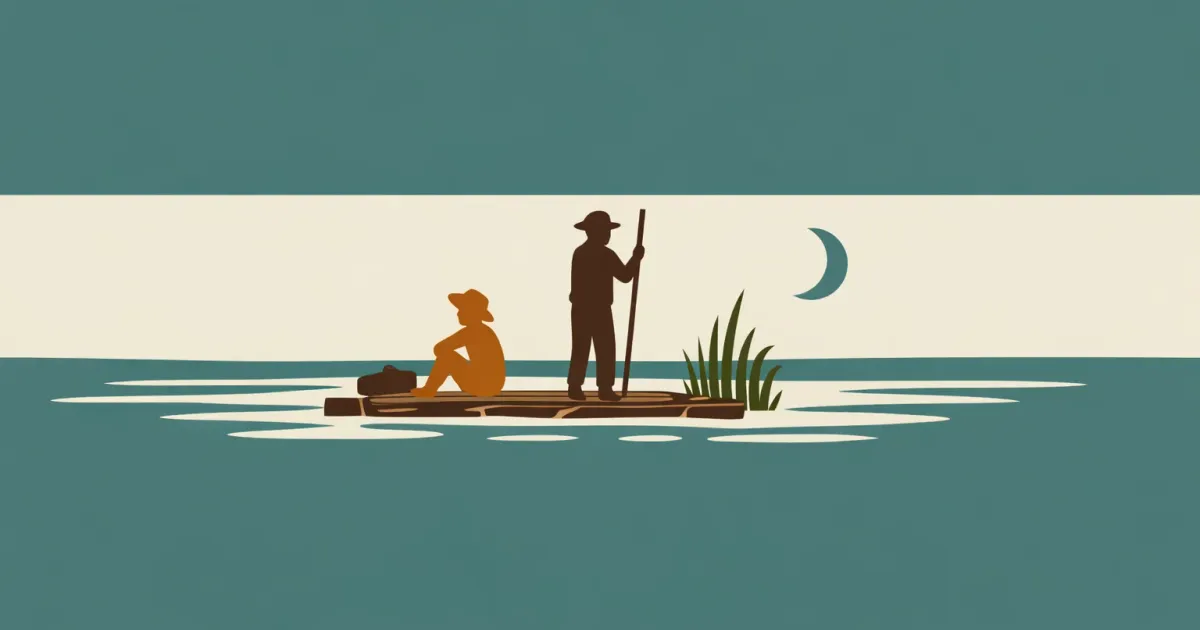
After the Grangerford-Shepherdson massacre, Huck finds Jim hidden in the swamp with the repaired raft and a supper of cornpone and buttermilk. They shove off and eat together. This is Huck's comment on how it feels to be back on the water — out from under a feud, a household, and a social code that requires loaded rifles in church pews. The line sounds casual, almost like a throwaway. It is one of the most quoted sentences in the novel because it says, plainly, what the raft means to both of them.
The raft is the novel's one honest space. Shore life, in every episode, turns out to be a performance — the widow's "sivilizing," the Grangerfords' parlor gentility, the revival preacher's tent, the duke and the king's whole repertoire. The raft has no stage and no audience, which is why Huck says it isn't "cramped up and smothery." Twain loads the word "home" with the weight of everything that word is supposed to mean and does not: neither Huck nor Jim has a home they can return to on land, but together, on ten feet of lashed logs, they have one. The pronouns matter, too. The passage begins with "we said" — a joint verdict, Huck and Jim agreeing — before slipping into "you feel" as an open invitation to the reader. For a split second the narration stops being purely Huck's and becomes something like a shared human testimony: freedom is this specific, this plain, this ordinary, and it cannot survive most of the places human beings have built.
"I ain't a-going to tell all that happened—it would make me sick again if I was to do that. I wished I hadn't ever come ashore that night to see such things. I ain't ever going to get shut of them—lots of times I dream about them."
Speaker: Huck Finn (Ch. 18)
Huck has watched from a tree as the Shepherdsons gunned down his friend Buck Grangerford and Buck's cousin in the river. He climbs down, pulls their bodies out of the water, covers Buck's face, and starts to cry. Then the narration refuses to describe what he saw in any more detail. Huck tells the reader directly that he will not tell, and that he still dreams about it. The Grangerford episode ends on this refusal.
This is Twain's cleanest use of narrative silence. Huck has a shaky command of grammar and a chatty style; he will describe a sunrise for half a page. The choice not to describe Buck's corpse is therefore conspicuous, and it does more than any sentimental paragraph could. The silence tells the reader that Huck, who has narrated Pap's delirium tremens and the wreck of the Walter Scott with the same matter-of-fact tone, has finally seen something that breaks the tone. Twain withholds the specific image — the face, the water, the dogs barking at the bank — because he wants the reader's imagination, not his prose, to carry the horror. Structurally, the sentence also ends the Grangerford section with a mark of trauma that Huck carries into the next chapter. He goes back to the raft, eats cornpone with Jim, and praises the feel of the water, but the reader knows a boy who says he dreams about a thing is not done with it. The understatement — "it would make me sick again" — functions the way the raft's silence functions a few pages later. In a book full of talkers, the moral weight is carried by what Huck cannot bring himself to say.
"The average man's a coward. In the North he lets anybody walk over him that wants to, and goes home and prays for a humble spirit to bear it. In the South one man all by himself, has stopped a stage full of men in the daytime, and robbed the lot."
Speaker: Colonel Sherburn (Ch. 22)
Sherburn has just shot old Boggs in the street in broad daylight. A mob forms at Sherburn's gate to lynch him. He steps onto his porch roof with a double-barreled shotgun and, without raising his voice, tells the mob exactly what he thinks of them. This sentence is the core of his speech, which runs for two pages and ends with the mob slinking home.
Sherburn is the closest thing the novel has to Twain's own voice stepping out from behind the curtain. Huck, who narrates the scene, has no opinion to offer; he just reports. Sherburn's argument is that courage in American life is a pose, that juries acquit murderers because they are afraid of the murderers' friends, and that a mob is cowardice organized under a leader. The speech functions as the novel's diagnostic report on every group scene so far — the Grangerford feud, the Royal Nonesuch audience, the Wilks townspeople about to dig up a coffin. None of these crowds can act without a "half-a-man" to start the yelling. The chilling turn is that Sherburn's diagnosis is delivered by a murderer. Twain will not let the reader simply enjoy the takedown of mob cruelty; the man telling the truth about Southern violence is himself a killer, and the townspeople, even after being shamed, never bring him to justice. The scene is one of the novel's most efficient demolitions of the myth of Southern honor — honor here is just the private arrogance of armed men and the public cowardice of the crowd that cannot face them.
"You can't pray a lie—I found that out."
Speaker: Huck Finn (Ch. 31)
After the king sells Jim to Silas Phelps for forty dollars, Huck tries to pray for guidance and finds that the words will not come. He realizes he cannot pray for forgiveness while still intending to help Jim escape — he is "playing double." This is his verdict on the attempt. He states it as a plain discovery, the way a child reports a physical fact: you cannot pray a lie, and he has just found that out.
Huck has received a relentless religious education from the widow and Miss Watson, but none of it has ever shown him, from the inside, what prayer actually is. In this moment he learns, on his own, that prayer requires the pray-er to mean it — that a performance of piety is not the thing itself. The insight is devastating in context, because it cuts directly against the version of Christianity the novel has been indicting since Chapter 1. The Grangerfords pray in a church with rifles between their knees. The fake pirate at the camp meeting gets eighty-seven dollars from praying townspeople. Miss Watson prays daily and owns Jim. Huck, who thinks he is too corrupt to pray, has in fact just discovered the one moral requirement all those adults have skipped. Twain is building toward the scene's climax: if you cannot pray a lie, then the only honest prayer left to Huck is the one in which he admits he will not turn Jim in. The theology Huck's elders have given him tells him that prayer leads to salvation; the theology his own conscience is teaching him tells him that honesty leads to damnation. The rest of the chapter resolves the contradiction.
"All right, then, I'll go to hell"—and tore it up.
Speaker: Huck Finn (Ch. 31)
Huck has written a letter to Miss Watson telling her where Jim is being held. For a moment he feels "washed clean of sin." Then he sits with the paper in his hand and remembers the trip — Jim standing his watches, Jim's grief in the fog, Jim calling him the best friend he ever had. He trembles, decides "forever, betwixt two things," says this line out loud, and rips up the letter. It is the most famous sentence in the book.
The line is often quoted triumphantly, as if Huck has chosen good over evil. The scene is more difficult than that. In Huck's own understanding, he has just chosen hell. He has not been converted to abolitionism; he holds no theoretical position about slavery; he has simply weighed a concrete set of memories of Jim against a concrete threat of damnation and chosen Jim. The reader, standing outside Huck's moral framework, sees the opposite — that Huck has chosen the only thing in his world worth choosing, and that the society that taught him to call this choice sin is the thing that is damned. Twain's technique here is the achievement the chapter is famous for: he gives the reader Huck's language intact, preserves Huck's sincere belief that he is doing wrong, and trusts the reader to do the moral translation. The italicized "go" gives the line its lilt — Huck is not grimly accepting punishment, he is committing to it with something like bravado. And the small stage direction — "and tore it up" — is one of the quietest yet most decisive actions in American fiction. Until this moment, everything in Huck's conscience has been rehearsal. Tearing the letter is the performance.
"But I reckon I got to light out for the Territory ahead of the rest, because Aunt Sally she's going to adopt me and sivilize me, and I can't stand it. I been there before."
Speaker: Huck Finn (Ch. The Last)
These are among the last words of the book. Tom is recovering from his bullet wound. Jim is free, with forty dollars in his pocket and Aunt Polly making a fuss over him. Tom proposes the three of them go have "howling adventures amongst the Injuns" in the Territory. Huck, in his own closing paragraph, says he has to go ahead of them anyway, because Aunt Sally wants to civilize him and he refuses to go through all that again. Then he signs off.
The closing works on three levels at once. As a joke, it brings the book full circle: the novel opened with the widow's attempt to "sivilize" Huck, and it ends with Huck running from another attempt by another well-meaning woman. As a structural move, it refuses any tidy resolution — Huck will not be assimilated back into the society the book has spent four hundred pages exposing. As a piece of American myth, the image of a boy "lighting out for the Territory" ahead of civilization becomes one of the country's most quoted self-images, picked up by Hemingway, Kerouac, and countless frontier stories afterward. But the line is also sadder than it reads. The Territory — the unorganized land west of Arkansas — is not actually free; it is Indian Country, occupied by people Tom has already fantasized about having adventures "amongst." Huck's only escape from a Southern society he cannot fix is to ride toward a new injustice the country is already committing. The fact that Jim, the one character the novel has asked the reader to see most clearly, is not invited on this westward trip is also noticeable. Freedom, at the book's close, is still a white boy's privilege. Huck signs off with "YOURS TRULY, HUCK FINN" — one last reminder that the whole book has been narrated in his voice, and that the country, if it is going to understand itself, is going to have to learn to listen to that voice.