Context
About the Author
Arthur Miller was born in Harlem in 1915 to a prosperous Polish-Jewish immigrant family that lost nearly everything in the 1929 crash. That childhood reversal — watching his father go from factory owner to broke — shaped Miller's lifelong obsession with the gap between how Americans present themselves and what they actually are. Before The Crucible, he had already written Death of a Salesman (1949), which established him as the country's preeminent dramatist. He was forty-seven years old when he attended the Salem witch trial records at the Historical Society in Salem, Massachusetts, and what he found there felt sickeningly familiar.
Miller was not an academic playwright. He grew up working in an auto-parts warehouse, played football in high school, and came to writing through the University of Michigan's theater program — not through the New York literary establishment. This working-class grounding shows in his dialogue, which favors blunt, muscular sentences over literary ornamentation, and in his instinct for characters who are defined by their labor: farmers, salesmen, longshoremen.
Miller's personal circumstances during the writing of The Crucible make the play's themes uncomfortably autobiographical. In the early 1950s, the House Un-American Activities Committee (HUAC) was investigating communist sympathies in the entertainment industry, and Miller's close friend, director Elia Kazan, agreed to name names — to identify colleagues who had attended Communist Party meetings. Kazan's decision shattered their friendship and became the personal wound behind The Crucible. Miller saw in the Salem trials the same dynamic he was watching unfold in Washington: a system where accusation was proof, where naming others was the price of survival, and where principled silence was treated as confession.
In 1956, three years after The Crucible opened, Miller himself was called before HUAC. He admitted attending Communist writers' meetings in 1947 but refused to name anyone else who had been present — essentially making the same choice John Proctor makes in Act Four. He was convicted of contempt of Congress (later overturned on appeal). The Crucible was, in this sense, not just an allegory but a rehearsal for a decision Miller would actually have to make.
Within Miller's body of work, The Crucible shares DNA with all his major plays but differs in one crucial respect: it is the only one set outside the twentieth century. Death of a Salesman, All My Sons, A View from the Bridge — all are contemporary domestic dramas about men destroyed by their failures of integrity. By setting The Crucible in 1692, Miller gained distance that allowed him to write about McCarthyism without the constraints of realism, and he discovered that the historical setting gave the play a universality his contemporary plays lack. Salem is every community that has turned on its own members.
Historical Background
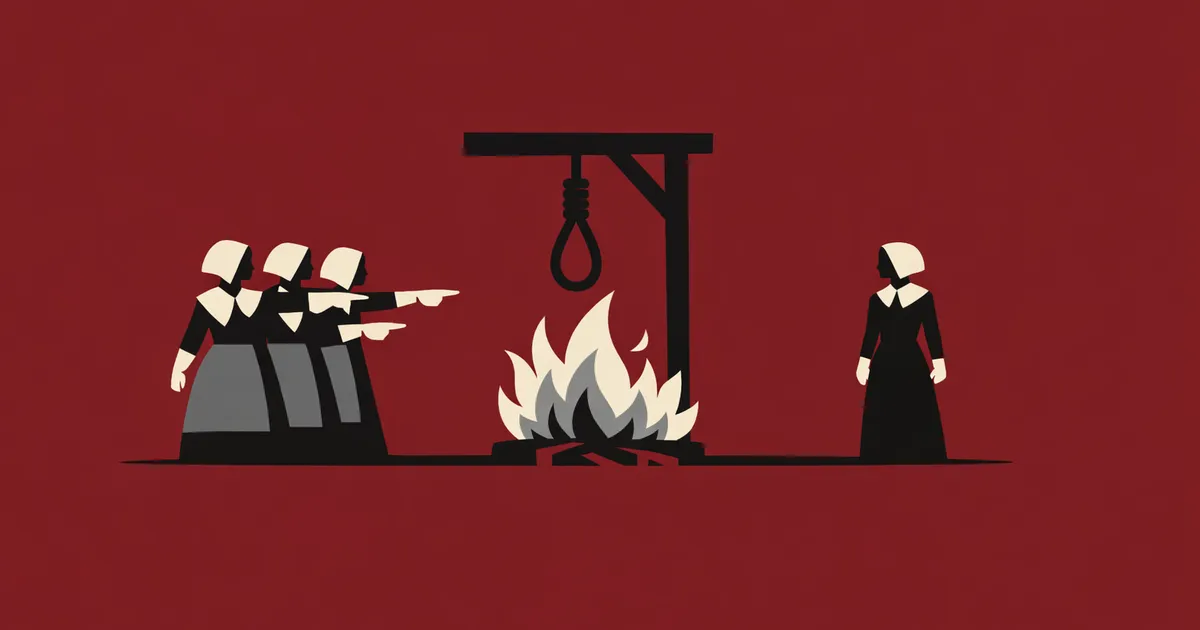
The Salem witch trials of 1692 were a brief, intense eruption of judicial murder in colonial Massachusetts. Between February 1692 and May 1693, more than two hundred people were accused of witchcraft, thirty were found guilty, and nineteen were hanged (plus one, Giles Corey, pressed to death for refusing to enter a plea). The accusations began among a small group of girls in Salem Village — including the real Abigail Williams, who was eleven, not seventeen as in the play — and spread rapidly through a combination of genuine fear, personal grudges, and a legal system that treated "spectral evidence" (testimony that the accused's spirit appeared to the accuser) as admissible proof.
Miller drew directly from the trial records, and many of the play's most dramatic details are historically accurate: Giles Corey's pressing, Tituba's confession, the Putnam family's land disputes, Reverend Parris's unpopularity, and the eventual collapse of the trials when the accusations began reaching too high into the social hierarchy. Miller's most significant departures were raising Abigail's age, inventing the affair between Abigail and Proctor, and compressing the timeline.
Miller began researching the play in the Salem courthouse, reading the actual trial transcripts, and he later described the experience as physically unsettling. The records revealed a community that was already fracturing before the accusations began — land disputes, ministerial controversies, tensions between the agricultural Salem Village and the mercantile Salem Town, and the lingering trauma of King William's War, which had driven refugees from the frontier into Salem. The witch trials were not an inexplicable outbreak of madness; they were the violent expression of pressures that had been building for years.
The play's reception shifted dramatically over time. When it opened on Broadway in January 1953, directed by Jed Harris at the Martin Beck Theatre, critics recognized the McCarthy parallels but found the play somewhat schematic — a political argument dressed in period costume. Initial reviews were respectful but cool compared to the rapturous response Death of a Salesman had received. But as McCarthyism collapsed and the play found audiences beyond its immediate political context, its reputation grew. By the 1960s, The Crucible was being performed more frequently than any other Miller play, and it has since become one of the most produced dramas in the American repertoire.
The play's endurance comes from its structural versatility. It has been staged as an allegory for McCarthyism, for apartheid-era South Africa, for the cultural purges in Mao's China, for post-9/11 security politics, and for social-media mob dynamics. Each generation finds a new application because Miller's subject is not any particular witch hunt but the universal mechanics of one: the way fear weaponizes institutions, the way accusation becomes self-perpetuating, and the way individual conscience is ground down by collective pressure. Miller himself resisted limiting the play to a single allegorical reading. "It is not any more an attempt to cure witch hunts than Salesman is a plea for the improvement of working conditions," he wrote. "It is a study in the mass illusion created by institutionalized terror."