Themes & Motifs
The Machinery of Accusation
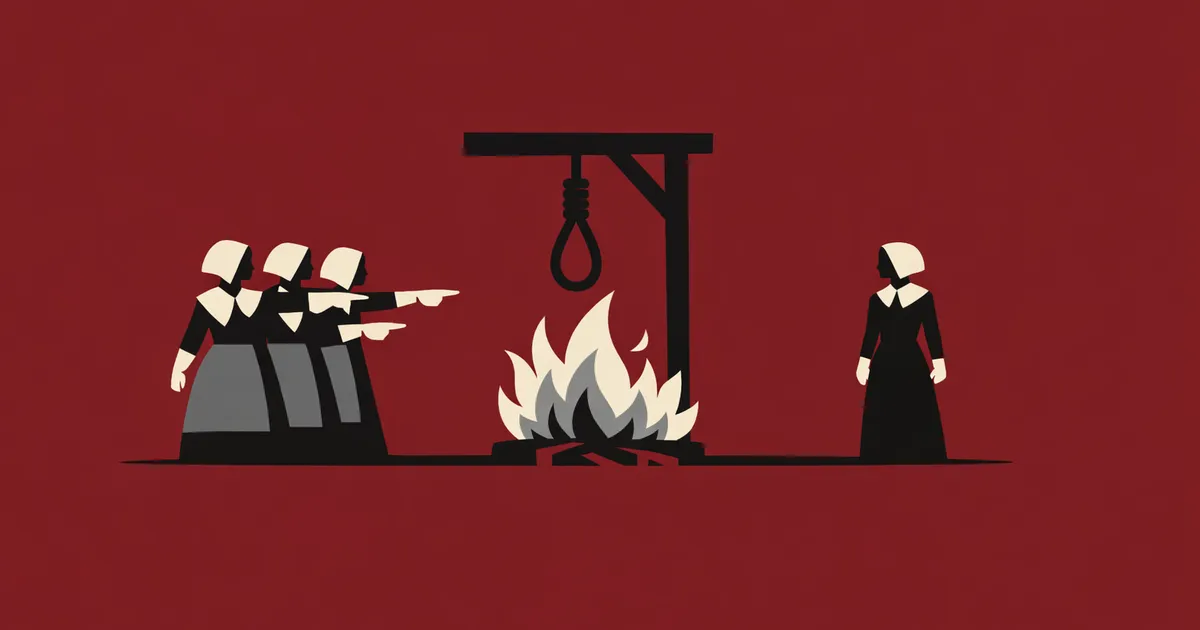
The Crucible's most urgent theme is not witchcraft but the mechanics of how accusations gain unstoppable momentum. Miller shows, with almost clinical precision, how a system designed to find truth instead manufactures guilt. The process begins with Tituba's coerced confession in Act One — a terrified slave told that she will hang unless she names names — and by Act Three, the system has become so entrenched that evidence of innocence is treated as evidence of guilt. When Francis Nurse presents a petition of ninety-one citizens vouching for Rebecca's character, Danforth orders all ninety-one brought in for questioning. The defense becomes the prosecution's next target.
This is not a system gone wrong by accident. Miller argues that accusation becomes self-sustaining once it is coupled with institutional power. Each conviction makes the next one easier, because reversing course would mean admitting the previous convictions were unjust. By Act Four, Danforth cannot pardon the remaining prisoners without implicitly condemning the twelve he has already hanged.
Miller builds the accusation machinery through carefully escalating stages. In Act One, the accusations emerge from a mix of genuine fear (Parris), grief (Mrs. Putnam), and opportunism (Abigail). In Act Two, they become formalized through the court, acquiring the weight of legal authority. In Act Three, the court actively resists attempts to dismantle the process — not because the judges are stupid, but because the process has become inseparable from their own legitimacy.
The key mechanism is what might be called the confession trap. The court offers a binary: confess to witchcraft and live, or deny it and hang. This structure guarantees an ever-growing body of "evidence," because each confession validates the court's assumptions and each refusal to confess is taken as proof of the Devil's hold. Proctor recognizes this logic in Act Four: "I blacken all of them when this is nailed to the church the very day they hang for silence!" His signed confession would not just save his life — it would retroactively justify every execution that preceded it.
Miller wrote the play during the McCarthy era, and the structural parallels are precise: the House Un-American Activities Committee used the same binary (name names or be blacklisted), the same escalation (each naming justified the investigation), and the same conflation of dissent with guilt. But the theme transcends its historical moment because the machinery Miller describes — accusation systems that feed on their own outputs — recurs in every era. The witch trial is not an aberration. It is a pattern.
Reputation and Identity
Nearly every character in The Crucible acts, at some point, to protect their name. Parris fears for his reputation throughout the play. Abigail insists "my name is good in the village!" Proctor's final act is to tear up a confession because "I cannot have another in my life." The play argues that in a small, theocratic community where public standing determines survival, reputation is not vanity — it is a material resource, as essential as land or livestock.
But Miller pushes the theme further than simple reputation management. For Proctor, the question of his name becomes a question of identity itself. When he asks, "How may I live without my name?" he is not worried about what the neighbors will think. He is asking whether a man who signs his name to a lie can still be himself.
Miller traces the theme of reputation through three distinct registers. For Parris, reputation is a social currency — he hoards it, protects it, and calculates its fluctuations like a merchant tracking his accounts. His terror at the witchcraft accusations is not moral or theological; it is professional. If his household is the source of the scandal, his enemies will drive him from his pulpit. Parris's relationship to his name is entirely external: it is what others think of him.
For Abigail, reputation is a weapon. Her insistence that "my name is good in the village" is not a statement of fact — it is a threat. She uses the machinery of the court to punish anyone who challenges her standing, and her accusations are, in part, reputation management through terror. Elizabeth Proctor's supposed witchcraft is, functionally, a reputation dispute: Abigail believes Elizabeth has "blackened" her name, and the trials give her the power to blacken Elizabeth's in return.
For Proctor, reputation becomes something entirely different in Act Four: it becomes the boundary between self and non-self. When he signs the confession, he is not just lying — he is handing his identity to Danforth and the court. His anguished distinction between a spoken confession (which dies in the air) and a signed one (which will be "nailed upon the church") reveals a man who understands, viscerally, that a written name has a life of its own. Once signed, the confession is no longer his — it is theirs, to be used for their purposes. Tearing the paper is not a political act. It is a refusal to be separated from himself.
The Weight of Private Conscience
The Crucible is a play about public events — courts, hangings, community hysteria — but its emotional core is private. Every major decision hinges on an internal moral struggle that the public system either cannot see or does not care about. Proctor's guilt over his affair with Abigail drives every choice he makes, from his delay in exposing the fraud to his final refusal to sign. Elizabeth's inability to forgive shapes the distance between them, which in turn shapes Proctor's sense of his own worth. Even Hale's crisis is private — a man alone with the knowledge that his expertise has killed people.
Miller suggests that the witch trials succeeded partly because Salem's theocratic structure left no room for private conscience. In a community where moral life was entirely public — where church attendance was monitored, sins were confessed before the congregation, and dissent was equated with disloyalty — there was no space for the kind of quiet, individual moral reckoning that might have slowed the hysteria.
Proctor's central struggle dramatizes the collision between private guilt and public identity. His affair with Abigail is, in Puritan terms, an unforgivable sin — but it is also a private one, known only to himself, Elizabeth, and Abigail. The play's plot is driven by the threat of that private sin becoming public. When Proctor finally does confess in court — "I have known her, sir. I have known her" — the confession is simultaneously a weapon (meant to expose Abigail's motive) and a surrender (he is destroying his public self to save others). Miller makes the moment excruciating because Proctor gains nothing from it: Elizabeth's lie immediately nullifies his confession, and he is arrested anyway.
Elizabeth's private conscience follows a quieter but equally devastating arc. Her admission in Act Four — "It needs a cold wife to prompt lechery" — is not Miller excusing adultery. It is Elizabeth recognizing that her own failure of emotional generosity contributed to the conditions of the affair. This is the play's most radical claim about conscience: that honest self-examination requires acknowledging your own role in the disasters that hurt you. Elizabeth does not forgive Proctor by saying this. She does something harder — she forgives herself for being unable to forgive him, and in doing so, releases them both.
Hale's private crisis offers the starkest version of the theme. He arrives in Salem armored by certainty — his books, his training, his faith in the court system — and by Act Four, every piece of that armor has been stripped away. His line "I come to do the Devil's work" is not theological despair; it is a man confessing that his expertise was the instrument of mass murder. Hale cannot fix what he has broken, and his desperate attempts to save the remaining prisoners by urging them to lie are the actions of a conscience that will not let him rest but cannot offer him redemption.
Authority and Its Abuses
Power in The Crucible flows through institutions — the church, the court, property ownership — and Miller tracks how each institution becomes a tool of persecution when its authority is threatened. Parris uses his pulpit to consolidate power, demanding the deed to his house and treating dissent as heresy. Putnam uses the trials to seize his neighbors' land — Giles Corey's deposition accuses him directly. Danforth uses the court to maintain his own credibility. And Abigail, who has no institutional authority of her own, creates a new kind of power by becoming the court's indispensable witness.
The play's Salem is not a place where authority has collapsed. It is a place where authority has become absolute, and absolute authority, Miller argues, does not prevent injustice — it guarantees it.
Miller structures the play so that each act features a different institutional setting — a bedroom (private life), a farmhouse (domestic life), a courtroom (public life), a jail cell (state power over the body) — and each setting reveals a different face of authority's corruption. In Parris's bedroom, authority is personal and petty: Parris worries about his salary, his firewood, his reputation. In the Proctor farmhouse, authority is domestic: Mary Warren's newfound power as "an official of the court" inverts the household hierarchy. In the courtroom, authority is procedural: Danforth follows the forms of justice while gutting its substance. In the jail, authority is naked: chains, executions, the state's absolute power over life and death.
Proctor's challenge to authority is distinctive because it is not ideological — it is instinctive. He does not argue against theocracy as a system. He simply refuses to submit to authorities he does not respect. His contempt for Parris's preaching, his resistance to Putnam's land-grabbing, his refusal to sign Danforth's confession — these all spring from the same impulse, which Miller describes in the stage directions: "He was the kind of man — powerful of body, even-tempered, and not easily led — who cannot refuse support to partisans without drawing their deepest resentment."
The most chilling aspect of Miller's treatment of authority is his demonstration that the court's power depends on the participation of its victims. The confession system requires the accused to validate their accusers. When Proctor refuses to name others — "I speak my own sins; I cannot judge another" — he is not just protecting his friends. He is refusing to participate in the system's self-replication. His refusal is what makes him dangerous to Danforth, because it exposes the one thing the court cannot survive: a person who would rather die than contribute to the lie.
Guilt and Forgiveness
Guilt in The Crucible is contagious. Proctor carries the guilt of his affair. Elizabeth carries the guilt of her coldness. Hale carries the guilt of his complicity. Even the community itself seems driven by a collective guilt that the trials temporarily purge — Miller notes in his Act One commentary that the witch hunt was "a long overdue opportunity for everyone so inclined to express publicly his guilt and sins, under the cover of accusations against the victims." The trials are, in one reading, a community's attempt to externalize its own internal failings.
Forgiveness, by contrast, is almost entirely absent from Salem's world. The Puritans, as Miller describes them, "had no ritual for the washing away of sins." Without a mechanism for forgiveness, guilt accumulates until it becomes unbearable, and the witch trials offer a grotesque alternative: blame someone else.
The Proctor marriage is the play's most sustained examination of guilt and forgiveness, and Miller refuses to resolve it neatly. John wants Elizabeth's forgiveness for the affair, but he also resents having to earn it. Elizabeth withholds forgiveness not out of cruelty but because she cannot manufacture an emotion she does not feel. Their marriage is a standoff between two kinds of integrity — his refusal to grovel and her refusal to pretend — and neither is entirely wrong.
The breakthrough comes in Act Four, and it is mutual rather than one-sided. Elizabeth's confession — "It needs a cold wife to prompt lechery" — is not absolution for John. It is her recognition that guilt, honestly examined, reveals complicity on both sides. And Proctor's decision to tear the confession is not primarily about the court; it is about forgiving himself enough to make a choice he can live with — or, more precisely, die with. When Elizabeth says "He have his goodness now," she is acknowledging that his death has accomplished something their marriage could not: it has given him back to himself.
Miller also uses guilt structurally, showing how individual guilt feeds collective persecution. Mrs. Putnam's guilt over her dead babies drives her to seek supernatural explanations — someone must have murdered them. Parris's guilt over his failing ministry drives him to embrace the witchcraft narrative — it deflects attention from his leadership. Putnam's guilt over his land-grabbing is transformed into righteous accusation. In each case, private guilt is laundered through public accusation, and the trials become a machine for converting personal failure into communal blame. The play's tragic insight is that a society without a mechanism for honest self-examination will inevitably find scapegoats.