Summary
Overview
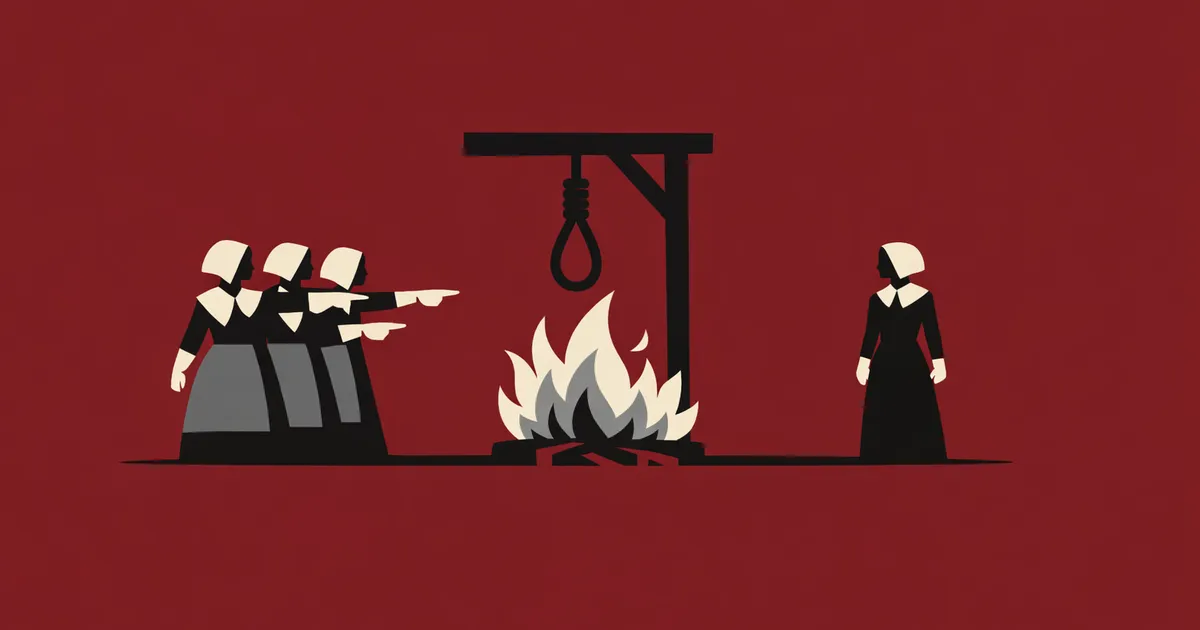
The Crucible is Arthur Miller's dramatization of the 1692 Salem witch trials, and it remains one of the most frequently performed American plays for good reason: it turns a historical nightmare into a story about what happens when fear makes otherwise decent people dangerous. Set in the small Puritan settlement of Salem, Massachusetts, the play follows John Proctor, a farmer whose past affair with a teenage girl named Abigail Williams puts him at the center of a widening hysteria. When Abigail and a group of girls begin accusing townspeople of witchcraft, the community fractures along old fault lines — land disputes, grudges, religious anxiety — and a theocratic court arrives to impose order through terror. Proctor must decide whether to expose Abigail's fraud and risk destroying himself, or stay silent while innocent people hang.
What makes the play lasting is its refusal to simplify. Miller doesn't present Salem as a place of pure villainy — he shows a community that built its identity on rigid moral certainty, and then watches what happens when that certainty becomes a weapon. The accusers are not all liars. The judges are not all corrupt. The victims are not all saints. And the central question — how do you act with integrity when every choice costs you something — has no clean answer.
Miller wrote The Crucible in 1953, during the height of Senator Joseph McCarthy's anti-communist hearings, and the parallels are intentional but not limiting. The play works as political allegory, but it survives because it transcends the specific moment that inspired it. Miller's structural innovation was to take a historical event — one documented in court records, depositions, and personal accounts — and compress it into a four-act domestic tragedy with the shape of classical drama. He raises Abigail's age to make the affair with Proctor plausible, fuses several historical figures into composite characters, and tightens the timeline to create unbearable dramatic pressure.
Within Miller's body of work, The Crucible represents his most direct engagement with the question that haunts all his major plays: what does a man owe to his community, and what does he owe to himself? Where Death of a Salesman examines this through economic self-deception, The Crucible stages it as a literal matter of life and death. The play also marks Miller's sharpest critique of institutional authority — not just the court, but the entire apparatus of a society that equates dissent with disloyalty. Its four-act structure mirrors the trajectory of the hysteria itself: ignition, escalation, crisis, and the grim morning after.
Act One
Act One opens in the bedroom of Reverend Samuel Parris, whose daughter Betty lies unconscious after being caught dancing in the forest with a group of girls and Parris's slave, Tituba. Parris is terrified — not primarily for his daughter, but for his reputation. Rumors of witchcraft are already spreading through Salem, and he has enemies in the congregation who would use any scandal to drive him from his pulpit.
The act introduces the community's key tensions through a series of visitors. Thomas Putnam, a wealthy landowner with old grievances, pushes Parris toward declaring witchcraft — partly out of genuine belief, partly because the chaos serves his land-grabbing interests. His wife Ann has lost seven babies and sent her daughter Ruth to Tituba to contact their spirits. Rebecca Nurse, a respected elder, counsels patience and prayer, suggesting the girls are simply being children. John Proctor arrives and clashes with Parris over his leadership, revealing a man who distrusts institutional authority but carries a private guilt: his affair with Abigail Williams, who served in his household until his wife Elizabeth dismissed her.
Abigail, meanwhile, is managing the other girls. In a private moment, she threatens them into silence about what really happened in the forest — including the fact that she drank blood as a charm to kill Elizabeth Proctor. When Reverend John Hale arrives from Beverly, an eager witchcraft expert carrying heavy books of demonology, the act accelerates toward its climax. Under Hale's questioning, Tituba — terrified of being hanged — confesses to consorting with the Devil and begins naming names. Abigail seizes the moment, joining the confession and crying out names of townspeople. Betty rises from her bed and joins in. The act ends in a frenzy of accusation.
Miller structures Act One as a slow burn that detonates in its final minutes. The first two-thirds of the act are almost entirely expository — Miller even interrupts the action with prose passages about Salem's history, the Putnam family's grievances, and the social dynamics of Puritan New England. This is unusual for a play, and it signals that Miller wants the audience to understand the structural conditions that make the hysteria possible before showing the hysteria itself. The witch trials don't erupt from nowhere; they grow from a community already primed by paranoia, property disputes, and the psychological strain of living under theocratic authority.
The act's turning point is Tituba's confession, and it demonstrates Miller's understanding of how coerced testimony works. Tituba confesses not because she is guilty but because confession is the only way to survive — a dynamic that will repeat throughout the play. Hale literally tells her what to say, feeding her the names and the narrative structure of a proper confession. When Abigail joins in, she is not imitating Tituba; she is recognizing that accusation is power. The girl who began the act as a frightened teenager trying to avoid punishment ends it as the most powerful person in Salem. Miller compresses this transformation into a single scene, and the speed is the point — the machinery of persecution, once started, runs faster than anyone expects.
Act Two
Act Two shifts to the Proctor farmhouse, eight days later. The opening scene between John and Elizabeth is a masterpiece of domestic tension — they discuss the farm, the weather, a rabbit she cooked, and beneath every line runs the unspoken weight of his adultery. Elizabeth tells John that the court has now jailed fourteen people, with Abigail as its star witness. She urges him to go to Salem and expose Abigail's fraud, since Abigail told him privately that the girls' afflictions had nothing to do with witchcraft.
The argument that follows exposes the wound in their marriage. John resists going because it would mean being alone with Abigail again, and Elizabeth reads his reluctance as lingering desire. Their servant Mary Warren returns from court with a poppet (a rag doll) she made during the proceedings and reveals that Elizabeth's name has been "somewhat mentioned" — a coded warning. When Reverend Hale visits to question the Proctors about their Christian character, the conversation turns dangerous: John cannot recite all Ten Commandments, pointedly forgetting the one about adultery. Elizabeth reminds him.
The act climaxes when Ezekiel Cheever and Marshal Herrick arrive with a warrant for Elizabeth's arrest. Abigail has accused her of attempted murder via witchcraft — claiming that Elizabeth's spirit stabbed her with a needle. The evidence is the poppet Mary Warren brought home, which has a needle stuck in it. John realizes Abigail is targeting Elizabeth to clear a path to him. He forces Mary Warren to agree to testify in court that the poppet was hers and that the girls are frauds, setting up the confrontation of Act Three.
Miller uses the domestic space of Act Two to show how public hysteria infiltrates private life. The Proctor farmhouse should be a refuge, but it isn't — the court's reach extends into their kitchen, their marriage bed, their relationship with their servant. Mary Warren's transformation is particularly telling. In Act One she was a frightened girl; now she asserts authority over Elizabeth, declaring herself "an official of the court." The servant has become the mistress's accuser, and this inversion of social hierarchy is exactly what makes the witch trials so destabilizing — they upend every established power structure.
The act's dramatic irony is devastating. John's forgotten commandment — "Thou shalt not commit adultery" — is not just a character detail; it's the play's thesis in miniature. His inability to speak the sin he actually committed foreshadows his inability to expose Abigail without exposing himself. Miller builds the trap carefully: the only way to stop the trials is to reveal Abigail's motive, which is to replace Elizabeth; but revealing Abigail's motive means confessing adultery, which destroys Proctor's reputation and credibility. Every path forward requires self-destruction, and this structural bind gives the play its tragic architecture.
Act Three
Act Three takes place in the vestry room of the Salem meeting house, adjacent to the court. Giles Corey bursts in trying to defend his wife Martha, who has been arrested for reading books. Francis Nurse has brought a petition signed by ninety-one citizens attesting to the good character of Rebecca Nurse, Elizabeth Proctor, and Martha Corey. John Proctor arrives with Mary Warren, who is prepared to testify that the girls' accusations are pretense.
What follows is a systematic demolition of every piece of evidence the defendants present. Deputy Governor Danforth, who presides over the court, treats each attempt at defense as an attack on the court's legitimacy. The petition of ninety-one names becomes a list of suspects. Giles Corey's deposition about Thomas Putnam using the trials to seize land is dismissed because Giles will not name his informant — knowing the man would be arrested. Proctor presents Mary Warren's deposition stating that the girls were pretending, and Danforth agrees to question the girls.
Abigail denies everything. When pressed, she turns the tables — she and the other girls begin shivering, claiming Mary Warren's spirit is attacking them as a cold wind. Mary, terrified, starts to waver. In desperation, Proctor confesses his adultery with Abigail to prove her motive. Danforth calls in Elizabeth to confirm, but Elizabeth — who has never told a lie — lies to protect her husband's name, not knowing he has already confessed. Her denial destroys Proctor's credibility. Abigail leads the girls in a crescendo of fake terror, and Mary Warren breaks, turning on Proctor and accusing him of forcing her to work for the Devil. Proctor is arrested. Hale, recognizing the injustice, denounces the proceedings and quits the court.
Act Three is the structural pivot of the play, and Miller builds it as a courtroom drama that exposes the court itself as the most dangerous force in Salem. Danforth's logic is airtight and terrifying: he has already hanged twelve people on the girls' testimony, so if the girls are lying, he has committed murder. Therefore, the girls cannot be lying. This is not stupidity — it is the logic of institutional self-preservation, and Miller makes clear that Danforth understands the stakes perfectly. His question to Francis Nurse — "Do you know that near to four hundred are in the jails from Marblehead to Lynn, and upon my signature?" — is not a boast. It is a threat. The weight of those four hundred arrests means the court cannot afford to be wrong.
The scene where Elizabeth lies to protect John is the play's cruelest irony. Miller has established her as a woman of absolute honesty — Proctor himself tells the court, "In her life, sir, she have never lied." When she is brought in and asked if her husband is a lecher, she does the one thing no one expected: she lies, out of love. And that single lie — the only compassionate falsehood in a play full of self-serving ones — is what condemns her husband. Miller's point is savage: in a system built on lies, the truth cannot save you, and love makes you a better liar than self-interest ever could.
Act Four
Act Four opens months later, on the morning of John Proctor's scheduled execution. The setting is a jail cell, and the tone has shifted from the frenzy of Act Three to something exhausted and hollow. Sarah Good and Tituba share delirious fantasies about the Devil coming to take them to Barbados. Parris, gaunt and frightened, reveals that Abigail has stolen his savings and fled Salem with Mercy Lewis — proving her fraud but too late to matter. Neighboring Andover has rejected its own witch court, and Parris fears rebellion in Salem if respected citizens like Rebecca Nurse and John Proctor are hanged.
Reverend Hale, who has returned to Salem not as the court's agent but as a broken man trying to prevent more deaths, begs Elizabeth to convince John to confess. Danforth refuses to postpone the executions, arguing that a reprieve would undermine the legitimacy of the twelve already hanged. Elizabeth is brought to John in his cell. In their final conversation, she tells him of Giles Corey's death — pressed to death with stones for refusing to enter a plea, his last words "More weight." She also, for the first time, acknowledges her own role in their estrangement: "It needs a cold wife to prompt lechery."
John decides to confess, then recoils when the court demands he sign his name to a written document that will be posted on the church door. He will say the words but will not sign, because his name is all he has left. When Danforth insists, Proctor tears the confession apart. "Because it is my name!" he cries. "Because I cannot have another in my life! Because I lie and sign myself to lies! Because I am not worth the dust on the feet of them that hang! How may I live without my name? I have given you my soul; leave me my name!" He is led to the gallows with Rebecca Nurse. Elizabeth, weeping, refuses Hale's plea to stop him: "He have his goodness now. God forbid I take it from him!"
Act Four strips away everything that made the earlier acts move — the arguments, the evidence, the maneuvering — and leaves only the question of whether John Proctor will choose to live as a liar or die as himself. Miller structures the act as a reverse confession scene. In the Salem trials, confession meant survival: admit to witchcraft you did not commit, and you live. Refuse to confess, and you hang. Proctor's final choice inverts this: he confesses (truthfully, this time) to having seen the Devil, but he will not sign his name to it, because signing means lending his reputation to the court's lie. The distinction between spoken and written confession might seem absurd, but Miller makes it the hinge of Proctor's integrity. A spoken confession dies in the air; a signed one becomes a public instrument that condemns others.
Giles Corey's death, reported secondhand through Elizabeth, functions as a mirror for Proctor's choice. Corey's refusal to plead — and his final words, "More weight" — represents the most absolute form of resistance: silence that costs everything. Proctor cannot match that silence; he is too honest about his own failings to claim sainthood. But he can refuse to let his name be used. Elizabeth's final line — "He have his goodness now" — is the play's emotional resolution, and it carries a specific theological weight. Throughout the play, Proctor has believed himself damned by his adultery, unworthy of the moral stand that Rebecca Nurse makes effortlessly. His refusal to sign is not sainthood; it is the discovery that goodness is not perfection but the willingness to pay for your own sins without dragging others down with you.