Exam & Discussion Questions
These are the questions your teacher is most likely to ask in class discussion, on quizzes, and on exams. Each comes with a model answer you can study from — use the accessible answers for short-response prep and the Detailed Analysis sections when you need to go deeper.
Chapter 1
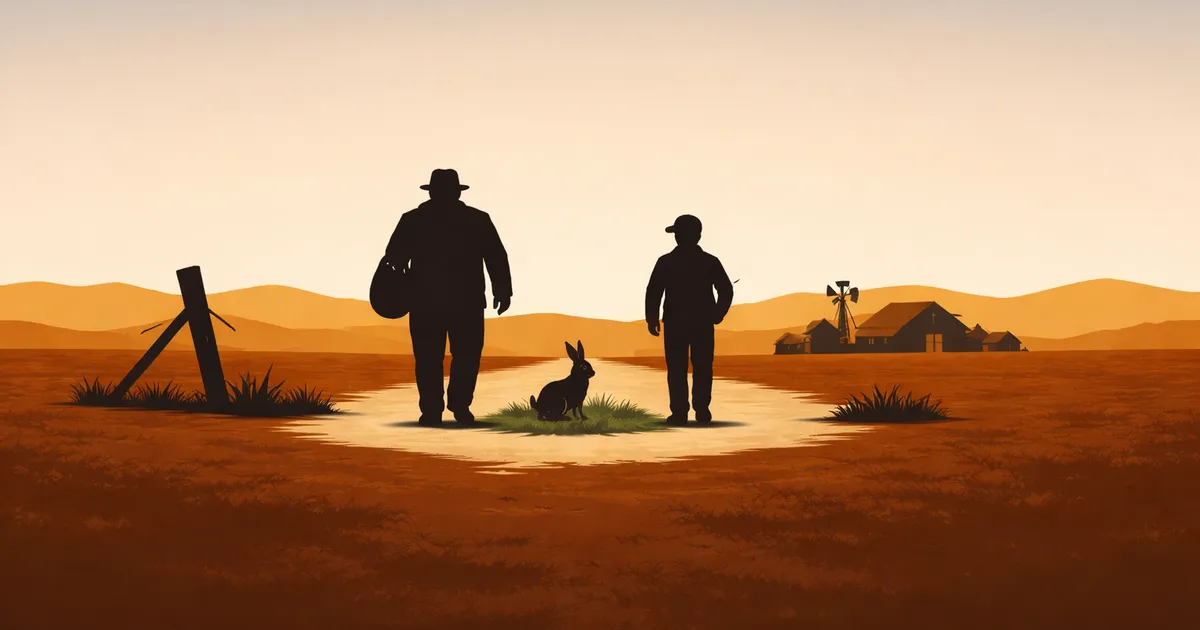
1. Why does George tell Lennie to come back to the clearing by the river if anything goes wrong?
George knows from experience that Lennie will get into trouble — the incident in Weed proved that. By establishing a meeting point in advance, George creates a safety plan: if things go bad at the ranch, Lennie should hide in the brush by the pool and wait for George to come find him. It's a practical measure born from George's awareness that he can't watch Lennie every minute, but it also reveals how deep their bond runs. George doesn't plan to abandon Lennie; he plans to come back for him.
2. What does the dead mouse in Lennie's pocket tell us about his character?
Lennie carries the dead mouse because he likes to pet soft things — it's a sensory compulsion he can't control. George takes it away and throws it across the pool, but Lennie retrieves it when George isn't looking. The mouse establishes the central pattern of the novella: Lennie's love for soft things and his inability to touch them gently. It also shows his tendency to hide things from George and his childlike reasoning — he sees nothing wrong with carrying a dead animal because it feels nice.
The mouse is the first item in a chain of escalating destruction that structures the entire novella: mice, the puppy, Curley's wife. Each object of Lennie's affection is larger and the consequences of his grip more severe. Steinbeck introduces this pattern in the opening pages so that every subsequent act of unintentional violence feels both surprising and inevitable. The mouse also establishes Lennie's relationship with death — he doesn't understand it as permanent or meaningful. His response to killing the mouse ("I could pet it with my thumb while we walked along") treats a dead animal as a comforting object rather than a loss, which foreshadows his confusion after killing Curley's wife.
3. How does Steinbeck use the natural setting of Chapter 1 to establish tone and foreshadow events?
The chapter opens with a detailed description of the Salinas River clearing — golden foothills, green water, willows and sycamores, rabbits sitting on the sand. It reads like a paradise, calm and warm. But when George and Lennie arrive, the wildlife scatters: the heron flies away, the rabbits disappear. This pattern — human presence disrupting natural peace — sets the tone for the entire novella and foreshadows the violence that will return to this exact spot in the final chapter.
Steinbeck's opening paragraphs function as a stage direction for the clearing, and the level of detail is unusual for him. He catalogs the trees, the water, the animal tracks with the precision of a naturalist — an approach that serves the "play-novelette" form by establishing the set before the actors enter. The Eden imagery is deliberate: this is a place of abundance and stillness, and Steinbeck wants the reader to associate it with possibility and innocence. Its corruption by the end of the novella — when the heron kills the water snake and George kills Lennie — transforms the clearing from a refuge into a killing ground. The circular structure depends on the reader remembering this opening and measuring it against the closing: same place, same description, entirely different meaning.
Chapter 2
4. What is George's strategy for getting jobs for himself and Lennie, and why is the boss suspicious?
George does all the talking during the job interview and instructs Lennie to stay silent. When the boss asks Lennie direct questions, George answers for him, claiming Lennie is his cousin and was kicked in the head by a horse as a child. The boss is suspicious because it's unusual for one worker to advocate so strongly for another — he assumes George must be taking advantage of Lennie, perhaps stealing his pay. This suspicion reveals the ranch culture's baseline assumption: nobody looks out for anyone else unless there's something in it for them.
5. Why does Curley immediately take a dislike to Lennie?
Curley is small, aggressive, and an ex-boxer. When he meets Lennie, who is much larger, Curley adopts a hostile stance — "he glanced coldly at George and then at Lennie. His arms gradually bent at the elbows and his hands closed into fists." Candy later explains that Curley is "like a lot of little guys. He hates big guys." Curley's aggression toward Lennie isn't personal; it's driven by insecurity about his own size and a need to prove his toughness by dominating larger men.
Curley's hostility toward Lennie establishes a tension that drives much of the novella's middle section and culminates in the fight in Chapter 3. Steinbeck uses Curley to illustrate how power on the ranch operates through aggression rather than authority — Curley has status through his father's ownership, but he craves respect earned through physical dominance. His focus on Lennie is strategic: defeating a giant would prove his toughness to the other men. This calculus backfires catastrophically when Lennie crushes his hand, and Curley's subsequent desire for revenge sets the conditions for the manhunt in Chapter 5. Steinbeck presents Curley's aggression not as aberrant but as a product of the ranch's masculine code, where size and fighting ability determine social standing.
6. What do we learn about Curley's wife from her first appearance in the bunkhouse doorway?
She stands in the doorway of the bunkhouse, blocking the light, wearing a cotton housedress and red mules with ostrich feathers. Her face is "heavily made up" with rouged lips and eyes with "the little sausage curls." She claims to be looking for Curley, but she lingers, talking to George and Lennie longer than necessary. George immediately labels her as trouble: "Jesus, what a tramp." Her first appearance establishes her as someone desperate for attention and conversation in an environment where she has access to neither.
7. How does Steinbeck use the bunkhouse setting to convey the transience of ranch workers' lives?
The bunkhouse is a long, rectangular building with eight bunks, each with an apple box nailed above it for personal belongings. The shelves hold only small items — soap, razors, magazines, medicine — things a man can carry in a bindle. George finds a can of bug killer left by the previous occupant, suggesting the beds cycle through anonymous bodies. The space is communal but impersonal: the men sleep inches apart but know almost nothing about each other's lives. Steinbeck uses the physical details of the bunkhouse to establish that these workers are interchangeable in the eyes of their employers and largely invisible to one another.
8. What does Slim's introduction tell us about his role on the ranch?
Steinbeck introduces Slim with more descriptive care than any other character: "a tall man" who "moved with a majesty only achieved by royalty and master craftsmen." His "hatchet face was ageless" and "his ear heard more than was said to him." Unlike the boss or Curley, whose authority comes from ownership or aggression, Slim's authority comes from competence and character. The other men defer to him naturally. This introduction signals that Slim will function as the novella's moral center — the one character whose judgment the reader can trust.
Chapter 3
9. What is the significance of Carlson's shooting of Candy's dog?
Carlson convinces the bunkhouse that Candy's old, blind, arthritic dog should be put out of its misery. Slim agrees, and Candy, unable to stand against the group's consensus, surrenders. Carlson takes the dog outside and shoots it with his Luger. The scene matters because it establishes two things: first, the community's willingness to destroy what has outlived its usefulness; second, Candy's devastating regret at not doing it himself. Both of these ideas pay off in the novella's ending.
The scene operates as a rehearsal for the ending. Carlson's practical argument — the dog is old, it smells, it suffers — mirrors the practical arguments that could be made about Lennie after he kills Curley's wife: he's dangerous, he can't be controlled, he'll suffer in prison or a cage. But where Carlson acts without emotional investment, George acts with full awareness of what he's losing. Candy's regret becomes the ethical framework: the person who loves should be the one to act. The silence in the bunkhouse after the shot — Steinbeck holds it for a full paragraph, describing the men staring at their cards, waiting for the sound — is one of the novella's most powerful moments. It forces the reader to sit with the men in the aftermath, feeling the weight of a death that mattered to one person and meant nothing to the rest.
10. Why is Candy so eager to join the farm dream, and what does his offer reveal about his situation?
Candy overhears George describing the farm to Lennie and immediately asks to join, offering his life savings — three hundred and fifty dollars, plus his next month's wages. His eagerness reveals his terror: he's old, he's disabled, he's just lost his only companion, and he knows the ranch will fire him as soon as he can't sweep anymore. "They'll can me purty soon. Jus' as soon as I can't swamp out no bunkhouses they'll put me on the county." The farm isn't just a dream for Candy; it's the only alternative to destitution and death.
11. How does the fight between Curley and Lennie affect the dream's viability?
Curley attacks Lennie without provocation, punching him repeatedly in the face while Lennie refuses to fight back. George finally yells at Lennie to defend himself, and Lennie grabs Curley's fist and crushes it. Slim forces Curley to claim he caught his hand in a machine. On the surface, the incident is resolved — but it creates a new enemy. Curley now has a personal grudge against Lennie, and when Lennie later kills Curley's wife, Curley's desire for revenge ensures there will be no mercy. The fight introduces the violence that will eventually destroy the dream.
Steinbeck's placement of the fight is precise: it comes immediately after the dream has reached its peak of tangibility. George has done the math, Candy has committed his money, and for the first time the farm seems genuinely possible. Then Curley walks in and picks a fight, and the chapter ends with crushed bones and blood. The juxtaposition is Steinbeck's clearest structural argument that violence and hope cannot coexist in this world. Lennie's response also deepens the novella's central irony about strength: the same hands that could build a farm and tend rabbits are the hands that crush a man's fist into pulp. Lennie's strength is simultaneously his contribution to the dream (he's the best worker on the ranch) and the force that will destroy it.
12. What does George's confession to Slim about Lennie reveal about their history?
George tells Slim that he knew Lennie's Aunt Clara and promised to look after him. He admits he used to play cruel tricks on Lennie — telling him to jump in rivers, getting laughs at his expense — until the day Lennie nearly drowned. After that near-tragedy, George stopped: "He was so damn nice to me for pullin' him out. Clean forgot I told him to jump in." The confession reveals that George's guardianship began with guilt and evolved into genuine devotion. It also shows that Slim is the only person George trusts enough to tell the truth.
This confession is one of the novella's only glimpses into George and Lennie's past, and Steinbeck places it strategically — just before the dog's shooting, the dream scene, and the fight. George's candor with Slim establishes a bond between the two that pays off in the final chapter, when Slim alone understands what George has done. The near-drowning story also complicates George's character: he is not a saint who has always cared for Lennie but a flawed man who learned compassion through causing harm. This makes his final act more complex — he kills Lennie not out of pure altruism but out of a relationship shaped by guilt, responsibility, love, and the knowledge that he is the only person who understands what Lennie needs.
13. How does the mood in the bunkhouse change after the dog is shot?
After Carlson takes the dog outside, the men sit in heavy silence. Steinbeck holds this silence for a full paragraph — describing the men staring at walls, fiddling with cards, avoiding eye contact. When the shot rings out, Candy turns to the wall. No one speaks about it directly. The mood shifts from casual evening activity to something thick and uncomfortable. Even the men who supported the decision seem to feel the weight of what happened. The silence functions as a communal acknowledgment of a loss that nobody wants to name.
Chapter 4
14. Why does Crooks initially refuse to let Lennie into his room?
Crooks tells Lennie, "You got no right to come in my room. This here's my room. Nobody got any right in here but me." He is asserting the only boundary available to him. Excluded from the bunkhouse by racial segregation, Crooks has turned his isolation into a form of dignity — if the other men won't share their space with him, he won't share his with them. His hostility is defensive, not aggressive, and it collapses as soon as Lennie's persistent friendliness offers something Crooks hasn't had in a long time: simple company.
Crooks's refusal mirrors the larger dynamics of exclusion on the ranch, but inverted. Where the white men exclude Crooks from communal space, Crooks asserts control over his private space as compensation. Steinbeck describes the harness room in meticulous detail — the medicine bottles, the tools, the books, the accumulated possessions — to show that Crooks has built a life in this small room, one that reflects a permanence the other men lack. His initial rejection of Lennie is a test: will this person respect my boundaries, or will he trample them like everyone else? Lennie, who doesn't understand social hierarchies, simply doesn't leave. His guilelessness becomes the only force in the novella capable of penetrating Crooks's defenses.
15. What happens to Crooks's brief hope about joining the farm?
After hearing about the dream from Candy, Crooks cautiously expresses interest — "If you . . . guys would want a hand to work for nothing — just his keep" — revealing how desperately lonely he is. But when Curley's wife enters and threatens him with lynching, Crooks immediately withdraws: "I didn' mean it. Jus' foolin'. I wouldn' want to go no place like that." By the end of the chapter, he has returned to his solitary routine, rubbing liniment on his back.
This arc — hope offered, hope destroyed — condenses the novella's larger structure into a single chapter. Crooks's withdrawal is not a change of heart; it's a survival response. He has been reminded, in the most brutal terms possible, that the social hierarchy will not permit him to dream alongside white men. His ownership of the California civil code — a detail Steinbeck includes early in the chapter — makes this particularly pointed: Crooks knows his legal rights but also knows that rights are meaningless against the threat of extralegal violence. The dream, which briefly seemed to expand beyond George and Lennie to include Candy and then Crooks, snaps back to its narrowest form. Steinbeck shows how racial terror functions as a boundary on aspiration itself: Crooks isn't just denied the farm, he's denied the right to want it.
16. What does Crooks's room and its contents tell us about his character and position on the ranch?
Crooks's room in the harness shed is the most detailed interior Steinbeck describes. It contains medicine bottles, leather-working tools, a tattered dictionary, a copy of the California civil code, gold-rimmed spectacles, and multiple pairs of shoes. Unlike the ranch hands who own only what fits in a bindle, Crooks has accumulated permanent possessions — because he is, paradoxically, more permanent than the other men. His race bars him from the bunkhouse but also means he won't be moving on to the next job. The civil code reveals a man who knows his rights; the spectacles and dictionary reveal a man who reads. He is the most intellectually engaged character on the ranch, and the most alone.
Chapter 5
17. Why does Curley's wife confide in Lennie in the barn?
She is desperately lonely — Curley has gone into town with the other men, and Lennie is the only person available who will listen without judging or dismissing her. She tells him about her dream of being in movies, about the man who promised her a letter that never came, about marrying Curley out of frustration. She confides in Lennie specifically because he's not a social threat — he won't gossip, mock her, or use the information against her. Ironically, the one person who is safe to talk to is the most physically dangerous person on the ranch.
18. How does Steinbeck use Lennie's dead puppy to foreshadow what happens next?
The chapter opens with Lennie sitting beside a puppy he has accidentally killed by petting it too roughly. He alternates between anger at the puppy ("Why do you got to get killed?") and fear that George will punish him by not letting him tend the rabbits. The dead puppy is the penultimate step in the novella's escalation pattern — mice, puppy, woman — and Steinbeck places it at the chapter's opening so the reader enters the scene with the pattern already activated. When Curley's wife invites Lennie to stroke her hair, the outcome is already written.
The puppy scene serves a structural function beyond foreshadowing: it establishes Lennie's emotional state before the killing. He is already anxious, already afraid of George's reaction, already thinking about the rabbits. This matters because when Curley's wife begins to struggle, Lennie's panic is not just about the present moment — it's compounded by every previous instance of destruction and the accumulated fear of losing the dream. Steinbeck wants the reader to understand that Lennie does not kill Curley's wife in a moment of isolated violence but as the final expression of a pattern that has been building since the first page. His refrain — "George gonna say I done a bad thing" — is the same refrain, with the same logic, he used about the mice and the puppy. The mechanism doesn't change. Only the scale does.
19. What is the significance of the description of Curley's wife after her death?
After Lennie flees, Steinbeck pauses for a long, still paragraph describing Curley's wife lying in the hay: "the meanness and the plannings and the discontent and the ache for attention were all gone from her face. She was very pretty and simple, and her face was sweet and young." Time seems to stop — "a moment settled and hovered and remained for much more than a moment." It's the only time the novella describes her without the lens of the men's judgment.
This passage is Steinbeck at his most controlled and most devastating. By stripping away the social attributes the men have projected onto Curley's wife — "tart," "jail bait," "tramp" — and revealing the young face beneath, Steinbeck indicts the entire ranch community's perception of her. She was never the danger they imagined; she was a lonely girl in a cotton dress. The suspension of time ("a moment settled and hovered") creates a space for the reader to see her clearly for the first and only time, and the effect is grief not just for her death but for the life she was denied. The passage also works structurally: it separates the violence of the killing from the chaos of the discovery, giving the reader a breath before the manhunt begins.
20. What is Curley's wife's dream, and how does it parallel the farm dream?
She tells Lennie that a man she met at a dance told her she was a natural for the movies. He promised to write, but the letter never came. She blamed her mother for stealing it and married Curley as an escape from home, only to find herself trapped in a different kind of prison. Her dream — Hollywood stardom — is as unlikely and sustaining as George and Lennie's farm. Both dreams are responses to economic dependency and loneliness, and both are destroyed by the novella's end.
21. How does George react when he finds Curley's wife's body, and what does his reaction reveal?
George's response is flat and almost resigned: "I should of knew. I guess maybe way back in my head I did." He doesn't express shock or disbelief — instead, he immediately grasps the implications. When Candy asks if they can still buy the farm, George pauses and then speaks about the future in terms of grinding repetition: "I'll work my month an' I'll take my fifty bucks an' I'll stay all night in some lousy cat house." The dream is over. George's reaction reveals that he has always known, on some level, that Lennie would do something like this and that the dream was a story he told himself to keep going.
Chapter 6
22. Why does George tell Lennie to look across the river before shooting him?
George wants Lennie's last moments to be spent imagining the farm — the place they were going to have, the rabbits Lennie would tend, the life they were going to build. By directing Lennie's gaze toward the Gabilan mountains and reciting the dream, George gives Lennie a final experience of hope and happiness. Lennie dies looking at the future he believed in, not at the gun behind his head.
23. How does the setting of Chapter 6 mirror the setting of Chapter 1, and why does it matter?
The novella begins and ends at the same clearing by the Salinas River, with nearly identical descriptions of the green pool, the sycamores, and the mountains. But Chapter 6 adds a new detail: a heron catches and swallows a water snake. Where Chapter 1 presented nature as a calm refuge, Chapter 6 introduces predation. The circular structure forces the reader to measure the ending against the beginning and recognize what has been lost.
The repetition is precise enough to feel ritualistic. Steinbeck re-creates the opening description almost word for word — the pool, the trees, the hillsides — and then introduces the heron and snake as a disruption of the Edenic pattern. In Chapter 1, the heron was startled away by human arrival; in Chapter 6, it is actively killing. This shift mirrors the novella's trajectory: the clearing, which was a space of safety and possibility, has become a place of death. Lennie's return completes the circle George established in Chapter 1 ("If you jus' happen to get in trouble... come right here"), and the dream recitation — the same words, the same rhythm — now functions not as hope but as a farewell. Every repeated element carries new weight. The reader has been here before, but everything has changed.
24. What is the significance of Lennie's hallucinations of Aunt Clara and the giant rabbit?
Before George arrives, Lennie imagines his dead Aunt Clara scolding him — "I tol' you an' tol' you. Min' George because he's such a nice fella an' good to you" — and a giant rabbit who tells him George will abandon him and beat him. Both hallucinations speak in Lennie's own voice, revealing that his deepest fears are internal: he knows he causes George trouble, and he's terrified of being left alone. The visions show that Lennie, despite his limited understanding, carries genuine guilt and anxiety about his impact on George.
The hallucinations are the novella's only departure from strict dramatic realism — the only moment where Steinbeck enters a character's subjective experience. This break in form is significant: throughout the book, we see only surfaces — actions, speech, gestures — and must infer interior states. By giving Lennie hallucinations, Steinbeck grants him an interior life at the moment of greatest vulnerability, humanizing him fully just before his death. The visions also function as a twisted version of the dream speech: where George's recitation promises a future of comfort and belonging, Aunt Clara and the rabbit predict abandonment and punishment. Lennie's psyche contains both versions — hope and terror — and Steinbeck stages them in sequence to show how thin the line between them is.
25. What is the difference between how Carlson and Slim react to Lennie's death?
Carlson assumes George wrestled the gun from Lennie and killed him in self-defense — a practical explanation that makes sense within the ranch's code. He then asks Curley, "Now what the hell ya suppose is eatin' them two guys?" with genuine confusion. Slim, by contrast, goes directly to George, sits close to him, and says "You hadda, George. I swear you hadda." Carlson sees a killing; Slim sees a mercy. The difference between them defines the novella's moral world: understanding versus obliviousness, empathy versus incomprehension.
26. Why does George take Carlson's Luger to kill Lennie rather than letting the other men find him?
George knows what will happen if Curley's posse reaches Lennie first — Curley has promised to "shoot 'im in the guts," an act of revenge, not justice. George also remembers Candy's regret about letting a stranger shoot his dog. By taking the Luger himself, George ensures that Lennie's death is as painless as possible — a single shot to the back of the head while Lennie is happy, imagining the farm. It is an act of love disguised as an act of violence, and it is the hardest thing George has ever done.
Thematic Questions
27. How does Steinbeck use the motif of hands throughout the novella?
Hands appear constantly and always with significance. Candy has lost a hand, marking him as diminished. Curley keeps one hand "soft" in a glove of Vaseline, supposedly for his wife — a detail the men find repulsive. Lennie's hands are "paws" that crush everything they touch. Curley's hand is destroyed by Lennie's grip. George stares at the hand that held the gun after killing Lennie. Hands in the novella represent capacity — for labor, for tenderness, for violence — and Steinbeck tracks how each character's hands define their power and their limitations.
The hand motif creates a physical vocabulary for the novella's abstract themes. Candy's missing hand is both a literal workplace injury and a symbol of his diminished agency — he cannot resist the group's decision about his dog, cannot assert himself in the bunkhouse, cannot hold onto the dream. Curley's gloved hand signals his performative masculinity; when it's crushed, his authority crumbles with it. Lennie's hands are the novella's central paradox: strong enough to do the work of two men, gentle enough in intention to pet a mouse, destructive enough in practice to kill a woman. George's final image — staring at his right hand — closes the motif by connecting the hand that pulled the trigger to every other act of hands in the book. The hand that killed was also the hand that carried work cards, tended campfires, and pointed toward a future on a shared farm.
28. What role does Slim play as the novella's moral authority, and is his judgment reliable?
Slim functions as the ethical center of the ranch — his word settles disputes, his approval validates decisions, and his understanding of George and Lennie legitimizes their bond. He is the one who sees George and Lennie clearly, who confirms the mercy killing, who leads George away with compassion.
Slim's authority is unusual in the novella because it is earned rather than imposed. The boss has structural power; Curley has inherited power; Slim has moral power, granted by the other men's respect for his skill and character. Steinbeck describes him in near-mythic terms: "his authority was so great that his word was taken on any subject." This makes Slim's final judgment — "You hadda, George" — carry enormous weight. But a careful reader might question whether Slim's certainty is fully earned. He arrives after the killing, assesses the situation, and pronounces judgment — but he never has to make the choice himself. His moral clarity is possible precisely because he is not the one holding the gun. Steinbeck may be using Slim not as an unquestionable authority but as a figure whose certainty provides comfort without resolving the novella's deeper moral ambiguity.
29. How does Steinbeck portray the relationship between power and vulnerability?
Every character in the novella occupies a specific position on a hierarchy of power and vulnerability. Curley has power through his father but is vulnerable to physical humiliation. Curley's wife has racial power over Crooks but no power relative to the white men. Crooks has legal knowledge but is vulnerable to extralegal violence. Lennie has physical strength but is socially helpless. George has intelligence but is trapped by economic necessity and emotional attachment.
Steinbeck constructs the ranch as a microcosm where power is always partial and always relational. No character is purely powerful or purely vulnerable — each occupies a different position depending on who they're standing next to. This becomes most visible in Chapter 4, where Crooks, Lennie, Candy, and Curley's wife are all present. Crooks has authority in his own room until Curley's wife enters. She has authority over Crooks until a white man enters. Lennie has physical superiority over everyone but social authority over no one. Steinbeck arranges these shifting dynamics to argue that the ranch's social order is maintained not by any single hierarchy but by the intersection of multiple hierarchies — race, gender, class, ability — each of which can be activated or suppressed depending on context. The result is a system where everyone is oppressed by someone and almost everyone oppresses someone else.
30. In what ways does Steinbeck use animals and animal imagery to develop the novella's themes?
Lennie is compared to a bear, a horse, and a terrier throughout the novella. He pets mice, kills a puppy, and dreams of rabbits. The clearing by the Salinas River is described in terms of its animal inhabitants — rabbits, herons, water snakes — and these animals appear and disappear in patterns that mirror the human action.
The animal imagery operates on two levels. First, it characterizes Lennie as a creature of instinct rather than reason — he is governed by sensory desire (the need to touch soft things) in the same way animals are governed by appetite. This places him outside the social world's rules and expectations, which is precisely why that world cannot accommodate him. Second, the animals in the natural setting function as a parallel narrative. In Chapter 1, the clearing is alive with rabbits, birds, and lizards; human arrival scatters them. In Chapter 6, the heron kills the water snake — predation enters the frame — and Lennie arrives to die in the same spot where animals once sat in peace. Steinbeck uses this parallel to suggest that the violence in the human world is not separate from the natural world but continuous with it. The difference is that humans add meaning to their violence — mercy, revenge, justice — while nature simply acts.
31. How does the novella's circular structure reinforce its thematic argument?
Of Mice and Men begins and ends at the same clearing by the Salinas River, with many of the same images and words repeated. This structure creates a sense of inevitability — the story ends where it started, as though nothing could have changed the outcome.
The circular structure is Steinbeck's most powerful formal choice, and it works because the repetition is not exact. The same pool, the same trees, the same dream speech — but every element has been transformed by what has happened in between. The clearing, which was a refuge in Chapter 1, becomes a killing ground in Chapter 6. The dream, which sounded like hope, becomes a lullaby for a dying man. Even Lennie's drinking from the pool is different: in Chapter 1 he plunges his face in the water like a horse, and George scolds him; in Chapter 6 he barely touches his lips to the surface. The near-identical repetition forces the reader to notice what has changed, and what has changed is everything that mattered. The structure argues, formally, what the plot argues narratively: the best laid schemes fail, and the return to the beginning is not a return to innocence but a confirmation of loss.
32. How does Steinbeck use the "play-novelette" form to achieve emotional intensity?
Steinbeck designed Of Mice and Men to work as both a novel and a stage play. Each chapter takes place in a single location, characters enter and exit as though through stage doors, and almost all information is conveyed through dialogue rather than narration. There are no interior monologues and minimal authorial commentary. This theatrical compression forces the reader to infer characters' emotions from their actions and speech, creating an intensity that a more expansive narrative form might dilute.
The formal constraints of the play-novelette shape the reader's experience in specific ways. Because Steinbeck cannot tell us what George feels, we must read his gestures — the hat pulled low over his eyes, the voice that becomes "almost a whisper," the hand that shakes and drops the gun. This indirectness makes the emotional moments more powerful, not less, because the reader must participate in constructing the emotional reality. The form also explains the novella's extraordinary economy: at roughly 30,000 words, it contains no scene that doesn't advance the plot, no character who doesn't serve a thematic function, and no detail that isn't doing double duty. The six-chapter structure maps directly onto a three-act dramatic arc — setup (Chapters 1-2), development (Chapters 3-4), and catastrophe (Chapters 5-6) — giving the novella a momentum that feels less like reading and more like watching something unfold in real time.
33. What is the significance of the novella's final line: "Now what the hell ya suppose is eatin' them two guys?"
Carlson asks this question while watching Slim lead George away from Lennie's body. He is genuinely confused — he cannot understand why two men would be upset after what looks to him like a justified killing of a dangerous fugitive.
The line functions as the novella's final judgment, but the judgment is directed outward — at Carlson, at the world he represents, and at the reader. Carlson is not a villain; he is an ordinary man who lacks the capacity to see what George and Lennie had. His incomprehension is the novella's portrait of emotional poverty: a man who can shoot a dog without understanding a companion's grief, who can witness a mercy killing without recognizing its cost. By ending on Carlson's obliviousness rather than George's pain, Steinbeck shifts the novella's closing emphasis from individual tragedy to social blindness. The reader, who has spent the book inside the relationship between George and Lennie, is suddenly confronted with how that relationship looks from the outside: invisible, insignificant, incomprehensible. It's a devastating formal choice — the novella doesn't end with the grief; it ends with the world's failure to see it.