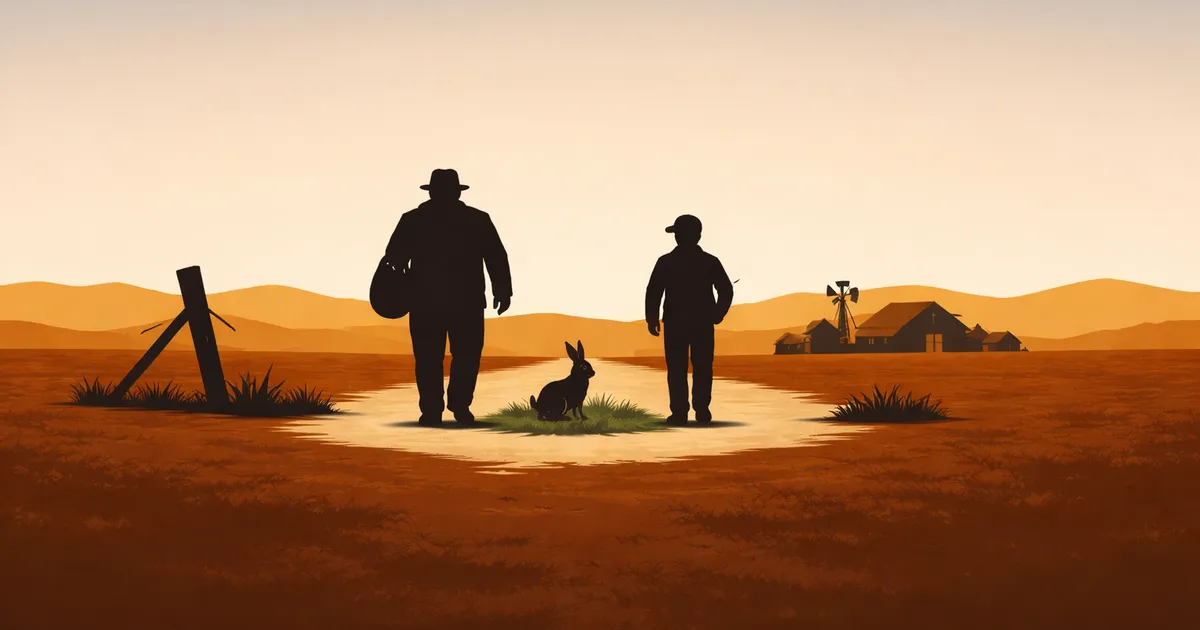
Key Quotes
"Guys like us, that work on ranches, are the loneliest guys in the world. They got no family. They don't belong no place."
Speaker: George Milton (Chapter 1)
George says this to Lennie by the campfire on their first evening near the Salinas River, right before launching into the dream of the farm. It's the setup for the call-and-response ritual that defines their relationship: George describes the loneliness of migrant workers, and Lennie responds with the exception — "But not us!" The line establishes the novella's central tension. George is describing reality as he knows it, and the dream that follows is his attempt to imagine something different.
This passage does double duty as both characterization and thesis statement. George's observation is sociological — he is diagnosing the structural loneliness of itinerant labor, where men "come in and get their bunk and work a month, and then they quit and go out alone," as Slim later confirms. The repetition of "no" and "loneliest" creates a rhetorical rhythm that mirrors the numbing repetition of the lives George is describing. What lifts the passage is the word "belong." George doesn't just say these men have no home; he says they have no place in the world. The follow-up — "But not us" — asserts an exception to this rule, but the novella will spend its remaining pages testing whether that exception can hold. By the final chapter, George is alone, and the line has become prophecy rather than prologue.
"I ought to of shot that dog myself. I shouldn't ought to of let no stranger shoot my dog."
Speaker: Candy (Chapter 3)
Candy whispers this to George after Carlson has taken his old dog outside and shot it. The other men hear a single crack, and the bunkhouse goes silent. Candy lies facing the wall. Later, when the conversation has moved on and George is describing the farm dream, Candy confesses this regret — not that the dog was killed, but that he allowed someone else to do it.
This is the most structurally important line in the novella. On the surface, it's a grieving man's expression of guilt. But Steinbeck positions it as the moral lesson that will govern the ending. When George shoots Lennie in Chapter 6, he is enacting what Candy could not: taking responsibility for the death of the being he loves most, rather than surrendering that responsibility to strangers who will do it without understanding or compassion. The line works because it arrives quietly — not as a thesis statement but as a whispered confession, easily missed on first reading. Its weight only becomes clear sixty pages later, when the gun goes off by the river. Candy's regret is George's instruction manual, and the novella's ending is unreadable without it.
"A guy needs somebody — to be near him. A guy goes nuts if he ain't got nobody."
Speaker: Crooks (Chapter 4)
Crooks says this to Lennie during their conversation in the harness room. It comes after Crooks has been testing Lennie — suggesting that George might not come back, watching Lennie's panic — and it marks the moment when Crooks drops his defensive hostility and reveals his own pain. He's not offering wisdom; he's describing his lived experience. Crooks has been alone in this room for years, separated from the other men by race, and he knows exactly what isolation does to a person.
The line's power comes from its universality housed inside a specific pain. Crooks is not philosophizing; he is talking about himself. His loneliness is enforced — he didn't choose to live apart from the other men — and his knowledge of its effects is empirical, not theoretical. The phrase "goes nuts" is deliberately colloquial; Crooks isn't using the language of psychology but the language of the ranch, and this grounds the observation in physical reality rather than abstraction. In context, the confession is also an act of trust. Crooks has spent the scene pushing Lennie away, testing him, asserting his right to privacy. This line is the moment he lets someone in — and it makes his later retreat, after Curley's wife threatens him, all the more devastating. Having opened himself to the possibility of connection, he is forced by racial terror to close himself again.
"I could get you strung up on a tree so easy it ain't even funny."
Speaker: Curley's wife (Chapter 4)
Curley's wife says this to Crooks when he asks her to leave his room. She has already insulted him, Candy, and Lennie as beneath her, and when Crooks asserts that he has rights, she shuts him down with this threat. The men in the room go silent. Crooks retreats completely, reducing himself to nothingness: "I didn' mean it. Jus' foolin'."
This is the novella's most explicit acknowledgment of racial violence in the Jim Crow era. Curley's wife, who has no power relative to the white men on the ranch — they dismiss her, avoid her, call her names — discovers that she does have power over Crooks, and she deploys it with casual viciousness. The line reveals the hierarchy that underlies all other hierarchies in the novella: a white woman with no social standing can still destroy a Black man's life with a single accusation. Steinbeck doesn't moralize about this; he lets the threat land and shows its effect. Crooks's physical response — he "seemed to grow smaller" and "pressed himself against the wall" — communicates what no dialogue could: the visceral, bodily experience of being reminded that your life depends on another person's whim. The scene complicates any simple reading of Curley's wife as victim; she is both oppressed and oppressor, depending on who she's standing next to.
"I done a bad thing. I done another bad thing."
Speaker: Lennie Small (Chapter 5)
Lennie whispers this after realizing he has killed Curley's wife. He has covered her body with hay and is crouching in the barn, terrified. The repetition — "another bad thing" — shows that even Lennie, with his limited understanding, recognizes the pattern: the girl in Weed, the mice, the puppy, and now this. He knows he has done something terrible, even if he cannot fully comprehend what death means.
The word "another" is the crux of this line. It tells the reader that Lennie carries the weight of his previous destructions, that he has some awareness — however dim — of a pattern in his behavior. This complicates the frequent reading of Lennie as purely innocent. He is not oblivious to the harm he causes; he is incapable of preventing it. The distinction matters because it determines how we read the novella's moral framework. If Lennie is truly unaware, his killings are natural disasters — amoral events with no agent. But "another bad thing" implies agency, however limited, and that agency is what makes his situation tragic rather than merely sad. He knows he does harm. He cannot stop. And the gap between knowledge and capacity is where Steinbeck locates the novella's deepest pity.
"You hadda, George. I swear you hadda. Come on with me."
Speaker: Slim (Chapter 6)
Slim says this to George immediately after George has shot Lennie by the river. The other men are arriving — Curley sees the body, Carlson asks questions — but Slim goes directly to George, sits beside him, and offers these words. It is the novella's only moment of absolution.
Slim's line completes the moral architecture Steinbeck has been building since Candy's dog was shot. "You hadda" is a judgment — not a legal one, but a human one — that George's action was necessary and that Slim, the ranch's moral authority, understands it as such. The physical detail matters: Slim "sat very close to him," offering bodily comfort in a novella where physical proximity is rare between men. The line also functions as a counterweight to Carlson's closing question — "Now what the hell ya suppose is eatin' them two guys?" Slim's understanding and Carlson's obliviousness frame the final scene as a test of perception: can you see what has happened here, or can't you? The novella ends with the suggestion that most people can't, that the kind of bond George and Lennie shared — and the kind of grief its destruction produces — is invisible to the world at large.
"Now what the hell ya suppose is eatin' them two guys?"
Speaker: Carlson (Chapter 6)
This is the novella's final line. Carlson watches Slim lead George away from Lennie's body and turns to Curley, genuinely confused about why the two men seem upset. It is the last sentence Steinbeck wrote, and it lands like a door slamming.
Carlson is the man who shot Candy's dog without understanding what the dog meant to Candy, and now he's watching the aftermath of another killing without understanding what has been lost. His confusion is not malicious — it's genuine. He literally cannot comprehend why George and Slim are grieving, because he has never had the kind of connection that would make such grief legible. Steinbeck ends the novella not with George's pain but with Carlson's incomprehension, shifting the reader's attention from the personal tragedy to the social condition that produced it. The final line is an indictment: not of Carlson individually, but of a world where men live so deep in isolation that another man's love is unrecognizable. It is the loneliest sentence in the book.