Summary
Overview
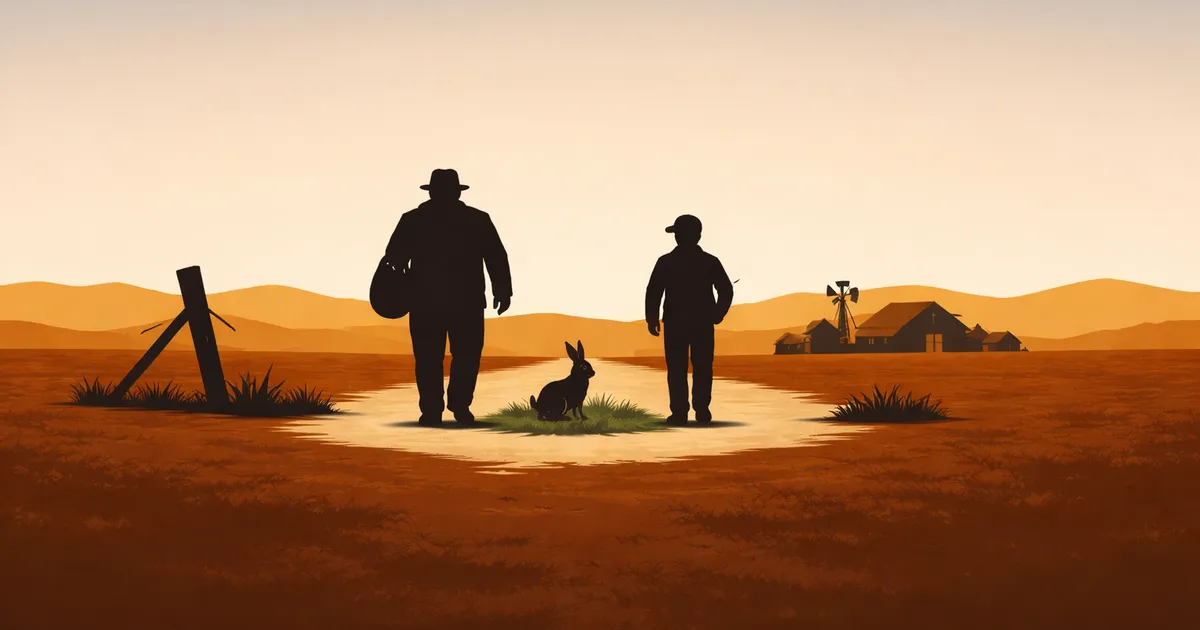
Of Mice and Men is a story about two migrant workers in Depression-era California who share something almost nobody around them has: each other. George Milton, small and sharp, travels with Lennie Small, a giant of a man with an intellectual disability and an uncontrollable desire to pet soft things. They've just been run out of their last job in Weed after Lennie grabbed a woman's dress and wouldn't let go, and now they're headed to a new ranch near Soledad to buck barley. What holds them together — what makes them different from every other ranch hand drifting through the Salinas Valley — is a shared dream: someday they'll save enough to buy a little piece of land, grow their own crops, and live off the fat of the land. Lennie will tend the rabbits.
That dream is the engine of the novella, and Steinbeck lets us believe in it just long enough to make its destruction hurt. Over the course of a few days at the ranch, George and Lennie encounter a cast of lonely, broken people — an aging one-handed swamper, a Black stable buck forced into isolation, the boss's vicious son and his restless wife — each of whom briefly reaches toward the dream before it collapses. The story builds toward a final act of violence that feels both shocking and inevitable, a mercy killing that forces George to destroy the one person who made his life different from the rootless existence he feared.
Steinbeck wrote Of Mice and Men in 1937, during the height of the Great Depression, and he structured it not as a traditional novel but as what he called a "play-novelette" — a work designed to be performed on stage with minimal adaptation. Each of the six chapters reads like a self-contained dramatic scene: a single setting, a group of characters entering and exiting, dialogue carrying nearly all the weight. This theatrical compression gives the novella its peculiar intensity. There are no interior monologues, no narrative digressions, no authorial commentary on what the characters feel. Everything is surface — gesture, speech, silence — and the reader is left to infer the emotional depths beneath.
Within Steinbeck's body of work, Of Mice and Men sits between his earlier labor novels (In Dubious Battle, 1936) and his masterpiece The Grapes of Wrath (1939). All three deal with California's working poor, but Of Mice and Men is the most intimate. Where The Grapes of Wrath sweeps across a continent, this novella confines itself to a bunkhouse, a barn, and a riverbank clearing. The title, drawn from Robert Burns's poem "To a Mouse" ("The best laid schemes o' mice an' men / Gang aft agley"), announces the central irony before the first page: plans fail, and the vulnerable suffer most. Steinbeck's achievement is making that familiar idea feel not like a lesson but like a wound.
Chapter 1: The Clearing by the Salinas River
George and Lennie arrive at a green pool along the Salinas River, a few miles south of Soledad, on the evening before they're due at their new job. Steinbeck introduces them through contrast: George is small, quick, dark-featured, and defined in every way; Lennie is huge, shapeless, and moves like a bear dragging its paws. They've walked from a bus stop after the driver dropped them off four miles early. George is irritated; Lennie is trying to hide a dead mouse he's been petting in his pocket.
Their conversation establishes everything the reader needs to know. Lennie has a childlike mind and keeps forgetting where they're going and why. George carries their work cards and does the talking for both of them. They were chased out of Weed because Lennie grabbed a girl's red dress and held on — the girl screamed, the town thought it was assault, and they had to hide in an irrigation ditch until dark. Now George is drilling Lennie on what to do at the new ranch: say nothing, let George talk. And if anything goes wrong, Lennie is to come back to this clearing by the river and hide in the brush until George comes.
The chapter ends with the first full telling of the dream. George begins grudgingly, as though reciting something he's said a hundred times, but the language takes on a ritualistic quality: "Guys like us, that work on ranches, are the loneliest guys in the world. They got no family. They don't belong no place." But not them. They have each other, and someday they'll have their own land. Lennie begs to hear about the rabbits. George tells him. They fall asleep by the fire.
The clearing functions as the novella's frame — it opens and closes here, giving the story a circular structure that reinforces its inevitability. Steinbeck's opening paragraphs describe the natural world in lush, almost Edenic detail: golden foothills, warm water, rabbits sitting like "little gray, sculptured stones." The arrival of humans disrupts this stillness; the heron flies away, the rabbits scatter. This pattern — nature disturbed by human presence — repeats in the final chapter with devastating effect.
George's instruction to Lennie about the clearing ("If you jus' happen to get in trouble like you always done before, I want you to come right here an' hide in the brush") is the novella's most important piece of foreshadowing. It establishes the clearing as a place of safety, but it also locks in the ending: when the worst happens, Lennie will return here, and so will George. The dream speech functions similarly — it sounds like hope, but its repetition marks it as a litany, something recited so often it has become insulation against a reality both men know they can't escape.
Chapter 2: Arrival at the Ranch
George and Lennie reach the ranch the next morning and are shown to the bunkhouse by Candy, an old swamper who lost his hand in a farm accident. They meet the boss, who is suspicious about George answering all the questions for Lennie. Then the characters who will drive the story's conflicts appear in quick succession: Curley, the boss's son, a small, aggressive ex-boxer who immediately takes a dislike to Lennie's size; Curley's wife, a young woman in a red cotton dress who lingers in the bunkhouse doorway, clearly starved for attention; Slim, the jerkline skinner, whose calm authority makes him the ranch's moral center; and Carlson, a thick-bodied laborer who complains about the smell of Candy's ancient dog.
George warns Lennie to stay away from Curley and especially from Curley's wife, whom he calls "poison" and "jail bait." Lennie, frightened by Curley's hostility, says he wants to leave: "I don't like this place, George. This ain't no good place. I wanna get outta here." George tells him they need to stay and earn their stake. The chapter ends with George reminding Lennie again about the clearing — if there's trouble, go to the brush by the river.
Chapter 2 operates as a theatrical set piece: Steinbeck introduces every major character through the bunkhouse doorway, each entrance revealing a different face of the ranch's social hierarchy. The boss has power but delegates cruelty to Curley. Curley compensates for his size with aggression, targeting anyone bigger. His wife has no name — she exists only in relation to her husband, a detail Steinbeck uses to underscore her erasure as a person. Slim, by contrast, earns his authority through competence; his word is law because the other men respect him, not because he demands it.
The most revealing detail is the can of bug killer George finds on his bunk shelf. It's a small moment, but it grounds the reader in the material reality of these men's lives: they sleep in beds vacated by strangers, own nothing they can't carry, and are interchangeable in the eyes of the men who employ them. Steinbeck builds the social world of the ranch through accumulation of such details, and the picture that emerges is one of pervasive loneliness. Every man on the ranch lives in proximity to others but in fundamental isolation — which is exactly what makes George and Lennie's bond so conspicuous and so threatening.
Chapter 3: The Bunkhouse at Evening
The longest and most pivotal chapter opens with Slim and George alone in the bunkhouse. Slim has given Lennie one of his dog's new puppies, and George, grateful and disarmed by Slim's quiet decency, confides the full truth about his relationship with Lennie. He explains that he knew Lennie's Aunt Clara, that he used to play tricks on Lennie until the day Lennie nearly drowned following George's order to jump in a river. After that, George stopped: "He's dumb as hell, but he ain't crazy."
While they talk, Carlson pressures Candy into letting him shoot Candy's old, blind, stinking dog. Slim agrees the dog is suffering. Candy, who has no authority to resist and no one to back him up, gives in. Carlson takes the dog outside, and after a long, terrible silence, the men hear a single shot. This scene is often read as foreshadowing, and it is — but it also functions as the emotional core of the chapter, demonstrating what happens when a lonely man loses his only companion.
After Carlson returns, George reluctantly tells Lennie about the dream within earshot of Candy. The old man, desperate and freshly bereaved, offers his life savings — three hundred and fifty dollars — to buy in. Suddenly the dream feels real. George does the math: they could have their land by the end of the month. For a brief, electrifying moment, all three men believe it will happen. Then Curley picks a fight with Lennie, battering the big man until George shouts at Lennie to fight back. Lennie grabs Curley's fist and crushes every bone in his hand. Slim forces Curley to say he caught it in a machine, and the men cover for Lennie — but the violence has introduced a crack in the dream's foundation.
Steinbeck structures this chapter as a series of escalating emotional beats: confession, execution, hope, violence. The shooting of Candy's dog operates on multiple levels. On the surface, Carlson's argument is practical — the dog is old, it suffers, it smells. But what Steinbeck dramatizes is the process by which a community strips an individual of his companion because the companion has become inconvenient. Candy's silence after the shot is the chapter's most devastating moment, and when he later tells George, "I ought to of shot that dog myself. I shouldn't ought to of let no stranger shoot my dog," he is articulating the principle that will govern the novella's ending.
The dream sequence in this chapter is the story's emotional high point. When Candy offers his money, the dream stops being a bedtime story and becomes a plan — George even identifies the specific property and its price. This is the moment of greatest hope, and Steinbeck places it immediately before the fight with Curley to make the contrast as jarring as possible. The dream is at its most tangible the instant violence reasserts itself. Lennie crushes Curley's hand with the same uncontrollable strength that killed the mice, that frightened the girl in Weed, and that will, in two chapters, kill a woman. The pattern is impossible to miss, but the dream is so vivid that both the characters and the reader choose to overlook it.
Chapter 4: Crooks's Room
On Saturday night, while most of the ranch hands are in town, Lennie wanders into the harness room occupied by Crooks, the Black stable buck who lives apart from the other men because of his race. Crooks initially tries to drive Lennie away — "You got no right to come in my room" — but Lennie's guileless friendliness wears him down. They talk, and Crooks, testing Lennie, asks what he would do if George didn't come back. Lennie's terror at this idea reveals the depth of his dependence. Crooks, recognizing a kindred loneliness, softens: "A guy needs somebody — to be near him. A guy goes nuts if he ain't got nobody."
Candy arrives looking for Lennie and lets slip the plan about the farm. Crooks, initially scornful — "I seen hunderds of men come by on the road an' on the ranches, with their bindles on their back an' that same damn thing in their heads" — gradually allows himself to imagine joining them. He offers to work for nothing, just for the company. For a moment, the dream has expanded to include the ranch's most isolated figure. Then Curley's wife appears, and everything collapses. She insults the three of them — "a nigger an' a dum-dum and a lousy ol' sheep" — and when Crooks protests, she threatens to have him lynched. Crooks retreats entirely, withdrawing his interest in the farm. By the end of the chapter he is rubbing liniment on his back again, alone.
This chapter is Steinbeck's most explicit examination of the hierarchy that keeps these men isolated from one another. Crooks occupies the bottom of the ranch's social order: a Black man with a disability, he is permanently excluded from the bunkhouse community. His room is a space of enforced solitude, and his initial hostility toward Lennie is the hostility of someone who has learned to protect himself by keeping others out. The tenderness that emerges when he drops his guard — the confession about needing somebody — is one of the novella's most vulnerable moments.
Curley's wife destroys that vulnerability with surgical precision. Her threat to Crooks ("I could get you strung up on a tree so easy it ain't even funny") is not an empty one — it reflects the actual danger faced by Black men in 1930s California. Steinbeck doesn't editorialize on the threat; he lets Crooks's physical reaction speak for itself. The man who moments ago was imagining a future on a shared farm now reduces himself: "I didn't mean it. Jus' foolin'. I wouldn' want to go no place like that." The dream, which had briefly expanded to include him, snaps back to its original boundaries and then some. Crooks's withdrawal is the novella's bleakest commentary on who is allowed to dream and who is not.
Chapter 5: The Barn on Sunday Afternoon
Lennie is alone in the barn with a dead puppy — he has accidentally killed it by petting it too hard, the latest in his series of destroyed soft things. While he agonizes over whether George will still let him tend the rabbits, Curley's wife enters. She is lonely and wants to talk, and despite Lennie's attempts to follow George's instructions to avoid her, she draws him into conversation. She confides her own thwarted dream: a man once told her she could be in the movies, and she married Curley on a whim when the promised letter from Hollywood never came. "I don' like Curley. He ain't a nice fella."
She notices Lennie's fixation on soft things and invites him to stroke her hair. He does, and the sensation overwhelms him. When she tries to pull away and begins to cry out, he panics and holds on harder — "Don't you go yellin'." He shakes her, and her body goes limp. He has broken her neck. Lennie understands he has "done a bad thing" and flees to the clearing by the river, exactly as George told him to.
Candy finds the body, then brings George. George's reaction is immediate and flat: "I should of knew. I guess maybe way back in my head I did." Candy asks if they can still have the farm, just the two of them. George already knows the answer. The dream is dead. George instructs Candy to wait and then pretend to discover the body, so the other men won't think George was involved. A search party forms. Curley wants Lennie shot on sight.
The conversation between Lennie and Curley's wife is the novella's longest scene between two characters, and it is devastating precisely because Steinbeck allows both of them to become fully human before the violence. Curley's wife — nameless throughout the book — gets her only extended monologue here, and it reveals her as someone trapped by the same forces that trap the men: loneliness, economic dependence, the gap between the life she imagined and the one she got. Her dream of Hollywood is as fragile and unlikely as George and Lennie's dream of a farm, and Steinbeck stages the scene so that two doomed dreamers sit together in a barn, each unable to save the other.
The killing itself follows the exact pattern established by every previous act of destruction in the book. Lennie pets the mice and kills them. Lennie pets the puppy and kills it. Lennie strokes Curley's wife's hair and kills her. Each escalation is accompanied by the same panicked refrain — worry about George's disapproval, terror that he won't get to tend the rabbits. Steinbeck's refusal to vary the pattern is deliberate: he wants the reader to see the death as structurally inevitable, not as an accident. The novella has been building a case, and this is the verdict. Candy's lament over the body — repeating the dream of the little farm in a "singsong" voice — is a eulogy not just for Curley's wife but for the possibility that any of these men could have escaped their circumstances.
Chapter 6: Return to the Clearing
The novella closes where it began: the clearing by the Salinas River, in late afternoon light. Steinbeck opens with the same natural imagery from Chapter 1 — the green pool, the sycamores, the Gabilan mountains — but introduces a new detail: a water snake glides across the pool and is snatched by a heron. Nature is no longer merely disrupted by human presence; it is actively predatory.
Lennie arrives and kneels to drink, remembering George's instruction. He hallucinates his Aunt Clara, who scolds him in his own voice for always causing George trouble, and then a giant rabbit who tells him George will abandon him. George appears. He is calm, but his calm is frightening. He tells Lennie to take off his hat and look across the river, and he begins the dream one last time: the little place, the cow, the alfalfa, the rabbits. While Lennie looks toward the Gabilan mountains, imagining the life they'll never have, George raises Carlson's Luger — the gun he took from the bunkhouse — and shoots Lennie in the back of the head.
The men arrive. Slim understands immediately what happened and why. "You hadda, George. I swear you hadda." Carlson, oblivious, assumes George wrestled the gun away and killed Lennie in self-defense. As Slim leads George away, Carlson turns to Curley and asks, "Now what the hell ya suppose is eatin' them two guys?" — a final, crushing line that reveals how invisible the bond between George and Lennie is to men who have never had one.
The circular structure — opening and closing in the same location — transforms repetition into tragedy. Every detail from Chapter 1 reappears, but altered. Lennie drinks from the pool carefully this time, barely touching his lips to the water; the heron is no longer startled away but is actively killing. The dream speech, which sounded like hope in the first chapter, now functions as a lullaby — George recites it not to sustain a vision of the future but to give Lennie a final moment of peace before ending his life.
George's decision to shoot Lennie himself is the novella's moral center, and Steinbeck has spent the entire book preparing the reader for it. Candy's regret — "I ought to of shot that dog myself" — supplies the ethical framework: it is better to kill what you love yourself, with kindness, than to let strangers do it with cruelty. George enacts this principle, but Steinbeck refuses to make it clean. George's hand shakes. He drops the gun once. The act is right by the logic of the world Steinbeck has constructed, but it is not right in any simple sense, and the novella's final image — George staring at the hand that held the gun — ensures the reader understands the cost. Carlson's closing question, in its total incomprehension, is Steinbeck's harshest judgment: not on George, but on a world so accustomed to disposable men that an act of devastating love looks like nothing at all.