Summary
Overview
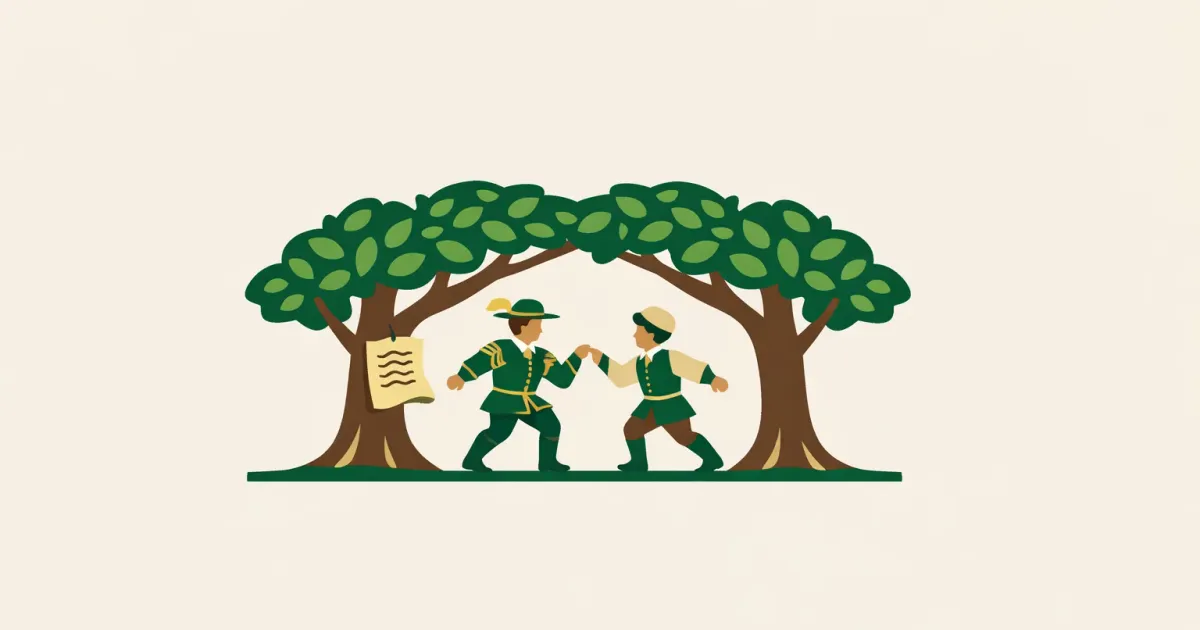
As You Like It is Shakespeare's great comedy of leaving — leaving court, leaving cruelty, leaving the roles other people want you to play. Written around 1599, it puts two cousins, a brutal usurper's daughter and his gentler brother's banished one, on the road together, dressed as a peasant girl and a young man, with a court fool in tow. They end up in the Forest of Arden, where a deposed duke already lives like Robin Hood, where love poems hang from trees, and where the heroine — disguised as a boy named Ganymede — decides to teach the man she loves how to love her properly before she reveals who she is.
The central action is a courtship, but almost none of it is conventional. Rosalind gets to woo herself, in a sense: she is both the woman Orlando pines for and the "boy" who stands in front of him teasing him about that pining. The play layers love stories on top of each other until the joke becomes serious — a shepherd worshipping a scornful shepherdess, a clown chasing a country girl, a repentant brother finding sudden love across a forest clearing. By the time four couples arrive at the altar in the final scene, Shakespeare has used laughter to say something almost straight-faced: that identity is flexible, that pastoral peace is partly an illusion, and that forgiveness, when it comes, arrives faster than we expect.
Among Shakespeare's comedies, As You Like It is the one most willing to sit still. There is very little plot after Act 1. Once the characters reach Arden, the play stops rushing — it loiters in songs, philosophical debates, seven-part lectures on melancholy, Touchstone's disquisitions on shepherds, Jaques's "All the world's a stage," and above all Rosalind's long conversations with Orlando that are both the courtship and its lesson. Shakespeare is borrowing and transforming Thomas Lodge's prose romance Rosalynde (1590), and he strips out Lodge's battles and complications to focus on what he wants: talk. The play's innovation is to make a comedy whose pleasures are conversational rather than farcical, where the audience's attention is held less by the question "what happens next?" than by "what will Rosalind say next?"
That means the play's most famous structural feature — Rosalind's disguise as Ganymede — becomes a device for exploring how people perform love in the first place. Shakespeare wrote the role knowing a boy actor would play a woman pretending to be a boy pretending to be a woman, and he keeps that vertigo in view throughout. The epilogue, delivered directly to the audience by Rosalind (unusual for a Shakespeare heroine), seals the play's unshowy radicalism: a woman hands the audience back the entertainment, names herself a performer, and blesses them for watching. Few comedies end on such a quietly confident note.
Act 1
Orlando, the youngest son of the dead Sir Rowland de Boys, has been kept "rustically at home" by his elder brother Oliver — denied education, left to feed with the servants — and he is ready to fight back. When the court's wrestler Charles arrives, Oliver sets him up to maim Orlando in the ring. At Duke Frederick's court, Orlando wins the match; the Duke, cold when he learns whose son he is, withdraws favor. Watching from the sidelines, Rosalind — daughter of the deposed Duke Senior, kept at court as companion to Celia, the usurper's daughter — falls for Orlando and gives him a chain from her neck. Soon after, Duke Frederick banishes Rosalind on suspicion that her popularity threatens him. Celia refuses to let her cousin leave alone. The two of them, along with the court jester Touchstone, plan an escape to the Forest of Arden, where Duke Senior is said to be living in exile "like the old Robin Hood of England." Rosalind will disguise herself as a young man named Ganymede; Celia will pass as his sister, Aliena. Meanwhile, Adam, Orlando's father's old servant, warns Orlando that Oliver means to kill him in his sleep. They flee together.
The first act is the only stretch of the play that moves fast, and it is almost entirely about escape. Shakespeare sets up two parallel tyrannies — Oliver over Orlando, Duke Frederick over Rosalind — so that by the act's end everyone sympathetic has been forced out of court. That symmetry is the engine that makes the play's pastoral middle possible: Arden is not a vacation, it is a refugee camp. Note also the speed at which Rosalind falls in love with Orlando — within one scene, before a single private conversation — and the speed at which Duke Frederick turns against her. Shakespeare is establishing a world where impulses move faster than judgment, and the rest of the play will ask whether time in the forest can slow those impulses down enough for the characters to learn what they actually want. The introduction of Touchstone in 1.2, with his shaggy-dog story about a knight who swears on nonexistent honor, is the play's first warning that it will be interested in oaths, performance, and the slipperiness of language.
Act 2
Act 2 spreads across two worlds. In Arden, Duke Senior delivers his famous speech praising the "uses of adversity" and finding "tongues in trees, books in the running brooks"; his court of exiles lives in a genial parody of their lost rank. The melancholy Jaques — introduced offstage before we meet him — moralizes over a wounded deer and finds in a chance meeting with Touchstone the kind of companion he didn't know he wanted. Meanwhile Rosalind (as Ganymede), Celia (as Aliena), and Touchstone arrive exhausted at Arden, buy a cottage and flock from the shepherd Corin, and take up residence. Orlando and old Adam, starving, stumble into Duke Senior's camp; Orlando draws his sword to demand food and is met instead with gentleness. Duke Senior recognizes him as Sir Rowland's son and welcomes him. Amid this welcome, Jaques delivers the "All the world's a stage" speech, cataloguing the seven ages of man just as Orlando re-enters carrying Adam like a child.
Shakespeare uses Act 2 to establish Arden as neither paradise nor wilderness but a kind of reflective space. Duke Senior's praise of exile is genuine, but the play undercuts it almost immediately: the hunted deer, Jaques's indictment of the hunters, Adam's near-death from hunger, the biting winter wind of Amiens's song. This is a pastoral with cold in it. The "All the world's a stage" speech is positioned with surgical precision. Jaques has just finished describing the last "age" — second childishness, sans everything — when Orlando walks on carrying a literal old man in his arms. The staging refutes the speech without a word. Shakespeare gives Jaques one of his most famous arias and then shows, in the same breath, what it leaves out: kindness, service, the fact that human beings carry each other. The act ends with Duke Senior recognizing Orlando, which sets up every reunion to come — fathers found, brothers reconciled — as a matter not of coincidence but of recognition.
Act 3
Duke Frederick, furious at the disappearance of his daughter and niece, seizes Oliver's property and sends him into the forest to hunt Orlando. Meanwhile, Arden has become Orlando's writing desk — he hangs love poems for Rosalind on every tree. Touchstone, in one of the play's great exchanges, debates court versus country manners with Corin the shepherd, getting the worst of it. Celia reveals to Rosalind that the poet is Orlando, and Rosalind — still disguised as Ganymede — engineers a meeting with him. She proposes a cure for his lovesickness: if he will come to her cottage every day and call her "Rosalind," she will cure him of love by playing the inconstant woman so convincingly he will give up the whole business. He agrees. Elsewhere, Touchstone courts a goatherd named Audrey and arranges a hasty marriage with the vicar Sir Oliver Martext, which Jaques interrupts. In another corner of the forest, the shepherdess Phoebe cruelly rejects her suitor Silvius; Ganymede intervenes, scolds Phoebe, and inadvertently becomes the object of her infatuation. Phoebe writes Ganymede a love letter and sends it back with Silvius.
Act 3 is where the play gets to do what it exists to do: talk about love from four simultaneous angles. Orlando is the courtly lover, writing verses. Silvius is the Petrarchan lover, prostrate and hopeless. Touchstone is the cynical lover, calling his courtship of Audrey "copulation of cattle." Phoebe is the scorner who becomes the scorned. Shakespeare puts them in the same woods so they can't ignore one another, and he puts Rosalind at the center — a woman pretending to be a boy pretending to be a woman to a man who doesn't know she is his. The device exposes every register of love as a kind of performance without suggesting that performance makes love fake. When Rosalind, as Ganymede, asks Orlando "are you so much in love as your rhymes speak?" she is both teasing him and genuinely asking. The scene's power comes from knowing that the answer matters to both sides of the mask. Note too that Act 3 is where the play almost entirely abandons verse in favor of prose for its central scenes — Shakespeare giving Rosalind the rhythms of ordinary conversation so that her wit can play freely.
Act 4
Rosalind (as Ganymede) meets Orlando for his daily "cure." What follows is the play's central scene: Rosalind stages a mock wedding, with Celia as priest, and puts Orlando through a comic workout on marriage, jealousy, women's wit, and her own imagined future behavior as a wife. When he leaves to attend Duke Senior at dinner, she confesses to Celia that her love for him is bottomless "as the Bay of Portugal." Meanwhile, Silvius arrives with Phoebe's letter to Ganymede; Rosalind reads it aloud as railing, then sends Silvius back with a message that if Phoebe loves him, she must love Silvius. Then Oliver, Orlando's brother, walks into the scene carrying a bloody handkerchief. He tells Rosalind and Celia a story that changes everything: Orlando found him asleep in the forest under a tree, a snake curled toward his mouth and a hungry lioness waiting for him to stir. Orlando could have let nature take its course. Instead, he fought off the lioness and saved his brother's life, taking a wound to his arm. The rescue has transformed Oliver. Rosalind, hearing the news, faints. Oliver and Celia lock eyes and — though no one has said it yet — fall in love on the spot.
Act 4 turns the play on a hinge most audiences don't see coming: the story of the lioness. It arrives as reported narration rather than staged action, and it changes everyone at once. Orlando's kindness reforms Oliver. Oliver's transformation inaugurates a sudden romance with Celia that will end in their marriage the next day. Rosalind's faint gives her away as something other than a young man. Shakespeare is doing something unusual here — a central emotional pivot delivered in a long, highly literary speech (Oliver's "Under an oak, whose boughs were mossed with age" is one of the play's great set-pieces) rather than in action on stage. The technique keeps the tone gentle. No lioness appears; no blood is spilled in front of us. What we witness is the ripple. The mock wedding with Celia presiding is also quietly significant: Rosalind, still in male disguise, has Orlando marry "Rosalind," which means he has married her in practice before she drops the mask. The legal machinery of Act 5 is already in motion.
Act 5
Touchstone intimidates a local boy named William away from Audrey. Oliver tells Orlando he loves Aliena and plans to marry her the next day, offering Orlando the family estate. Orlando, happy for them but freshly lovesick, tells Rosalind he can no longer "live by thinking" — he needs the real Rosalind, not a boy playing her. Rosalind, who has had enough of the disguise, promises to deliver the real Rosalind the next day by magic, and when Silvius and Phoebe arrive she binds Phoebe to marry Silvius if she refuses Ganymede. The wedding scene is the play's longest and most choreographed sequence. Touchstone and Audrey show up; Jaques interrogates Touchstone; the god Hymen enters with Rosalind out of disguise, and four couples — Rosalind and Orlando, Celia and Oliver, Phoebe and Silvius, Touchstone and Audrey — take hands at once. Then Jaques de Boys, the middle brother no one has mentioned, arrives with the act's final surprise: Duke Frederick marched into the forest to kill Duke Senior, met "an old religious man" at the wood's edge, converted on the spot, renounced the dukedom, and retired from the world. Duke Senior's lands are restored. Jaques announces he will go join Frederick in religious life rather than dance. Rosalind delivers the epilogue.
Act 5's final scene is almost satirically tidy — four weddings, a restored dukedom, a villain redeemed offstage by an anonymous holy man — and Shakespeare wants us to notice the tidiness. The convenience of Duke Frederick's conversion is the kind of convenience that exposes itself. Shakespeare is playing with romance convention, and the play has always been half-inside those conventions and half-commenting on them. The choice to have Hymen (the god of marriage) physically enter and officiate is particularly striking: the resolution is so complex that only a masque-figure can tie it off. Jaques's refusal to join the dance is the one discordant note Shakespeare insists on. He leaves to seek the "convertites" because the melancholic has no place in a festival. His departure makes the comedy feel bigger by acknowledging what it can't contain. The epilogue then steps outside the play entirely. Rosalind, now a woman again (and still a boy actor), addresses the audience directly, teases them about beards and breath, and invites their applause. The moment undoes the illusion, names everything as performance, and asks the audience to consent to the play's pleasure. It is the warmest epilogue in the comedies — and the most self-aware.