Key Quotes
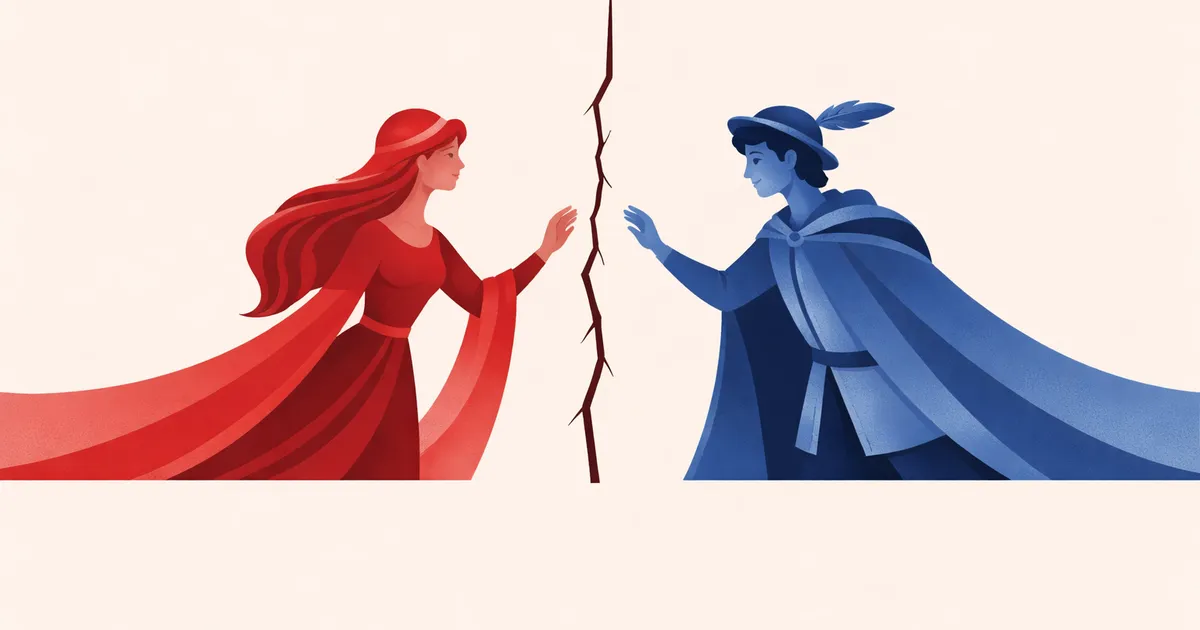
"Two households, both alike in dignity, / In fair Verona, where we lay our scene, / From ancient grudge break to new mutiny, / Where civil blood makes civil hands unclean."
Speaker: Chorus (Prologue)
The Chorus opens the play by laying out the entire situation before a single character walks onstage. Two wealthy, powerful families in Verona have been feuding for so long that nobody remembers why it started. That old grudge keeps erupting into fresh violence, and the bloodshed has contaminated the whole city -- "civil blood makes civil hands unclean" means the citizens themselves are being dragged into the mess. This four-line setup tells you everything you need to know: the world Romeo and Juliet are born into is already broken before they ever meet.
Detailed Analysis
The Prologue is a complete sonnet -- fourteen lines of iambic pentameter with a rhyme scheme that mirrors the form Shakespeare's audience associated with love poetry. Using the most intimate poetic structure available to announce a public catastrophe is a deliberate mismatch, and it signals the play's central tension between private feeling and public destruction. The phrase "both alike in dignity" is quietly devastating in retrospect. The families are mirrors of each other, equally wealthy, equally proud, equally guilty. There is no righteous side in this feud, no original injury that would make one family's grievance more legitimate than the other's. Shakespeare refuses to assign moral advantage, which makes every death that follows feel doubly wasteful.
The word "civil" in "Where civil blood makes civil hands unclean" carries a pointed double meaning. It refers both to citizens' blood and to civilized behavior. The feud has made civility itself impossible -- the hands that should maintain social order are stained with the blood of the people they're supposed to protect. By telling the audience upfront that the lovers will die, Shakespeare removes suspense entirely and replaces it with dramatic irony. Every hopeful moment in the play -- the balcony scene, the secret wedding, the Friar's plan -- arrives already shadowed by an ending the audience cannot forget.
"O Romeo, Romeo, wherefore art thou Romeo? / Deny thy father and refuse thy name. / Or if thou wilt not, be but sworn my love, / And I'll no longer be a Capulet."
Speaker: Juliet (Act II, Scene II)
This is probably the most misquoted line in all of Shakespeare. "Wherefore" doesn't mean "where" -- it means "why." Juliet isn't calling out for Romeo from her balcony; she's asking why he has to be Romeo, why the boy she just fell for has to carry the one name that makes their love impossible. She's working through the problem out loud, and she lands on a radical solution: if he won't give up his family name, she'll give up hers. She's thirteen years old, and she's already willing to sever herself from everything she knows for someone she met two hours ago.
Detailed Analysis
Juliet's speech launches the balcony scene's philosophical argument about names and identity. Her logic is sharp: a name is a label, not an essence, so "Romeo" minus "Montague" should still be the same person. The famous lines that follow -- "What's in a name? That which we call a rose / By any other name would smell as sweet" -- extend this reasoning with an analogy that sounds unanswerable. But the play treats her argument as tragically insufficient. In Verona, names are not arbitrary conventions. They determine who you can marry, who you must fight, who will kill you on sight. Juliet's nominalist philosophy is intellectually correct and practically useless, and that gap between what reason tells her and what her world enforces is the engine of the tragedy.
The speech also reveals a Juliet who is strikingly more decisive than Romeo at this stage. She doesn't agonize or equivocate -- she proposes a concrete exchange. If he swears his love, she'll abandon her identity as a Capulet. Romeo, overhearing, responds with romantic flourish ("Call me but love, and I'll be new baptis'd; / Henceforth I never will be Romeo"), but Juliet has already moved past poetry to logistics. This pragmatic streak, easy to miss under the lyricism, defines her character throughout the play and separates her from the passive heroines of the romance tradition Shakespeare was working against.
"What's in a name? That which we call a rose / By any other name would smell as sweet; / So Romeo would, were he not Romeo call'd, / Retain that dear perfection which he owes / Without that title."
Speaker: Juliet (Act II, Scene II)
Juliet is still working through her argument on the balcony, and this is where it reaches its sharpest expression. Her point is simple and persuasive: a rose smells the same regardless of what you call it, so Romeo is still the same person whether or not he carries the Montague name. She's trying to separate the man she loves from the label that makes him her enemy. It's one of the most famous philosophical statements in English literature, and students encounter it on exams more than almost any other Shakespeare passage.
Detailed Analysis
The rose analogy has entered common English as a proverb, but within the play it functions as an argument that the plot systematically dismantles. Juliet is making a claim about the relationship between language and reality -- that words are conventional signs, not essential properties. A modern philosopher would call this a nominalist position. And she's right, in the abstract. But Romeo and Juliet inhabit a world where names carry lethal force. "Montague" is not a neutral label; it is a social identity that triggers automatic violence from anyone named Capulet. Romeo cannot "doff" his name any more than he can doff his skin. The tragedy proves that Juliet's logic, however sound in theory, cannot survive contact with the institutional reality of the feud.
Shakespeare builds additional irony into the word "owes" -- in Elizabethan usage, it means "owns" or "possesses." Juliet says Romeo would retain the "dear perfection which he owes" without the Montague title. But perfection is precisely what the name prevents him from possessing. His identity as a Montague will drive him to kill Tybalt, get banished, and ultimately take his own life. The name doesn't just label Romeo; it scripts his fate. Juliet's beautiful, reasonable argument is the play's great tragic irony: she sees clearly what should be true while living in a world that refuses to cooperate.
"These violent delights have violent ends, / And in their triumph die; like fire and powder, / Which as they kiss consume."
Speaker: Friar Lawrence (Act II, Scene VI)
Friar Lawrence says this to Romeo moments before Juliet arrives for their secret wedding. Romeo has just declared that no amount of future sorrow could outweigh the joy of one minute with Juliet, and the Friar's response is a blunt warning: passions this intense burn themselves out. Fire and gunpowder destroy each other at the moment of contact. The Friar is telling Romeo to pump the brakes, and Romeo isn't listening -- which is exactly the problem the Friar keeps running into throughout the play.
Detailed Analysis
The simile of fire and powder is one of Shakespeare's most precise images for the play's structure. Fire and gunpowder are individually stable; it is their meeting that produces destruction. Romeo and Juliet are each, on their own, perfectly viable young people. Their love is the spark, and the feud is the powder. The Friar sees this clearly enough to articulate it, but he lacks the authority or will to prevent it -- he marries them anyway, hoping the union will end the feud. His warning becomes a self-fulfilling prophecy he helped engineer.
The phrase "in their triumph die" captures something specific about how desire operates in this play. The lovers' triumphant moments -- the kiss at the feast, the wedding, the one night together -- are always immediately followed by catastrophe. The kiss leads to the discovery of enemy identities. The wedding leads to Tybalt's death and Romeo's banishment. Their single night together leads to the disastrous Capulet ultimatum about Paris. Shakespeare patterns the entire plot so that every peak of joy is also the trigger for the next disaster. The Friar's metaphor isn't just a general warning about moderation; it's a structural blueprint for how the tragedy unfolds.
"A plague o' both your houses."
Speaker: Mercutio (Act III, Scene I)
Mercutio says this as he's dying from a wound he received in a fight that wasn't even his. Tybalt came looking for Romeo, Romeo refused to fight (because he'd just secretly married Tybalt's cousin), Mercutio stepped in out of disgust at what he saw as cowardice, and Tybalt stabbed him under Romeo's arm while Romeo was trying to break up the duel. With his dying breath, Mercutio curses both the Montagues and the Capulets. He's not picking a side -- he's condemning the entire feud that got him killed for no reason. He repeats the curse three times before he dies, and it's the angriest, most clear-eyed line in the play.
Detailed Analysis
Mercutio is neither a Montague nor a Capulet -- he is a kinsman to Prince Escalus, which makes his death a direct assault on Verona's governing authority. His curse lands with particular force because he has no stake in the feud. He dies as collateral damage, killed by a conflict he never chose and never benefited from. The repetition of the curse -- three times in twenty lines -- gives it an almost ritual quality, as though Mercutio is pronouncing a formal malediction. And the play treats it as one: after this moment, the body count accelerates. Tybalt dies within minutes. Romeo is banished. The chain of events leading to every subsequent death begins here.
The dramatic mechanics of Mercutio's wounding deserve attention. Romeo's attempt to make peace -- physically stepping between the duelers -- is the exact gesture that allows Tybalt's blade to reach Mercutio. The peacemaker's body becomes the instrument of his friend's death. Shakespeare constructs the scene so that Romeo's love for Juliet (which motivates his refusal to fight Tybalt) is literally the reason Mercutio dies. The play's most generous impulse produces its most destructive consequence. After this scene, the genre shifts permanently. The witty banter, the comic Nurse, the playful romance -- all of it is over. Mercutio was the voice of irreverent comedy in the play, and the tragedy cannot fully take hold until that voice is silenced.
"O, I am fortune's fool!"
Speaker: Romeo (Act III, Scene I)
Romeo screams this immediately after killing Tybalt, standing over the body of the man who just killed his best friend -- a man who is also now his wife's cousin by marriage. In five words, Romeo captures the whole shape of his situation: he feels like a puppet being played by fate. He tried to do the right thing by refusing to fight Tybalt, and the result was Mercutio's death. He avenged Mercutio by killing Tybalt, and the result is banishment from the city where Juliet lives. Every choice he makes, right or wrong, leads to a worse outcome.
Detailed Analysis
The line crystallizes the play's ongoing argument about whether the tragedy is caused by character or by fate. Romeo blames fortune -- external cosmic forces manipulating him like a jester, a "fool" in the Elizabethan sense. And there is real evidence for his reading: the Prologue called the lovers "star-cross'd," the timing of events is consistently catastrophic, and the final disaster hinges on a letter that never arrives because of a random plague quarantine. But the play also shows Romeo making choices -- impulsive, emotional choices that compound every piece of bad luck. He crashed the Capulet feast. He married Juliet in secret. He stepped between Mercutio and Tybalt. He killed Tybalt in a fury he could have restrained.
Shakespeare leaves the question deliberately unresolved. Romeo is both fortune's fool and his own fool, both a victim of cosmic bad luck and an architect of his own destruction. The ambiguity is the point. Unlike classical tragedy, which tends to locate causation clearly in either the gods or the hero's flaw, Romeo and Juliet distributes blame across fate, character, social structures, and sheer contingency. The line "O, I am fortune's fool" is Romeo's attempt to make sense of his situation by assigning a single cause, and the play gently refuses to let that explanation be sufficient.
"Give me my Romeo, and when I shall die, / Take him and cut him out in little stars, / And he will make the face of heaven so fine / That all the world will be in love with night / And pay no worship to the garish sun."
Speaker: Juliet (Act III, Scene II)
Juliet speaks this while waiting for Romeo to come to her on their wedding night. She doesn't yet know about Tybalt's death or Romeo's banishment -- this is pure anticipation, the last moment of uncomplicated joy she'll have in the play. She's imagining Romeo transformed into stars, so brilliant that the entire world would prefer night to day. The speech crackles with desire and impatience, and the imagery is wild: she wants to cut her husband into constellations. It's simultaneously the most romantic and the most ominous passage in the play, since the audience already knows the night she's longing for will bring devastating news.
Detailed Analysis
The star imagery works on multiple levels. Throughout the play, stars represent fate -- the lovers are "star-cross'd" from the Prologue onward. Juliet's fantasy of turning Romeo into stars is, unknowingly, an image of his death. He will become part of that cosmic order the Prologue described, but only through dying. The speech also inverts the play's dominant light/dark pattern. Normally, light imagery attaches to the lovers (Romeo calls Juliet the sun, she is "a rich jewel in an Ethiop's ear"), and darkness represents danger and concealment. Here, Juliet reverses the equation: night becomes the space of beauty and love, while the "garish sun" is something to be rejected. For the lovers, darkness has always been safer than daylight, which exposes them to the feud's violence.
The verb "cut" introduces a startling edge of violence into an otherwise ecstatic love speech. Juliet imagines physically dismembering Romeo -- "cut him out in little stars" -- to achieve her vision of cosmic beauty. This fusion of desire and destruction runs through all of the play's love language. Romeo and Juliet consistently describe their love in terms that suggest annihilation: consuming fire, explosive powder, poison and antidote. Juliet's speech is the most vivid instance of this pattern, a passage where love and death share not just a thematic connection but a single image. She wants to unmake Romeo in order to immortalize him -- a wish the play will grant in the cruelest possible way.
"My bounty is as boundless as the sea, / My love as deep; the more I give to thee, / The more I have, for both are infinite."
Speaker: Juliet (Act II, Scene II)
Juliet says this during the balcony scene, right after Romeo tries to swear his love by the moon and she tells him not to bother. She's responding to his question about whether she'd take back her declaration of love. No, she says -- in fact, her love operates on a different kind of economics entirely. Most things get smaller when you give them away. Juliet's love gets larger. It's a simple, stunning idea, delivered in three lines that are easy to memorize and hard to forget.
Detailed Analysis
The metaphor of infinite bounty pushes against the transactional language that surrounds the lovers everywhere else in the play. Capulet treats Juliet's marriage as an economic exchange, negotiating her value with Paris. The Nurse advises Juliet to marry Paris because he's a better "catch" materially. Even Romeo's earlier infatuation with Rosaline was framed in Petrarchan terms of merchant-like negotiation -- sighs as currency, beauty as commodity. Juliet's image of love as an inexhaustible ocean rejects all of that. She's describing a form of value that doesn't operate by scarcity, that doesn't diminish through exchange. In a play where nearly every relationship is transactional, this is radical.
The comparison to the sea also carries structural weight. The sea is deep, uncontrollable, and dangerous -- not merely vast. Shakespeare frequently uses ocean imagery to suggest forces beyond human mastery, and Juliet's declaration, for all its tenderness, is also a description of something overwhelming. "The more I give to thee, / The more I have" sounds like pure generosity, but it also describes a feeling that feeds on itself, that grows beyond the giver's ability to regulate it. Juliet's boundless love is the quality that will drive her to take a death-mimicking potion, refuse to leave Romeo's body, and ultimately stab herself. The bounty she describes is both her greatest virtue and the force that destroys her.
"Wisely and slow; they stumble that run fast."
Speaker: Friar Lawrence (Act II, Scene III)
The Friar drops this warning on Romeo as they rush off to arrange the secret marriage. Romeo is practically vibrating with impatience, and the Friar -- who has just agreed to perform the wedding despite serious reservations -- tells him to slow down. It's common-sense advice, the kind of thing any cautious adult would say to a teenager in a hurry. The problem is that nobody in this play has the luxury of being wise and slow. Events move too fast, the feud is too volatile, and the Friar himself will soon be devising frantic, rushed plans that blow up spectacularly.
Detailed Analysis
The line functions as one of the play's most pointed examples of dramatic irony. The Friar counsels patience while enabling the very haste he warns against -- he agrees to marry Romeo and Juliet on the same day Romeo asks, after knowing Juliet for less than twelve hours. His own sleeping-potion scheme in Act IV is precisely the kind of "fast" plan he cautions Romeo against here: improvised, dependent on perfect timing, vulnerable to any single point of failure. When that plan collapses because Friar John gets quarantined, the stumble the Friar predicted arrives, though not where he expected it.
Shakespeare uses the Friar as a figure who embodies the gap between wisdom and action. Friar Lawrence understands the play's dangers with almost choric clarity -- his herb soliloquy diagnoses the paradox of virtue turning to vice, and this line diagnoses the paradox of urgency creating catastrophe. But understanding a danger and preventing it are different things. The Friar keeps choosing to intervene (the marriage, the potion, the letter) while warning against the very recklessness his interventions require. He is the play's most well-intentioned character and arguably its most culpable, a man whose good advice never applies to his own decisions.
"For never was a story of more woe / Than this of Juliet and her Romeo."
Speaker: Prince Escalus (Act V, Scene III)
The Prince speaks the play's final couplet, standing in the Capulet tomb over the bodies of Romeo, Juliet, and Paris. It's a deliberately simple ending -- no grand speech, no philosophical resolution, just a flat statement that this is the saddest story anyone has ever seen. The Prince has spent the whole play trying to keep the peace and failing. His earlier threats of death for anyone who disturbed the streets didn't prevent a single killing. Now, surrounded by corpses, all he can offer is a rhyming summary of the devastation.
Detailed Analysis
The couplet's simplicity is deceptive. By placing Juliet's name before Romeo's -- "Juliet and her Romeo" rather than "Romeo and Juliet" -- the Prince subtly inverts the play's title and, with it, the expected hierarchy. Throughout the play, the patriarchal order has controlled everything: fathers negotiate marriages, men fight duels, the Prince (another man) adjudicates disputes. Juliet's name coming first in the final line quietly acknowledges what the play has dramatized -- that she is the bolder, more decisive figure in the love story, the one who proposes marriage, who takes the potion, who refuses to leave the tomb.
The line "A glooming peace this morning with it brings; / The sun for sorrow will not show his head" -- which immediately precedes the closing couplet -- refuses to offer redemption. The peace that follows is not triumphant; it is exhausted, gray, sunless. Montague and Capulet promise golden statues of each other's children, but gold statues are memorials to what has been lost, not symbols of what has been gained. The play ends with an accounting, not a reconciliation. Shakespeare denies the audience the comfort of believing the deaths accomplished something noble. The feud ends not because the families have been morally transformed but because they have run out of children to sacrifice. The Prince's couplet, plain and final, closes the door on any reading that would make this tragedy feel worthwhile.