Themes & Motifs
The Feud as Identity: Inherited Hatred and Its Cost
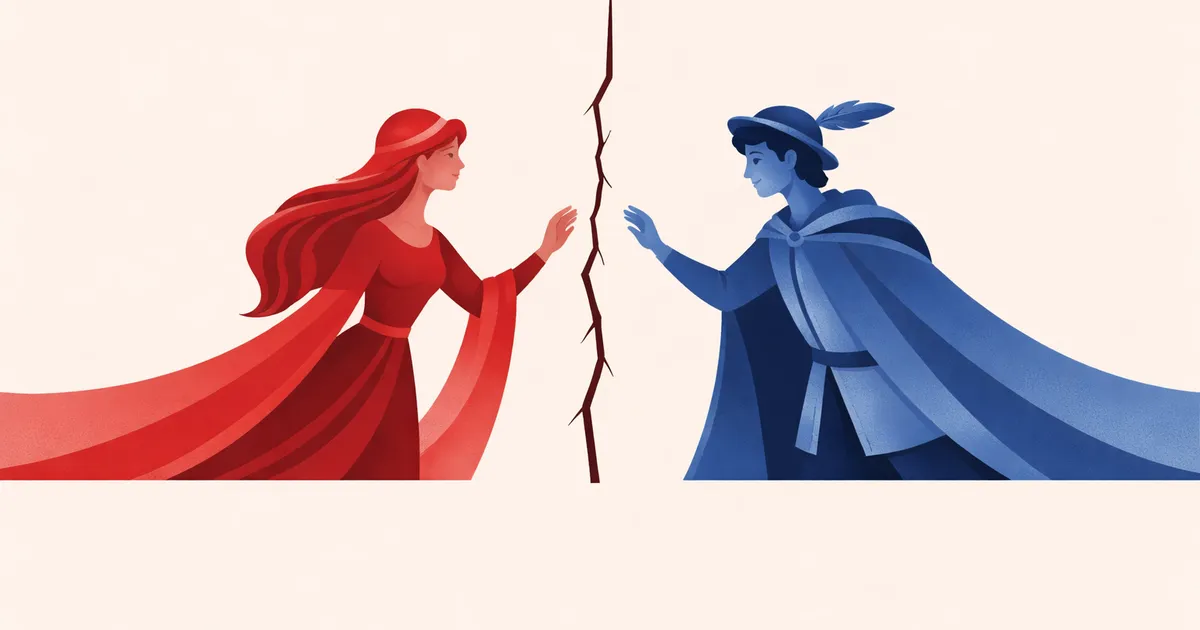
The Montague-Capulet feud isn't just a plot device that keeps the lovers apart -- it's the play's central political reality, an inherited hatred so deeply embedded in Verona's social fabric that people fight and die for it without knowing why it started. The opening scene makes this painfully clear: Sampson and Gregory, low-ranking Capulet servants, pick a fight with Montague servants not out of personal grudge but out of reflex. They belong to the house of Capulet, so they hate Montagues. That's the entire logic. When Tybalt arrives and declares "I hate the word / As I hate hell, all Montagues, and thee," he's not expressing a reasoned grievance -- he's expressing an identity. The feud has become who these people are, not something they do.
What makes this especially devastating is that the hatred operates at every social level. Old Capulet reaches for his sword when he sees Montague, even as his wife mocks him for it. The Prince has had to intervene three times. Citizens grab clubs the moment a fight breaks out. The feud has poisoned Verona so completely that Romeo and Juliet's love isn't merely forbidden -- it's literally unthinkable within the social categories available to them. Juliet grasps this when she says "My only love sprung from my only hate!" The grammar matters: love doesn't just conflict with hate; it springs from it, tangled up in the same family structures that produced both.
Detailed Analysis
Shakespeare uses the feud to explore how collective violence perpetuates itself even when no one can articulate its purpose. No character in the play ever explains what the Montagues and Capulets are actually fighting about. The Prince calls them "three civil brawls, bred of an airy word" -- bred of nothing, in other words. The feud sustains itself not through rational grievance but through social pressure, masculine honor codes, and the simple momentum of tradition. Tybalt doesn't need a reason to hate Romeo; being a Montague is reason enough. This makes the feud a structural problem rather than a personal one, which is precisely why individual acts of love or goodwill cannot solve it.
The play systematically demonstrates that private virtue is powerless against public violence. Romeo's attempt to make peace with Tybalt in Act III -- "Tybalt, the reason that I have to love thee / Doth much excuse the appertaining rage" -- is the most direct test of whether love can disarm hatred. It fails catastrophically. Romeo's refusal to fight doesn't defuse the situation; it inflames it. Mercutio reads his restraint as cowardice and draws his own sword, which gets him killed. The peacemaker's body literally becomes the instrument of death, as Tybalt stabs Mercutio under Romeo's intervening arm. Shakespeare constructs this scene so that Romeo's love for Juliet, which should bridge the families, instead produces the play's pivotal murder.
The feud's resolution is equally bleak. The families don't reconcile because they've learned the error of their ways or because love has triumphed. They reconcile because the body count has become unbearable -- five young people dead, plus Lady Montague offstage. The golden statues Capulet and Montague promise to erect are monuments to waste, not wisdom. The Prince's closing lines describe "a glooming peace" that the sun itself refuses to illuminate. Shakespeare refuses to let the audience feel good about the ending. Peace purchased with dead children isn't a victory; it's an indictment.
Love as a Radical Act
Romeo and Juliet's love is often read as youthful infatuation, and there's a case for that -- they've known each other less than a day before they marry. But Shakespeare frames their love as something far more disruptive than a teenage crush. In a city organized around family names and tribal allegiance, choosing to love someone from the enemy house is a political act. It requires dismantling the entire framework through which Verona understands identity. When Juliet asks "What's in a name?" she's not making small talk. She's proposing that personhood can be separated from family -- a genuinely radical idea in a feudal world where your name determines your alliances, your enemies, and your marriage prospects.
The lovers' shared sonnet at the Capulet feast captures this perfectly. Romeo and Juliet complete each other's lines, mirror each other's imagery, and build a fourteen-line poem together as though they've been collaborating for years. They create a private language in a room full of people who would kill them for speaking it. That instinctive harmony -- two people from warring houses finishing each other's rhymes -- is Shakespeare's most elegant argument that love can recognize something in another person that social categories cannot see.
Detailed Analysis
Shakespeare distinguishes Romeo and Juliet's love from mere infatuation partly through contrast with Romeo's earlier obsession with Rosaline. Romeo's language about Rosaline is stiff with Petrarchan convention -- "O brawling love! O loving hate! / O heavy lightness! serious vanity!" -- a parade of oxymorons that signals performance rather than feeling. He's playing the role of the tortured lover because that's what young men in his world do. When he sees Juliet, the rhetorical machinery drops away. "Did my heart love till now? Forswear it, sight! / For I ne'er saw true beauty till this night" is still extravagant, but it has a directness and self-awareness the Rosaline speeches lack. Romeo isn't just reciting; he's questioning his own history.
Juliet, meanwhile, is the more intellectually rigorous lover from the start. In the balcony scene, she interrogates Romeo's declarations with genuine skepticism: she questions whether his feelings are real, warns him against swearing by "th'inconstant moon," and acknowledges her own vulnerability with startling honesty -- "I should have been more strange, I must confess, / But that thou overheard'st, ere I was 'ware, / My true-love passion." She knows that by the conventions of courtship she should play hard to get, and she refuses to perform that game. Her frankness is itself a form of rebellion against the social scripts that govern Verona's gender roles.
The play also insists that love and death are not opposites but twins. Juliet's epithalamium in Act III -- "Come gentle night, come loving black-brow'd night, / Give me my Romeo, and when I shall die, / Take him and cut him out in little stars" -- fuses erotic desire with cosmic imagery in language that already anticipates the tomb. Romeo's final speech treats the vault as a bridal chamber: "Here, here will I remain / With worms that are thy chambermaids." The lovers consistently describe their passion in terms that blur the boundary between consummation and annihilation, as though Shakespeare is arguing that love this absolute -- love that defies every social structure meant to contain it -- can only fully express itself in death. The tomb becomes the one place where Romeo and Juliet can be together without names, without families, without Verona's machinery of hatred interfering.
Time and Haste: The Compression of Tragedy
One of the most striking things about Romeo and Juliet is how fast everything happens. The entire play unfolds in under five days. Romeo and Juliet meet on Sunday night, marry Monday afternoon, consummate the marriage Monday night, and are both dead by Thursday morning. Shakespeare inherited a story that originally stretched over nine months -- Arthur Brooke's source poem takes its time -- and deliberately crushed the timeline into a long weekend. That compression isn't just dramatic convenience. It's the engine of the tragedy. Every catastrophe in the play flows from someone not having enough time to think, to communicate, or to let a situation cool down.
Friar Lawrence sees this clearly. "Wisely and slow; they stumble that run fast," he warns Romeo, and the line functions almost as a thesis statement for the play. But the Friar's own advice proves impossible to follow. He agrees to the hasty marriage because he hopes it will end the feud. He devises the sleeping potion plan under time pressure because Juliet is being forced to marry Paris in days, not weeks. Even his letter to Romeo fails because of a timing accident -- Friar John gets quarantined. The play creates a world where wisdom and patience are the obvious solutions but haste is the only option anyone actually has.
Detailed Analysis
Shakespeare encodes temporal urgency into the play's language as well as its plot. Characters constantly reference clocks, hours, and the passage of time. Juliet tells Romeo "I have no joy of this contract tonight; / It is too rash, too unadvis'd, too sudden, / Too like the lightning, which doth cease to be / Ere one can say 'It lightens.'" She knows the relationship is moving dangerously fast, and she names the danger explicitly. But naming it doesn't slow it down. Romeo returns at nine the next morning to arrange the wedding. Juliet sends the Nurse before the hour is out. The marriage takes place that afternoon. Shakespeare gives his characters full awareness of the danger of speed and then denies them any way to decelerate.
The compressed timeline also exposes how institutions fail under time pressure. Friar Lawrence is an intelligent, well-meaning man whose plans require time and coordination that the plot refuses to provide. His sleeping potion scheme depends on a letter reaching Romeo in Mantua -- a perfectly reasonable plan that collapses because of a plague quarantine, a mundane bureaucratic accident. Lord Capulet accelerates the Paris wedding from Thursday to Wednesday on a whim, shaving away the already-thin margin of safety. The tragedy accumulates not from one grand error but from a sequence of small timing failures, each individually forgivable, collectively fatal. Shakespeare seems to be arguing that tragedy doesn't need a villain or a fatal flaw. Sometimes it just needs a world moving too fast for its own communication systems to keep up.
The play's relationship to time also works on a meta-dramatic level. The Prologue tells the audience everything -- "A pair of star-cross'd lovers take their life" -- so the audience watches from a position of knowing the ending while the characters rush toward it blind. Every moment of happiness is shadowed by the clock the audience can hear ticking. When Romeo cries "Then I defy you, stars!" the audience already knows the stars have won. This creates an emotional texture unique among Shakespeare's tragedies: not the slow unraveling of a flawed character but the helpless witnessing of a disaster that unfolds too quickly for anyone to prevent.
The Motif of Light and Darkness
Light and darkness aren't just background scenery in Romeo and Juliet -- they form the play's most pervasive visual pattern, and Shakespeare inverts their usual meanings in ways that reward close attention. Conventionally, light means safety, truth, and public order; darkness means danger, secrecy, and sin. Romeo and Juliet flips this. The lovers meet at night, declare their love at night, consummate their marriage at night, and die in the darkness of a tomb. Daylight, by contrast, brings violence: the street brawls happen in broad daylight, Romeo kills Tybalt under the hot afternoon sun, and the morning always arrives to separate the lovers. Juliet's desperate plea -- "Wilt thou be gone? It is not yet near day; / It was the nightingale, and not the lark" -- captures this reversal perfectly. Dawn is the enemy.
Romeo's first description of Juliet establishes the pattern: "But soft, what light through yonder window breaks? / It is the east, and Juliet is the sun!" Juliet becomes a source of private light in a dark world -- not the public sun that exposes them to their families' hatred, but a personal illumination visible only to Romeo. He consistently describes her in terms of stars, torches, and brightness that outshines the natural world. Even in the tomb, he sees her beauty as light: "her beauty makes / This vault a feasting presence full of light."
Detailed Analysis
The light/darkness motif tracks the play's larger argument about public versus private worlds. The public sphere -- daytime Verona, the streets, the feast -- is governed by the feud, by patriarchal authority, by the Prince's law. The private sphere -- the balcony at night, the bedchamber, even the tomb -- is where Romeo and Juliet can exist as themselves rather than as Montague and Capulet. Shakespeare consistently associates the public world with sunlight and the private world with darkness, then loads the private world with all the play's most luminous imagery. The effect is paradoxical: darkness becomes the space of genuine sight, while daylight becomes a form of blindness.
Romeo's trajectory through the play literalizes this pattern. In Act I, Montague describes his son hiding from sunlight -- "Away from light steals home my heavy son, / And private in his chamber pens himself, / Shuts up his windows, locks fair daylight out." This reads as depression and moping over Rosaline. But the image recurs with different meaning later: Romeo seeks out darkness not to wallow but to love. Night becomes the condition of authentic feeling, the space where names dissolve and the social machinery of Verona goes quiet. Juliet's epithalamium -- "Spread thy close curtain, love-performing night" -- explicitly invokes darkness as an erotic and protective force, a curtain that hides the lovers from "runaway's eyes."
The motif reaches its most devastating expression in the tomb scene. Romeo carries a torch into the Capulet vault and discovers that Juliet's beauty still blazes: "Death, that hath suck'd the honey of thy breath, / Hath had no power yet upon thy beauty." The dramatic irony is agonizing -- the light Romeo sees in her face is literal truth, because she is alive, but he reads it as a cruel metaphor. Throughout the play, Romeo has been right to associate Juliet with light. In this final moment, his poetic instinct is factually correct and interpretively fatal. He sees the light and dies anyway. The motif that sustained the love story becomes the mechanism of its destruction.
Patriarchal Authority and the Ownership of Women
Juliet's tragedy is not just that she loves the wrong person -- it's that she lives in a world where her body, her future, and her consent are treated as property to be allocated by men. This theme runs quietly beneath the louder drama of the feud, but it shapes every major decision in the play. Lord Capulet initially tells Paris to win Juliet's heart -- "My will to her consent is but a part" -- which sounds progressive until you notice that he's already decided Paris is an acceptable suitor. Juliet gets a vote, but only among candidates her father has pre-approved. By Act III, even that limited agency evaporates. Capulet arranges the Paris marriage without consulting Juliet, and when she objects, his response is volcanic: "An you be mine, I'll give you to my friend; / An you be not, hang, beg, starve, die in the streets."
The shift from Act I Capulet to Act III Capulet isn't a character inconsistency -- it's a revelation of how patriarchal power works under stress. Tybalt's death has weakened the family's social standing. A marriage to Paris, a kinsman of the Prince, would repair it. Juliet has become a political asset, and her personal feelings are irrelevant to the transaction. Even the Nurse, Juliet's closest ally, ultimately sides with patriarchal logic, advising her to forget Romeo and marry Paris because "Romeo's a dishclout" compared to a count. Juliet's complete isolation at the end of Act III -- abandoned by father, mother, and surrogate mother -- is the play's starkest dramatization of what happens when a woman tries to exercise autonomous desire in a world that doesn't recognize her right to it.
Detailed Analysis
Shakespeare embeds the language of ownership and transaction throughout the play's treatment of women. Paris speaks of Juliet as a commodity to be acquired; Capulet speaks of her as a gift to be bestowed. Even Romeo, for all his genuine passion, initially describes Juliet through the Petrarchan tradition that treats the beloved as an object of worship rather than a person with agency. It's Juliet who consistently resists being reduced to an object. Her balcony speech doesn't just question Romeo's name -- it questions the entire system by which names assign people to categories and roles. "Deny thy father and refuse thy name" is a request that applies to her as much as to him; she, too, wants to shed the identity that her father's house has imposed.
The play's opening scene quietly sets up this theme. Sampson's boasts about what he'll do to "Montague's maids" -- "I will push Montague's men from the wall, and thrust his maids to the wall" -- frame violence against women as an extension of the feud. Women's bodies become contested territory in the war between houses. This crude joke foreshadows the play's serious treatment of the same logic: Juliet's marriage is a strategic maneuver in the Capulet family's power positioning, her body a bargaining chip in aristocratic negotiation. Paris's claim at Juliet's grave -- "Thy face is mine, and thou hast slander'd it" -- reveals how completely the patriarchal framework denies women self-possession, even over their own faces.
Juliet's response to all of this is not passive suffering but increasingly autonomous action, and that autonomy is what makes her a tragic hero rather than a tragic victim. She proposes marriage to Romeo. She navigates the Nurse's rambling and Paris's presumption with wit and precision. She drinks the sleeping potion despite a terror so acute that she catalogs every nightmare scenario in her soliloquy -- "What if this mixture do not work at all? / Shall I be married then tomorrow morning? / No, No! This shall forbid it" -- keeping a dagger as her backup plan. When the potion scheme collapses and she wakes to find Romeo dead, she doesn't wait for Friar Lawrence to manage the situation. She seizes Romeo's dagger and acts. "O happy dagger, / This is thy sheath; there rust, and let me die." Her final act is one of absolute self-determination in a world that has denied her that right at every turn. The tragedy is not that Juliet is weak but that even her extraordinary strength cannot overcome the structures arrayed against her.