Summary
Overview
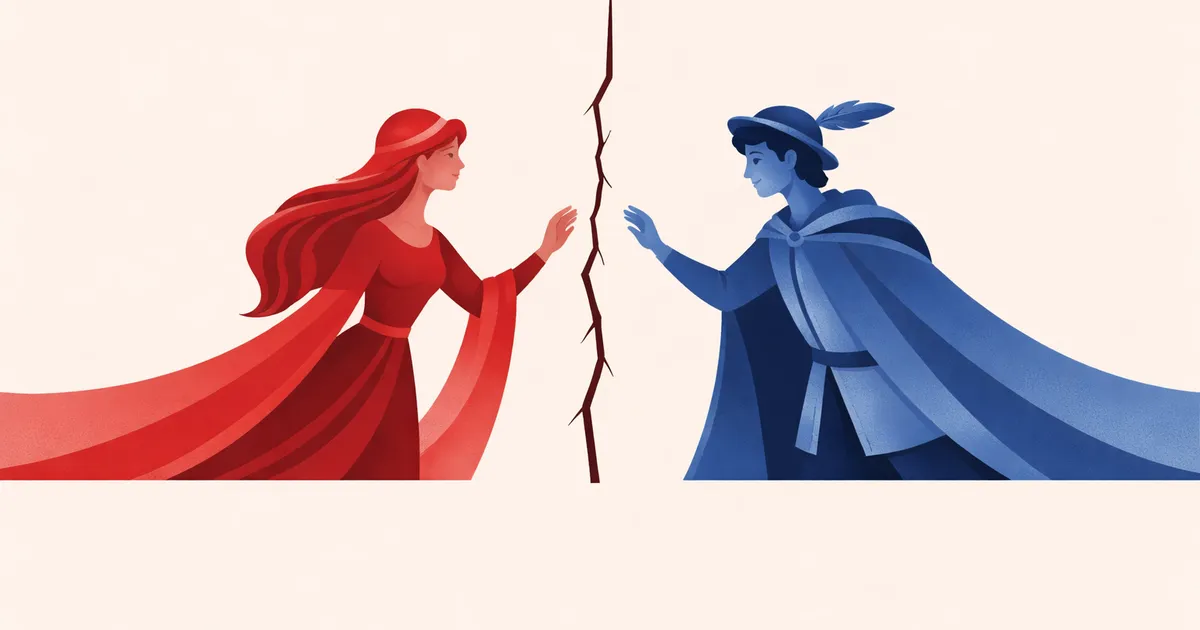
Romeo and Juliet is Shakespeare's most famous love story, but calling it just a love story misses the point. Set in Verona, Italy, the play tracks two teenagers from feuding families -- the Montagues and the Capulets -- who fall in love at a party, marry in secret the next day, and are dead by the end of the week. The central conflict isn't really between the lovers and their families, though that's what drives the plot. It's between the private world Romeo and Juliet create together and the public world of inherited hatred that refuses to leave them alone. Every decision they make -- the secret marriage, the desperate plans, the final suicides -- flows from that impossible gap between who they are to each other and who their families demand they be.
What makes the play devastating rather than merely sad is its speed. Shakespeare compresses the entire story into fewer than five days, and that compression is the engine of the tragedy. Romeo and Juliet don't fail because their love is foolish or because they make obviously bad choices. They fail because the feud has poisoned Verona so thoroughly that there's no space for patience, no room for the slow work of reconciliation. Friar Lawrence keeps urging caution -- "Wisely and slow; they stumble that run fast" -- but wisdom and slowness are luxuries this world doesn't offer. The play asks whether love powerful enough to transcend a generational blood feud can survive in a city determined to sustain it. The answer is no, but the cost of that answer is what finally shames both families into peace.
Detailed Analysis
Written around 1594-1596, Romeo and Juliet belongs to Shakespeare's early period, produced when he was still in his late twenties or early thirties and working primarily in comedies and histories. The play draws heavily on Arthur Brooke's 1562 narrative poem The Tragicall Historye of Romeus and Juliet, but Shakespeare made radical structural changes that transformed the material. Brooke's poem unfolds over nine months; Shakespeare collapsed the timeline to under a week. Brooke moralized relentlessly about the dangers of lust and disobedience; Shakespeare stripped away the moralizing and let the tragedy speak for itself. He also invented Mercutio as a significant character -- Brooke's version mentions him only once -- and in doing so created one of the play's most important dramatic functions: the voice of irreverent wit that the tragedy must silence before it can fully take hold.
Structurally, the play represents Shakespeare's most disciplined experiment with the Prologue as a dramatic device. The opening sonnet tells the audience exactly how the story ends -- "A pair of star-cross'd lovers take their life" -- which means the tragedy operates not through surprise but through dramatic irony. Every moment of joy is undercut by what the audience already knows. Romeo's exuberant "Then I defy you, stars!" in Act V lands differently when the audience has been told since line six that the stars have already won. This technique of announced doom, rare among Shakespeare's other tragedies, gives the play its distinctive emotional texture: not the slow revelation of a fatal flaw (as in Hamlet or Macbeth) but the relentless ticking of a clock the characters cannot hear. Within Shakespeare's body of work, Romeo and Juliet also marks his first sustained attempt at writing tragedy with a double protagonist, distributing the audience's sympathy across two equally compelling figures rather than concentrating it on a single tragic hero.
Act I
Act I establishes the feud and the lovers with remarkable economy. It opens with a street brawl between Capulet and Montague servants -- Sampson biting his thumb at Abram in a provocation that's both petty and dangerous -- which escalates until Prince Escalus himself intervenes, threatening death to anyone who disturbs the peace again. Against this backdrop of casual violence, we meet Romeo, but not as the passionate lover he'll become. He's moping over Rosaline, a woman who has sworn to live chaste and wants nothing to do with him. His friend Benvolio talks him into crashing the Capulet feast to see that other women exist. Meanwhile, Lady Capulet and the Nurse try to interest Juliet in Count Paris, a nobleman seeking her hand. Juliet, not yet fourteen, is politely noncommittal. At the feast, Romeo sees Juliet and everything changes -- "Did my heart love till now? Forswear it, sight! / For I ne'er saw true beauty till this night." They share a sonnet, they kiss, and then they each discover the other belongs to the enemy family. Juliet's response captures the play's essential bind: "My only love sprung from my only hate!"
Detailed Analysis
Shakespeare accomplishes something structurally brilliant in this act by layering three parallel introductions -- to the feud, to Romeo's character, and to Juliet's situation -- that converge at the Capulet feast. The opening brawl isn't just scene-setting; it demonstrates that the Montague-Capulet hatred has trickled down to the lowest servants, who fight without personal grievance, purely out of tribal loyalty. When Tybalt enters and declares "I hate the word / As I hate hell, all Montagues, and thee," the audience sees hatred that has become an identity, not a rational position. This makes Romeo and Juliet's later love not just forbidden but philosophically radical: it requires them to separate personhood from family name, an idea Juliet articulates explicitly in the balcony scene's "What's in a name?" speech.
Romeo's infatuation with Rosaline also does critical dramatic work. His elaborate, oxymoron-laden language about love -- "O brawling love! O loving hate! / O heavy lightness! serious vanity!" -- marks him as someone performing the role of lover rather than actually experiencing love. The contrast with his language when he first sees Juliet is stark: the Petrarchan cliches give way to images of light and religious devotion that feel spontaneous rather than rehearsed. Their shared sonnet at the feast -- a complete fourteen-line poem divided between two speakers -- is Shakespeare's most elegant metaphor for romantic compatibility. They finish each other's rhymes and mirror each other's conceits without effort, as though they've been writing together for years. But the scene also plants Tybalt's "this intrusion shall, / Now seeming sweet, convert to bitter gall," a promise of violence that will detonate in Act III.
Act II
Act II belongs almost entirely to the lovers. After the feast, Romeo climbs the Capulet orchard wall and overhears Juliet on her balcony, speaking his name and wishing he were not a Montague. He reveals himself, and they pour out their feelings in one of the most celebrated love scenes in English literature. Juliet is the more practical of the two: she worries about the danger ("If they do see thee, they will murder thee"), questions whether his feelings are real, and warns against swearing by the inconstant moon. She's also the one who proposes marriage, telling Romeo that if his intentions are honorable, he should send word tomorrow of when and where they'll wed. Romeo goes straight to Friar Lawrence, who is skeptical -- the Friar remembers all those tears over Rosaline -- but agrees to perform the marriage, hoping it might end the feud. The Nurse serves as go-between, carrying messages back and forth, and by the end of the act, Romeo and Juliet are secretly married in Friar Lawrence's cell.
Detailed Analysis
The balcony scene works on two levels simultaneously. On the surface, it's a love declaration; underneath, it's a philosophical argument about names, identity, and whether language can be separated from the reality it describes. Juliet's "What's in a name? That which we call a rose / By any other name would smell as sweet" sounds like simple common sense, but the play systematically proves her wrong. Names in Verona are not arbitrary labels -- they are death sentences, social positions, and inherited obligations. Romeo cannot shed the name Montague any more than he can shed his skin. The tragedy hinges on this gap between what Juliet's logic correctly argues (names are conventions) and what Verona's social reality brutally enforces (names are fates).
Friar Lawrence's soliloquy on herbs -- "Virtue itself turns vice being misapplied, / And vice sometime's by action dignified" -- functions as the play's thematic thesis statement. The idea that the same substance can heal or kill depending on application runs through every major plot point: love produces both the play's most transcendent poetry and its body count; the Friar's sleeping potion is meant to save Juliet but becomes the mechanism of the final catastrophe; even Romeo's capacity for passionate feeling, his greatest virtue, drives him to impulsive violence and suicide. Shakespeare uses the Friar as a choric figure who understands these paradoxes intellectually but cannot control them practically, a limitation that will prove fatal.
Act III
Act III is where the play pivots from comedy to tragedy, and the hinge is a single fight scene. Tybalt comes looking for Romeo to challenge him over crashing the Capulet feast. Romeo, now secretly married to Juliet and therefore Tybalt's kinsman by marriage, refuses to fight. He tries to defuse the confrontation -- "Tybalt, the reason that I have to love thee / Doth much excuse the appertaining rage" -- but Mercutio, disgusted by what he sees as cowardly submission, draws his own sword. Romeo steps between them to stop the duel, and Tybalt stabs Mercutio under Romeo's arm. Mercutio dies with the bitter curse "A plague o' both your houses" on his lips. Romeo, overwhelmed by fury and guilt, kills Tybalt in retaliation and flees, crying "O, I am fortune's fool!"
The Prince banishes Romeo from Verona instead of executing him. Juliet learns from the Nurse that her new husband has killed her cousin, and her response is a wrenching display of divided loyalty -- "O serpent heart, hid with a flowering face!" -- before she ultimately sides with Romeo. Romeo hides at Friar Lawrence's cell, where the Friar talks him out of suicide and sends him to spend one night with Juliet before fleeing to Mantua. But while Romeo and Juliet are together, Lord Capulet makes a fateful decision: he promises Juliet to Paris, with the wedding set for Thursday. When Juliet refuses, Capulet erupts in terrifying rage, threatening to disown her. Even the Nurse betrays her, advising Juliet to forget Romeo and marry Paris. Completely alone, Juliet resolves to seek help from Friar Lawrence, and if he cannot provide it, she'll take her own life.
Detailed Analysis
Mercutio's death is the structural turning point that makes the play a tragedy rather than a comedy of secret marriage and family reconciliation. Until this moment, the plot could still resolve happily -- the marriage could be revealed, the families could reconcile, the Prince could pardon Romeo's trespass at the feast. Mercutio's death forecloses all of that. And Shakespeare makes the mechanics of the killing devastating: Romeo's attempt to make peace is literally the gesture that enables Tybalt's fatal thrust. The peacemaker's body becomes the weapon. Romeo's love for Juliet, which should make him a bridge between the families, instead gets his best friend killed because Tybalt reads his refusal to fight as weakness and Mercutio reads it as dishonor. The scene dramatizes the impossibility of private virtue in a world structured by public violence.
Capulet's transformation in this act deserves close attention. In Act I, he told Paris that Juliet's consent mattered -- "My will to her consent is but a part." By Act III, Scene IV, he's arranging the marriage without even consulting her, and by Scene V, he's threatening to throw her into the street if she refuses. The change isn't inconsistent; it reveals how patriarchal authority works under pressure. Tybalt's death has destabilized the family's social position, and Capulet needs the Paris match to shore it up. Juliet has become a political asset, not a daughter with preferences. Her isolation at the end of the act -- abandoned by father, mother, and Nurse -- is total. The Nurse's advice to marry Paris is particularly devastating because the Nurse has been Juliet's closest confidante and surrogate mother. When Juliet calls her "Ancient damnation!" and resolves to seek the Friar's help alone, she's severing her last connection to childhood safety.
Act IV
Desperation drives Act IV. Juliet goes to Friar Lawrence and finds Paris there, already planning their Thursday wedding. After Paris leaves, Juliet threatens to kill herself with a knife rather than commit bigamy. The Friar, panicking, devises the sleeping potion plan: Juliet will drink a liquid that mimics death for forty-two hours. Her family will place her in the Capulet tomb, and Romeo, warned by letter, will be there when she wakes. They'll escape to Mantua together. Juliet agrees without hesitation -- "Give me, give me! O tell not me of fear!" -- and goes home to play the obedient daughter, pretending to accept the Paris match.
The night before the wedding, alone in her chamber, Juliet confronts what she's about to do in a soliloquy that ranks among Shakespeare's most psychologically raw passages. She imagines waking early in the tomb, surrounded by her ancestors' bones and Tybalt's decomposing body, and wonders if the terror will drive her mad. She drinks the potion anyway. The next morning, the Nurse finds her apparently dead, and the household erupts in grief. The wedding preparations transform into funeral arrangements. Friar Lawrence urges the family to carry Juliet to the Capulet vault, knowing the plan is in motion.
Detailed Analysis
Juliet's soliloquy before drinking the potion (Act IV, Scene III) is the moment that most clearly separates her from the stock romantic heroine she might have been. She does not drink in a haze of lovesick resolve. She systematically inventories every reason not to: What if the potion doesn't work? What if it's actually poison? What if she wakes too early and suffocates? What if Tybalt's ghost is there? The speech reveals a mind that is both terrified and ruthlessly logical, running through worst-case scenarios the way a soldier might before battle. That she drinks despite all this makes her courage concrete rather than abstract. Shakespeare also plants a crucial detail -- "What if this mixture do not work at all? / Shall I be married then tomorrow morning? / No, No! This shall forbid it" -- as she lays down her dagger. Juliet has a backup plan for the backup plan. Her death at the end of Act V, by that same dagger, echoes this moment and confirms that her capacity for decisive action never wavered.
The mourning scene that follows Juliet's apparent death (Act IV, Scene V) has troubled readers and audiences for centuries with its seemingly excessive, almost parodic grief. Capulet's lament -- "Death is my son-in-law, death is my heir; / My daughter he hath wedded" -- uses the same marriage language that has structured the entire play, and the Friar's consolation speech rings hollow because the audience knows Juliet isn't dead. Shakespeare appears to be doing something deliberately uncomfortable here: showing how grief performances can be sincere and formulaic at the same time. The musicians' scene that closes the act, with Peter badgering them about whether to play a sad song, breaks the tragic tone entirely -- a reminder that life's mundane concerns don't pause for anyone's catastrophe.
Act V
Everything falls apart in Act V because of a letter that never arrives. In Mantua, Romeo's servant Balthasar brings news that Juliet is dead -- he saw her body placed in the Capulet tomb. Romeo's response is immediate and irreversible: "Then I defy you, stars!" He buys poison from a starving apothecary and rides for Verona. Meanwhile, Friar Lawrence learns that his letter to Romeo, explaining the sleeping potion plan, was never delivered -- Friar John was quarantined in a house suspected of plague and couldn't leave the city. The Friar rushes to the tomb, but he's too late.
At the Capulet vault, Romeo encounters Paris, who is mourning at Juliet's grave. They fight, and Romeo kills Paris -- another senseless death in a play already full of them. Romeo enters the tomb, sees Juliet's body, and delivers his final speech. He notices that she still looks alive -- "Death, that hath suck'd the honey of thy breath, / Hath had no power yet upon thy beauty" -- an observation that is literally true, since she's only sleeping, but which he takes as a cruel trick of death. He drinks the poison and dies with a kiss. Moments later, Juliet wakes to find Romeo dead beside her. Friar Lawrence arrives and begs her to leave, but she refuses. She kisses Romeo's lips hoping for residual poison, and when that fails, takes his dagger and stabs herself. The Prince, the Capulets, and the Montagues arrive to find the bodies. Friar Lawrence confesses the whole story. The two fathers, standing over their dead children, finally agree to end the feud. Montague promises a gold statue of Juliet; Capulet promises one of Romeo. The Prince closes the play with the famous couplet: "For never was a story of more woe / Than this of Juliet and her Romeo."
Detailed Analysis
The catastrophe turns on contingency rather than character flaw, and this is one of the play's most provocative structural choices. Romeo doesn't die because of hubris, ambition, jealousy, or any of the traditional tragic flaws. He dies because a friar got stuck in a quarantine. The letter's failure to arrive is mundane, accidental, and entirely outside anyone's control -- a plague quarantine intercepting a messenger. Shakespeare seems to be arguing that tragedy doesn't require a protagonist's moral failure; sometimes the world simply conspires against people through bad timing and institutional failure. This puts Romeo and Juliet in tension with Aristotelian tragic theory, which insists on hamartia (a character's error or flaw) as the engine of tragic downfall. Here, the engine is a postal delay.
Romeo's final speech in the tomb carries extraordinary dramatic irony. When he observes that Juliet's lips are still crimson and her cheeks still flushed -- "Why art thou yet so fair?" -- the audience knows exactly why: she's alive. Romeo even entertains the right answer ("Shall I believe / That unsubstantial death is amorous, / And that the lean abhorred monster keeps / Thee here in dark to be his paramour?") but rejects it for a poetic conceit. He's inches from the truth and reaches instead for metaphor. This is Shakespeare at his cruelest: the gap between what the audience sees and what the character understands is measured in seconds and a few ounces of poison.
The play's final scene of reconciliation -- the golden statues, the handshake between Capulet and Montague -- is often played as catharsis, but the text resists easy comfort. The Prince's "A glooming peace this morning with it brings; / The sun for sorrow will not show his head" does not describe resolution. It describes exhaustion. The families don't end the feud because they've learned something profound about love transcending hatred. They end it because the body count has become unbearable. Montague's wife has died offstage from grief. Paris, Mercutio, Tybalt, Romeo, and Juliet are all dead. The golden statues are memorials to failure, not to triumph -- monuments that will remind Verona forever of what its hatred cost. The play ends not with healing but with an accounting of losses, and the peace it purchases is bought entirely with the currency of dead children.