Summary
Overview
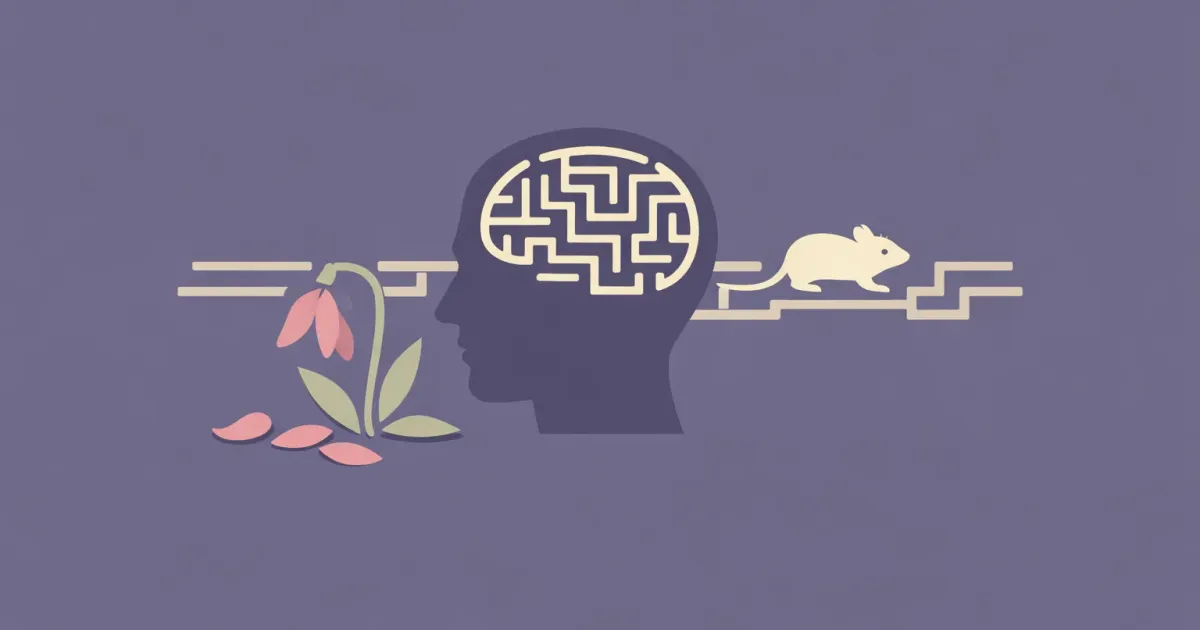
Flowers for Algernon is the story of Charlie Gordon, a thirty-two-year-old man with an IQ around 68 who works sweeping floors at Donner's Bakery in New York and takes night classes for adults with intellectual disabilities. When two scientists at Beekman University offer him an experimental brain surgery that has already tripled the intelligence of a white lab mouse named Algernon, Charlie volunteers, eager to "get smart" so his coworkers will finally like him. The novel takes the form of his own "progress reports," which begin in phonetic, misspelled fragments, bloom into erudite scientific prose as his IQ climbs to around 185, and then slowly collapse back into the halting handwriting of the man he used to be. What starts as a science-fiction conceit turns into one of the most wrenching novels ever written about intelligence, loneliness, and what we owe people whose minds work differently from our own.
The central conflict isn't really whether the experiment will succeed. It's whether Charlie, having been given a self, gets to keep it. As he gets smarter, he realizes that the friends at the bakery have spent years laughing at him, that his mother Rose forced him out of the family when his sister Norma was born, and that Professor Nemur and Dr. Strauss see him as an experimental subject rather than a man. He falls in love with his former teacher, Alice Kinnian, but a childhood full of violent punishments makes intimacy almost impossible. Then, at a scientific convention in Chicago, he watches Algernon begin to regress and understands, in a single sickening moment, that he is watching his own future. The rest of the book is Charlie racing to find meaning before the light goes out.
Daniel Keyes first published "Flowers for Algernon" as a short story in 1959, won a Hugo for it, and then spent years expanding it into the 1966 novel that made his name. The expansion mattered: the short story ends with Charlie's decline, while the novel has room for the excavation of his childhood, the two failed romances, the confrontation with Nemur, and the long visit to the Warren State Home that forces him to look at the life waiting for him on the other side of regression. The progress-report form is the book's single most important decision. Because the reader only ever sees the world through Charlie's words, his intelligence becomes something the prose itself has to do, and the reader has to feel the rise and the fall sentence by sentence rather than being told about them. The early chapters read like a child's notebook; the middle chapters are dense with philosophical vocabulary and psychoanalytic terminology; the last chapters grind down through grammar, then spelling, then the very ability to read what Charlie has already written.
Within the broader current of 1960s American fiction, the novel is an outlier. It borrowed the experimental-science premise from pulp science fiction but bent it toward psychological realism, and it gave American literature a protagonist with a cognitive disability who was written as a full interior self rather than a symbol or an object of pity. The book arrived at a moment when state institutions like the fictional Warren Home were beginning to face public scrutiny, and its depiction of the system, sympathetic but unsparing, carries documentary weight. Keyes never wrote another novel that matched it. He went on to nonfiction (The Minds of Billy Milligan) and one quieter follow-up, but Flowers for Algernon is the book that earned him permanent space on American reading lists, precisely because it refuses the consolations its premise seems to promise.
Reports 1-5: Before the Operation
The novel opens in the first week of March with three nearly unreadable progress reports. Charlie, prompted by Dr. Strauss to write down everything he thinks and remembers, introduces himself: thirty-two years old, bakery worker under Mr. Donner, student of Miss Kinnian at the Beekman College Center for Retarded Adults, and a willing volunteer for an experiment he doesn't remotely understand. He takes Rorschach and Thematic Apperception tests that confuse and humiliate him, then meets the graduate student Burt Selden, who introduces him to Algernon, a white mouse who has just beaten a man with an IQ of 68 at solving a maze. Charlie races Algernon ten times and loses every time. Professor Nemur and Dr. Strauss interview him about his family; Charlie says his Uncle Herman, who got him the bakery job, is dead, and he has not seen his mother, father, or sister Norma in a very long time. Reassured by Miss Kinnian that Charlie wants the experiment more than anyone, they agree to use him. The surgery happens in the hospital. Charlie wakes up bandaged and disappointed, since he doesn't feel any smarter. At the bakery, Gimpy, Joe Carp, and Frank Reilly keep hollering at him, teasing him, and insisting they are his friends.
These opening reports do two kinds of work at once. On the surface, they establish the premise and introduce every figure who will matter later. Underneath, they quietly plant the evidence that Charlie's "friends" are nothing of the kind. Joe and Frank's jokes about "where Charlie had his operashun" and their casual cruelty land harmlessly on the page because Charlie cannot read them as cruelty, which means the reader can't quite, either. The reader's growing unease is the engine of the early book: we see what Charlie can't, and the dramatic irony generates the ache that the rest of the novel will cash in. The spelling itself, long ridiculed and long imitated, is the novel's most radical formal choice. Every misplaced letter is a limitation that the reader shares in real time. When Charlie writes "I want to be smart" in his first report, the sentence costs him something, and the prose makes the reader feel that cost before any plot has even started.
Reports 6-8: The Surgery and the First Glimmer
The operation happens on March 8. Charlie is back at the bakery within days, still writing in misspelled fragments, still losing to Algernon, still begging Miss Kinnian to tell him when he will finally get smart. Then, on April 1, an April Fool's prank misfires. Joe Carp and Frank Reilly dare Charlie to work the dough mixer, expecting him to make a mess that gets the bakery shut down for the day. Instead he runs it perfectly, faster than the man who spent two years learning the job. Mr. Donner gives him a raise. Around the same time Charlie finishes Robinson Crusoe on his own, begins to notice punctuation, and experiments with it (the famous passage where he throws commas and semicolons across the page like a child learning to juggle). A party thrown by his coworkers turns into a nightmare when Joe tricks him into drinking, pushes a girl named Ellen at him, and lets the guests laugh as Charlie trips and falls. The realization that Joe and Frank have always been laughing at him, that "to pull a Charlie Gordon" is an insult everyone in the bakery uses, is the novel's first true wound.
The structural turn of the novel happens here, in miniature. Charlie's growing intelligence is first a technical marvel (the mixer, the books) and then almost immediately a moral burden (the party, the realization). Keyes is arguing something unsentimental: new knowledge does not automatically improve a life. The first thing Charlie's new mind lets him see is that he has been humiliated for years, and the book never lets the reader forget that insight is a form of pain. The prose is also doing something technically remarkable in these reports. The spelling normalizes gradually, the sentences lengthen, and by the end of the section Charlie is using dialogue tags and internal italics. Because the reader has watched this happen word by word, Charlie's intelligence never feels like a plot point. It feels like a body growing up too fast.
Reports 9-11: Alice, Memory, and the First Cracks
By May, Charlie is reading faster than his teachers, his vocabulary has overtaken Miss Kinnian's, and he is starting to call her Alice. They go to a movie; he tries and fails to put his arm around her; he loses his nerve at her apartment door. His dreams begin to fill with his mother Rose, his sister Norma, and a bloody kitchen knife. Long-buried memories surface: Rose slapping him for touching the baby, Rose screaming that he must never look at Norma in the bath, his father Matt standing by helplessly. At the same time, Charlie is pulling away from the bakery. Fanny Birden warns him that something about him has changed. A petition circulates to have him fired, signed by the same friends who once teased him, and Mr. Donner regretfully lets him go. Charlie moves out of his old furnished room. At the lab, his intelligence has now far outstripped Burt's and is closing in on Nemur's, and he begins to see Nemur clearly for the first time: a competent, frightened man pushed into premature publication by a wife who needed him to be great. Charlie's relationship with Alice deepens in language but freezes in the body. Every time she touches him, a wave of nausea and shame rises from a childhood where desire was punished.
This is where Flowers for Algernon stops being a science-fiction novel about an experiment and becomes a psychological novel about a self. The progress reports start to operate on two time-tracks at once: the present-tense reports of adult genius Charlie, and the italicized memories of Charlie at six, at nine, at fourteen. The adult Charlie watches the child Charlie the way Virgil watches Dante, and the distance between them is the novel's emotional subject. Keyes uses Rose's violence very carefully here. She isn't a monster. She is a woman whose shame at her son's disability has fossilized into cruelty, and the book lets the reader see how a community's intolerance migrates into a mother's hand. Charlie's erotic paralysis with Alice, often discussed in isolation, is the direct consequence of those scenes. The book argues that trauma is not something that happens in one generation and stops there, and that intelligence alone cannot unlearn what a body has been taught to fear.
Reports 12-13: Fay, Chicago, and the Discovery
Charlie loses his job, moves to a new apartment on Forty-third Street near Times Square, and meets his neighbor Fay Lillman, a blonde painter who drinks too much, forgets to wear clothes, and lives in aggressive disarray. With Fay, for whom he feels no complicated tenderness, Charlie can finally be physical. She becomes his first lover. Meanwhile, Nemur has scheduled a presentation at an international psychological convention in Chicago, and Charlie, Burt, Strauss, and Nemur fly out together. The trip is disastrous. Nemur patronizes Charlie in front of the audience; Charlie, furious at being discussed as a product rather than a person, watches Nemur present preliminary data that he, Charlie, can already see is wrong. Back in the hotel, he realizes Algernon has begun to fail the same complex problems he used to solve. On impulse, Charlie grabs Algernon's cage, walks out of the convention, and takes the mouse home to New York. His face and Algernon's sketch appear on the front pages of the tabloids; a reporter tracks down his mother and sister, and for the first time in seventeen years Charlie knows his family's address.
The Chicago convention is the novel's formal center and its moral one. Every theme the book has been patiently laying out converges here: the scientist as patron, the experimental subject as property, the triumph that requires another creature's diminishment. When Charlie stands up and corrects Nemur's statistics in front of an international audience, he is not only asserting himself as a human being; he is also starting to do the research that will predict his own collapse. The Algernon-Gordon Effect, the paper he will co-author in the next section, begins here. Keyes structures the scene so that Charlie's greatest intellectual moment and the first visible symptom of Algernon's decline happen in the same forty-eight hours. Running away with the mouse is not a rescue; it is a recognition. Charlie understands that he and Algernon are the same experiment, and that if one is failing the other will fail too. It is also a small brutal irony that the act of escaping makes him newsworthy, and the newspapers give him back the mother he has been trying to avoid for thirty years.
Reports 14-15: Family, Warren, and the Algernon-Gordon Effect
The middle reports compress a lot: Charlie in hiding in his Times Square apartment with Fay across the hall and Algernon running three-dimensional mazes in the spare bedroom; a furious reunion with his sister Norma at the old Brooklyn house, where he finds their mother Rose senile and Norma exhausted and, startlingly, grateful; a guarded return to the lab when Charlie persuades the Welberg Foundation to let him lead his own research; a cold meeting with Nemur in which Nemur explains, with awkward honesty, that if the experiment fails Charlie has been pre-committed to Warren State Home for life. Charlie drives out to Warren to see where he will end up, is shown through the cottages by the young psychologist Winslow, and is devastated by the quiet children and the woman with the wine-colored birthmark who gives her life to them. He throws himself into the science. Working with Burt and Strauss, he co-authors a paper titled "The Algernon-Gordon Effect: A Study of Structure and Function of Increased Intelligence," which proves mathematically that the gains from the surgery are temporary and that regression will be proportional to the gain. Algernon begins to refuse food, to forget mazes, and finally dies. Charlie buries him in a small box in the back yard and lays flowers on the grave.
These reports dismantle, in order, every consolation the novel has offered. The visit to the Brooklyn house is the book's most painful scene: Rose, once the tyrant of Charlie's childhood, now pulls a kitchen knife on him in a moment of delusion, and Norma, once the favored child, has become her unpaid nurse. The scene short-circuits any hope that knowledge will lead to reconciliation. The trip to Warren is equally hard. Winslow's quiet dignity, and the image of a bigger boy cradling a smaller one because there is no one else to do it, forces Charlie to admit that the life he is dreading is also a life full of human tenderness. The paper itself is the novel's cruelest formal gesture. Charlie's intelligence reaches its peak exactly at the moment he uses it to prove that his intelligence must fail. The reader is asked to feel that equation in their chest: the thing he has become is the tool he uses to diagnose himself, and the work is good enough to count as his contribution to science and also his death warrant. Algernon's burial, quiet and offhand, is the rehearsal for the ending.
Reports 16-17: Regression and the Last Postscript
The regression arrives faster than Charlie expected. He fights with neighbors, smashes records, quarrels with Strauss in therapy, stops being able to read German, then French, then long English sentences. He pushes Fay away first, then Alice, telling her to leave because he cannot stand her pity. There is a strange final interlude of happiness when Alice comes back through the fire escape and, for one night, they are able to be lovers in a way his earlier trauma had blocked. But it cannot last. Charlie forgets the names of books, then the books themselves. He goes back to Donner's Bakery and asks for his old sweeping job; Mr. Donner, crying, gives it to him. A new worker named Meyer Klaus bullies him until Joe Carp, Frank Reilly, and Gimpy, the men who used to humiliate him, stand up for him, promising that anyone who hurts Charlie will answer to them. Finally Charlie, ashamed of having walked into Miss Kinnian's classroom and not remembered why, writes one last progress report announcing that he is going, voluntarily, to the Warren Home. The handwriting is the handwriting of the first chapter. He thanks Miss Kinnian. He asks that Professor Nemur not be so much of a grouch. And he ends with the postscript that gives the book its title: "please if you get a chanse put some flowrs on Algernons grave in the bak yard."
The closing reports reverse, deliberately and with unbearable patience, every gain the novel has described. The misspellings return. The sentences shorten. The vocabulary narrows. Keyes is arguing, through form, that identity is not a possession but a practice, and that losing it hurts more than never having had it. The late scenes at the bakery are the book's moral pivot. The same men who tormented Charlie in the first chapters now defend him, and Charlie forgives them, which is to say he understands that their cruelty was also a kind of relationship, and relationship is what he is dying for. The choice to enter Warren himself, rather than be sent, is the novel's one unambiguous act of dignity. Charlie is giving the institution no satisfaction. He is going on his own feet.
The final postscript is famous for a reason. It is the voice of the original Charlie, poorly spelled and punctuated, caring for a dead mouse he can no longer fully remember but has not forgotten. The sentence argues, with almost no literary machinery, that the capacity for love is not proportional to IQ, and that what Charlie has at the end of the novel is not less than what the genius had in the middle but something different, possibly older, and possibly truer. It is one of the rare endings in American fiction that leaves the reader both completely undone and unable to say the book is pessimistic. Charlie has lost everything he gained, but the gain was real, and the memory of the gain, which the reader now carries, is the only place it can survive.