Themes & Motifs
Intelligence Is Not the Same as Personhood
When Charlie objects to being treated as an experimental product, Nemur slips: he tells him he wasn't referring to now, he meant "before the operation" — as if the Charlie who existed on the operating table was not yet a person at all. That small correction does most of the novel's thematic work. Intelligence and personhood are two different things, and mistaking one for the other is the engine of almost every cruelty in the story. Charlie before the surgery has a self. He has preferences, a moral vocabulary ("I want to be smart"), loyalties, shame, and a clumsy but genuine sense of kindness. What he lacks is a vocabulary sophisticated enough to make the world take him seriously. The surgery gives him that vocabulary and immediately reveals how little anyone around him cares about the self underneath it.
That single exchange is the novel's moral fulcrum. Rose's older version of the same mistake is louder and more anguished: "He'll go to college someday. He'll be somebody." She claws the word out of herself as if personhood were a certificate the state might deny her son. Keyes's quiet counter-argument is carried entirely by the prose of the first and last chapters — the fact that the rabbit's-foot-carrying, misspelling Charlie of the final postscript is recognizably the same person as the genius who wrote the Algernon-Gordon paper. The reader has been with him the whole time.
The book makes its case about personhood not through speeches but through dramatic irony engineered by the progress-report form. In the early reports, Charlie calls Joe Carp and Frank Reilly his best friends. He cannot see that "to pull a Charlie Gordon" has become a bakery idiom for a pratfall. The reader sees it on page one, because the reader can read what Charlie writes but also read around it. This gap is not condescension — it is the book's ethical machinery. Every time Charlie fails to recognize an insult, the reader is forced into the position of the only sympathetic adult in the room. The reader becomes responsible for noticing Charlie's personhood, because Charlie cannot yet claim it for himself.
Keyes sharpens the argument at the Chicago convention, the book's formal hinge. Nemur stands at a podium and describes his subject, in Charlie's hearing, as a man who was "not a human being" before the operation. Charlie's response is one of the novel's most famous lines: "I'm not an inanimate object. I'm a person." The line is more than self-assertion — it is a correction of a category error. Nemur has conflated intelligence with humanity, and Charlie, using the intelligence Nemur gave him, uses it against Nemur's own premise. The scientist's gift undoes the scientist's framework. The move is so clean it reads almost like a logic proof: if the operation made me a person, then a person existed to consent to it, and Nemur's entire moral justification collapses.
The theme's final proof is negative rather than positive. When Charlie regresses and returns to the bakery, he is not less of a person than he was as a genius. The book refuses that reading with its closing postscript, where Charlie — unable to spell "chance" — still remembers to ask that flowers be put on the grave of a mouse. The gesture is a small, ungrammatical act of tenderness that no amount of IQ could improve. Keyes has arranged the plot so that Charlie's humanity is demonstrated at the two cognitive extremes and is revealed to be continuous between them. Intelligence rises and falls; personhood is the constant.
The Experimental Subject as Property
The hyphen in "Algernon-Gordon" is the novel's cruelest piece of typography. It fuses a human subject and a lab animal in a single scientific term, and Charlie himself has to invent that term to describe his own coming death. What makes that hyphen so unnerving is that the men who put it there are not villains. Nemur and Strauss are decent men operating inside a scientific culture that has not yet reckoned with the ethics of using a human being as a test case. The novel was written against a mid-century backdrop of growing public anxiety about institutional research — the Nuremberg Code was only fifteen years old when the short story appeared — and Keyes dramatizes the problem not through an evil experiment but through an experiment staffed by well-meaning people who nonetheless end up talking about a man the way they talk about a mouse.
The book's quietest insight is that ownership of an experimental subject doesn't announce itself as ownership. It shows up as paperwork, as funding arrangements, as casual plans — Nemur has already pre-committed Charlie to the Warren State Home if things go wrong. Charlie is not told this; it surfaces almost as an afterthought. He is, legally and institutionally, a piece of property being loaned out by his own future.
The motif that carries this theme is the word "guinea pig," which Charlie flings at Nemur twice, across different reports. At the laboratory in New York he complains that he resents "the attitude that I am a guinea pig. Nemur's constant references to having made me what I am." Charlie hears in that phrasing a man being spoken of as if he had been built rather than born. Later, when Nemur lectures him about gratitude, Charlie explodes: "Since when is a guinea pig supposed to be grateful?" And at the end, when he finally walks out, he says it again: "I'm not a guinea pig any more. I've done enough. I want to be left alone now." Three moments, escalating, all circling the same metaphor. Keyes is using repetition not for emphasis but for documentation — these are the three stages of a subject's moral awakening. First, Charlie notices the category. Then he rejects its obligations. Finally, he withdraws consent altogether.
The theme has a darker structural dimension in the Algernon-Gordon paper itself. Charlie uses his peak intelligence to prove that the intelligence is temporary. In economic terms, he is the product performing its own product-recall. Keyes is arguing something specific about the scientific method as it was practiced in 1966: that a subject's ability to analyze his own treatment was not counted as a gain but as a liability, because it complicated the data. Nemur's resistance to Charlie's independent research is not malice. It is the territorial reflex of a scientist who has discovered that his specimen can now critique the methodology.
The Warren trip completes the argument. Winslow, the young psychologist, walks Charlie through the cottages and explains that patients come here to stay for the rest of their lives. The facility is sympathetic, even tender — the bigger boy cradling the smaller one, the nurse with the wine-colored birthmark — but it is still a place where bodies are warehoused because there is nowhere else to put them. When Charlie realizes that this is the endpoint pre-selected for him, the novel closes a loop it opened in the first chapter. The experiment always had a disposal plan. It simply wasn't disclosed.
Mockery as Pseudo-Belonging
One of the book's most unsettling arguments is that cruelty can masquerade as friendship and be accepted as friendship by the person on the receiving end. Charlie tells anyone who will listen that Joe Carp and Frank Reilly are his best friends. They are the ones he calls when he's lonely. They are the ones he is most eager to impress. And they have spent years humiliating him for entertainment. The novel asks a question that most accounts of bullying never quite get to: what if the alternative to being laughed at is being alone? What if mockery is the only form of inclusion available to some people, and they choose it knowingly?
The April Fool's party at Muggsy's Saloon is the scene where Charlie, newly intelligent, reads his own social life and realizes what it has been. Joe pushes him at a girl named Ellen, gets him drunk, trips him deliberately, and the room laughs. Charlie writes afterward that he "never knew before that Joe and Frank and the others liked to have me around just to make fun of me," and that he is "ashamed." The shame is not at his own behavior — it is retroactive, at his trust.
The phrase "to pull a Charlie Gordon" is the novel's sharpest piece of linguistic evidence. The bakery workers have turned Charlie's name into a common noun for clumsy mistake. This is not background color; it is the argument itself. Keyes is showing that an entire workplace culture has been built on converting one man into a joke, and that the joke has become so automatic that the men using it no longer remember it is a joke at anyone's expense. Charlie's name — the thing that distinguishes him as himself — has been absorbed into the shared vocabulary of the group that excludes him. Mockery here is not an incidental cruelty. It is the mechanism by which the bakery maintains its hierarchy.
The theme's most radical turn happens in the regression chapters. After the surgery fails and Charlie returns to Donner's as a sweeper, a new worker, Meyer Klaus, starts bullying him — and Joe Carp, Frank Reilly, and Gimpy, the original tormentors, stand up for him. They tell Klaus that anyone who hurts Charlie will answer to them. The reversal is not a redemption arc; it is something stranger and more accurate. The same men who laughed at Charlie also, in some broken way, considered him theirs. Their cruelty and their protectiveness come from the same place: Charlie was their mascot, and you do not let outsiders hurt a mascot. Keyes refuses to let the reader feel either simple contempt for these men or simple warmth toward their late-stage kindness. He is arguing that inclusion inside a damaged community can look, from the inside, like love.
Charlie's response in the final chapter confirms the argument. He forgives them. More than that, he writes — in the crooked handwriting of the original Charlie — that "its easy to have fiends if you let pepul laff at you. Im going to have lots of fiends where I go." The misspelling of "friends" as "fiends" is one of the book's most famous accidents, and probably not an accident at all. In Charlie's world the two words have always overlapped. The people who laugh at you are the ones who keep you company. The people who keep you company are the ones who laugh at you. The novel neither endorses nor condemns this economy of belonging. It simply insists that for many people on the margins, it is the only economy on offer.
The Child Trapped Inside the Adult
Charlie's mind after the surgery is not a blank slate learning the world from scratch. It is a thirty-two-year-old body housing a six-year-old who was beaten every time he showed desire, a nine-year-old who was told to never look at his baby sister, and a fourteen-year-old who was finally pushed out of his mother's house because Norma was growing up and Rose could no longer pretend. The adult who emerges from anesthesia has to live with all of them. The most devastating argument of the novel is that intelligence alone cannot dismantle the conditioning of a childhood. Charlie can quote Freud, write in three languages, and prove mathematical theorems, and he still cannot put his arm around Alice Kinnian in a movie theater without his stomach turning.
The novel treats trauma not as a symptom to be cured but as an inheritance to be negotiated. Charlie's erotic paralysis with Alice — his nausea, his sudden visions of his sister in the bath, the hallucinated mother threatening punishment — is the direct transcript of what was done to him at seven. The knowledge is not the healing.
Keyes structures the memory reports as a second timeline running underneath the experimental one. They appear in italics; they intrude without warning; they often arrive mid-sentence. The formal choice is itself the argument. The adult Charlie is writing about laboratory procedures and suddenly he is eight years old again in a Brooklyn kitchen, watching his mother scream. The text refuses to keep the timelines separate because Charlie's psyche cannot keep them separate. Genius has not given him a filter. It has given him a clearer window onto rooms he used to be able to forget.
Rose carries most of this theme, and Keyes writes her with unusual moral precision. She is not a villain in the melodramatic sense. She is a woman whose own shame at her son's disability has fossilized into hitting, and the book takes care to show that her shame was itself produced by a community that treated intellectual disability as contagion. "He'll be normal, whatever we have to do, whatever it costs," she tells Matt. The cost turned out to be her son. When Charlie finally goes back to the old Brooklyn house, he finds Rose senile and paranoid, pulling a kitchen knife on the very son she drove out, because in her collapsed mind the adult Charlie has arrived to assault the child Norma she is still trying to protect. The scene is almost unbearable because it reveals that Rose has been living inside the same loop Charlie has. They were both trapped in the same seven-year-old kitchen, for the same quarter-century, and knowledge cannot free either of them.
The theme closes with a grim symmetry at the end of the novel. As Charlie regresses, the memories stop being retrievable and become operative again. In one of the final reports he stands outside a neighbor's bathroom window watching a woman undress, gets aroused, and then feels "let down and lonely" when she turns out the light. The adult Charlie of the middle chapters could have analyzed this behavior; the regressing Charlie can only perform it. The surgery's temporary gift was the ability to see his own pathology. Its revocation leaves him with the pathology and no longer the sight. Keyes's argument is unsentimental: the child was still inside the adult when he was a genius, and when the genius is gone, the child is simply in charge again.
The Limits of Intelligence
The surgery gives Charlie a staggering amount of knowledge in a staggeringly short time, and the novel is frank about how little of that knowledge translates into anything he actually wants. He learns to read German, French, Portuguese, and Hindi. He reads Milton and outpaces his professors. He co-authors a paper that advances the field. And he is more lonely, more alienated, and more incapable of love than he was as a dishwasher. The book's argument is not anti-intellectual. It is specifically against the belief — a belief the experimental premise flirts with and then demolishes — that cognitive capacity is the variable that determines a good life.
Charlie's own statement of the theme is blunt. "Intelligence and education that hasn't been tempered by human affection isn't worth a damn," he tells Alice, near the peak of his abilities. The line is delivered by a man who has the intelligence and lacks the affection, and who has just lost the last relationship in which affection was possible.
Fay Lillman, the painter downstairs, works only because she doesn't want anything from him except sex and company and doesn't care about his mind. Alice, who loved him at every stage, cannot love him at his peak because he has become unreachable. The contrast maps the novel's diminishing returns. At IQ 68, Charlie has false friends who at least want him around. At IQ 120, he has real peers who are beginning to resent him. At IQ 185, he has no one who can keep up with him intellectually and no one who can reach him emotionally. The experiment's success is the engine of its own emotional failure.
The novel's quietest statement on the subject comes from Nemur, the character least equipped to make it. When Charlie confronts him about why he pushed the research forward before it was ready, Nemur confesses that his wife needed him to be great. The scientist who is supposed to embody the power of pure intellect turns out to be driven by the most ordinary emotional hunger: the need to not disappoint the person he married. Keyes sets this revelation right next to Charlie's own collapse so that the reader cannot miss the parallel. Intelligence, whether it is Nemur's lifetime accumulation or Charlie's engineered spike, is subordinate to love, shame, and fear. Every choice of consequence in the novel is made by those feelings, not by the cortex.
The final proof is the paper itself. The Algernon-Gordon Effect is a beautiful piece of scientific reasoning, executed at the peak of Charlie's abilities, and its conclusion is that the abilities are going away. This is the limit of intelligence stated in its own preferred vocabulary. The smartest version of Charlie is smart enough to know he is going to lose everything he has gained, and that knowledge does not prevent the loss, does not soften it, and does not offer consolation. The book leaves the reader with a hard-earned position: knowing a thing is not the same as being able to do anything about it. Charlie's genius ultimately produces not a solution but an obituary, and the novel treats that outcome as the honest answer to the question the experiment asked.
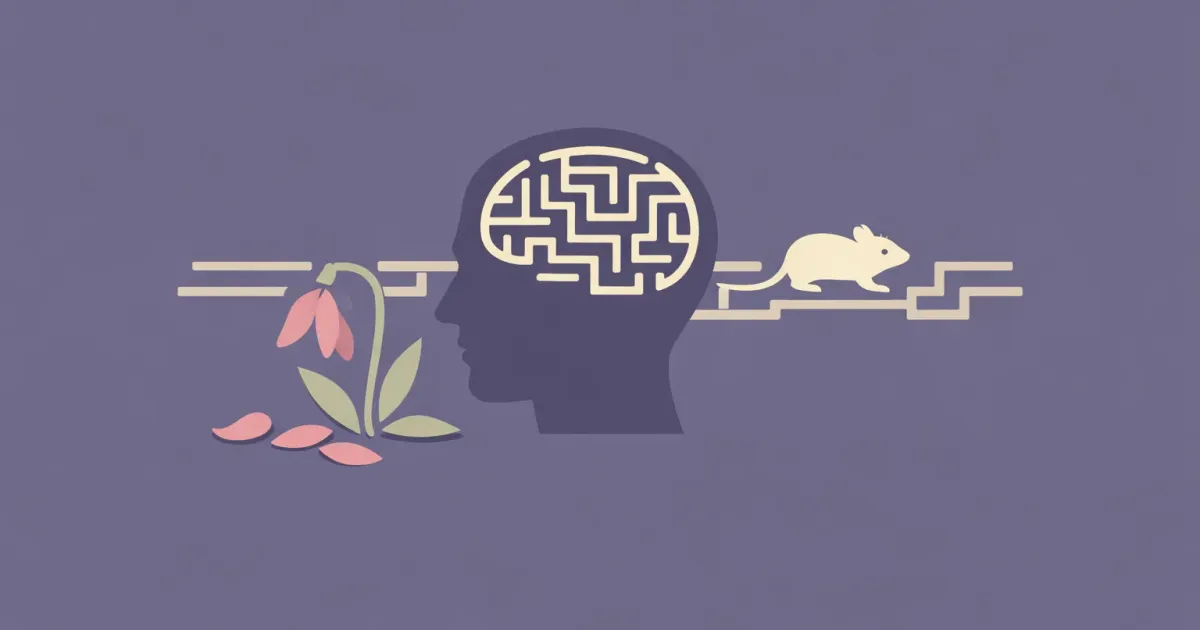
Flowers, Graves, and the Title
The title is doing more work than most titles. The flowers of the title never appear in the novel as an image until the last paragraph, where they arrive as a request, misspelled, from a man who is no longer capable of laying them himself. Algernon is a mouse. Charlie is a man. And the novel ends with a sentence that asks a stranger — Miss Kinnian, or the reader, or anyone — to perform the small, ritual act that humans perform for their dead and that no one, in the ordinary course of things, performs for a laboratory animal. The title is a promise that the novel redeems only at the very end, and the delay is the point.
Flowers, in this book, are the smallest possible unit of human recognition. To put flowers on a grave is to admit the creature in the grave mattered. Charlie's last legible act is to insist that Algernon mattered.
The postscript — "please if you get a chanse put some flowrs on Algernons grave in the bak yard" — is one of the most analyzed sentences in twentieth-century American fiction, and most of the analysis circles the same observation: the misspellings are the point. The Charlie who can write the Algernon-Gordon paper has already been replaced by the Charlie who cannot spell "chance" or "flowers." But the emotional content of the sentence — the remembering, the tenderness, the appeal across species — requires no spelling. Keyes is arguing that the moral faculty and the literate faculty are not the same faculty, and that a person who has lost one can still operate the other. The postscript is a thesis statement smuggled in as a child's note.
The motif of burial runs quietly through the novel's last third. Algernon is buried in a small cheese-box in Charlie's back yard. Rose, in the Brooklyn scene, is already a kind of living burial — her mind gone, her life narrowed to a kitchen she can no longer leave. Warren is a burial ground that happens to still be feeding its residents three meals a day. The novel associates institutions, dementia, and graves as variations of the same idea: places where the dead go when the living cannot bear to watch. Charlie's final decision to walk into Warren on his own feet is his refusal to be buried passively. He will enter the grave while he can still spell his way toward flowers.
The last twist of the title is that the flowers are requested but never shown. The novel ends before anyone has had the chance to lay them. The final image exists only in the reader's head, and only if the reader agrees to supply it. Keyes has handed the ritual off. Whether Algernon gets flowers depends on whether the person finishing the book cares enough to imagine them there. It is one of the quietest acts of reader-implication in modern American fiction — a book that asks, without asking, whether its audience is willing to do for the characters what the characters can no longer do for themselves. The answer, for most readers, is yes, and that yes is the only kind of hope the ending permits.