Themes
Identity and the Divided Self
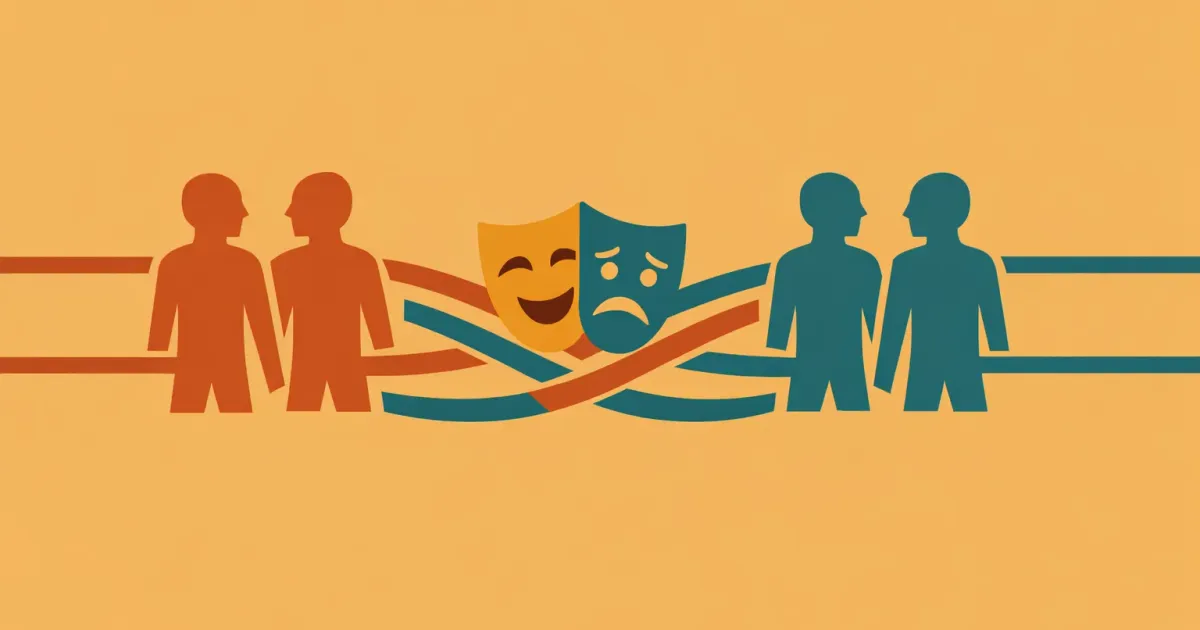
The Comedy of Errors is, on its surface, about two sets of twins who cannot tell each other apart. Underneath, it is about what happens to a person when the city around them no longer recognizes them as themselves. Antipholus of Syracuse arrives in Ephesus feeling incomplete — he names himself a "drop of water" seeking another — and is promptly handed a wife, a house, a fortune, and a reputation that belong to someone else. Antipholus of Ephesus, meanwhile, is stripped of his wife, his house, his credit, and his sanity in the space of a single afternoon. Neither brother is himself for most of the play, and Shakespeare turns that double crisis into comedy without letting the audience forget how disorienting it would be to live through.
The play's governing metaphor for identity arrives in the first scene Antipholus of Syracuse speaks: "I to the world am like a drop of water / That in the ocean seeks another drop, / Who, failing there to find his fellow forth, / Unseen, inquisitive, confounds himself. / So I, to find a mother and a brother, / In quest of them, unhappy, lose myself" (1.2.35-40). Shakespeare then has Adriana recycle the same image at 2.2.125-129 when she pleads with the wrong husband: "For know, my love, as easy mayst thou fall / A drop of water in the breaking gulf, / And take unmingled thence that drop again / Without addition or diminishing, / As take from me thyself, and not me too." The repetition is deliberate. One speaker uses the figure to describe a twin searching for his lost brother; the other uses it to describe a wife's fusion with her husband. Shakespeare is quietly asserting that the crises are versions of each other — that marriage, like twinship, is a way the self finds its other half, and that the fear of being separated from either is the same fear.
The play's comedy, in other words, runs on a pre-modern model of identity as relational rather than internal. You are who your wife, your servant, your neighbors, and your creditors take you to be. Dromio of Syracuse makes the point most nakedly in 2.2: "I am transformed, master, am I not? . . . Nay, master, both in mind and in my shape." His experience of being called by the wrong name in the wrong house is not a mistake the world is making about him — it is a genuine alteration of what he is. When Antipholus of Ephesus cries in Act 5 for justice on the basis of old war scars, he is appealing to the last category of identity he has left. Shakespeare's insight is that identity is never merely internal; it is the credit extended by a community. Comedy, which usually plays this fact for laughs, is here doing double duty.
Marriage, Jealousy, and Authority
The play's most fully developed human relationship is not between twins but between Adriana and Antipholus of Ephesus — a marriage staged from the wife's side. Shakespeare gives Adriana more lines of genuine emotion than Plautus gave the corresponding figure in Menaechmi, and he surrounds her with two counterweights: a sister who preaches wifely submission, and an Abbess who accuses her of nagging her husband into madness. The play uses the farce to ask, in the background, what a marriage is supposed to be — submission, fusion, partnership, or a kind of commerce.
Luciana's Act 2 Scene 1 speech on wifely duty — "Man, more divine, the masters of all these, / Lord of the wide world and wild wat'ry seas, / . . . Are masters to their females, and their lords: / Then let your will attend on their accords" — is the most conventional position the play stages. Shakespeare gives Adriana the counter in the following lines, a sharp defense of wives' claims to the same liberty their husbands take. What keeps the scene from resolving into a simple debate is that Adriana immediately slides from argument into jealousy, and from jealousy into a near-confession that her suspicions have been wearing the marriage down. The soliloquy that closes the scene — "Since that my beauty cannot please his eye, / I'll weep what's left away, and weeping die" — is genuinely painful. Shakespeare is writing a wife who is right to be angry and wrong in how she expresses it.
The play's most damning assessment of the marriage comes from outside it, from the Abbess in Act 5: "The venom clamours of a jealous woman / Poisons more deadly than a mad dog's tooth" (5.1.71-72). The speech is cruel — it is also not the play's final word. The Abbess is about to turn out to be the mother of Antipholus of Ephesus, so her criticism lands with familial weight rather than objective truth. And Adriana's reply is not defensive but stricken: "She did betray me to my own reproof" (5.1.91). The marriage is not fixed at the end of the play — Adriana and Antipholus of Ephesus exit together without exchanging a word — but Shakespeare has at least made it diagnosable. Whatever the play's title suggests, the wrongs between this husband and wife are not merely "errors." The theme looks forward to the interior portraits of marriage Shakespeare will write in Othello, The Winter's Tale, and Antony and Cleopatra.
Commerce, Debt, and the Limits of Credit
Ephesus in this play is a city running on money — gold, ducats, chains, bail, arrests for unpaid debts. The plot is structured around economic instruments: a thousand-mark ransom, a thousand marks of gold left with a servant, a carcanet (gold chain) ordered for a wife, a debt owed by a goldsmith to a merchant, a bail-purse of ducats, a diamond ring with a fixed resale value. The comedy of errors is also a crisis in commerce. When identities do not match their reputations, credit stops working, and the city's economy seizes up.
The arrest of Antipholus of Ephesus in Act 4 Scene 1 is Shakespeare's most pointed illustration of the theme. Angelo, who has delivered a gold chain (to the wrong man) and who owes a merchant the chain's value by nightfall, tries to collect from Antipholus and cannot. Antipholus refuses to pay for what he has never received; the merchant arrests Angelo; Angelo transfers the suit to Antipholus; a sergeant takes Antipholus into custody. The sequence is funny because the audience knows what everyone on stage does not. It is also economically precise: Angelo's key protest — "Consider how it stands upon my credit" (4.1.70) — names the thing at stake. Credit, in an Elizabethan commercial city, is trust that a person is who they say they are. The twins' mutual existence is a kind of counterfeiting that no one has authorized.
Shakespeare also uses the economic frame to give the play a political edge. Egeon's death sentence in Act 1 is triggered by a trade war between Syracuse and Ephesus; his life hangs on whether he can raise a thousand-mark ransom. The opening and closing scenes are, therefore, both legal proceedings in which a life is priced. The closing line of the ransom conversation between Duke and Egeon — "Beg thou, or borrow, to make up the sum" (1.1.154) — is the first time the play asks whether identity can be converted into money. The last time is in the recognition scene, where Antipholus of Ephesus offers to pay his father's bail: "These ducats pawn I for my father here" (5.1.392). The Duke refuses, because in the moment of reunion money has become beside the point. The reunion is its own payment.
Magic, Madness, and the Foreignness of Ephesus
The play is set in Ephesus, and Shakespeare's Ephesus is a city with a reputation for sorcery. Antipholus of Syracuse is warned about it in Act 1 and returns to the warning all through the play — "They say this town is full of cozenage, / As nimble jugglers that deceive the eye, / Dark-working sorcerers that change the mind, / Soul-killing witches that deform the body" (1.2.97-100). When he cannot explain why a woman is calling him husband, or why a tailor is cutting him a suit, he reaches for the supernatural. Dromio of Syracuse does the same. The audience knows the magic is the presence of an identical twin; the Syracusans experience it as enchantment.
Ephesus is chosen deliberately. In the New Testament book of Acts, Ephesus is famous for "curious arts" — exorcism, magic books, the casting out of evil spirits. Shakespeare's original audience would have heard the name and thought of it as a city associated with the spiritual uncanny. He plays that association for all it is worth. The play contains a scene of literal exorcism (Dr. Pinch conjuring Satan out of Antipholus of Ephesus in 4.4), a priory that grants sanctuary, references to fairyland, goblins, sprites, and mermaids, and a consistent language of "transformation" — Dromio of Syracuse fearing he has been turned into an ape or an ass, Antipholus of Syracuse suspecting Lapland sorcerers. The play's funniest scenes are the ones in which a perfectly rational Ephesian — the Courtesan, Angelo, the goldsmith's merchant — is diagnosed by a visitor as a devil.
The deeper use of the theme is to think through the relationship between madness and otherness. The play that begins in a world of everyday Elizabethan commerce ends in an almost fairy-tale reunion, as a long-lost mother emerges from a priory carrying two sons she had not known she was still carrying. The border between the natural and the supernatural is deliberately blurred — the Duke, witnessing the two pairs of twins together, says "I think you all have drunk of Circe's cup" (5.1.270), and in a sense they have. Shakespeare's Ephesus is the first of his enchanted stage-worlds — a direct ancestor of the forest in A Midsummer Night's Dream, Illyria in Twelfth Night, and the island in The Tempest. The "comedy" of the errors is that the magic everyone fears turns out to be a family coming back together.
The Family as the Shape of Grace
The Plautine source of this play ends with a reunion of twins. Shakespeare makes the ending do more work: he adds a father under sentence of death, a mother turned Abbess, and a reconciliation that gathers a whole family long thought dispersed. The final tableau is not two twins shaking hands but eleven or twelve people walking into a priory for a "gossips' feast." The comedy of errors is resolved, in the end, by the recovery of a family the play never told the audience to expect.
The Abbess's final speech converts the day's chaos into a birth metaphor: "Thirty-three years have I but gone in travail / Of you, my sons, and till this present hour / My heavy burden ne'er delivered" (5.1.401-403). It is an unusual image for a farce to end on. The play's comic machinery — beatings, lockouts, exorcisms, arrests — is recast as the painful labor of a mother finally giving birth to the family she has been separated from for three decades. The Duke's response — "I'll gossip at this feast" (5.1.407) — borrows a word that meant "godparent at a christening," completing the metaphor. Every member of the scattered family is reborn into each other's recognition at the same moment.
This is the seed of a pattern Shakespeare will return to again and again in the late romances — Pericles, Cymbeline, The Winter's Tale — in which a family is broken apart by a storm or a tyrant's jealousy and is restored, decades later, at a moment of nearly miraculous convergence. The Comedy of Errors is his earliest sketch of the form. The tonal contrast with the farce before it — light cross-purposes, then suddenly the weight of time and recovery — is what gives the play a resonance its plot alone would not earn. Reading the final Act in this light, the laughter of the preceding four acts takes on a retrospective tenderness. Every beating, every missed recognition, every cry of "witch" and "demon" has been the family blindly feeling for itself. The play's theme is not that errors are funny, though they are, but that the errors of separation are what make reunion feel like grace.