Exam & Discussion Questions
These are the questions your teacher is most likely to raise in class, on a quiz, or on an exam — with model answers you can study from and adapt. The questions run from plot-level comprehension through close reading and thematic analysis.
Induction
1. Who is Christopher Sly, and what trick is played on him?
Christopher Sly is a drunken tinker who is thrown out of an alehouse and falls asleep in the road. A Lord returning from a hunt finds him and, as sport, has him carried to a fine bedroom, dressed in rich clothes, and attended by servants instructed to convince him he is a wealthy nobleman who has been mad for fifteen years. A page named Bartholomew is disguised as Sly's "wife." When Sly wakes he is confused but slowly accepts the fiction. A troupe of players then performs the play about Kate and Petruchio as entertainment for this gulled tinker.
2. What is the purpose of the Induction, and what happens when it is left unfinished?
The Induction frames everything that follows as a play-within-a-play performed for a deceived audience, which invites the reader to question what is real performance and what is genuine feeling — a question the taming plot will keep raising. The Lord's trick and Petruchio's taming strategy are structurally parallel: both involve powerful figures imposing a false identity on someone with less power. The problem is that Shakespeare never closes the frame; Sly disappears after Act 1 and never returns. In the anonymous source play A Shrew, Sly reappears at the end. In Shakespeare's version, the audience is left inside the fiction with no authorial signal about how to interpret Kate's final speech.
The Induction's most important line may be Sly's own: "Am I a lord? and have I such a lady? / Or do I dream?" The question — am I who they say I am, or am I who I know myself to be? — is precisely the question Kate will face for the rest of the play. Sly eventually accepts the imposed identity because the material conditions surrounding him (the soft bed, the servants, the music) make resistance seem absurd. Petruchio uses exactly the same logic in Act 4: by controlling Kate's material environment — her food, her sleep, her clothing — he creates conditions in which her old self becomes unsustainable.
The open frame also changes the dramatic stakes of Kate's final speech. If Sly had reappeared and Shakespeare had reset the play as "just a jest," the submission speech would read as comedy within comedy, safely distanced. Without that reset, whatever Kate's speech means, it means in the audience's world. The missing ending is the play's central interpretive provocation, not an accident of transmission.
3. What role do the players perform in the Induction, and how does this multiply the play's layers of performance?
The players are a troupe of real actors hired to perform a comedy. The Lord instructs them that their audience — Sly — has never seen a play before, and they must not break into laughter at his odd behavior. So the players are performing for Sly, who has himself been cast in a performance by the Lord, and the audience watching all of this is watching the players perform for the Lord's audience about characters who are themselves in disguise. The Induction stacks performances inside performances, making identity and authenticity impossible to locate — a theme that runs through every disguise and role in Padua.
Act 1
4. What is Baptista's rule about his daughters, and why does it cause problems?
Baptista Minola has declared that his younger daughter Bianca cannot be courted or married until someone first weds his older daughter Katherina. Bianca has multiple suitors — including the wealthy old Gremio and the younger Hortensio — but they cannot pursue her so long as Kate is unmarried. The rule effectively makes Kate an obstacle to everyone else's desires, which poisons her social position before the play even gets going. It creates the market for Petruchio: Gremio and Hortensio eventually agree to fund whoever will take Kate off Baptista's hands.
5. What does Petruchio tell Hortensio is his reason for coming to Padua?
Petruchio tells Hortensio that his father Antonio has died and left him his fortune. He has come to Padua to seek his fortune further and, explicitly, "to wive it wealthily in Padua; / If wealthily, then happily in Padua." He makes no pretense of romantic motivation: a rich wife is his stated goal. When Hortensio describes Katherina's temper, Petruchio dismisses it entirely — he has heard lions roar and cannons in battle, and a woman's tongue will not daunt him, provided there is sufficient dowry.
6. How do Lucentio and Tranio's roles get reversed, and what makes this possible in Padua?
When Lucentio falls in love with Bianca at first sight, he realizes he can only gain access to her as a tutor — but someone must maintain his public identity in Padua so his father's name and credit are not lost. He and Tranio therefore swap clothes and roles on the spot: Tranio becomes "Lucentio," moving through Paduan society as the son of Vincentio, while the real Lucentio disguises himself as a Latin tutor named Cambio. Biondello is told a cover story. The scheme works because they are strangers in Padua — no one yet knows their faces.
Lucentio's identity swap is the first of the play's many performed identities, and it introduces a key irony: Lucentio's stated purpose in coming to Padua was serious study — "a course of learning and ingenious studies" — but within fifty lines of arriving he has abandoned scholarship for courtship and dispatched his servant to impersonate him while he disguises himself as a pedagogue. The university town famous for learning becomes a theater of deception. Tranio's readiness to take on his master's identity is played partly as loyal service and partly as parody — he immediately begins outbidding Gremio for Bianca with wealth he does not own.
What the subplot exposes is that identity in this world is purely social performance. "Lucentio" is whoever is wearing Lucentio's hat and claiming Vincentio for a father. The same logic applies to Kate: in Petruchio's hands, "Katherina" will be redefined as whoever agrees with him about the sun and the moon.
Act 2
7. How does Petruchio describe Katherina to Baptista after their first meeting — and what is the truth of the situation?
After the famous wooing scene, Petruchio tells Baptista that Kate is actually sweet and modest in private, that she only affects sharpness in company, and that the two of them have agreed she will continue to play the shrew publicly while being gentle with him alone: "she hung about my neck, and kiss on kiss / She vied so fast, protesting oath on oath." The truth is that Kate struck him, called him a lunatic, and declared she would see him hanged before marrying him. Petruchio's speech is a deliberate lie — but the audience has just watched the scene, so they know it — and Baptista accepts it anyway.
8. What is the significance of Baptista's line "Faith, gentlemen, now I play a merchant's part, / And venture madly on a desperate mart"?
Baptista says this immediately after agreeing to the match between Petruchio and Kate. It is significant because it makes explicit what the play has been circling around: Baptista treats his daughters as commercial inventory. He is "playing the merchant's part" — accepting Petruchio's offer for his damaged goods because he cannot get a better price. The comic subplot running alongside this scene (Gremio and Tranio bidding against each other for Bianca with exaggerated lists of ships and estates) mirrors the same logic at a farcical register. Both plots frame marriage as an auction, and Kate is the commodity being moved.
9. Describe the strategy Petruchio announces before meeting Katherina. Does he stick to it?
Before Kate enters, Petruchio reveals his approach in soliloquy: whatever she says, he will say the opposite. If she rails, he will say she sings sweetly; if she frowns, he will say she looks clear as morning roses; if she is mute, he will praise her eloquence; if she bids him leave, he will thank her as if she asked him to stay. He does largely follow this plan in the scene — when Kate insults him, he refuses to register the insult and instead praises her for the quality its opposite would represent. The tactic forces her into a bind: any protest becomes evidence of the charming personality he claims she has.
Petruchio's pre-wooing soliloquy is the blueprint for the entire taming strategy. The genius of the method is that it removes Kate's verbal weapons by systematically redefining them. Her sharpness becomes pleasantness; her silence becomes eloquence; her fury becomes modesty. By insisting on a version of Kate that contradicts everything she is actually doing, he denies her the satisfaction of being heard — her words have no effect because he simply does not receive them on her terms.
"'Twas told me you were rough, and coy, and sullen, / And now I find report a very liar; / For thou art pleasant, gamesome, passing courteous" — he delivers this while she is actively insulting him, which is not cognitive error but deliberate strategy. The same rhetorical move will escalate in Act 4 when he denies that she is cold, or hungry, or tired, always framing his cruelties as kindnesses. The taming begins here in language, before the country house, before the food deprivation. What Act 4 does is simply remove the social context in which Kate's alternative reading of events could find any audience.
Act 3
10. How does Bianca respond to Lucentio's coded Latin declaration of love?
Lucentio uses his Latin lesson to slip Kate his real identity and intentions, translating "Hic ibat Simois; hic est Sigeia tellus; Hic steterat Priami regia celsa senis" as: "I am Lucentio, son unto Vincentio of Pisa, disguised thus to get your love; and that Lucentio that comes a-wooing is my man Tranio." Bianca responds in the same code: "I know you not; I trust you not; take heed he hear us not; presume not; despair not." She signals cautious interest without committing — she is intrigued but careful, giving him hope without giving him her hand.
11. Why does Petruchio arrive at his own wedding in ragged, mismatched clothes riding a broken-down horse?
Petruchio's deliberate choice of absurd dress — old jerkin, mismatched boots, a rusty sword — is his opening performance of the "bad husband" role. Biondello's long comic inventory of the horse's ailments (spavins, lampass, windgalls) extends the joke. Petruchio dismisses the objections with "To me she's married, not unto my clothes" — a line that is half genuine philosophy and half theatrical deflection. The point is to demonstrate, publicly and before the wedding has even happened, that he intends to control the terms of reality around Kate. What he wears, what the ceremony means, whether they will stay for the feast — all of this will be what Petruchio decides it is.
12. How does Petruchio remove Kate from the wedding feast, and what does his speech in that moment reveal?
Petruchio announces immediately after the ceremony that he and Kate must leave at once. When everyone protests — including Kate herself — he theatrically declares that she is being threatened by thieves and he must rescue her: "She is my goods, my chattels; she is my house, / My household stuff, my field, my barn, / My horse, my ox, my ass, my anything." He draws Grumio in as a mock guard and hustles her out before she can eat. The speech is a parody of the legal language of coverture — a husband's property rights over his wife — pushed to such an extreme that it becomes absurd. Whether Petruchio knows he is parodying it, or sincerely believes it, is something the play deliberately leaves unclear.
The wedding scene's theatrical structure is revealing. Shakespeare refuses to show the ceremony itself; we only hear about it secondhand from Gremio's outraged report. The violence Petruchio performs at the altar — striking the priest, throwing wine — is described, not shown. What we do see is the "rescue" speech, which is all exterior performance. The catalogue of property — "my ox, my ass, my anything" — is pitched in the vocabulary of Elizabethan marriage law, but in a register so hyperbolic that it reads as mockery of that very vocabulary.
The crucial effect of the scene is logistical: it removes Kate from Padua. For the rest of Act 3 and all of Act 4, she is isolated at Petruchio's country house, cut off from her father, her sister, and any social context in which her shrewishness has power over people. The taming requires isolation. The wedding scene is the mechanism that achieves it, and the property speech is the justification Petruchio gives in public while his real purpose — to control her environment — plays out offstage.
Act 4
13. Describe Petruchio's "falcon taming" soliloquy. What does the extended metaphor reveal about his method?
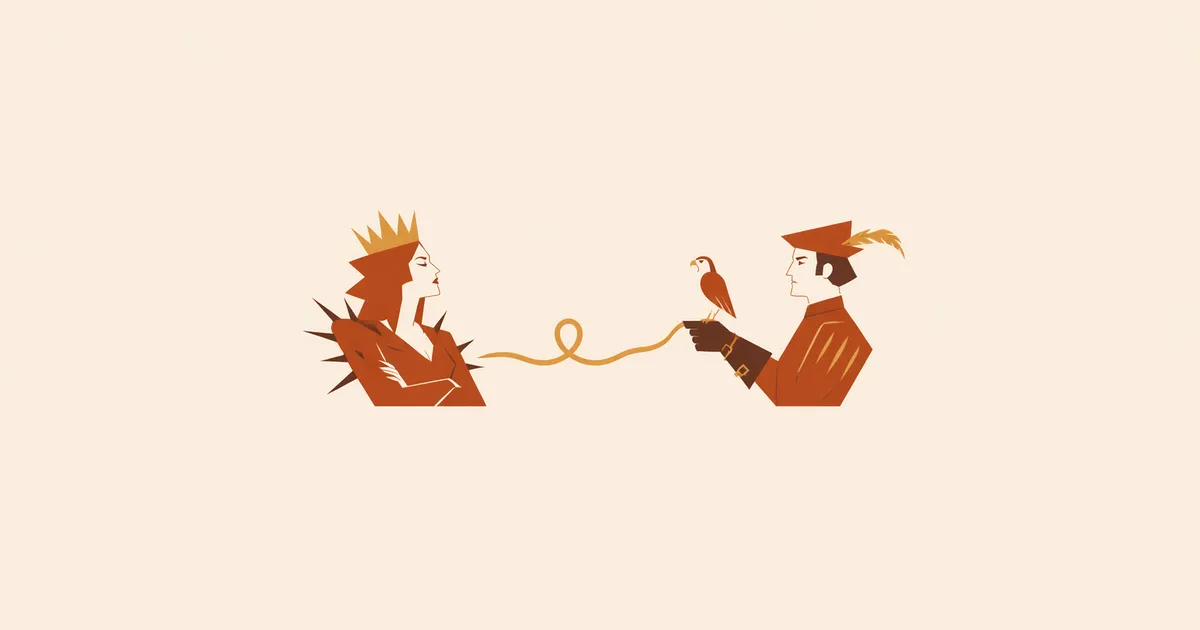
In his soliloquy at the end of Act 4, Scene 1, Petruchio compares Kate to a falcon being brought to the lure: "My falcon now is sharp and passing empty. / And till she stoop she must not be full-gorg'd, / For then she never looks upon her lure." He maps out his program: no food, no sleep, the bed scattered in pretend fury over its inadequacy, all delivered "in reverend care of her." He concludes: "This is a way to kill a wife with kindness." The falcon metaphor frames the taming as skilled practice — the falconer is not cruel but expert. Whether the audience takes this frame at face value depends on whether they believe Petruchio's self-presentation.
14. How does Grumio's food scene work, and what does it contribute to the play's treatment of Kate's situation?
Kate, starving, asks Grumio for food. He offers a sequence of items — neat's foot, tripe, beef and mustard — and withdraws each one on the grounds that it is "too choleric" and would only inflame her temper further. The joke is that every food Kate accepts is suddenly disqualified by a dietary theory that has nothing to do with the food and everything to do with Petruchio's control system. Kate eventually beats Grumio in frustration. The scene is funny in the way much physical comedy is funny — the victim's escalating desperation creates laughs — but it also makes unusually explicit that Kate is being tortured by a man who has framed the torture as care.
The food-refusal sequence is the play's most compressed illustration of what scholars of coercive control call "gaslighting" — the systematic denial of a person's perception of reality. Kate is starving; Petruchio says the meat is too burnt to eat and the cook is at fault, not him. Kate is cold and exhausted; Petruchio says the bed is not good enough for her. Each deprivation is delivered as a kindness, each expression of Kate's distress as evidence of the choleric temper that makes deprivation necessary. The logic is circular and inescapable from inside it.
Yet the play also keeps Grumio's comedic distance from the cruelty. The food scene reads differently in a dark production — where Kate's desperation is played for suffering — than in a farcical one where Grumio's escalating excuses are played for absurdity. Shakespeare gives directors a choice about how much suffering to show. What he does not do is resolve the question of whether Petruchio's stated frame (killing her with kindness) is true. That ambiguity is what makes Act 4 the most contested section of the play.
15. What happens on the road to Padua in Act 4, Scene 5, and why does Hortensio call it "the field is won"?
On the road back to Padua, Petruchio insists that the sun is the moon. Kate corrects him. He threatens to turn back unless she agrees. Hortensio advises her to say as he says. Kate finally capitulates — "be it moon, or sun, or what you please; / And if you please to call it a rush-candle, / Henceforth I vow it shall be so for me" — and then, when Petruchio immediately reverses and says it is the sun after all, she agrees again: "What you will have it nam'd, even that it is / And so it shall be so for Katherine." Hortensio says "the field is won" because Kate has now accepted Petruchio's control over reality itself, the logical endpoint of everything he has been doing since they met.
The sun/moon scene is the play's structural hinge. Before it, Kate resists Petruchio's framing at every turn; after it, she appears to have adopted his terms. But the manner of her compliance leaves the interpretive question entirely open. Her speech — "be it moon, or sun, or what you please; / And if you please to call it a rush-candle" — could be read as broken submission (she has simply given up fighting) or as something more ironic: she has grasped the rules of the game Petruchio has been playing and has decided to play it back on him.
The speech to Vincentio supports the ironic reading. Kate calls the old man a "young budding virgin, fair and fresh and sweet" — a line she delivers with what many productions read as comic excess, going further than Petruchio asked, performing the game with more theatrical polish than he managed himself. If Kate is broken, why does she embellish so gleefully? If she has genuinely internalized submission, why does her speech to Vincentio feel like a performance rather than a belief? The text gives no soliloquy to settle it.
Act 5
16. How is the disguise plot in the Bianca subplot finally exposed?
The real Vincentio arrives at Lucentio's lodgings in Padua just as Lucentio and Bianca have slipped off to marry secretly at Saint Luke's church. He finds the Pedant impersonating him in the window and Tranio wearing his son's clothes. Chaos follows: Vincentio is nearly hauled off to jail for insisting he is who he is. The farce collapses when Lucentio and Bianca return from their secret wedding and kneel before both fathers. Lucentio confesses everything — his disguise as Cambio, Tranio's impersonation, the Pedant's role — and asks pardon. The fathers grumble but accept the fait accompli.
17. What is the wager in Act 5, Scene 2, and what are the results?
After the wedding banquet, Petruchio proposes that each husband send for his wife; the one whose wife comes most obediently wins the pot. The initial stakes are twenty crowns, but Petruchio raises it to a hundred, saying he would venture twenty times that on his wife. Lucentio sends for Bianca — she refuses, sending word she is busy. Hortensio sends for the Widow — she refuses and says he should come to her instead. Petruchio sends for Kate, and she comes immediately. He then sends her to fetch the other two wives, which she does. Petruchio wins the hundred crowns; Baptista adds another twenty thousand crowns to Kate's dowry on the spot.
18. What does Kate's final speech argue, and how does the speech's length and rhetorical sophistication complicate a straightforward reading?
Kate's speech tells Bianca and the Widow that a wife who disobeys her husband is a "foul contending rebel / And graceless traitor to her loving lord." She argues that a husband labors at sea and on land while the wife stays "warm at home, secure and safe," and that a wife owes her husband the same obedience a subject owes a sovereign. She offers to place her hand beneath Petruchio's foot as a token of this duty. The speech runs to over forty lines — far longer than Petruchio's prompt requested. Its rhetorical control, its extended imagery of political sovereignty applied to domestic life, and its almost excessive compliance raise the question of whether this is sincere belief, performed capitulation, or something more collaborative: a wife who has mastered the game and is now playing it to win a wager.
The speech's most debated line is the last: "My hand is ready; may it do him ease." Critics have split over whether "ease" is resigned service or subtle irony — the gesture of a woman who knows her husband likes theatrical displays and is giving him exactly what he asked for, performed to perfection. The speech's opening command — "Fie, fie! unknit that threatening unkind brow, / And dart not scornful glances from those eyes" — is addressed to women who are doing what Kate spent Acts 1 through 3 doing herself. Whether she believes her own argument or has simply changed teams is something the play refuses to adjudicate.
The political analogy embedded in the speech — "Such duty as the subject owes the prince, / Even such a woman oweth to her husband" — aligned with real Elizabethan homilies on marriage that Shakespeare's audience would have heard from the pulpit. A contemporary playgoer could have heard this speech as orthodox doctrine delivered sincerely. A twenty-first-century reader, having watched Kate's treatment in Act 4, reads it differently. The play has managed to write a speech that functions historically as conservative doctrine and functions theatrically as an open question. That double function is what keeps it controversial.
19. Why do Bianca and the Widow disobey the summons, and what does this reveal about the play's gender dynamics?
Bianca sends word she is busy and cannot come. The Widow says she suspects some jest and bids her husband come to her instead. These are the women who have been presented throughout as models of feminine compliance — Bianca is the good, gentle sister; the Widow is Hortensio's sensible new choice. Their refusal reverses the play's apparent moral logic: the woman labeled a shrew proves more obedient than the women labeled dutiful. The reversal has several possible readings: it might suggest that Kate's final submission is entirely manufactured for the wager; it might suggest that true domestic authority depends on something established between spouses that cannot be shortcut; or it might simply be the play's darkest joke.
Thematic Questions
20. How does the play use the concept of performance throughout? What is the connection between Sly's deception, the disguise plots in Padua, and Petruchio's taming strategy?
Every layer of the play involves someone performing an identity they have not chosen or have chosen tactically. The Lord's servants perform deference to a man they know is a tinker; Sly performs nobility under duress. In Padua, Tranio performs Lucentio, Lucentio performs Cambio, Hortensio performs Licio, and the Pedant performs Vincentio. Petruchio performs "the bad husband" at the wedding and "the loving provider" throughout Act 4. Kate eventually performs submission — or becomes submissive — in the wager scene. The play's central question is whether any of these performances conceals a true self underneath, or whether identity is simply what one performs convincingly enough.
The philosophy of identity that Shrew implies is closer to performance theory than to essentialism. No character in the play has a stable self that resists performance: Bianca, presented as gentle and modest, turns out to prefer Lucentio's boldness over Hortensio's courtly gamut and has no trouble managing two suitors simultaneously. The "real" Bianca is no more visible than the "real" Kate. What the play makes available for inspection is the social machinery that enforces which performances are rewarded and which are punished.
Petruchio's taming is effective not because he changes who Kate is internally — the text gives no evidence of any internal transformation — but because he systematically removes the conditions under which her previous performance was possible. He isolates her from every audience that recognized her anger as legitimate. By Act 4, Kate's shrew performance has no theater to play in. What replaces it on the road to Padua may be capitulation or collaboration or something in between, but it is always still a performance. The distinction between sincere submission and performed submission is one the play deliberately refuses to resolve.
21. How does Baptista's treatment of his daughters function as a commentary on the Elizabethan marriage market?
Baptista is not presented as a villain, but his relationship to both daughters is essentially commercial. He cannot move Bianca until he has cleared Kate; Kate is explicitly the "damaged goods" he is relieved to offload at any price. His dowry negotiations with Petruchio happen before Petruchio has even met Kate. The bidding war between Gremio and Tranio for Bianca's hand — in which Tranio wins by promising wealth he does not have — is played for comedy but enacts exactly the same logic as the main plot. Baptista's final gesture, adding twenty thousand crowns to Kate's dowry when she performs her wager-winning submission, completes the economic framework: good behavior in a wife is rewarded with increased market value.
22. What is the relationship between social class and the disguise plots? Does disguise reveal anything about the stability of class identity in the play?
In Shrew, class is entirely a function of costume and claim. Tranio passes as Lucentio not because he behaves like an aristocrat but because he wears the right clothes and says the right things. The Pedant passes as Vincentio not because he knows the man but because Tranio coaches him briefly and he acts with sufficient gravity. When the real Vincentio arrives, the play's farcical climax turns on the fact that everyone in Padua believes the impostor Vincentio more readily than the real one, because the impostor has been performing the role longer. Class identity is shown to be entirely performative — a conclusion with uncomfortable implications for a society predicated on inherited rank.
23. How do the Lucentio/Bianca and Petruchio/Kate plots comment on each other?
The two plots run as ironic mirrors. Lucentio pursues Bianca through romantic disguise and elopement, flouting parental authority in the name of love; Petruchio pursues Kate through blunt commercial negotiation and enforced compliance, fully within paternal and legal sanction. The "romantic" subplot ends with a secretly married couple begging forgiveness from their fathers; the "transactional" plot ends with a publicly married couple who appear to have arrived at something. In the final scene, the roles reverse: Bianca refuses to come when called and costs Lucentio a hundred crowns; Kate comes immediately and wins the wager. The play implies that the romantic courtship produced a worse marriage, practically speaking, than the coercive one.
The irony of the double plot structure is that it forces the audience to reassess what they thought they were watching. Lucentio's courtship looks like romantic comedy — disguise, secret messages in Latin, elopement — while Petruchio's looks like wife-breaking. But in Act 5, Bianca emerges as ungovernable and Lucentio emerges as a man who has been had. "The more fool you for laying on my duty," she tells him after he loses the wager. Kate, by contrast, comes at once and delivers a forty-line speech on wifely devotion.
Shakespeare is clearly asking whether romantic love produces better marriages than practical arrangement — and declining to give a simple answer. Bianca was always performing compliance as a strategy to escape her father's house; her refusal in the wager scene is her first honest action in the play. Kate may have started performing compliance as a survival strategy and arrived at something more like mutual understanding. Or she may simply have been broken. The play places these possibilities side by side without resolving them, which is why directors always have to choose.
24. What different interpretations are available for Kate's final submission speech, and what textual evidence supports each?
Three interpretations are most commonly argued. The sincere-submission reading holds that Petruchio has genuinely reformed Kate: she has internalized the doctrine of wifely obedience that the speech articulates, and the speech reflects actual belief. Evidence: the speech is long, rhetorically polished, and aligns with Elizabethan homiletic doctrine on marriage; there is no wink or aside to suggest irony. The ironic-performance reading holds that Kate has learned to master the game and is performing submission with theatrical excess: she delivers a much longer and more elaborate speech than Petruchio asked for, suggesting she is outdoing the role rather than fulfilling it. Evidence: her speech to Vincentio on the road ("young budding virgin") already showed her doing what Petruchio wanted in an exaggerated, mock-romantic register; the final speech may be the same tone at greater length. The private-game reading holds that Kate and Petruchio have developed a shared private joke about the marriage market and Kate's speech is the public culmination of that joke, aimed at Bianca and the Widow (who have shown themselves to be the real shrews) rather than at Petruchio. Evidence: Petruchio's aside to Hortensio — "Eat it up all, Hortensio, if thou lovest me" — during Act 4's food scene suggests he does not believe his own performance either; the wager has the feel of two partners collaborating on a con.
25. Does the Induction change how you read the main plot — and what would the play mean if we took the Induction seriously throughout?
The Induction establishes that everything the audience is about to see is a performance for a deceived spectator who does not know how plays work. If we hold that frame in mind throughout, every event in Padua acquires a second layer: not just "what is happening" but "what it looks like to someone who cannot distinguish fiction from reality." Sly's situation rhymes precisely with the position the play puts Kate in — someone being told that a reality imposed on them from above is actually who they are. The Lord's benign fraud on Sly is structurally identical to Petruchio's campaign on Kate, except that Shakespeare shows us both sides of the Sly deception (the Lord's planning and Sly's experience) while giving us only Petruchio's side of the taming strategy, never a soliloquy from Kate.
If the Induction were closed — if Sly reappeared at the end and the frame snapped shut around the Padua story — Kate's submission speech would sit inside a fiction-within-a-fiction, safely contained as a performance for a drunken tinker and nothing more. The missing closure is what makes the play's gender politics inescapable rather than quarantineable as historical comedy. The audience cannot dismiss the taming plot by saying "it's just a play Sly is watching" because Shakespeare refuses to let them. Sly drops out; the play continues in its own right; and whatever conclusion the taming reaches, it reaches in the real theatrical world, not in a nested fiction.
This structural incompleteness is probably why Shakespeare's near-contemporary John Fletcher wrote The Woman's Prize, or The Tamer Tamed as an explicit sequel, in which Petruchio is himself tamed by a second wife after Kate has died. Fletcher's sequel is a direct response to the discomfort left by Shakespeare's ending — an attempt to close the frame that Shakespeare left open.