Key Quotes
"What! would you make me mad? Am not I Christopher Sly, old Sly's son of Burton-heath..."
Speaker: Christopher Sly (Induction, Scene 2)
The drunken tinker wakes up in a strange bed, surrounded by servants calling him "lord" and insisting he has been mad for fifteen years. His protest is the play's first articulated identity crisis — a man with a name, a hometown, and a job being told that none of those things are real. The Lord's prank is in full swing, and Sly's instinct is to defend himself with biographical specifics: he is the cardmaker, the bear-herd, the tinker, and the man who owes Marian Hacket fourteen pence for ale. Within minutes the lie will overwhelm him, and he will be reclining in fine clothes calling for "a pot o' the smallest ale" with the manners of a baron.
This line is the master key to the play, and it is buried in a frame most readers skim past. Shakespeare opens his comedy with a man being asked to accept an imposed identity over his own — and then, almost on cue, he caves. Sly's collapse from "I am Christopher Sly" to "Upon my life, I am a lord indeed" takes a single scene and depends entirely on the surrounding cast committing to the fiction. Read against Kate's eventual transformation, the rhyme is unmistakable: identity in this play is what the people with power agree it is. The accumulating detail of Sly's biography (his father's name, the alehouse hostess, the unpaid bar tab) is also a small Shakespearean joke about realism — the more particular and ordinary a self is, the more vulnerable it turns out to be when an audience refuses to recognize it.
"I pray you, sir, is it your will / To make a stale of me amongst these mates?"
Speaker: Katherina (Act 1, Scene 1)
This is Kate's first speech in the play, and it lands with surgical precision. Her father has just announced that Bianca cannot marry until Kate does, while Bianca's two suitors openly discuss whether anyone would take Kate at all. She turns to her father and asks, in effect: are you really going to put me up for sale in front of these men? "Stale" is a triple pun — a laughingstock, a lure used to attract birds, and a vulgar word for prostitute. Before Petruchio has even heard her name, Kate has named exactly what is being done to her.
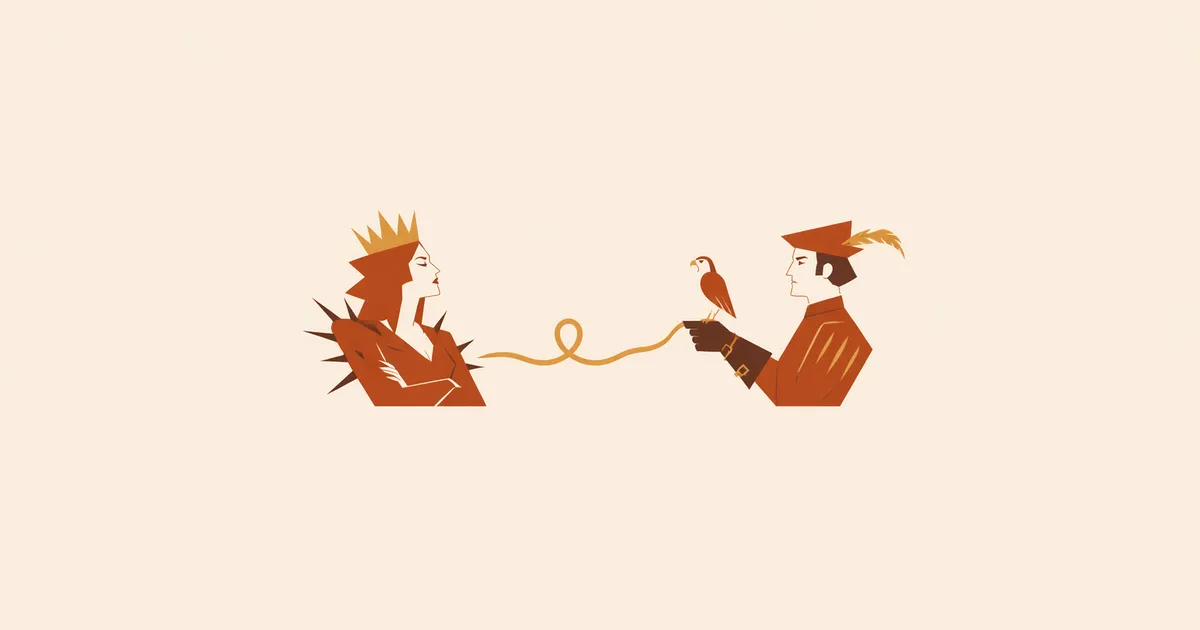
The line matters because it preempts the easy reading in which Kate is simply mean. She is not screaming or hitting anyone here; she is making a precise rhetorical complaint about being treated as goods at auction, and she does it in front of the men doing the auctioning. The pun on "stale" also sets up the bird imagery that runs through the play and lands hardest in Petruchio's falcon soliloquy in Act 4 — Kate begins as a decoy bird in a male hunting metaphor, and ends, in her husband's framing, as a hawk being trained to the lure. By giving her this line at the door, Shakespeare loads the deck against any production that wants to play her as merely irrational. Whatever the rest of the play does to her, it does to a character who saw her circumstances clearly from the first scene.
"I come to wive it wealthily in Padua; / If wealthily, then happily in Padua."
Speaker: Petruchio (Act 1, Scene 2)
Petruchio's father has died, leaving him an inheritance and the freedom to look for a wife. He arrives at Hortensio's house in Padua and announces, with no ornament, that any woman with money will do — she can be old, ugly, sharp-tongued, or "as curst and shrewd / As Socrates' Xanthippe," and it will not put him off. His servant Grumio confirms it bluntly: give him gold, and Petruchio will marry "a puppet or an aglet-baby." This is the moment the play tells the audience exactly what kind of marriage market Kate is being moved through.
The chiming repetition of "wealthily" and "happily" is Petruchio's whole worldview compressed into a couplet — the two words rhyme so neatly because, for him, they are the same word. The line is also the play's clearest counterargument to romantic readings of the courtship. Petruchio decides to marry Kate before he has met her, on the basis of her dowry, and the play does not pretend otherwise. What complicates this, and what every reader has to wrestle with, is that the man who shows up to woo her turns out to be sharper, funnier, and more strangely engaged with her than this opening suggests. Either he discovers something in Kate that the dowry could not have predicted, or he doesn't and the rest of the play is one long coercive performance. Shakespeare lets Petruchio start as a fortune-hunter so the question of what he becomes stays live.
"For I am he am born to tame you, Kate, / And bring you from a wild Kate to a Kate / Conformable as other household Kates."
Speaker: Petruchio (Act 2, Scene 1)
After several pages of trading insults and one slap, Petruchio drops the verbal sparring and tells Kate plainly what he intends. He has already negotiated the dowry with her father. He is not asking for her consent; he is informing her of the project. "Wild Kate" puns on "wildcat," and "household Kates" pivots into a pun on "cates," meaning delicacies or domestic provisions. In one move he renames her into the kitchen.
The pun-stack is doing the heavy lifting. "Kate" stops being a name and becomes a category Petruchio can sort into "wild" and "household" varieties — predator and pantry, animal and ingredient. By the third use the proper noun has been completely instrumentalized, which is the linguistic version of what he is about to do for the rest of the play: take Kate's identity and treat it as raw material to be reshaped. The line is also one of the few moments where Petruchio drops the strategy of pretending Kate is sweet and good and just states the program out loud. Read alongside the falcon speech in Act 4, this is the thesis statement; the falcon speech is the methodology.
"She is my goods, my chattels; she is my house, / My household stuff, my field, my barn, / My horse, my ox, my ass, my anything."
Speaker: Petruchio (Act 3, Scene 2)
The wedding has just ended in chaos — Petruchio arrived late and dressed in rags, abused the priest, and threw wine at the sexton. Now, at the wedding feast, he announces that he and Kate are leaving immediately. Kate refuses. Petruchio responds by pretending her family is trying to abduct her, draws his weapon, and "rescues" her from her own wedding. This speech is the legal cover for the kidnapping: she is his property, he can do what he wants with her, and anyone who tries to stop him will have to fight him.
The list runs deliberately past the point of seriousness — house, stuff, field, barn, horse, ox, ass, anything. The escalation from real estate to livestock to "anything" empties the catalog of meaning, and several productions play it as Petruchio loudly performing the legal logic of marriage in order to expose how absurd it is. That is one reading. The other, harder reading is that the speech accurately describes coverture as it actually existed in Elizabethan law and that Petruchio is using the law's real teeth to extract Kate from a setting where she has allies. Both readings can be true at once. What the speech unambiguously accomplishes is isolation: by the end of Act 3, Kate is in a coach with her husband, no longer in her father's house, and the rest of her resistance will happen with no one watching.
"My falcon now is sharp and passing empty. / And till she stoop she must not be full-gorg'd... This is a way to kill a wife with kindness."
Speaker: Petruchio (Act 4, Scene 1)
Petruchio has dragged Kate through mud back to his country house and refused to let her eat, sleep, or have new clothes — every time she might receive something, he finds a fault and sends it away. Now alone on stage, he turns to the audience and explains the plan in detail. He compares Kate to a falcon being trained: the bird must be kept hungry until it learns to come to the falconer's call. Sleep deprivation, food deprivation, manufactured rage, all framed as devotion. The chilling phrase "kill a wife with kindness" is presented as a method, not a warning.
This is the play's most disturbing speech and also its most self-aware one. Petruchio does not pretend to himself, or to the audience, that what he is doing is anything other than systematic conditioning — the falconry vocabulary ("haggard," "lure," "stoop," "bate") is technically precise, drawn from a real Elizabethan training manual rather than improvised metaphor. By choosing to monologue this directly to the audience, Shakespeare denies any reading in which Petruchio is merely eccentric or unintentionally cruel. The cruelty is the strategy. What the speech leaves open is the question of motive. A falconer trains a bird in order to hunt with it, not to break it; the falcon that "stoops" to the lure is not a destroyed bird but a working partner. Whether Petruchio means this in the sentimental sense (a partnership Kate will eventually welcome) or the predatory sense (a creature that has learned to obey) is the interpretive fork the rest of the play balances on.
"And be it moon, or sun, or what you please; / And if you please to call it a rush-candle, / Henceforth I vow it shall be so for me."
Speaker: Katherina (Act 4, Scene 5)
On the road back to Padua for Bianca's wedding, Petruchio insists the sun is the moon. Kate corrects him; he refuses to move forward unless she agrees. After a beat — and Hortensio's nervous prompt — Kate gives in. She agrees not just to the moon but to anything: a rush-candle, whatever Petruchio decides reality is, she will go along with it. A few lines later he reverses and calls it the sun, and she immediately revises to match. Then they meet the elderly Vincentio on the road, Petruchio greets him as a "young budding virgin," and Kate plays along with elaborate, almost giddy oratory.
This is the moment the play's interpreters fight over hardest, because the same lines can sound like surrender or like the click of someone solving a puzzle. The literal content is total submission — she will call a candle the sun if he says so. But the rhetorical performance that follows, complete with the mock-courtly speech welcoming Vincentio as a fair maiden, is closer to comedy than to defeat. Kate has just discovered the rules of the game her husband has been forcing her to play, and her response is to play it back at him with more skill than he displayed. Hortensio's line — "Petruchio, go thy ways; the field is won" — settles the question for him but not for the audience. Whether this is the moment Kate breaks or the moment she becomes Petruchio's collaborator depends entirely on tone, and Shakespeare has supplied no stage direction to settle it. The text is open.
"Thy husband is thy lord, thy life, thy keeper, / Thy head, thy sovereign... My hand is ready; may it do him ease."
Speaker: Katherina (Act 5, Scene 2)
At the wedding banquet for Bianca, Petruchio bets the other husbands that Kate is more obedient than their wives. Bianca and the Widow refuse to come when called; Kate comes immediately. Petruchio then sends her to fetch the other two and tells her to lecture them on a wife's duty. What Kate produces is not a sentence but a forty-five-line speech, the longest in the play, building from a comparison of women to muddied fountains, through a vision of husbands as tireless laborers protecting their soft wives, to an offer to place her hand beneath Petruchio's foot.
There is no neutral reading of this speech, and any honest analysis has to acknowledge the range. The straight reading is that Kate has been broken and has internalized Elizabethan marriage doctrine — the speech is structured like a Sunday homily, and contemporary audiences would have heard exactly that genre. The ironic reading takes seriously how far the speech overshoots its prompt: Petruchio asked for instruction, Kate delivered a public-spectacle aria with rhetorical polish that exceeds anything the Bianca-praising men in the room could produce. The collaborative-game reading sits in the middle, hearing the speech as a performance Kate and Petruchio are doing together to win a hundred-crown wager and to embarrass the "good" daughter who turned out to be the real shrew. The closing offer — "My hand is ready; may it do him ease" — is the line that splits critics most sharply, because it can be played as defeated, dutiful, theatrical, or tender. The text holds all of these in suspension and refuses to choose, which is why the speech survives as one of the most argued-over passages in the canon.
"'Tis a wonder, by your leave, she will be tam'd so."
Speaker: Lucentio (Act 5, Scene 2)
This is the last spoken line of the play. Petruchio has won the wager, kissed Kate, and led her off to bed; the other two husbands are stunned. Hortensio observes that Petruchio has tamed a "curst shrew." Lucentio, who married the supposedly perfect Bianca and just watched her refuse to come when he called her, gets the closing word: it is a wonder Kate will be tamed at all.
Shakespeare hands the play's final judgment to its weakest male character, which is itself a critical statement. Lucentio spent five acts in disguise pretending to be a Latin tutor, lost a wager he was sure he would win, and discovered in the same evening that the docile bride he stole away with has a will of her own. His "wonder" is not triumph; it is a man who realizes he has bought the wrong daughter. The line also leaves the larger question pointedly open with the verb "will" — Kate will be tamed so. Not "is" tamed, not "has been" tamed, but "will be," conditional, future-facing, unresolved. And because Christopher Sly never returns to close the frame, Lucentio's puzzlement is the last thing the audience hears. The play ends inside its own argument.
"Now let me see if I can construe it: Hic ibat Simois, I know you not; hic est Sigeia tellus, I trust you not..."
Speaker: Bianca (Act 3, Scene 1)
While Kate is being dragged toward her wedding in the main plot, Bianca is in her father's house being wooed by two men in disguise. Lucentio, pretending to be a Latin tutor, slips a coded love confession into a translation of Ovid. Bianca translates back in the same Latin scaffolding and tells him exactly where she stands: she does not yet know him, does not yet trust him, and he should not assume too much.
This is the play's quietest demonstration that Bianca is no innocent. The line shows her coolly using the same disguise mechanism Lucentio is using, in the same dead language he hides behind, to set the terms of the courtship herself. She is neither the obedient flower her father praises nor the helpless prize her suitors imagine; she is the person who will, by Act 5, refuse to come when her husband calls her. Shakespeare plants the evidence here. The Bianca subplot also functions as the play's mirror for the main plot: Kate is openly loud and resists the marriage market by attacking it; Bianca is publicly demure and works the same market from inside, and ends up married to a man she has chosen on her own terms. By the wager scene, the play has quietly inverted its own premise about which sister was the manageable one.