Summary
Overview
The Taming of the Shrew is Shakespeare's most argued-about comedy — a loud, fast, physically chaotic play that has been staged as farce, as courtship story, and as cautionary tale depending on who is directing it. The central question it poses is deceptively simple: what happens when a sharp-tongued woman who refuses to perform niceness is married off to a man who decides he will "tame" her? Set in Padua, the play follows Katherina Minola, the older daughter of a wealthy merchant, and Petruchio, a fortune-hunter from Verona who takes her on as a kind of challenge. Around their violent courtship, Shakespeare weaves a second plot: Katherina's younger sister Bianca, the "good" daughter, cannot marry until Kate does, so her suitors disguise themselves as tutors and scheme their way into her house.
What makes the play genuinely strange — and what gets forgotten constantly — is that none of it is "really happening" in the world of the play. The whole story is performed for a drunken tinker named Christopher Sly, who has been tricked by a bored lord into believing he is a nobleman awakened from fifteen years of madness. Shakespeare opens with Sly, lets the players perform the Padua story in front of him, and then never returns to him at the end. That unfinished frame changes everything about how the taming plot lands, though audiences and readers routinely forget it's there.
The play endures because it refuses to resolve cleanly. Kate's final speech, in which she counsels wives to obey their husbands, can be read as sincere conversion, bitter irony, a private game between two partners who have learned each other, or genuine submission extracted under duress. The text supports all of these readings. Every production has to pick one, and no reading ever feels complete.
Shrew is one of Shakespeare's earliest comedies, probably written in the early 1590s, and its structural ambition is larger than its reputation suggests. The play-within-a-play frame — the Induction with Christopher Sly — was almost certainly drawn from an anonymous rival play called The Taming of a Shrew, while the Bianca subplot borrows its intrigue machinery (disguises, switched identities, the counterfeit father) from George Gascoigne's Supposes, itself a translation of Ariosto's I Suppositi. Shakespeare's innovation was to fuse a coarse folk-tale about wife-taming with a Roman-style intrigue comedy and then wrap both in a frame about a deluded drunkard. The result is a play obsessed with performance — every character is pretending to be someone they aren't, every relationship is transacted through a role.
Within Shakespeare's body of work, Shrew anticipates the courtship wars of Much Ado About Nothing (Beatrice and Benedick owe a clear debt to Kate and Petruchio) and the cross-dressing intrigues of Twelfth Night and As You Like It. What sets Shrew apart is its refusal to romanticize its central couple. Beatrice and Benedick soften; Kate and Petruchio escalate. The play's gender politics are not a modern problem imposed on an old text — Shakespeare's contemporaries also wrote answering plays (John Fletcher's The Woman's Prize, or The Tamer Tamed) that pointedly reversed the ending. The discomfort is baked in. Reading Shrew well means sitting with that discomfort instead of resolving it.
Induction
Before the main plot begins, a drunken tinker named Christopher Sly is thrown out of an alehouse and passes out in the road. A traveling Lord returning from a hunt finds him and decides to "practise on this drunken man" — to dress him in fine clothes, put him in a soft bed, and convince him when he wakes that he is a wealthy lord who has been insane for fifteen years. A page is dressed as Sly's "wife." When Sly wakes, dazed, he slowly accepts the lie. A troupe of traveling players arrives, and the Lord arranges for them to perform a comedy for his prank victim. Sly and his fake wife settle in to watch. The play they are about to see is the story of Kate and Petruchio.
The Induction is not a throat-clearing exercise — it is the lens through which everything that follows should be viewed. By opening with a man being tricked into believing in a false identity imposed from above, Shakespeare frames the entire "taming" plot as another kind of performance: an elaborate fiction about who someone really is, enforced by people with power on someone who has less. Sly's line "Am I a lord? and have I such a lady? / Or do I dream?" quietly rhymes with the questions the play will ask about Kate. Is she really tamed, or is she performing tameness for an audience that wants to see it? Is Petruchio really a loving husband, or is he playing one the way the Lord's servants play at being Sly's retinue?
The notorious problem is that Shakespeare never closes the frame. In the anonymous source play A Shrew, Sly reappears at the end, vowing to go home and tame his own wife. In Shakespeare's version, Sly drops out after Act 1 and never returns. Whether this is a textual accident or a deliberate choice, the missing ending leaves the audience suspended inside the fiction. The taming plot never gets the safety of being marked as "just a play." Whatever it means, it means in the reader's world, not in Sly's.
Act 1
Lucentio, the son of a wealthy Pisan merchant, arrives in Padua with his servant Tranio, intending to study. Instead he stumbles onto a street scene in front of Baptista Minola's house: Baptista is announcing that no one may court his gentle younger daughter Bianca until someone marries her "shrewish" older sister Katherina first. Two of Bianca's suitors, the old rich Gremio and the more eligible Hortensio, grumble at this. Watching from the side, Lucentio falls instantly in love with Bianca and hatches a plan with Tranio: they will swap identities. Tranio will play Lucentio in Padua while the real Lucentio disguises himself as a schoolmaster to get inside Baptista's house and court Bianca directly. Meanwhile, Petruchio, a Veronese gentleman whose father has died and left him a fortune, arrives at Hortensio's house announcing that he has come to Padua "to wive it wealthily." Hortensio, thinking quickly, tells him about Katherina — rich, beautiful, and famously impossible — and Petruchio agrees at once to woo her. Hortensio also arranges to disguise himself as a music tutor to sneak in as Bianca's suitor.
Act 1 establishes the play's defining structural gimmick: nearly everyone is in disguise, and almost every relationship is transactional. Lucentio is Cambio. Tranio is Lucentio. Hortensio will become Licio. Petruchio speaks of wooing as commerce before he has even seen Kate — "I come to wive it wealthily in Padua; / If wealthily, then happily in Padua" — and Baptista treats his daughters almost explicitly as inventory, refusing to release the more desirable one until he has cleared the less desirable one from his shelves. The scholarly Latin and the romantic rhetoric the characters deploy are all cover for a market.
Against this, Kate's first appearance lands with real force. She is given very few lines, but she asks her father, "I pray you, sir, is it your will / To make a stale of me amongst these mates?" — and "stale" means both laughingstock and prostitute. She sees clearly what the men around her are doing and refuses to perform the expected female role within it. The audience is primed, before Petruchio has even heard her name, to read her anger as a reasonable response to being auctioned. Whatever "taming" will mean, it begins with a woman who has diagnosed her situation correctly.
Act 2
At Baptista's house, Kate has tied Bianca's hands and is interrogating her about which of her suitors she loves, slapping her when she doesn't get a satisfactory answer. Baptista breaks up the fight. Petruchio arrives with his disguised allies: he presents Hortensio as "Licio," a music tutor, while Gremio presents the disguised Lucentio as "Cambio," a Latin tutor. Petruchio blunt-forcedly negotiates the dowry with Baptista before ever meeting Kate, and then demands to woo her alone. When she enters, the two of them fight through one of the fastest, filthiest stichomythic exchanges in Shakespeare — a barrage of insults, puns, and one physical blow from Kate. Petruchio announces, regardless of what she actually says, that she has consented to marry him, sets the wedding for Sunday, and tells Baptista that in private she has "hung about my neck" with kisses. Kate is furious. Baptista accepts the match anyway. The act closes with Tranio (still disguised as Lucentio) and Gremio bidding against each other for Bianca, with Tranio winning by promising ships and estates he doesn't own.
The Kate-Petruchio wooing scene is the rhetorical heart of the first half. What's striking is how evenly matched they are — Kate gives as good as she gets, and Petruchio's tactic is not to out-insult her but to refuse to register her insults as insults. "Twas told me you were rough, and coy, and sullen, / And now I find report a very liar; / For thou art pleasant, gamesome, passing courteous." By insisting on a version of Kate that contradicts everything she is doing, he forces her into a bind: every protest becomes evidence of the personality he claims she doesn't have. This is the strategy he will use on a larger scale for the rest of the play. The taming, in other words, begins here, not at his country house. It begins in language.
Baptista's quick capitulation — "Faith, gentlemen, now I play a merchant's part, / And venture madly on a desperate mart" — makes explicit the commercial logic the play has been circling. His daughters are cargo, and Kate is the damaged freight he is relieved to offload. The subplot bidding war between Tranio and Gremio, which runs immediately after, is the comic mirror of the same transaction. The play is simultaneously asking us to laugh at the Padua marriage market and to notice that Kate is being ground up inside it.
Act 3
At Baptista's house, the disguised Lucentio and Hortensio bicker over which of them gets to teach Bianca first. Alone with each, Bianca handles them both with ease — Lucentio uses a Latin translation to declare his love in code, and she coolly volleys back in the same code, signaling that she likes him but doesn't entirely trust him yet. Hortensio tries a musical gamut with his feelings spelled out in it, which she politely dismisses. Wedding day arrives, and Petruchio is spectacularly late. When he finally appears, he is dressed in deliberate rags on a broken-down horse, and he refuses to change before the ceremony: "To me she's married, not unto my clothes." Offstage, Gremio reports that he behaved like a lunatic at the altar, swearing, striking the priest, and throwing wine in the sexton's face. At the wedding feast, Petruchio announces that he and Kate are leaving immediately. Kate protests; he theatrically pretends she is being threatened and "rescues" her from her own family: "She is my goods, my chattels; she is my house, / My household stuff, my field, my barn." He drags her out before she can eat.
The wedding is the play's first big structural hinge, and Shakespeare stages it in a deliberately alienating way. He refuses to show us the ceremony itself — we get it only as Gremio's outraged secondhand report — and the violence Petruchio performs is all spectacle. He is publicly doing a character called "The Bad Husband" for an audience that includes Kate. The speech where he claims her as his property is pitched so far over the top ("my ox, my ass, my anything") that it reads less like conviction than like a parody of the very patriarchal language the Padua marriage market actually runs on. Petruchio is mirroring Kate's community back at them, in uglier form, and daring them to object. They don't.
What this gains him is custody. By leaving the wedding early and forbidding Kate food or rest, he removes her from every social context in which her shrewishness has any power — her father's house, her sister, the suitors who have called her a devil. The rest of the taming will happen in isolation, and Act 3 is the mechanism that isolates her. Note also the comic timing: Bianca's subplot advances by tiny erotic half-steps in 3.1, while in 3.2 Kate is being physically extracted from her own life. The tonal collision — courtly flirtation against domestic violence — is the play's signature move.
Act 4
At Petruchio's country house, Kate arrives cold, exhausted, and hungry. Petruchio launches his real campaign. He rages at his servants for every small fault, sends the meat back as burnt, throws dishes, and denies Kate food on the grounds that it isn't good enough for her. At bedtime he finds fault with the bedding and keeps her awake all night under the pretense of caring for her comfort. In a key soliloquy he compares her to a falcon being trained: "My falcon now is sharp and passing empty. / And till she stoop she must not be full-gorg'd... This is a way to kill a wife with kindness." Meanwhile in Padua, Tranio has convinced a traveling Pedant from Mantua to impersonate Lucentio's father, Vincentio, so he can formally sign the marriage contracts for Bianca. Hortensio, seeing Bianca kissing "Cambio," gives up on her and resolves to marry a wealthy widow instead. Back at Petruchio's, a haberdasher and a tailor arrive with a cap and gown; Petruchio finds arbitrary fault with both and drives them away, leaving Kate in the plain clothes she came in. On the road back to Padua, Petruchio insists the sun is the moon, forcing Kate to agree — and when she finally does ("be it moon, or sun, or what you please"), he immediately reverses and insists it is the sun, to make her agree again. They meet the real Vincentio on the road. Petruchio calls the old man a "young budding virgin" and makes Kate play along. She does. Hortensio mutters that the field is won.
Act 4 is where the play's uncomfortable genius shows most clearly. Petruchio's tactics — sleep deprivation, food deprivation, unpredictable rage, and the relentless insistence that reality is whatever he says it is — map with uncomfortable precision onto techniques that modern readers recognize from literature on coercive control. The play does not soften this. Grumio's servant comedy — the bit where he offers Kate a list of foods and then withdraws each one as "too choleric" — is funny on the page and brutal in performance. The cruelty is part of the comedy, and the comedy does not cancel the cruelty.
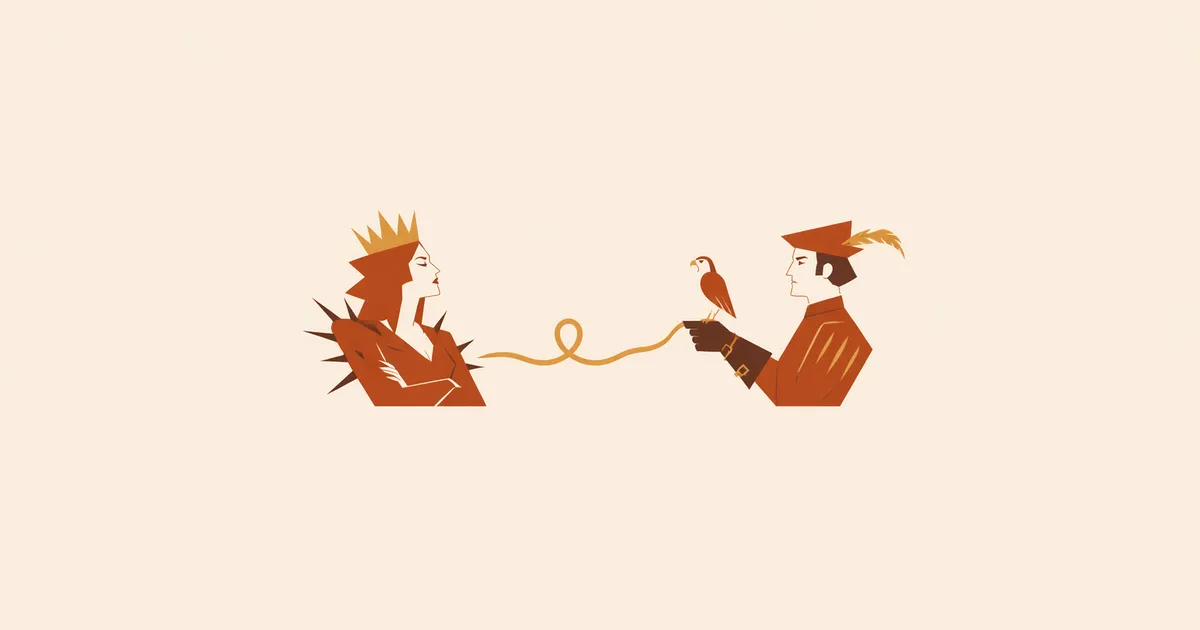
But Petruchio frames the method differently. The falcon speech is not a speech of hatred; he describes Kate as a hawk being brought to the lure, and insists his method is "to kill a wife with kindness." Whether the reader takes this at face value depends on whether they believe him. What is undeniable is the turning point on the road. When Kate says, "be it moon, or sun, or what you please; / And if you please to call it a rush-candle, / Henceforth I vow it shall be so for me," something has shifted. Depending on the reading, this is the moment she breaks — or the moment she grasps the game he has been playing and decides to play it back. Her speech to Vincentio, with its heightened, almost mock-romantic imagery about the "young budding virgin," is arguably Kate's first joke in the play. She is doing what Petruchio has been doing: she is deliberately calling a thing what it isn't, with her tongue in her cheek. Either this is submission or it is collaboration. The text holds both possibilities open.
Act 5
The subplot comes to a head first. The real Vincentio arrives at Lucentio's Paduan lodgings to find the Pedant in the window claiming to be Vincentio, and Tranio in Lucentio's clothes claiming to be Lucentio. Farce erupts; Vincentio is nearly hauled off to jail for insisting he is who he is. Lucentio and Bianca return from a secret marriage at Saint Luke's, kneel, and confess everything. Vincentio and Baptista grumble but accept. The play then moves to the wedding banquet, where all three couples — Lucentio and Bianca, Hortensio and his Widow, Petruchio and Kate — sit together for the first time. Over the meal, insults fly. Baptista tells Petruchio he now has "the veriest shrew of all." Petruchio proposes a wager: each husband will send for his wife, and the one whose wife comes most obediently wins. Lucentio sends for Bianca; she refuses. Hortensio sends for the Widow; she refuses. Petruchio sends for Kate, and she comes at once. Petruchio then sends her to fetch the other two wives back, which she does. At his command, she delivers a long speech to Bianca and the Widow about the duty wives owe to their husbands — "Thy husband is thy lord, thy life, thy keeper, / Thy head, thy sovereign" — and concludes by offering to place her hand beneath Petruchio's foot. Petruchio wins the wager. The play ends with Petruchio leading Kate off to bed, leaving the other two husbands stunned.
The final scene is the knot the play has been tying for five acts, and there is no interpretive reading that unties it without leaving loose ends. The sincere-submission reading is the plainest: Kate has been broken, has internalized patriarchal doctrine, and delivers an orthodox Elizabethan sermon on wifely obedience. The text does support this. The speech is long, articulate, and rhetorically constructed — not the spontaneous outburst of a woman being coerced in the moment. It also aligns with contemporary homilies on marriage that Shakespeare's audience would have heard from the pulpit. A straight reading is historically defensible.
The ironic reading takes seriously how far the speech exceeds what Petruchio asks for. He tells Kate to explain to the other wives "what duty they do owe their lords and husbands" — a prompt she answers not with a sentence but with forty-plus lines of elaborately subservient oratory. In performance, many Kates deliver it with the rhetorical polish of someone who has mastered exactly the role her husband wanted, and is performing it so thoroughly that the performance becomes visible as performance. The private-game reading sits nearby: that Kate and Petruchio, over the course of the journey home, have arrived at a shared joke about the marriage market, and Kate is now cashing in a hundred crowns' worth of wagered obedience to embarrass Bianca (who has always been praised as the "good" daughter) and the Widow, who have shown themselves to be the real shrews. The line "My hand is ready; may it do him ease" is the one that most splits critics — is it resignation, or is it the wry gift of a partner who knows her husband loves theatrical gestures?
The play gives us no soliloquy from Kate to settle the question, and the missing Sly frame — which might have let Shakespeare reset and distance the whole performance as a jest — never arrives. The audience is dismissed with a toast, Lucentio's half-amazed final line ("'Tis a wonder, by your leave, she will be tam'd so"), and no authorial hand telling them what to feel. That absence is not a bug. It is the reason the play still gets staged four centuries later, and the reason every production of it is also an argument about it.