Themes & Motifs
Marriage as a Marketplace
In Padua, marriage is not a meeting of two hearts — it is a transaction conducted between fathers, suitors, and household ledgers, with the women themselves treated as inventory. Baptista refuses to release his "good" daughter Bianca for marriage until he has cleared the difficult Kate from his shelves, and Petruchio, before he has so much as glimpsed his future wife, declares his entire program in a single line: "I come to wive it wealthily in Padua; / If wealthily, then happily in Padua." That sentence is the play's economic thesis statement. Affection, desire, even bare acquaintance are afterthoughts to the contract.
The wager scene at the end gives this theme its final, most uncomfortable expression. After three weddings, the husbands literally bet money on whose wife will obey fastest, and Petruchio walks away with one hundred crowns plus the dowry-doubling Baptista throws in. Marriage in the world of Shrew never stops being a deal. The only question is who is keeping score.
The marketplace logic is established before any character courts anyone. In Act 1, with Kate standing right beside him, Baptista announces to the assembled suitors that "no man shall have access to Bianca / Till Katherine the curst have got a husband." The transaction is publicly priced: a hard sale unlocks a soft one. Kate's response cuts through the polite language of the scene with diagnostic precision. "I pray you, sir, is it your will / To make a stale of me amongst these mates?" The pun on "stale" — both decoy and prostitute — registers exactly what is happening to her. She is being used as bait in a sale, and she names it.
Baptista's most revealing line comes after Petruchio has bullied through the contract and exited with Kate in tow. Turning to the remaining suitors, the father shrugs: "Faith, gentlemen, now I play a merchant's part, / And venture madly on a desperate mart." The metaphor is not ornamental. Baptista really has been playing a merchant — rolling damaged stock at the first plausible offer — and the bidding war that follows over Bianca, in which Tranio (disguised as Lucentio) outbids Gremio with promises of ships and estates that don't belong to him, is structured as an actual auction. Shakespeare lets the romantic subplot literalize what the main plot has implied.
The wager in Act 5 closes the loop. Petruchio's "Why, there's a wench!" comes the instant his investment pays out, and his exit line — "'Twas I won the wager" — frames the marriage's success not in emotional terms but in winnings. What's worth noticing is that Shakespeare gives every couple a transactional element. Lucentio elopes only after the disguise plot has produced a forged marriage settlement; Hortensio gives up on Bianca and marries the Widow specifically because she is rich. The play does not present Petruchio as uniquely mercenary. It presents him as the most honest practitioner of a system everyone is already using.
Performance and Imposed Identity
Almost nothing in Shrew is what it claims to be. A drunk tinker is dressed up as a lord. A page is dressed up as the lord's wife. Lucentio becomes Cambio the Latin tutor; Tranio becomes Lucentio; Hortensio becomes Licio the music master; a wandering Pedant from Mantua is dragooned into impersonating Lucentio's father. The play opens with one fake identity (Sly's lordship) and ends with a wife performing perfect obedience in front of an audience that has paid to watch her do it. Identity in this world is a costume — and the question the play keeps pressing is whether wearing the costume eventually changes the person inside.
Petruchio's "taming" works precisely because he treats Kate's identity as a role she is performing rather than a fixed truth about her. He insists on a Kate who doesn't exist and refuses to acknowledge the one who does, and by the journey home she has begun playing the role he has scripted.
The Induction is the master key. The Lord's instructions to his servants — "Persuade him that he hath been lunatic" — describe in miniature the technique Petruchio will later apply to Kate: insist with a straight face on a counterfeit reality until the target accepts it. Sly's wondering line, "Am I a lord? and have I such a lady? / Or do I dream?", is the play's first version of a question that will be asked over and over: when everyone around you treats you as someone you aren't, how long can you keep being who you were? By the end of the Induction Sly is saying "we" of the lord's household and instructing his "wife" to come to bed. The conversion takes about fifty lines.
Petruchio's wooing scene runs the same play. "'Twas told me you were rough, and coy, and sullen, / And now I find report a very liar; / For thou art pleasant, gamesome, passing courteous." Kate is in the room being neither pleasant nor gamesome, and Petruchio knows it. The point is not to describe her accurately but to overwrite her — to keep narrating a counterfeit Kate over the top of the real one until the real one starts to wonder which is which. By Act 4, on the road back to Padua, the technique has worked at the level of physical reality. "What you will have it nam'd, even that it is, / And so it shall be so for Katherine." She has accepted that Petruchio's word, not her senses, defines what is true.
The Pedant subplot mirrors all of this in farce. A complete stranger is talked into "playing" Vincentio so persuasively that the real Vincentio, when he turns up, is nearly arrested as the impostor. The bit is funny because it's the same trick Petruchio is playing on Kate, only with the absurdity dial cranked to eleven. Shakespeare's larger argument is unsettling: in a society obsessed with performed roles — wife, daughter, husband, father, lord — the line between sincere identity and successful performance may be thinner than the people inside the performance can tell. The famous unanswerable question of Kate's last speech is whether she is being a tame wife or playing one. The play has been training the audience for five acts to recognize that, in this world, the difference may not matter.
The Politics of Taming
The play's title promises a comedy and delivers, in its main action, something much harder to laugh at: a woman is starved, deprived of sleep, isolated from her family, and contradicted on every observable fact until she agrees to her husband's version of reality. The modern discomfort with this is real, but it is not a recent invention. Shakespeare's contemporary John Fletcher was bothered enough to write The Woman's Prize, or The Tamer Tamed, a sequel in which Petruchio's second wife turns the tables on him. The discomfort is built into the play. The question is what to do with it.
There is no single correct reading of the taming plot, and the strongest interpreters resist the urge to pick one. The text genuinely supports multiple readings of Kate's transformation — sincere conversion to Elizabethan wifely doctrine, ironic performance of submission so excessive it parodies itself, or a private game between two partners who have figured each other out. Productions have to commit to one. Readers don't.
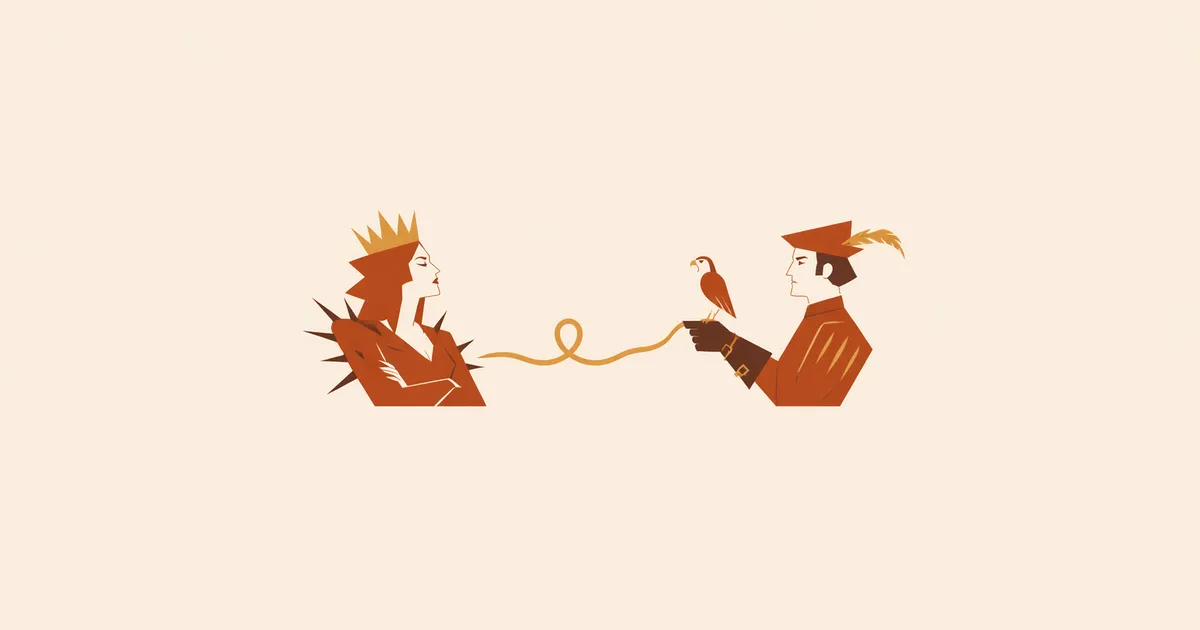
Petruchio's own description of his method should be read closely. The famous Act 4 soliloquy compares Kate to a falcon being trained — "My falcon now is sharp and passing empty. / And till she stoop she must not be full-gorg'd, / For then she never looks upon her lure" — and culminates in "This is a way to kill a wife with kindness." The falconry imagery casts the taming as a craft, even an act of love. What's harder to forgive is the inventory of techniques: deny her food ("She eat no meat today, nor none shall eat"), deny her sleep ("Last night she slept not, nor tonight she shall not"), invent "some undeserved fault" so she can never anticipate his anger, and frame all of it as care — "all is done in reverend care of her." A modern reader recognizes this catalog. So, evidently, did some Jacobean readers, or Fletcher would not have bothered to answer it.
The reading that takes Kate's final speech as sincere submission has the simplest textual case. The speech is long, doctrinally orthodox, and rhetorically polished — "Thy husband is thy lord, thy life, thy keeper, / Thy head, thy sovereign" tracks closely to Elizabethan homilies on marriage. A first-time playgoer in 1592 would have heard it as a familiar sermon delivered with conviction. The ironic reading takes seriously how far the speech overshoots Petruchio's actual prompt: he asks her only to "tell these headstrong women / What duty they do owe their lords and husbands," and she answers with forty-plus lines of escalating self-abasement, ending with the offered hand beneath the foot. The very thoroughness of her performance can read as performance — a Kate who has fully grasped what kind of theater her husband enjoys and is staging it back to him at full volume. The private-game reading sits on top of the ironic one: the offered hand is a wager paid out, the speech is a shared joke at the expense of the supposedly "good" wives Bianca and the Widow, and the line "My hand is ready; may it do him ease" is a wink only Petruchio is meant to catch.
Whichever reading a reader chooses, the play makes one thing structurally clear: the women who refuse to obey at the end — Bianca, who has been universally praised as the gentle daughter, and the rich Widow Hortensio chose for her docility — turn out to be the actual shrews. The "tame" women shrew, and the "shrew" runs the room. That inversion is doing argumentative work whether or not it makes Kate's submission speech feel any less coercive. Shakespeare is saying, at minimum, that the labels Padua hands out to its women have very little to do with the women themselves.
Language as Power
In Shrew, fights are won with words long before they are won with food deprivation. Kate is described as a shrew before the audience meets her because she talks back; Petruchio's tactic for managing her is not to silence her but to outdefine her, insisting on his own vocabulary for every situation until she has no neutral words left. The play is full of characters wielding language as a weapon — Kate's stinging puns, Petruchio's relentless reframings, Lucentio's coded Latin lessons to Bianca, Grumio's farcical wordplay with Curtis at the country house — and the central marriage is, at bottom, a long argument about who gets to name things.
This matters because it suggests the "taming" is not primarily a physical conquest. It is a rhetorical one. Whoever controls the dictionary controls the marriage.
The wooing scene in Act 2 is the play's clearest demonstration of language-as-combat, and it is also genuinely the closest thing in Shrew to a meeting of equals. Kate and Petruchio trade puns at the speed of a tennis volley — "If I be waspish, best beware my sting" / "My remedy is then to pluck it out" — and the scene's energy comes from the recognition that here, finally, is someone who can keep up with her. Petruchio's strategy emerges in the middle of it. Rather than answering Kate's insults with insults, he refuses to accept them as insults at all and substitutes his own vocabulary: she is not "rough, and coy, and sullen" but "pleasant, gamesome, passing courteous." The maneuver is not psychological yet — it's rhetorical. He is trying to take her dictionary away.
The road-home scene in Act 4 is the same maneuver pushed to its extreme. "I say it is the moon," Petruchio insists at noon. When Kate finally yields — "be it moon, or sun, or what you please; / And if you please to call it a rush-candle, / Henceforth I vow it shall be so for me" — she is not conceding a fact. She is conceding the right to name. Her next line is the philosophical heart of the play: "What you will have it nam'd, even that it is, / And so it shall be so for Katherine." That is a statement about authority over language, not about the celestial body in question. The brilliance, and the ambiguity, is that Kate's yielding is itself a performance of fluency in Petruchio's language game — she immediately turns and addresses old Vincentio as a "young budding virgin, fair and fresh and sweet," doing exactly what her husband has been doing throughout the play. Whether that's collapse or collaboration depends on the reader's ear.
The Bianca subplot reinforces the theme by inverting it. Bianca's suitors literally use language as a smuggling vehicle: Lucentio hides a marriage proposal inside a Latin grammar lesson ("Hic ibat Simois, hic est Sigeia tellus..."), translating Ovid's Latin into private love-code. Bianca handles them coolly in their own coded register and chooses among them on her own terms. Within her sphere of action, she controls the dictionary. The play's larger pattern emerges across the two plots: in Padua, the woman who appears tame uses language to get exactly what she wants from men, while the woman who appears wild loses the linguistic high ground only after a sustained campaign to take it from her. The play is, among many other things, a sustained argument that rhetoric is a form of power and that women in this world are neither uniquely victims nor uniquely beneficiaries of it. They are players in a market for words.
The Frame That Won't Close
Shakespeare opens the play with Christopher Sly being tricked into believing he is a lord, then has the players perform the entire taming story as entertainment for him — and then never returns to him. Sly drops out somewhere in Act 1 and the frame is simply abandoned. In the anonymous source play A Shrew, Sly reappears at the end, vowing to go home and tame his own wife, which would mark the whole story as harmless fiction safely contained. Shakespeare's version refuses that safety. The play-within-a-play never gets brought back to its outer frame, and the audience walks out of the theater still inside the inner play.
This is not a small detail. It is the structural reason the play still feels uncomfortable centuries later. Whatever Kate's last speech means, it lands without a buffer.
The Induction goes to remarkable lengths to set up a frame that never closes. The Lord doesn't merely arrange entertainment — he stages an elaborate metaphysical prank in which Sly is convinced that his real life as a tinker was a fifteen-year delusion ("These fifteen years you have been in a dream, / Or, when you wak'd, so wak'd as if you slept"). A page in a dress is presented as Sly's wife with explicit instructions about how to play "such duty to the drunkard" with "soft low tongue and lowly courtesy." When the players arrive and Sly settles in to watch, the play we are about to see has been triple-framed: a story being performed by actors, for a tinker, who is being performed at by a household, while a real audience watches all of it. Every layer is theater.
The trick of leaving the frame open is that it strips the inner play of the protective marker "this is just a play." If Sly had reappeared at the end laughing and going off to terrorize his own wife, audiences would have an exit ramp: the taming was a story inside a story, a joke about a joke, neutralized by its frame. Without that closure, Kate's submission speech happens not at one remove but at zero. There is no narrator returning to remind the audience that what they have just watched was made up for the entertainment of a drunkard who didn't know any better. The audience is the drunkard.
Whether this was a deliberate authorial choice or a textual accident is genuinely unknown. The First Folio simply has no closing scene with Sly — he and his lord vanish from the stage directions and never come back. But the absence functions thematically whether or not Shakespeare intended it. The Induction has spent its entire length training the audience to think of identity, marriage, and obedience as roles imposed from above on people too disoriented to resist. The taming plot then performs exactly such an imposition on Kate. With no frame to close, the audience is left holding the question the Induction raised: what's the difference between a person who has truly been transformed and one who is dressed in the costume of the transformation, attended by a household that calls them by the new name? The play won't say. It just turns out the lights and goes home.