Context
About the Author
Toni Morrison was born Chloe Ardelia Wofford in Lorain, Ohio, in 1931, and died in 2019 as the most decorated American novelist of her generation — a Pulitzer Prize for Beloved in 1988, the Nobel Prize in Literature in 1993 (the first Black woman ever to receive it), a Presidential Medal of Freedom in 2012. She studied English at Howard University and took a master's at Cornell before spending nearly two decades as an editor at Random House, where she became one of the first Black women to hold a senior editor post. That editorial work matters for Beloved in a very concrete way: in 1974 Morrison edited The Black Book, a collage-like scrapbook of three hundred years of African American history assembled by Middleton Harris and others, and it was there — in a reproduced 1856 newspaper clipping titled "A Visit to the Slave Mother Who Killed Her Child" — that she first encountered the case of Margaret Garner. Beloved, her fifth novel, grew directly out of that discovery.
Morrison's career is often read as a single, sustained project: to write African American interior life without permission from a white literary establishment. Her earlier novels — The Bluest Eye (1970), Sula (1973), Song of Solomon (1977), Tar Baby (1981) — had each widened her scope, but Beloved is the novel in which she turned directly on American slavery, and it opens the loose trilogy she completed with Jazz (1992) and Paradise (1997). Each volume of the trilogy circles a different historic wound: Beloved on chattel slavery and its afterlives, Jazz on the Harlem of the Great Migration, Paradise on intra-Black violence in an all-Black Oklahoma town. Reading them together clarifies what is singular about Beloved — its willingness to let the dead speak in their own voice, its refusal to let Reconstruction read as recovery. Morrison's editorial eye also shaped her prose. Having spent years shepherding work by Toni Cade Bambara, Gayl Jones, Angela Davis, and Muhammad Ali into print, she wrote with an acute sense of what the publishing apparatus would and would not hear. The fragmented chronology, the untranslated memory, the unresolved status of Beloved herself are not stylistic flourishes but refusals — a way of telling a story that the polite American sentence had been built to contain.
Historical Background
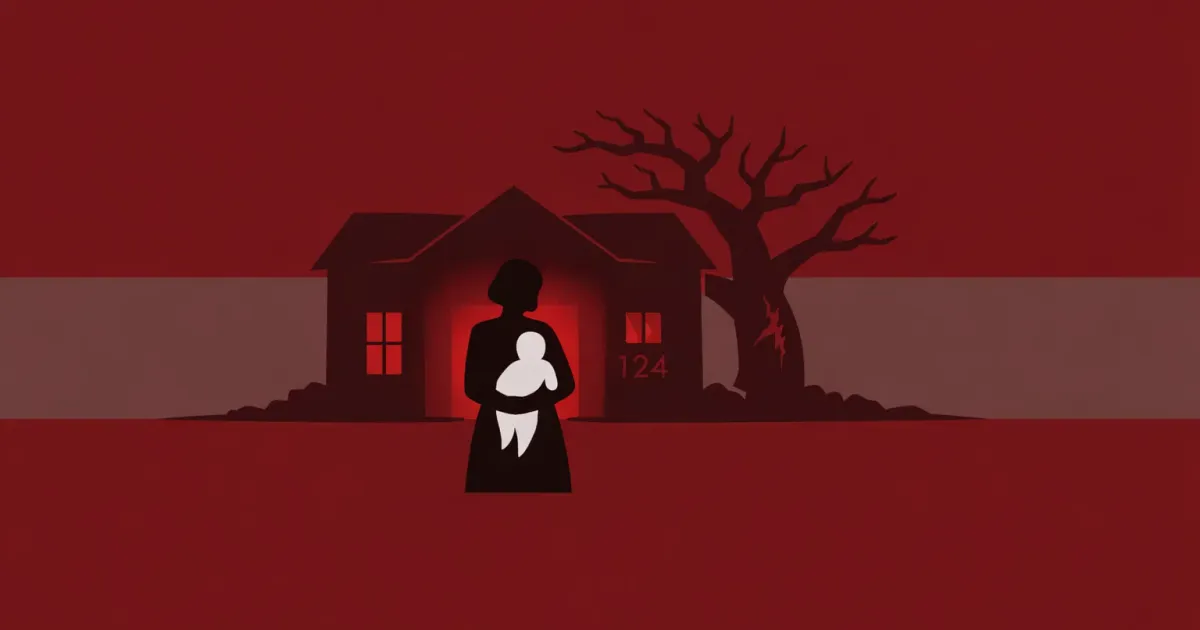
Beloved is set mostly in 1873, in a freedman's household at 124 Bluestone Road just outside Cincinnati, but its real historical reach is longer than that. The backstory runs through the 1850s, when Sethe is enslaved at Sweet Home in Kentucky and escapes across the Ohio River. Kentucky was a slave state; Ohio was free. In an ordinary reading of American geography this would mean the river was the border of safety. The Fugitive Slave Act of 1850 made it something closer to a fiction. Passed as part of the Compromise of 1850, the law required federal marshals and ordinary citizens in free states to assist in the capture and return of escaped slaves, stripped the accused of the right to a jury trial, and made harboring a fugitive a federal crime. This is why a Black family in Cincinnati in 1855 could still be legally hunted: free soil did not confer freedom on the person standing on it. That legal fact is the pivot of the novel's central act. When schoolteacher rides up Bluestone Road with a nephew, a slave catcher, and a sheriff, he is not operating outside the law. He is operating inside it, and Sethe knows it. Morrison's dedication — "Sixty Million and more" — frames the novel against an even larger historical figure: a widely cited (and contested) estimate of the death toll of the transatlantic slave trade.
The seed of the plot is the Margaret Garner case of 1856. Garner, an enslaved woman in her early twenties, fled Kentucky with her husband, their four children, and other family across the frozen Ohio. When federal marshals surrounded the Cincinnati house where they had taken refuge, Garner killed her two-year-old daughter with a butcher knife in the woodshed and was attempting to kill the other children when she was subdued. The case became a national flashpoint. Abolitionists argued for a murder trial (which would have tried her in free Ohio); the federal government insisted she be returned under the Fugitive Slave Act as property. The property argument won. Morrison has said that after reading the clipping in The Black Book she deliberately stopped researching Garner, because she wanted to imagine the interior of the act rather than document its outside. Sethe is not Margaret Garner. Sethe is what Morrison built in the space where the historical record had been silenced.
Beloved is impossible to place without the slave narrative tradition against which it is written. The nineteenth-century narratives of Frederick Douglass, Harriet Jacobs, and Solomon Northup were the most powerful American literature abolitionism produced, but they were published under editorial constraints that required them to omit the most intimate brutalities — sexual violence, infant death, the interior psychic cost — on the grounds that white readers would not accept them. Morrison described her own task, in her 1987 essay "The Site of Memory," as to "rip the veil" off that polite public record. The novel's technique of withheld disclosure — the reader hearing the word "schoolteacher" dozens of times before learning what he did; learning about the murder before learning why — is the structural form of that argument. What was edited out of the nineteenth-century archive returns in the twentieth-century novel as something the prose itself has to learn how to say. This same pressure draws Beloved into the Gothic tradition of the American haunted house — Hawthorne's House of the Seven Gables, Poe's Usher, Faulkner's Sutpen mansion — and just as deliberately into the magical realism of García Márquez and Alejo Carpentier and the Yoruba and West African spiritual frameworks in which the dead are present, local, and answerable. Beloved the character is readable as a ghost, a revenant from the Middle Passage, a psychological projection, and a literal young woman, all at once, because Morrison is drawing on traditions in which those categories do not have to separate.
The reception history is itself part of the novel's meaning. Beloved was published by Knopf in September 1987. When it did not win that year's National Book Award or the National Book Critics Circle Award, forty-eight Black writers and critics — including Maya Angelou, John Wideman, Henry Louis Gates Jr., and June Jordan — signed an open letter in The New York Times Book Review on January 24, 1988, objecting that Morrison's body of work had never received the "keystone honor" the industry reserved for its canonical figures. Three months later Beloved won the Pulitzer Prize for Fiction. The Nobel committee, awarding Morrison the 1993 prize, singled out the novel as the center of her achievement. A 1998 film adaptation directed by Jonathan Demme and starring Oprah Winfrey as Sethe struggled commercially but cemented the book's place in the broader culture. In American classrooms, Beloved is now a core AP Literature text and has appeared on AP Lit free-response prompt lists repeatedly since the late 1990s; it is most often taught alongside Zora Neale Hurston's Their Eyes Were Watching God, Ralph Ellison's Invisible Man, Douglass's Narrative, and, more recently, Colson Whitehead's The Underground Railroad — a lineage Morrison's novel did more than any single book to make legible as a lineage at all.