Themes & Motifs
Motherhood and the Limits of Maternal Love
Beloved is the rare novel that takes a mother's love seriously as a force capable of committing a felony. Sethe does not kill her daughter despite loving her; she kills her because of loving her, in the exact measure of that love. When Paul D finally learns what happened in the woodshed, he tells her flatly that her love is "too thick," and Sethe answers that thin love is no love at all. The argument never quite resolves. The novel builds its emotional architecture around a mother who believes her children are "the best thing" — her words to Paul D — and then enacts that belief to a conclusion no one else in the book — not Baby Suggs, not Paul D, not the Cincinnati community — can follow her to.
What makes this theme unusual in American fiction is Morrison's refusal to flatten it into either a crime or a sacrifice. Sethe's choice is presented as coherent inside the logic of slavery and monstrous outside it, and the novel insists on holding both truths at once. The stolen milk, the chokecherry tree of scars, the two-year-old throat, and the skeletal woman starving herself in Part Three so that Beloved can eat are all stations of the same argument: that a mother under slavery cannot love her children the way a free mother can, and that the attempt to do so can destroy her.
Morrison builds the theme around a single physical substance — breast milk — and then lets that substance do structural work for four hundred pages. When schoolteacher's nephews hold Sethe down in the barn and suck her breasts, the violation Sethe cannot recover from is not the whipping that follows. It is the theft of what belonged to her baby. Sethe tells the story obsessively, circling back to the same phrase about having "enough milk for all," and that phrase is the key to her psychology. Her selfhood has been routed entirely through the act of feeding her children. Any threat to that feeding — schoolteacher's hat in the yard, Beloved's hunger two decades later — flips a switch in her that ordinary moral reasoning cannot reach.
The novel's most famous image of maternal love, Sethe's hummingbird passage, stages this switch in real time. When she is squatting in the garden in 1855 and recognizes schoolteacher's hat coming toward her, tiny hummingbirds "stick needle beaks right through her headcloth into her hair and beat their wings," and in that blurred instant she carries her children to the shed. Morrison returns to the same hummingbird imagery eighteen years later when Sethe sees Mr. Bodwin's hat coming up Bluestone Road during the exorcism. The repetition is deliberate. Sethe's mothering operates below language, at the level of reflex, and the reflex is to remove her children from the reach of a white man — by any route available, including death. Morrison is not endorsing the logic; she is showing how slavery makes such a logic intelligible.
The counterweight to Sethe is Baby Suggs, who has lost eight children to sale and has learned to love only "a little bit" because more than that is unbearable. Paul D, watching Sethe's attachment to Denver, thinks the "best thing was to love just a little bit." Between Baby Suggs's self-rationed love and Sethe's "too thick" love, the novel draws the coordinates of what slavery does to mothers: either you parcel yourself out in survivable portions and live, or you pour yourself into your children absolutely and become hostage to them. Beloved's return is the return of that hostage-taking. She eats Sethe alive, and Sethe consents, because she has always understood herself as food her children were entitled to. The novel does not resolve the theme so much as refuse it a resolution. Paul D's final line — "You your best thing, Sethe" — is an attempt to propose another way, but Sethe's response is a question, not a surrender: "Me? Me?"
Rememory and the Past as a Place
"Rememory" is the word Sethe uses for the novel's central idea about time, and it is worth pausing on because no other American novel uses time quite this way. For Sethe, the past is not a sequence of events that has already occurred. It is a location. Sweet Home, she tells Denver, is still out there — still a place — and if Denver ever stumbled into its neighborhood, the thing that happened there would happen to her too, even though she was born afterward and has never seen it. Memory in Beloved is not something you keep. It is something you can walk into, and something that can walk out to meet you.
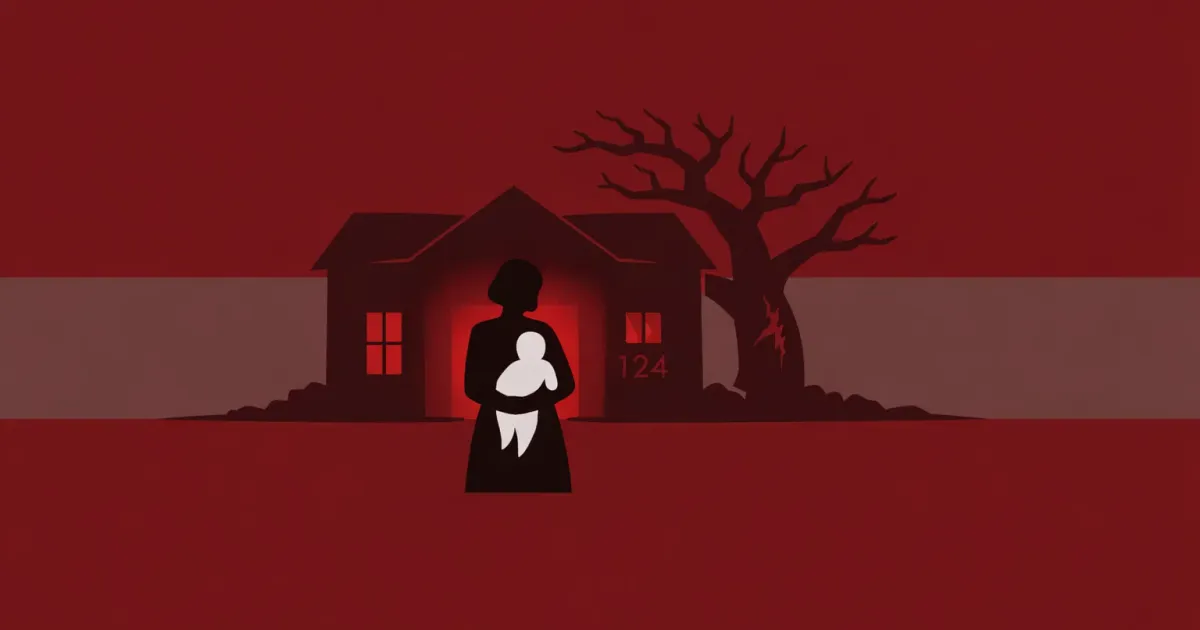
The easiest way to see this theme is in how the novel is put together. Morrison tells her story out of order and in fragments, looping through the same moments — the milk, the woodshed, the ferry crossing, the Clearing — from different angles and at different emotional distances. The structure enacts rememory on the page. By the time Beloved walks up out of the stream in Chapter 3, the reader understands that a past this dense has to take shape somewhere, and that the house at 124 has been holding it back for eighteen years.
Sethe's explanation of rememory to Denver contains one of the book's most quietly radical propositions: that some events are so charged they become permanent features of the landscape, independent of any individual consciousness. "Places, places are still there," she says — what happened there is still happening. This is not a metaphor in Morrison's world; it is cosmology. Beloved's appearance is the literal proof. She is not a symbol summoned by Sethe's guilt but a presence that has been waiting in a specific location for a specific return, and when Paul D exorcises the baby ghost from inside the house, that waiting simply reorganizes itself into a body and walks up to the porch.
The technique that enforces this theme is Morrison's refusal of a conventional chronology. The novel's opening sentence puts the reader in 1873, but within pages it has slid to 1855, then back, then to a moment in between, and it continues sliding for the rest of the book. Calling this stream of consciousness misses the distinction Morrison is drawing: conventional interior monologue traces a mind's associations in the present tense of thought. What Morrison is doing is different — the prose maps the terrain of a past that refuses to become past, and the reader moves through it not as a character's memory but as a landscape with its own geography. The prose is not following Sethe's associative mind so much as documenting the terrain her mind has been forced to inhabit. When Part Two begins with the sentence "124 was loud" — a deliberate echo of "124 was spiteful" — the reader is being told that the house is a recording device, that each phase of its occupation by Beloved has its own acoustic signature, and that the novel's chapters are being dated not by year but by what the walls are emitting.
This is also the theme that connects Sethe's individual psychology to the novel's historical reach — and that reach extends to the Middle Passage itself. The dedication, "Sixty Million and more," names Morrison's estimate of those who died in the Atlantic crossing: in the holds, over the rails, in ports before the ships even sailed. The novel proper never announces this dimension directly. Instead, it buries it inside Beloved's monologue in Part Two, where Morrison strips punctuation, dissolves pronouns, and lets a voice report in fragments: the iron circle, the men without skin, the dead man on her face, the woman with earrings who jumps into the sea. None of these images belong to the infant Sethe killed in 1855, who was born in Ohio and never saw a ship. They belong to someone else — many someones. Beloved is simultaneously the particular child Sethe murdered and a revenant of the Middle Passage dead, and the monologue is written so that either reading works, and the deepest reading holds both at once. The slave-ship passages are impossible as personal memory and perfectly legible as rememory: the past of other Black bodies is located in the same kind of place Sweet Home is, and a consciousness wounded enough can walk into it. The ghost is more than one child; the novel is more than one story. Morrison scales her book from a domestic Cincinnati haunting to a continental historical witness without dropping the specificity of either — not through a lecture or a chapter heading but through the internal logic of rememory. Morrison is arguing something genuinely uncomfortable: that ordinary forward-moving time is a privilege the descendants of slavery cannot entirely access, and that the country's refusal to face its history has turned every Black interior into a house with something in the walls.
Slavery as the Unmaking of Personhood
What separates Beloved from almost every other American novel about slavery is its focus. Morrison is not primarily interested in slavery as labor extraction or as political atrocity, though it is both. She is interested in slavery as a technology — a coordinated set of practices designed to unmake the self. Take schoolteacher's notebook, with its two columns sorting the Sweet Home people into human and animal characteristics: the document is not a deviation from respectable practice but its clearest expression, the accounting method of the Enlightenment applied to a person. Or take Paul D, valued at $900 in schoolteacher's ledgers, bitted like a horse on the chain gang, reduced in his own reckoning until he concluded that the rooster Mister — uncollared, unpriced — was more real than he was. What unites these is not cruelty as a personal failing but system as design. Morrison's argument is that every mechanism — the notebook, the bit, the price — is slavery doing exactly what it was built to do: convert a self into a commodity. The novel's great subject is what happens to interiority when that conversion is nearly complete.
The reader meets this theme through the bodies of the Sweet Home people. Every one of them carries the evidence. Sethe's back is a map of scars the size of a tree. Paul D's neck is scarred by the iron ring. Baby Suggs has a crushed hip and hands that she has to ask permission of her own body to feel. The wounds are not ornaments. They are receipts.
Morrison stages slavery's assault on personhood through a pair of contrasting masters: Mr. Garner, who prides himself on calling his enslaved men "men," and schoolteacher, who arrives after Garner's death and runs the farm by the book. The novel's argument is that these two figures are not opposites. Garner's paternalistic exception depends on his personal willingness to sustain it; when he dies, the system reverts to its default state within weeks. Schoolteacher's notebook is simply the default state made visible. Morrison places its most famous image — Sethe's overheard lesson in which schoolteacher instructs his nephews to put her human characteristics on the left and her animal characteristics on the right — at the center of the novel's moral argument, because it demonstrates that slavery is not a deviation from Enlightenment rationality but one of its products. The notebook is pedagogy.
Paul D's arc is the novel's most sustained study of what this pedagogy costs. He has been bought, sold, leased, collared, and bitted; schoolteacher has priced him at $900 in the breeding-stock column of his ledger; he has worn an iron bit in his mouth while Mister the rooster sat free on a tub watching him, and he has concluded — this is the detail that breaks him — that the rooster was "more real" than he was, because the rooster got to keep his name. His response is the tobacco tin: a rusted-shut container in the chest where a red heart used to be, into which he has put the sight of butter, the smell of hickory, "notebook paper, one by one," every memory he cannot metabolize. The tin is Morrison's metaphor for the personhood that slavery forces its victims to seal off in order to function. The ordinary mechanics of selfhood — desire, feeling, remembrance of pleasure — become too dangerous to carry, so they are buried.
What the novel does with this theme in its final third is crucial. Beloved does not come only for Sethe. She pries open Paul D's tobacco tin, pulls Denver out of the twelve-year silence she has been living in, and forces every major character to confront what has been sealed. The past that slavery has unmade must be remade before anyone can go on, and the only instrument for that remaking turns out to be communal — the thirty women's song, older than words, gathering in the yard. Personhood in Beloved is not something an individual can reclaim alone. It has been taken apart collectively and has to be put back together the same way.
Community, Isolation, and the Collective Voice
Beloved is often read as a novel about one mother and her ghost, but it is equally a novel about a community and its silences. 124 Bluestone Road is haunted not only by the baby Sethe killed but by the neighbors who watched four horsemen ride up the driveway in 1855 and failed to send warning. The feast Baby Suggs threw the night before — the blackberries, the rabbit, the bread, the ninety guests — offended the community's sense of proportion, and the offense curdled into the resentment that cost Sethe her daughter. For the next eighteen years, the town withholds itself from 124. No one walks up the path. No one sings Baby Suggs back into the Clearing. The house becomes a sealed unit, isolated inside its grief, and the ghost fills the vacuum that community used to occupy.
The novel's emotional climax reverses this isolation. When thirty women walk up Bluestone Road in Part Three and begin to sing, they are not just confronting Beloved. They are repairing what they broke in 1855. The exorcism is a restoration of community, and Morrison makes clear that no smaller unit — not the mother, not the lover, not the daughter — could have accomplished it.
Baby Suggs's Clearing is the positive pole of this theme. In her preaching, she gathers the free and the fugitive into a single circle in the woods and tells them that their hands, their mouths, their necks, their flesh are worth loving because no one in the world outside will love these things for them. "Here, in this here place, we flesh..." she says — the sentence continues: "flesh that weeps, laughs; flesh that dances on bare feet in grass" — and the sermon is Morrison's image of what Black community is for: a collective act of repair against a country engineered to mutilate. But the Clearing is also fragile. Baby Suggs's collapse after the woodshed is not just personal grief; it is the loss of the one figure who could gather that community, and without her the Clearing goes quiet. The silence that follows is the silence in which the ghost grows louder.
Morrison stages the community's failure through two opposed feasts. The blackberry feast is generous to a fault — "loaves and fishes," Stamp Paid calls it — and its generosity becomes a provocation. The neighbors wake the next morning in a collective sulk, and no one puts eyes on the road when four strangers ride in. Eighteen years later, when Ella hears that Sethe is being consumed by the daughter she killed, she decides that the past cannot be allowed to come up out of the ground and eat the living. The thirty women who gather in the yard are the same community, reassembled — only this time they arrive in time. Morrison's point is not that communities are always moral. It is that individual survival under the conditions Beloved describes is not really available; a person cut off from her community can be eaten, and a community that withdraws from one of its own leaves her unprotected.
The novel's formal expression of this theme is the collective voice itself. In the braided monologues of Part Two, Sethe, Denver, and Beloved lose their separate pronouns and merge into a chorus: "You are my sister / You are my daughter / You are my face." That chorus is dangerous inside 124, where it signals Sethe's dissolution into Beloved's hunger. But at the exorcism it becomes something else — a wordless sound, "the sound that broke the back of words," produced by women who are not related to each other and who have not spoken to 124 in two decades. The novel offers this sound as its strongest counter-argument to the private, enclosed, consuming love that slavery has taught Sethe. Community in Beloved is not sentimentality. It is technology for keeping individuals alive.
Naming and Unnaming
Names in Beloved are never neutral. The farm is called Sweet Home, which Sethe observes bitterly was neither sweet nor home. The house where the action takes place is identified only as "124" — a number famously missing its three, as if one child has been subtracted from the address itself. The dead baby has no given name; the word carved on her headstone is the only word Sethe could afford, bought from the engraver with ten minutes of sex, and the word is Beloved. The freedman who ferries fugitives across the Ohio has renamed himself Stamp Paid, declaring by fiat that all his debts are settled. Three of the Sweet Home men are called Paul A, Paul D, and Paul F, not as first names with surnames but as letters appended to a single imposed identity. Halle's mother was Jenny Whitlow on her bill of sale and Baby Suggs everywhere else that mattered. Every name in this novel has been chosen, imposed, refused, purchased, or left blank.
This is not decoration. It is the theme by which Morrison organizes slavery's assault on identity at the level of the word. To own a person is to own the naming of that person, and the novel's characters are continually improvising around the gap where self-names should be.
Historians of American slavery have documented how systematic renaming was — owners routinely stripped the names enslaved people carried from their families, their languages, their countries of origin, and assigned new ones as a first act of possession. Morrison builds on this record, but her interest is less in the historical fact than in its aftermath: what does it do to a person's interiority when their name is not theirs? The Sweet Home men illustrate the spectrum. Garner has given them what he considers individuation — a first letter each — but the shared last name Paul, imposed by a prior owner, makes them entries in the same ledger, interchangeable at the point of sale. When Paul D tries to reconstitute himself as a man after years on the chain gang, the first obstacle is that his name functions as a tag rather than a self. Sixo refuses the entire system: he declines to speak English and when schoolteacher's men burn him alive, his last word is "Seven-O!" — the name of the unborn son the Thirty-Mile Woman is carrying. Sixo dies naming the one life slavery has not yet managed to price.
The name Beloved itself is the theme's deepest move, and it operates at a different register from the Pauls or Sixo. "Beloved" is not a proper name but a liturgical function — how the dead are addressed in the phrase "Dearly beloved." Sethe buys the single word from a stonecutter because she can't afford the whole phrase, and she means it as an epitaph, not a given name. When the young woman in the new shoes announces "Beloved" as her identity, she is claiming the fragment of the funeral liturgy that Sethe could afford — and the missing three in 124 is the same arithmetic: the address contains four slots, the third is empty, and Beloved's return is the three trying to fill it. Morrison never explains either pattern. She lets the arithmetic and the liturgy do their work in parallel, page after page, until the reader understands that the book's title is itself an incomplete sentence, a dedication without a recipient — and that the novel is the rest of the phrase Sethe couldn't buy.
The Body as Site of History
In Beloved, history is not something that happened to the characters. It is something written on their bodies in ink they cannot remove. Sethe's back is the novel's most elaborated example — a cluster of scars so raised and intricate that Amy Denver, the white girl who finds her in the woods, reads them as a chokecherry tree with "trunk, branches, and even leaves." Sethe cannot see this tree herself. It is on her back, where only other people can read it. That arrangement — a wound legible only from outside — is the theme's essential image. The past has marked these bodies with a text they cannot access directly but cannot refuse either, and the novel's drama is largely about what happens when someone else reads those texts aloud.
Every major character carries a version. Paul D wears the scars of the iron ring around his neck. Baby Suggs has a hip that was crushed when her second son was bartered to pay off Mr. Whitlow's debt, and she walks the rest of her life on it. Sixo dies by fire. Beloved arrives with skin as smooth as an infant's — the only unmarked body in the book, and the mark of her unmarked-ness is what identifies her as uncanny.
Morrison uses the chokecherry tree with deliberate care across the novel. Amy Denver reads it first, in a scene of tenderness that allows the scars to be named aloud. Baby Suggs bathes them next, section by section, as if the tree needed to be received by someone who loved Sethe. When Paul D lies with Sethe for the first time, he reads the tree with his hands — tracing branches he cannot see — and his acceptance of those scars is one of the things that draws them together. What shifts the sequence from mere repetition to argument is Beloved's reading in Part Two: she suckles at the neck, at the scars, as if attempting to nurse from the wound itself. Where Sethe's history is written on her skin for others to read, Paul D's is buried inside his chest, in a tin where a red heart used to be, its lid "rusted shut," every metabolized memory locked away. Both are forms of storage, not trauma in the psychological sense but physical archive — outside on the skin or inside in the chest, readable or pried open, but always material. When Beloved forces the tin open in the cold house, Morrison's logic is consistent: what was sealed by slavery can only be unsealed by something that will not accept the sealing.
The novel's strangest body is Beloved's, and the strangeness works entirely by inversion. She has none of the expected marks — her feet should be worn from walking, her skin should be weathered, her teeth should be loose — and the absence is the evidence. In a book where every surviving body is a record of what was done to it, an unmarked body is a body that did not survive. Morrison places Beloved in the same symbolic economy as the Sixty Million dedication: bodies whose history was interrupted before they could wear it, and who have come back to borrow the flesh of the living to finish carrying it.
Haunting, Silence, and the Coda's Double Refrain
Beloved opens with one of the most compressed first sentences in American fiction — "124 was spiteful" — and the novel's three parts each begin with a variation: spiteful, loud, quiet. The haunting is the book's weather system, and its phases are the novel's chronology. A ghost in Beloved is not a gothic ornament or a metaphor for guilt. It is a structural element. The past, in this novel, has not been metabolized; it has not been worked through; it has not even been fully narrated. It therefore leaks into the present in the form of a baby spirit throwing kettles and, later, a young woman with new shoes and an appetite. The same logic governs the silence the characters keep: Sethe will not speak of the woodshed; Paul D has locked his memories in a tobacco tin; the entire community has withheld itself from 124 for two decades. The haunting and the silence are the same refusal, operating at different scales.
At the novel's end, Morrison converts both into a formal statement. The coda repeats, three times, a sentence that refuses to be only one sentence: "This is not a story to pass on." The phrase means "don't transmit this" and "don't skip over this" in equal measure, and Morrison refuses to decide between the readings. By existing, the novel disobeys its own refrain — and leaves the contradiction unresolved.
Morrison is precise about what the haunting is not. The baby ghost of the first section is not a metaphor for Sethe's psychology — Sethe is not particularly haunted in the conventional sense, and when Paul D throws the ghost out, she goes along with it without difficulty. The ghost is a presence in the house, external to any individual's mind, experienced in the same way by Sethe, Denver, Baby Suggs, and the two sons who flee it. By locating the haunting in the building rather than in a character's head, Morrison makes the past something the community shares rather than something the individual carries. The address 124 is not Sethe's trauma. It is a public address, and what's happening there is public too — which is why Stamp Paid, passing in the road in Part Two, can hear the voices in the walls.
The novel's movement from "spiteful" to "loud" to "quiet" tracks the haunting's evolution through three distinct phases. The spiteful phase is an unresolved wound throwing objects; the loud phase is the wound speaking in a chorus of unintelligible voices; the quiet phase is the wound trying to eat its way back into a body. Morrison's choice to align each Part with a new adjective for 124 makes the haunting the book's true protagonist. Sethe, Denver, Paul D — these are characters inside a story the house is telling. When Beloved finally disperses at the end of Part Three, the narrator notes that 124 has gone quiet again, and that the footprints behind the house appear and disappear in ways that fit anyone who steps into them. The haunting has not ended. It has only redistributed.
The silences the characters keep are the haunting's interior counterpart. Beloved is the figure who makes those silences untenable. She demands stories from Sethe, pries open Paul D's tin, pulls Denver out of her twelve-year muteness. Morrison stages the problem most acutely through Ella, who has survived her own unspeakable past — a "lowest yet," a child fathered by her captors whom she refused to nurse — and whose rule is that the past "had better stay there." Ella's willingness to organize the exorcism is an exception she makes only because Beloved has violated the rule from the other direction: a past has come into the present and begun eating the living. Some stories will destroy you if you tell them; some will destroy you if you don't. The novel does not pretend to resolve this. It takes a position — that this particular story must be told — and then, in the coda, undercuts the position.
Beloved does not vanish back into a grave; she disperses into the landscape, into the stream, into a prairie wind, into anyone who happens to step in her tracks. The community agreed to forget her, and the forgetting was itself an act — not a lapse but a decision. The final word of the book, "Beloved," set alone on its own line, is the novel's last attempt to honor both halves of the contradiction: it is the name of the thing being forgotten and the name of the book being read. To pronounce it is to pass the story on; to leave it isolated on the page, without sentence or context, is to leave it unintegrated, unexplained, still not quite a story. Morrison gives the reader the last task. The word is now in the reader's mouth. Whether that amounts to transmission or trespass is a question the novel refuses to close.