Summary
Overview
Beloved is a novel about a woman who killed her own daughter to keep her out of slavery, and about what happens eighteen years later when the daughter — or something shaped exactly like her — walks back up the driveway. The woman is Sethe, a former slave who escaped the Kentucky plantation called Sweet Home and made it across the Ohio River to Cincinnati in 1855. The house she lives in, 124 Bluestone Road, is haunted from page one: a baby ghost throwing kettles, pushing sideboards, scaring off her two sons. When the novel opens in 1873, the only people left in the house are Sethe, her lonely teenage daughter Denver, and the ghost. Then Paul D arrives, one of the other Sweet Home men, and walks the ghost out of the house on his first day. A few weeks later a strange young woman in new shoes appears on a tree stump in the yard, gives her name as Beloved, and never leaves.
The plot is not the hard part of the book — the hard part is the chronology. Morrison tells this story sideways and in pieces. You learn about the murder long before you learn why Sethe did it. You hear the word "schoolteacher" dozens of times before you understand that this is the name of the man who took over Sweet Home after the Garners died and turned a barely bearable slavery into an unbearable one. You meet Baby Suggs, Sethe's dead mother-in-law, as a voice in memory for most of the book before you understand that she once preached a whole community into a brief, impossible joy, and then lay down and waited to die of grief. Morrison calls this technique "rememory" — the past is not behind Sethe but still happening, located in the world, waiting to be walked into by anyone who gets too close. The novel's structure enacts what it's about: a past that refuses to stay past.
What makes Beloved unlike any other American novel is its refusal to treat slavery as background or history. It is the story's weather. Every character carries physical evidence of it — the tree of scars on Sethe's back, the iron ring scars on Paul D's neck, Baby Suggs's crushed hip, the tobacco tin where Paul D has buried his heart. The dedication — "Sixty Million and more" — points to the death toll of the Middle Passage, and the novel keeps widening its frame, in its most famous sequence, to include a first-person voice from inside a slave ship itself. The last page's repetition of "This is not a story to pass on" closes out an argument the whole book has been making against that sentence.
Beloved was published in 1987, won the Pulitzer Prize the next year, and is generally read as Morrison's masterpiece and the central novel in the post-1970 American canon about slavery. It sits inside a specific literary project — what Morrison herself called "rip[ping] the veil" from the polite public record of American slavery, which the slave narratives of the nineteenth century had been forced to draw by their white abolitionist editors. Frederick Douglass and Harriet Jacobs could describe the whip but had to elide the worst of what they had seen in order to be published at all. Morrison, writing more than a century later, put back in what had been edited out. The novel is loosely based on the 1856 case of Margaret Garner, a Kentucky fugitive who killed her two-year-old daughter in a Cincinnati woodshed rather than let federal marshals return her family to slavery. Morrison read the case in a clipping collected in The Black Book and built Sethe around it, but she was not interested in a documentary retelling. She wanted to imagine what the unspeakable interior of that act felt like — and what it would mean if that daughter came back.
The structural innovation is the braid of three voices in Part Two. Sethe, Denver, and Beloved each get a stream-of-consciousness chapter that eventually collapses into a choral passage ("Beloved / You are my sister / You are my daughter / You are my face") in which the three can no longer be separated. Embedded inside that braid is Beloved's monologue, which is not a memory of Ohio at all but the testimony of a consciousness on a slave ship — "the men without skin," the iron circle, the dead man on her face, the woman with earrings who disappears into the sea. Morrison deliberately blurs whether Beloved is the murdered daughter, a generalized revenant of every African woman who died in the Middle Passage, or both. Her refusal to resolve this is the novel's deepest move. Within Morrison's own work, Beloved is the first volume of a loose trilogy with Jazz (1992) and Paradise (1997), each exploring a different wound in Black American history; but Beloved is the one that reset what American fiction could do with slavery, and every novel about it since — from The Underground Railroad to The Water Dancer — is written in its gravity.
Part One, Chapters 1–3: 124 Bluestone Road and the Arrival of Paul D
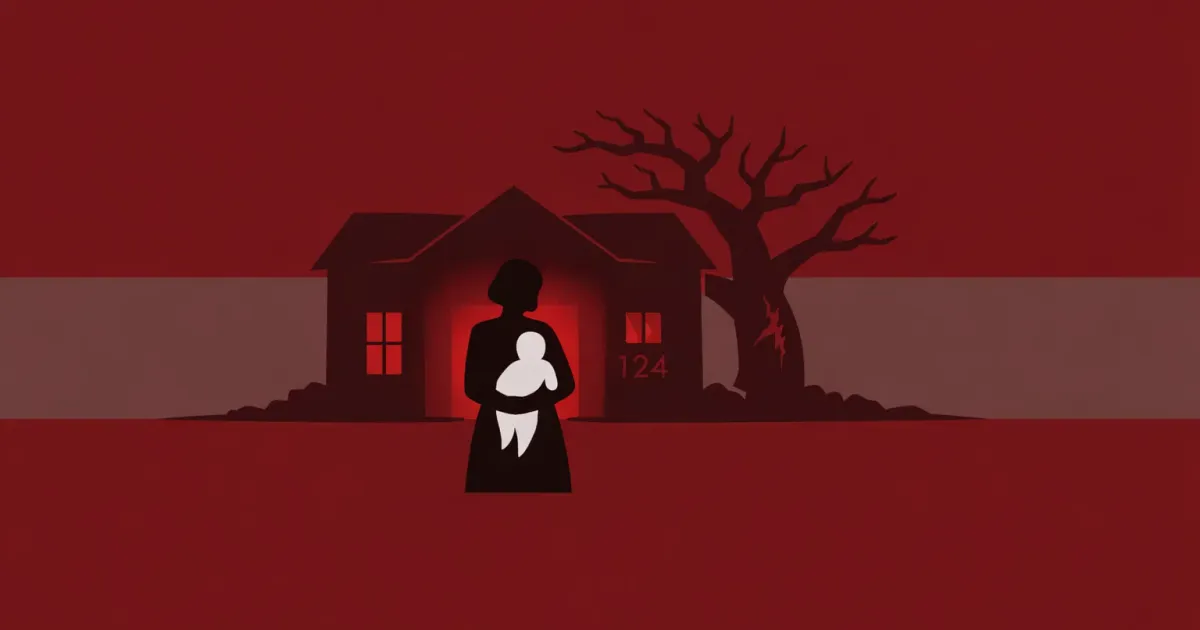
The novel opens in 1873 at 124 Bluestone Road, a gray and white house on the outskirts of Cincinnati that is haunted by the spiteful ghost of a baby. Sethe's two sons, Howard and Buglar, have already fled the house. Her mother-in-law, Baby Suggs, has died upstairs "in her sickbed." Only Sethe and her eighteen-year-old daughter Denver remain. Into this stillness walks Paul D Garner, the last of the Sweet Home men, whom Sethe has not seen in eighteen years. He sits on her porch, follows her inside, feels the grief pooled in the room like red light, and on the same first day he grabs the legs of a shaking table and orders the ghost out. The baby spirit seems to leave. Paul D takes Sethe and Denver to a Cincinnati carnival — their first outing as something like a family. Denver, who has grown up friendless, resents him immediately. On the way home from the carnival, the three of them find a fully dressed young woman sitting on a tree stump in the yard. She has perfect, unblemished skin and new shoes. She gives her name as "Beloved." They take her in. She is weak, sleeps for days, and cannot answer questions about where she came from — only that she "walked." Denver, who has been silently dying of loneliness, attaches to her instantly.
These opening chapters establish the novel's basic ironic structure: a ghost story in which the ghost is not the problem. The problem is what the ghost represents — a piece of the past that 124 has been containing but cannot release. Paul D's expulsion of the spirit seems at first like a classic male-hero entrance into a female-haunted house, but Morrison is setting him up for the reversal: the ghost returns within days, in a different form, embodied, and far harder to evict. Beloved's appearance on the stump is the novel's first major plot engine, and Morrison introduces her with precisely the details that mark her as uncanny — she emerges from the water (she later explains she walked "out of the water"), she has the skin of an infant, her first full night in the house exhausts her "as if she'd walked miles." The word "Beloved" itself is the only word Sethe could afford to have engraved on her daughter's headstone, bought with ten minutes of sex with the engraver. That detail, slipped into Chapter 1, primes the reader to understand what has just walked in the door before any character does.
Part One, Chapters 4–9: Sweet Home and the Escape
As Paul D settles in, the novel moves fluidly between 1873 and the Sweet Home years, assembling the backstory in fragments. Sweet Home was the Kentucky farm owned by Mr. Garner, who prided himself on calling his enslaved men "men" in front of other slaveholders. There were five of them — Paul A, Paul D, Paul F, Sixo (called "the wild man"), and Halle Suggs. Sethe arrived at thirteen to replace Baby Suggs, whom Halle had bought out of slavery with five years of Sunday labor. Sethe chose Halle; they were married in a single bedding dress she sewed herself, and had four children. Everything changed when Mr. Garner died and Mrs. Garner brought in the man who had married Mr. Garner's sister to run the place — a man known only as "schoolteacher," who taught his two nephews "scientific" racial measurements and wrote Sethe's human and animal characteristics in a notebook in two columns. The planned escape fell apart. Sethe sent her three older children ahead across the Ohio River to Baby Suggs. The night before she was to follow, schoolteacher's nephews held her down in the barn and stole her breast milk, while a third nephew watched and schoolteacher wrote it up. When Sethe reported this to Mrs. Garner, the nephews whipped her, opening the cluster of scars on her back that Amy Denver will later call "a chokecherry tree." Sethe ran anyway, pregnant and whipped. On the way north, collapsing in the woods by the Ohio, she was found by Amy Denver, a white indentured girl running from Boston, who rubbed her feet, bandaged her back, and delivered the baby — Denver — in a lean-to on the riverbank. Stamp Paid, a freedman running the ferry on the north bank, then carried them to Baby Suggs at 124.
This section is the novel's clearest statement of its central argument: slavery is not a backdrop but a technology designed to unmake personhood. Garner's "benevolent" slavery — he calls his men men — is revealed to be exactly as structural as schoolteacher's cruelty; the only difference is that it requires Garner's individual will to sustain, and when he dies, the whole thing reverts instantly to its natural state. Schoolteacher's notebook is Morrison's most compact image of white supremacy as a written, scientific project: human characteristics on the left, animal ones on the right. The stolen milk is the pivot of Sethe's psychology for the entire novel, and Morrison stages it with terrible precision — the theft is not the whipping, which is the lesser violence; it is the nursing, the treating of a mother as livestock. Sethe's entire later claim on her children (and Beloved's claim on her) runs through that milk. The Amy Denver passages are written in a different key entirely: a white girl and a Black woman, both fugitive, both destitute, making a child together in the woods. Morrison refuses the easy narrative in either direction: Amy is a scared teenager running from her own brutal master, and the novel grants her her part in Denver's survival without sentimentalizing the encounter.
Part One, Chapters 10–15: The Feast, the Woodshed, and the End of Baby Suggs
Twenty-eight days after Sethe reaches 124, Stamp Paid brings two buckets of blackberries, and Baby Suggs — who has become the unofficial preacher of the Cincinnati Black community — hosts an impromptu feast that turns into a celebration for ninety people. She preaches in a wide place in the woods that the community calls the Clearing, telling them to love their bodies because no one else will: "Here, in this here place, we flesh..." The feast is too much. The neighbors are offended by Baby Suggs's abundance, and their resentment blinds them the next morning to what is coming. Four horsemen ride up Bluestone Road to retake the fugitives under the Fugitive Slave Act: schoolteacher, one nephew, a slave catcher, and a sheriff. When Sethe sees schoolteacher's hat in the yard, she grabs her four children, carries them into the woodshed, and begins to kill them. She saws through the throat of her "crawling-already?" daughter with a handsaw, tries and fails to brain Denver against the wall, and is reaching for the other two when Stamp Paid wrenches the baby away. Schoolteacher takes one look at the bloody scene, decides the woman is ruined for breeding, and rides away without her. Sethe is arrested, jailed with the nursing infant Denver, and released only because the white abolitionist Bodwins intervene. The community, which had warned Baby Suggs of nothing, now withdraws from 124. Baby Suggs lies down in her bed, refuses to preach or see anyone, and spends her last years "pondering color." The baby ghost starts in the house shortly after.
The killing is the novel's structural and moral black hole. Morrison withholds it for almost half the book, then gives it to the reader from schoolteacher's point of view — a choice that is both formally audacious and morally ruthless. The reader sees the woodshed first as the slave catcher sees it: "a nigger woman holding a blood-soaked child to her chest with one hand and an infant by the heels in the other." That framing forces the reader to sit inside the eye that reduces Sethe to a broken animal, which is precisely the eye Sethe has just refused to let touch her daughter again. Only when Stamp Paid and Baby Suggs enter the shed does the prose soften back into Sethe's world. The technique is Morrison's answer to the question of whether such an act can be narrated at all: she narrates it twice, from outside and from inside, and lets the reader live with the gap. Baby Suggs's collapse in the aftermath is one of the most quietly devastating sequences in American fiction. A woman who has spent the last decade telling her people to love their hands, their mouths, their necks, their flesh, is undone by the discovery that "there was no bad luck in the world but whitepeople." Her withdrawal into color (pink, lavender, whatever Sethe can bring her) is a kind of spiritual suicide that the novel never quite forgives and never quite condemns.
Part One, Chapters 16–18: The Red Heart and the Clipping
Back in 1873, Beloved's hold on the household tightens. She demands stories from Sethe, touches her constantly, flatters Denver, and watches Paul D with an appetite he cannot name. She visits him in the cold house out back at night — he finds himself unable to sleep inside 124, though he can't explain why to Sethe — and seduces him, or commands him, or simply moves him, in a scene Morrison writes as something closer to possession than sex. His tobacco tin pops open: the metaphorical box in his chest where he has buried every unbearable Sweet Home memory. He tells Sethe he wants her to have his child, as if a future might be built on top of the past. The next day, Stamp Paid shows Paul D an eighteen-year-old newspaper clipping about the woman at 124 and the woodshed. Paul D confronts Sethe. She tells him the whole story, walking in circles around the kitchen. He tells her: "You got two feet, Sethe, not four." He leaves. Sethe sits in Baby Suggs's keeping room, and the baby ghost's voice, now speaking through Beloved, begins to take over the house.
Paul D's line — "You got two feet, Sethe, not four" — is the novel's most controversial sentence, and Morrison wants it to be. It is a man pronouncing moral judgment on a woman who killed her own child, and the book immediately tests whether the judgment is fair. The scene is structured so that the reader hears Sethe's explanation first — her circling, the famous passage about how her love was "too thick," the image of a hummingbird beating at her head — and then hears Paul D's refusal to accept it. He is both right and wrong. He is right that no ethical system available to him lets Sethe off the hook. He is wrong that the alternative — letting schoolteacher write Denver's animal characteristics in a column — was a life. Morrison gives neither of them the last word. What ends the section is not an argument but Paul D's departure, which leaves Sethe alone with Beloved, and Beloved alone with what she wants. The tobacco tin image is Morrison's figure for traumatic repression: a rusted-shut container in the chest where a red heart used to be. Paul D's tin is pried open by Beloved. Whether opening it will kill him or free him is the question the rest of the book holds.
Part Two, Chapters 19–23: 124 Turns Loud
"124 was loud," Part Two begins, mirroring the "124 was spiteful" that opened the book. Stamp Paid hears the voices from the road — a clamor of unintelligible speech coming out of the walls of the house. He tries to knock on the door and cannot bring himself to. Inside, Sethe has realized who Beloved is. The scar beneath Beloved's chin — "the little curved shadow of a smile" — confirms it. She loses her job at Sawyer's restaurant because she keeps staying home later and later. The three women — Sethe, Denver, and Beloved — move into a fevered, isolated intimacy: ice skating together on a frozen creek, making cookies in the shape of men and women, braiding each other's hair, sleeping in the same bed. For one winter month it looks like joy. Then Beloved begins to demand, and Sethe begins to apologize. She cannot explain herself fast enough. Every detail of her love — the crawl to the lean-to, the milk she kept, the one word on the headstone — Beloved dismisses or counters with her own claim: that Sethe left her, that dead men lay on top of her, that no one smiled. Sethe stops eating so that Beloved can have more. Beloved, pregnant-seeming, keeps swelling. Between these chapters comes the braided interior monologue sequence — Sethe, Denver, and Beloved each speaking in a collapsing, punctuation-less voice, with Beloved's chapter pulling in the Middle Passage images of the slave ship: the iron circle, the men without skin, the woman with the earrings going into the sea.
This is the formally most radical section of the novel and the hardest to read. Morrison dissolves the third-person narration that has held the first two hundred pages together and lets the three women speak directly, one after the other, until their voices braid into a litany that cannot be assigned to any one of them: "You are my sister / You are my daughter / You are my face; you are me." The effect is an ontological claim — that mother and daughter and sister are not separate categories in this house, that Sethe is being consumed into Beloved's want because there was never a clean line between them. Beloved's monologue is the book's widest lens. It is not a memory any individual character could have, and Morrison's refusal to clarify is the point: Beloved is simultaneously the child Sethe killed and a witness from a slave ship, the personal and historical ghost collapsed into one body. The chapter enacts what the dedication announces. Sixty Million and more. The prose itself, stripped of punctuation and sequence, mimics a consciousness that has never been allowed to separate the past from the present, because the past was too violent to be metabolized into a past. That is also, Morrison suggests, Sethe's condition. And increasingly, as Beloved eats Sethe alive, it is literally Sethe's condition.
Part Two, Chapters 24–25: Paul D in Exile, Stamp Paid's Grief
Paul D, meanwhile, has been sleeping in the basement of a small Black church, drinking, trying to understand how he got run out of a house by a grown man's word. The novel follows him back through Sweet Home, through the failed escape, through the chain gang in Alfred, Georgia, where he and forty-five other men were kept in boxes in the ground and got out by pulling the chain together and swimming up through mud. Sixo's death comes into view: cornered by schoolteacher's men, he laughs, begins to sing, and shouts "Seven-O!" — the name of the unborn son carried by his lover, the Thirty-Mile Woman — as his captors shoot him to stop his voice. The name means Sixo has already won. Stamp Paid, ashamed of having shown the clipping, tries to visit 124 repeatedly and cannot enter. He begins to understand that what he hears coming out of the house is not words but "the jungle whitefolks planted" in Black people — the accumulated, unspeakable testimony of what was done and is still being done. Paul D and Stamp Paid cross paths in the town. Stamp asks Paul D to forgive him. Paul D asks who the young woman at 124 actually is. Stamp Paid answers honestly: he does not know.
The Paul D chapters are Morrison's portrait of what slavery does to male interiority. Where Sethe's damage is concentrated — the milk, the scars, the baby — Paul D's is diffuse. He has been leased, collared, bitted, boxed, chained, and sold; he has been made to wear a horse's bit in his mouth while Halle's rooster Mister sat free on a tub watching; he has been told, by schoolteacher's pricing him in dollars, that his whole self was worth $900. Every time he thinks he has survived the past, something pries his tobacco tin open. Sixo's death sequence is pure refusal — of English, of schoolteacher, of the archive that would have recorded him as property. He goes to his death singing. The baby the Thirty-Mile Woman is carrying is the only Sweet Home legacy the novel allows to survive intact, because Sixo has turned a child into a weapon of the future. Stamp Paid's arc — a man whose name literally declares his debts canceled — is Morrison's argument that even the most generous, wounded self-sacrifice available in this community has its limits. Stamp has spent his life ferrying the suffering of others. His failure to cross the threshold of 124 is not cowardice; it is an admission that some grief cannot be reached from outside.
Part Three, Chapters 26–28: Denver Leaves the Yard, the Exorcism, and the Coda
By Part Three, 124 is starving. Beloved is huge, petulant, and violent. Sethe is skeletal, vacant, and cannot be reached. It is Denver — the daughter who has barely left the porch in twelve years — who understands that if she doesn't act, both her mother and sister will die. She walks to the house of her old teacher Lady Jones and asks for help. Food begins appearing at the edge of the yard, left by neighbors who have not spoken to 124 in two decades. Denver finds work at the Bodwins' as a night girl. Word of the situation at 124 spreads through the community. Ella, the woman who once organized Sethe's escape route, hears that Sethe has lost her mind to the devil-child, and something in her snaps. Whatever Sethe did in the woodshed was wrong, Ella believes, but the past does not get to come up out of the ground and eat the living. She organizes thirty women from the community. On a hot afternoon they walk up Bluestone Road to 124, singing, looking for a sound older than words. Sethe steps out onto the porch holding Beloved's hand. At that moment Mr. Bodwin, the white abolitionist, happens to drive up the road in his cart to pick up Denver for her night job. Sethe sees a white man coming into her yard and, for the first time in eighteen years, she does not freeze. She breaks from the porch with an ice pick raised — not toward her child this time, but toward the white man — and the women and Denver tackle her to the ground before she can reach him. When they look up, Beloved is gone. Later a neighbor boy reports seeing, down by the stream, a naked woman with fish for hair.
Paul D, hearing rumors, comes back to 124. He finds Sethe in bed in the keeping room, singing to herself, sure she is dying. She tells him Beloved was her best thing, and she left. Paul D takes her hand, touches her face, and tells her: "You your best thing, Sethe. You are." The novel closes with a brief choral coda. The community "forgot her like a bad dream." Her footprints come and go by the stream behind 124, and anyone who steps into them finds they fit. The last line Morrison offers is the name itself: "Beloved."
The exorcism is the book's structural mirror of the woodshed. Both are acts of mother-love performed under the gaze of a white man in a hat. In the first, Sethe turns her rage inward, against her own children, in a futile attempt to save them from him. In the second, eighteen years later, she turns it outward — at the man, at history, at the thing coming into her yard. The fact that the white man this time is Mr. Bodwin, the abolitionist who saved her from the gallows, is not a plot convenience; it is Morrison's final refusal of the idea that any individual white goodness can redeem the structure. From the porch, through Sethe's hummingbird haze, Bodwin is just a white man in a hat, coming for her best thing. The thirty women's song is Morrison's counter-image. Where schoolteacher's weapon was writing — his notebook, his ink, his columns — the women's weapon is a sound older than writing, "the sound that broke the back of words." Beloved cannot survive it. She does not die; she disperses — into the stream, into the footprints, into the communal silence that agrees to forget her. That silence is the condition on which the living can keep living. Paul D's return to Sethe, and his insistence that she is her own best thing, refuses the final form of self-annihilation she has been rehearsing. The line is not a triumph, exactly. Sethe's answer — "Me? Me?" — is a question, not an acceptance. The coda's refrain, "This is not a story to pass on," is deliberately two-faced in English: it means both "do not transmit this story" and "do not skip over it." Morrison's entire novel is the act of disobeying the first reading and obeying the second.