Key Quotes
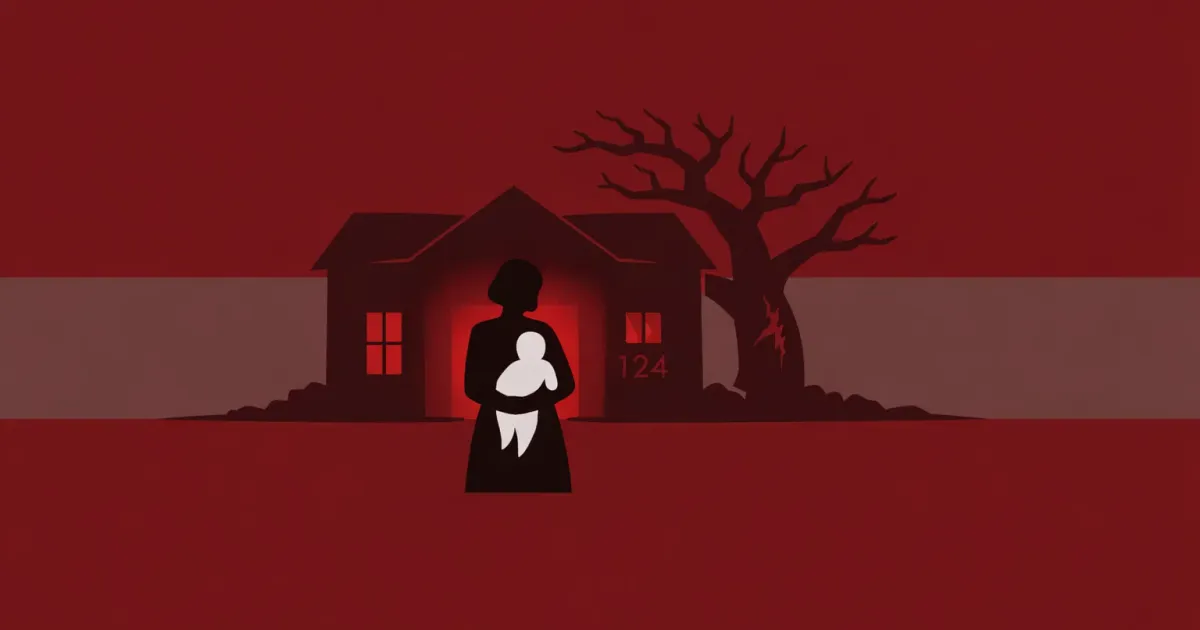
"124 was spiteful. Full of a baby's venom."
Speaker: Narrator (Part One, Chapter 1 — opening lines)
The first two sentences of the novel do more work than most novels do in a chapter. In plain English: the house at 124 Bluestone Road is haunted, and the thing haunting it is a baby, and the baby is angry. Morrison skips every piece of conventional exposition — no naming of characters, no placing of the year, no setting of the Ohio weather — and starts instead with a house and the feeling inside it. By the time a reader finishes the paragraph she already knows that this is a ghost story in which the ghost is a child, and that the child has reason to hate.
The line does three formal things at once. It personifies the house so completely that "124" becomes the subject of the sentence the way a character might — a choice Morrison will repeat at the head of every part ("124 was loud," "124 was quiet"), turning the address itself into the novel's most stable narrator. It withholds the ghost's identity, which licenses the entire backward-reaching structure of the book: the reader spends two hundred pages learning whose venom this is. And it picks the noun "venom" with a precision that later pays off — not grief, not rage, but a poison secreted in self-defense, which is exactly what a murdered infant's haunting turns out to be. Critics often note that Beloved begins in medias res the way an epic does; Morrison herself said she wanted to drop the reader "without preparation" into the same disorientation a captured African would have felt on a slave ship. The three-word sentence that opens the book is the formal enactment of that drop.
"Anything dead coming back to life hurts."
Speaker: Amy Denver, to Sethe (Part One, Chapter 8 — in the lean-to on the Ohio River)
Amy is the white runaway girl who finds Sethe collapsed in the woods, rubs feeling back into her ruined feet, and a day later delivers Denver on the riverbank. She says this as the blood starts moving again in Sethe's legs and the pain sets in. The literal meaning is physiological: numb flesh coming back online is agony. What Denver — who overhears the story as family lore — correctly identifies is that the sentence is also about the whole novel. Beloved is a book in which dead things keep coming back, and every one of them hurts.
The novel's interpretive key goes to the least authoritative voice in the book — a barely literate fourteen-year-old indentured servant, speaking in a Boston-inflected backcountry drawl. The placement is deliberate. The book will not let its big truths be delivered by the figures who have earned them; Baby Suggs's sermon, Paul D's confessions, and Sethe's explanations are all qualified, interrupted, or contested. Amy's line stands because it is offered casually, almost as folk medicine, and because the reader is allowed to apply it themselves across the next three hundred pages. The tobacco tin Paul D has sealed around his worst memories obeys this rule: when Beloved finally pries it open, what pours out is not relief but devastation — the very pain the tin was built to contain. Beloved on the stump obeys it too. The past does not return clean. It returns inflamed, and the inflammation is the sign that the tissue was ever alive.
"A chokecherry tree. Trunk, branches, and even leaves."
Speaker: Sethe, quoting Amy Denver (Part One, Chapter 1)
This is how Sethe describes the mass of whipping scars on her back when Paul D, her first morning back in her life, asks about them. She has never seen the scars herself; she is repeating the image Amy gave her eighteen years earlier in the woods. What's happening in the scene is small — a man and a woman in a kitchen, biscuits in the oven — but the image does enormous work. A disfigurement from a whipping is translated, by a frightened white teenager, into a tree, and Sethe has carried that translation on her body and in her mouth ever since.
The chokecherry is a fruiting tree — it flowers, sets fruit, and is alive — so the metaphor performs the exact operation slavery tried to foreclose: it reclassifies a body that has been reduced to meat as something growing. Morrison layers the image further when Paul D leans his cheek against the scar and the prose notes that he "was pressing into the branches of her chokecherry tree." The scar is no longer a trauma; it has become terrain, a place where another person can rest. The move is characteristic of the novel's entire ethical method — the book refuses to describe damage only as damage. It insists on the possibility, however fragile, that damage can be inhabited. At the same time, Morrison never lets the image go sentimental. The tree is on Sethe's back because schoolteacher's nephews held her down and opened her skin in rows, and the scars are numb — dead tissue — which is why only another person can feel them for her. What looks like a redemptive metaphor is actually a report on what slavery permanently removed.
"And they took my milk!"
Speaker: Sethe, to Paul D (Part One, Chapter 1)
Sethe tells Paul D the story of the barn at Sweet Home twice in two pages, and each time she circles back to the same phrase, as if she cannot get past it. Paul D keeps trying to redirect her toward the whipping — "They used cowhide on you?" — and she keeps answering as if his question were the wrong one. The cowhide opened her back. The taking of her milk, she is trying to tell him, did something worse. This is the quote that anchors Sethe's whole moral universe: the thing she cannot forgive is not the beating but the theft of what belonged to her children.
The repetition is the point. Morrison writes the line twice, flat once and then with an exclamation, so the reader can feel Sethe's insistence bang against Paul D's miscomprehension. In one of the novel's sharpest compressions, the phrase carries the entire theory of slavery that the book is mounting. What schoolteacher's nephews did was not incidental violence; it was the precise act of turning a mother into livestock — milking her — while a third nephew watched and wrote it down. Sethe's fury at Mrs. Garner ("I told Mrs. Garner on em") also names the collapse of the Garners' "benevolent" fiction: the mistress she trusted had no authority over what the nephews did, and no interest in having any. Every later choice Sethe makes — the run, the killing, the surrender to Beloved's appetite eighteen years later — is traceable to the milk. She spends the novel trying to be the mother the barn tried to make impossible, and Beloved, who later claims "I have your milk" in the braided monologue, is the hungry mouth that will not be refused a second time.
"Here, in this here place, we flesh; flesh that weeps, laughs; flesh that dances on bare feet in grass. Love it. Love it hard."
Speaker: Baby Suggs (Part One, Chapter 9 — the Clearing)
Baby Suggs was a slave for sixty years before her son Halle bought her freedom, and once in Cincinnati she became an unordained preacher the community called Baby Suggs, holy. She preached in a clearing in the woods. She did not tell her congregants to repent; she told them to love their own bodies, because no one in the white world would. This line is the sermon's hinge. In plain language: here, in this place, we are flesh — living, weeping, laughing flesh — and you have to love it because everywhere else, they won't.
The grammar of "we flesh" is Morrison writing a theology in a sentence. She drops the copula — not "we are flesh," which would position flesh as a property the self possesses, but "we flesh," which makes flesh the predicate of the self directly. Under slavery, the body was the thing taken; Baby Suggs's sermon insists that the body is also the thing to be reclaimed, and that reclamation begins in the imperative — "Love it. Love it hard." The sermon moves as a part-by-part benediction: from eyes and the skin on the back, through hands and mouth, down to feet, then back up through backs, shoulders, and neck, through the liver, and arriving finally at heart and womb. Each body part gets named, gets the violence done to it named ("Yonder they flay it"), and then gets ordered into self-love. The passage is one of the most quoted in American fiction because it is one of the few genuine attempts in the canon to write a pastoral for a people the pastoral tradition was not designed for. Its tragedy, which the novel is careful to mark, is that Baby Suggs herself stops believing it after the woodshed. The woman who preached "no bad luck in the world but whitepeople" took to her bed and lay there contemplating color until she died. The sermon remains true. The preacher was destroyed by what she had not yet seen.
"Definitions belonged to the definers — not the defined."
Speaker: Narrator, on why schoolteacher beat Sixo (Part Two, Chapter 19)
Sixo is the Sweet Home man who speaks in riddles, steals a shoat, and, when schoolteacher catches him, argues that taking food to improve the master's property is not theft but "improving your property." Schoolteacher beats him anyway. The narrator then delivers this line as the moral schoolteacher was enforcing with the beating. It is one of the plainest statements of the novel's political argument: the violence of slavery was not only physical but epistemic. The power to say what a word means was itself a weapon.
The line names the mechanism schoolteacher has represented since his arrival. His notebook, with its two columns for human and animal characteristics; his measurement of Sethe's head; his instruction to the nephews to keep the records neat — all of it is the bureaucracy of definition. Sixo's crime is not that he stole the shoat; it is that he tried to seize the definition of "theft" and redirect it. That attempt is what the beating is for. Morrison's sentence rhymes with W. E. B. Du Bois's double consciousness and Ralph Ellison's invisibility, but it is more tactical than either: it isolates the exact technology by which whiteness held epistemological power, and it frames the novel's entire formal project as an act of definitional reclamation. Calling Sethe's act in the woodshed murder, or rescue, or sin, or love — the book stakes its whole ethical life on refusing to let any one definer settle the question. Even the narrator refuses. The sentence is diagnostic, not prescriptive; it tells the reader what has been done with the word, and leaves the reader to decide what to do about it.
"You got two feet, Sethe, not four."
Speaker: Paul D, to Sethe (Part One, Chapter 18)
This is what Paul D says when Sethe finishes telling him about the woodshed — the killing of her crawling-already daughter to keep schoolteacher from taking the children back to Sweet Home. Sethe has just walked him through her reasoning in circles, telling him her love was "too thick." He answers with nine words, picks up his hat, and leaves the house. In the plainest reading, he is telling her that what she did was animal, not human, and that no mother who truly was one could have done it. It is the most devastating line a character says to another in the novel.
The sentence wounds in two directions at once. On the surface it sounds like a demand for human dignity — Paul D is asserting, against everything Sweet Home told them both, that a Black woman is not livestock. Under that, it is the exact language schoolteacher used about Black people, and Paul D hears himself use it as soon as the words are out: "right then a forest sprang up between them; trackless and quiet." The book's refusal to let Paul D be simply right is crucial to its moral structure. He is reacting, justly, to an act he cannot metabolize; he is also, in the same breath, reaching for schoolteacher's grammar to do it. The line foreshadows his later collapse in the church basement, where the novel will slowly reveal that his own interior — the tobacco tin, the bit, the price tag of $900 — has been shaped by the very measurement system he has just imposed on Sethe. His return at the end of the book, and his revision of this judgment ("You your best thing, Sethe"), is the arc the novel is built to make him walk.
"You are my Beloved. You are mine."
Speaker: The braided voice of Sethe, Denver, and Beloved (Part Two, Chapter 23)
After the three women's separate interior monologues, Morrison collapses their voices into a single litany that no longer belongs to any one of them. "You are my sister / You are my daughter / You are my face; you are me. / I have found you again; you have come back to me / You are my Beloved / You are mine." On a first read, it sounds like love — three women who have found each other declaring it. On a second read, knowing that Beloved has already begun eating Sethe alive, it is something else: a possession with no exit.
The repeated "You are mine" is the novel's darkest echo of a slaveholder's claim. It is the sentence schoolteacher would have signed beside Sethe's name in his ledger, and Morrison places it in Sethe's own mouth, addressed to her daughter. The inversion is precise and terrible: the mother who killed her child to keep the definer from owning her is now, in her grief, reenacting the definer's syntax on herself. The braided form — three voices merging without punctuation or speaker attribution — enacts at the level of grammar what ownership does to relation: it erases the seam between persons. Morrison's refusal to assign the lines to any single speaker is the argument. Possession, in this house, has become mutual and indistinguishable; Sethe owns Beloved, Beloved owns Sethe, and neither can finish a sentence that belongs only to herself. That is the condition Ella and the thirty women will have to break with a sound older than words.
"It was not a story to pass on."
Speaker: Narrator (Part Three, Chapter 28 — the coda)
The last pages of the novel repeat the line three times in a different paragraph each time, the last variation shifting to "This is not a story to pass on." After three hundred pages of excavating a story — the runaway, the handsaw, the ghost, the revenant, the community, the exorcism — Morrison ends by saying the story cannot be transmitted. It is the final instruction the book gives its reader, and it contradicts everything the book has just done.
The line is deliberately two-sided in English, and Morrison wants both sides working at once. "Pass on" can mean "transmit, hand down to the next generation" — do not pass this story on, keep it buried. It can also mean "decline, skip, refuse" — this is not a story to pass on, one cannot afford not to tell it. The two meanings are opposite, and the novel has earned the right to hold both. The community that "forgot her like a bad dream" chose the first reading; Morrison, by writing Beloved at all, chose the second. Structurally, the repetition enacts what the book has been describing: a past that refuses to stay past, language that will not resolve, a wound that comes back. The shift from past tense ("was") to present ("This is") in the third repetition pulls the reader out of the fictional frame and into the reader's own hand holding the book. The sentence the novel closes on, the last word on the last page, is the name itself — "Beloved" — which is both the address the murdered child claimed and the thing the whole book has tried to do: to call her by name.
"You your best thing, Sethe. You are."
Speaker: Paul D, to Sethe (Part Three, Chapter 28)
After Beloved disperses and the house empties, Paul D comes back to 124 and finds Sethe lying in Baby Suggs's keeping-room bed, convinced she is dying. She tells him, of Beloved, "She was my best thing." He takes her hand, touches her face, and answers with six words. The scene is small and the sentence is almost plain. It is also the revision Paul D has traveled the whole novel to make.
Paul D said "You got two feet, Sethe, not four" in Chapter 18 and walked out. Forty chapters later, he comes back and says this. The novel treats the two lines as a pair, and the arc between them is the novel's case for the possibility of repair. The earlier sentence borrowed schoolteacher's measurement — the human-animal column — and turned it on Sethe. This sentence dismantles the logic of "best thing" itself: it refuses to let Sethe locate her worth in a child, in a possession, in anything that can be taken. Grammatically, "You your best thing" repeats the "we flesh" construction of Baby Suggs's sermon, dropping the copula so that the self and the valuable thing become a single continuous claim. It is Paul D preaching Baby Suggs's gospel back to Sethe after the woman who first preached it has died believing it was a lie. Morrison refuses to let the moment become a resolution. Sethe's answer — "Me? Me?" — is a question, not an acceptance. The novel ends not on assurance but on the tentative opening of a door that the reader is trusted to watch without being told what comes through.
"There is a loneliness that can be rocked."
Speaker: Narrator (Part Three, Chapter 28 — opening the coda)
The final section of the novel opens with this line and then immediately doubles it: "Then there is a loneliness that roams. No rocking can hold it down. It is alive, on its own." Morrison divides human aloneness into two kinds — the kind a body can soothe by holding itself, and the kind that walks. The second is what Beloved has become, now that the house has expelled her: an ambient presence, not a person, haunting footprints by the stream.
The coda's first sentence is the novel's last exercise in its signature technique — taking an emotional state and assigning it a physics. Loneliness is not an internal feeling here; it is a thing with behavior. One kind can be rocked, which is the body's oldest gesture toward itself (and toward a lost child: the rocking chair Paul D sinks into in the next page). The other cannot, because it "roams." Morrison's image of the second loneliness — "a dry and spreading thing that makes the sound of one's own feet going seem to come from a far-off place" — is one of her most precise descriptions of historical trauma as environment rather than event. It is not something that happens to a person; it is something a person walks through, and hears at a distance inside herself. The rest of the coda unfolds from this distinction. The living — Sethe, Paul D, Denver, the community — will rock their loneliness and survive. Beloved, dispersed into the water and the footprints, will roam hers forever. The novel closes by admitting that some wounds can be tended and some cannot, and that the act of writing the book has been an attempt to tend the tendable without pretending the rest has been healed.