Characters
Ralph
Ralph is the closest thing the novel has to a conventional hero, and Golding uses that against both the character and the reader. He's twelve, fair-haired, and carries himself with the easy confidence of a boy who has always been liked. The other boys elect him chief almost instinctively — he's the one holding the conch, and he looks the part. Ralph genuinely wants to do the right thing: build shelters, keep the fire burning, get everyone rescued. His tragedy is that wanting to do the right thing and being able to make others do it are entirely different skills, and he possesses only the first.
What makes Ralph compelling is not his leadership but his gradual, painful awareness that he's losing a fight he barely understands. He can feel the group slipping away from him but can't articulate why, and his frustration turns inward. He forgets what he's trying to say in assemblies. He stares at the ocean and feels the weight of their isolation. By the novel's end, Ralph has become something none of the boys expected: a person who understands what happened to them. His weeping in the final scene is not the crying of a frightened child. It's grief — for Piggy, for Simon, and for the version of himself that believed civilization was something you could simply choose.
Ralph's arc is a study in the insufficiency of good intentions. Golding constructs him as the democratic ideal — rational, fair-minded, committed to the common good — and then systematically demonstrates why those qualities fail without institutional support. Ralph can articulate the right priorities ("the fire is the most important thing"), but he cannot enforce them. His authority depends on consensus, and consensus dissolves the moment Jack offers something more immediately satisfying than waiting for rescue. The conch gives Ralph a procedural framework, but procedure without power is theater.
The most revealing moment in Ralph's characterization comes during the mock hunt in Chapter 7, when he wounds a boar and feels "the desire to squeeze and hurt." Golding does not exempt Ralph from the violence he's fighting against; instead, he shows that Ralph's decency is a choice made against real internal pressure, not a fixed trait. This complicates the novel's allegory considerably. If Ralph were simply "good," the book would be a fable about good versus evil. Because Ralph contains the same impulses as Jack — and knows it by the end — the book becomes something harder: a story about how thin the membrane between order and chaos actually is, even inside a single person.
Ralph's relationship with Piggy evolves from embarrassed tolerance to genuine dependence, though Ralph never fully acknowledges this until it's too late. He uses Piggy's ideas while publicly distancing himself from Piggy's person — a dynamic Golding presents as both psychologically realistic and morally damning. Ralph's final grief for "the true, wise friend called Piggy" carries the weight of belated recognition: he needed Piggy all along and spent most of the novel failing to say so.
Jack Merridew
Jack arrives on the island already performing authority. He marches his choir in formation, in black cloaks, in the tropical heat — a small dictator before he has anything to be a dictator of. He's tall, red-haired, and ugly in a way Golding describes with unsettling specificity: "his face was crumpled and freckled, and ugly without silliness." Jack expects to be elected chief and is visibly stung when he loses to Ralph. That wound never heals. Everything Jack does afterward — the hunting, the face-painting, the feasts, the fort at Castle Rock — can be read as a sustained project to prove that he should have been chosen first.
But reducing Jack to a power-hungry bully misses what Golding is doing with the character. Jack is genuinely skilled. He can track, hunt, and command loyalty. He understands what the other boys want — meat, excitement, protection from fear — and he provides it. His failure is not incompetence but moral direction: he builds a society organized around violence and submission, and he builds it well. Jack doesn't descend into savagery because he's weak. He descends because savagery offers him a version of leadership that democracy denied him.
Jack's transformation is marked by three physical stages that Golding uses as external signs of internal change. First, he hesitates to kill the piglet in Chapter 1 — "the enormity of the knife descending and cutting into living flesh" stops him cold. The old world's prohibitions still grip his hand. Second, he paints his face in Chapter 4, and behind the mask "he was safe from shame or self-consciousness." The paint doesn't create a new Jack; it removes the inhibitions that were suppressing an existing one. Third, at Castle Rock, he sits "painted and garlanded" like an idol while Roger does his violence for him. Jack has completed the journey from boy to chief to something closer to a god demanding sacrifice.
Golding structures Jack as Ralph's mirror image, not his opposite. Both boys want to lead. Both feel the pull of the hunt. Both struggle with fear. The divergence is in what each boy does with those impulses. Ralph fights against the current; Jack swims with it. The novel's pessimism lies partly in the fact that Jack's approach works better in the short term — his tribe has food, fire (stolen), and a sense of purpose, while Ralph's dwindling group has principles and an empty stomach. Golding is not arguing that Jack's way is right but that it is, under the conditions of the island, more immediately viable. This is the book's most uncomfortable political observation: authoritarian systems often outperform democratic ones in crises, not because they're better, but because they're simpler.
Piggy
Piggy is the smartest person on the island and the least powerful, and Golding makes those two facts inseparable. He is overweight, asthmatic, nearly blind without his glasses, and speaks with a lower-class accent that marks him as socially inferior to boys like Ralph and Jack. Nobody takes him seriously. Even Ralph, who comes to rely on Piggy's intelligence, is embarrassed to be associated with him. Piggy's ideas — the conch as a speaking tool, the sundial, the system for counting the littluns — are consistently better than anyone else's, and they are consistently credited to someone else or simply ignored.
What saves Piggy from being a mere symbol of "brains over brawn" is his specific, stubborn personality. He complains. He nags. He invokes his auntie. He is genuinely annoying in the way that very smart, very powerless people sometimes are — he insists on being right in situations where being right is irrelevant. Piggy cannot run, cannot hunt, and cannot command a room. His only currency is reason, and the novel is a demonstration of reason's limits when it lacks the physical or social authority to enforce itself.
Piggy's glasses are the novel's most overdetermined symbol — they represent intellect, science, technology, and the capacity for civilization itself. That Golding makes them literal corrective lenses adds another layer: Piggy is the only boy who sees the situation clearly, and his sight is the one thing everyone needs (the glasses make fire) but no one values in its human context. The progressive destruction of the glasses — one lens shattered in Chapter 4, the remaining pair stolen in Chapter 10 — tracks the island's regression from partial to total blindness.
Golding positions Piggy as the novel's representative of rational empiricism — the Enlightenment tradition that says problems can be solved through reason and evidence. His constant refrain is logical: "What are we? Humans? Or animals? Or savages?" But the novel's answer is devastating to Piggy's worldview. Reason cannot stop Roger's boulder. Logic cannot counter the visceral appeal of the hunt. Piggy dies still holding the conch, still believing that the rules mean something, and his death is Golding's bleakest statement about the relationship between intelligence and survival. In the world of the novel, being right is not enough. It is not even relevant.
Piggy's class position is worth noting because Golding was deliberate about it. In the rigid hierarchy of mid-century British schoolboys, Piggy's accent and body mark him as lower-class regardless of his intelligence. The other boys' dismissal of Piggy is not just cruelty — it's a social reflex they brought from home. Golding is arguing that the hierarchies of civilized society are themselves a form of violence, quieter than Jack's but no less real. The island doesn't create inequality; it strips away the pretenses that make inequality polite.
Simon
Simon is the boy who doesn't fit any of the novel's political categories, and that's precisely his function. He's not a leader like Ralph, not a hunter like Jack, not an intellectual like Piggy. He's small, dark-haired, and prone to fainting spells — probably epileptic, though Golding never names the condition. Simon wanders off alone into the jungle, sits in a hidden clearing surrounded by butterflies, and seems to experience the island in a way none of the other boys can access. He is kind without agenda — he feeds the littluns fruit they can't reach, he helps Ralph build shelters when no one else will — but his kindness is instinctive, almost involuntary, not a moral program.
Simon is the only character who understands the beast. During the assembly in Chapter 5, he tries to say that the beast is "maybe it's only us" — that the evil they fear is not a creature in the jungle but something inside themselves. The boys shout him down. Later, his hallucinated conversation with the Lord of the Flies confirms what he already sensed: "You knew, didn't you? I'm part of you?" Simon climbs the mountain, discovers the dead paratrooper, and comes down to tell the others the truth. They kill him for it.
Simon functions as the novel's spiritual or prophetic figure, and critics have long debated whether to read him as a Christ analogue, a mystic, or simply a sensitive child whose perceptions outrun his ability to communicate. All three readings have textual support. Like Christ, Simon retreats to solitude, perceives a truth no one else can see, and is killed by the community he tries to save. Like a mystic, he experiences direct contact with a truth that transcends rational argument — his understanding of the beast is intuitive, not logical, which is why Piggy's rationalism can't reach the same conclusion. And like a child, he is physically vulnerable, inarticulate under pressure, and utterly unprotected by the social structures that might have shielded him.
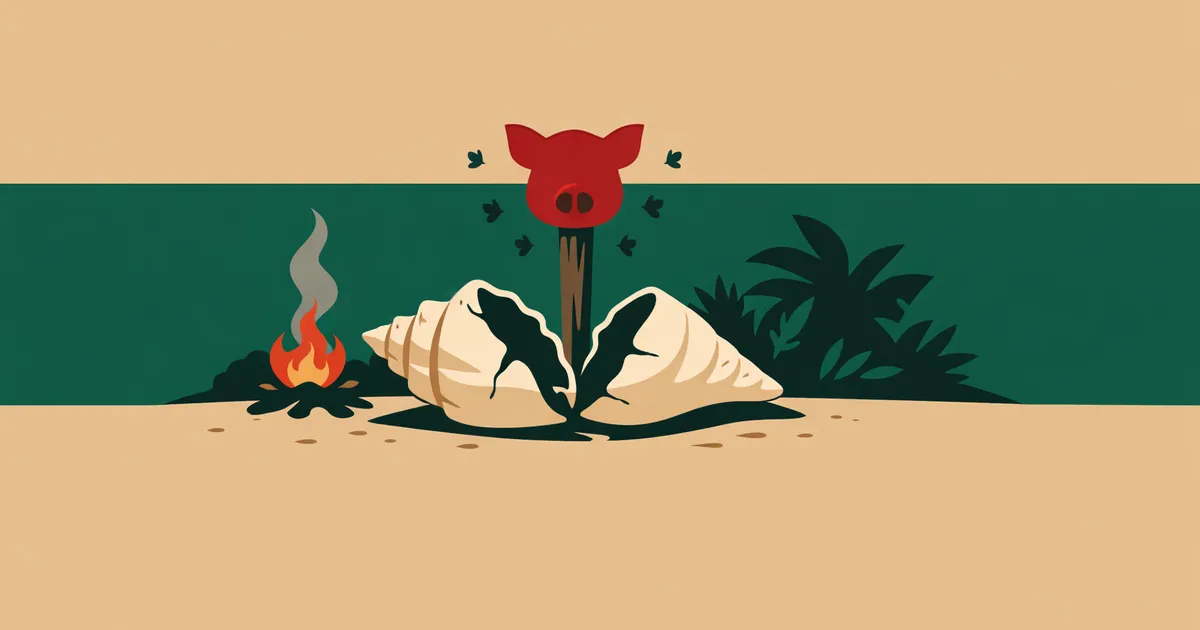
The Lord of the Flies scene in Chapter 8 is the novel's philosophical center. The pig's head, swarming with flies in the tropical heat, speaks to Simon in the voice of a "schoolmaster" — an authority figure from the civilization the boys have left behind. Its message is that the beast cannot be killed because it is not separate from the boys: "I'm the reason why it's no go." This scene collapses Golding's allegory into its starkest form. The beast is not a paratrooper, not a snake-thing, not a creature from the sea. It is the human capacity for destruction, and it lives inside every character in the novel, including Ralph, including the naval officer, including the reader. Simon's death — mistaken for the beast he has just disproven — is the novel's cruelest irony. The one person who could have freed the boys from their fear is destroyed by that fear, and his knowledge dies with him.
Roger
Roger is the character Golding uses to answer a question the novel's main conflict doesn't fully address: what happens when a person has no internal resistance to violence at all? Ralph resists savagery and mostly succeeds. Jack embraces it but needs justifications — the hunt, the tribe, the beast. Roger needs none. He is drawn to cruelty the way other boys are drawn to the ocean or the fire, and Golding tracks his progression with chilling economy.
We first see Roger throwing stones at Henry on the beach, deliberately aiming to miss. Golding tells us that "the taboo of the old life" — the memory of parents, police, punishment — keeps Roger's arm in check. But the taboo is presented as external, not internal. Roger doesn't refrain from hitting Henry because he feels it's wrong. He refrains because he remembers that it used to have consequences. Remove the consequences, and there is nothing left to restrain him.
Roger's arc from stone-thrower to executioner is the novel's most economical character study. In Chapter 4, the invisible circle around Henry measures six yards — the exact distance of civilized conditioning. By Chapter 11, Roger levers a boulder onto Piggy "with a sense of delirious abandonment." The six-yard boundary hasn't shrunk gradually; it has vanished completely. Golding implies that for some people, morality was never internalized — it was only ever compliance with external authority, and once that authority disappears, there is nothing underneath.
Roger becomes Jack's enforcer at Castle Rock, and his presence transforms Jack's tribe from a hunting party into something genuinely totalitarian. Jack provides the charisma and the ideology (the beast, the feast, the paint); Roger provides the violence that makes dissent impossible. Sam and Eric's terrified whisper to Ralph — "Roger sharpened a stick at both ends" — reveals that the boys understand Roger's intentions before Jack's. Roger is the first to realize that the rituals and offerings can be turned on a human target. In the novel's political allegory, Roger represents the figure every authoritarian regime requires: the person who does the work that even the dictator prefers not to name. He is not the leader of the savagery but its instrument, and instruments don't need reasons.