Summary
Overview
Lord of the Flies opens with a premise that sounds like a boys' adventure novel and then methodically destroys every assumption that genre depends on. A group of British schoolboys, evacuated during a nuclear war, crash-lands on an uninhabited tropical island with no adults. They have fresh water, fruit, warm weather, and each other. By the novel's final pages, they've killed two of their own and set the island on fire. Golding's question is brutally simple: strip away the structures of civilization, and what's actually left?
The story tracks the disintegration of the boys' attempt at self-governance. Ralph, the elected leader, tries to maintain order through democratic assemblies and a signal fire meant to attract rescue. Jack Merridew, the leader of the choir-turned-hunters, gradually pulls the group toward violence, ritual, and authoritarian control. Between them stand Piggy, whose intelligence no one respects, and Simon, whose spiritual intuition no one understands. The island itself becomes a character — lush and edenic on the surface, concealing a darkness the boys project onto an imaginary "beast" that is really their own capacity for cruelty.
What gives the novel its lasting power is Golding's refusal to let any character — or the reader — off the hook. This is not a story about bad kids. Ralph is decent and well-intentioned; Jack is charismatic and competent; even Roger, who becomes the group's torturer, starts as just a quiet boy who throws stones near littluns but not at them. The horror of the book is that ordinary children, given the right conditions, will construct the very savagery their civilization was built to suppress.
Published in 1954, Lord of the Flies arrived in a literary landscape still processing the atrocities of World War II. Golding, who served in the Royal Navy and participated in the D-Day invasion, wrote the novel as a direct response to R.M. Ballantyne's The Coral Island (1857), a Victorian adventure story in which stranded British boys cheerfully impose order and Christian values on their tropical surroundings. Golding found Ballantyne's optimism obscene in the shadow of the Holocaust and Hiroshima, and Lord of the Flies is, at its foundation, an argument: the beast is not out there. It never was.
Structurally, the novel operates as an accelerated allegory. Twelve chapters compress what might be weeks or months into a relentless narrative arc from order to chaos. Golding uses the island's geography as moral architecture — the mountaintop signal fire represents hope and connection to civilization, the jungle becomes a space of hunting and primal ritual, and Castle Rock, Jack's eventual fortress, sits on barren stone where nothing grows. The novel's pacing mirrors its theme: the assemblies grow shorter and more chaotic; the hunts grow longer and more frenzied; the gap between the boys' language and their actions widens until the final hunt, where they pursue Ralph with the same methods they used on the pigs. Golding's achievement is in making the reader feel, rather than just understand, how gradually and completely a society can unravel.
Chapters 1-2: The Sound of the Shell
The boys emerge from the wreckage of their crashed plane scattered across a tropical island. Ralph, a fair-haired twelve-year-old, meets Piggy, an overweight, asthmatic boy with glasses and a sharp mind. Piggy spots a conch shell in a lagoon, and Ralph blows it to summon the other survivors. The boys gather on the beach — among them a choir marching in formation under the command of Jack Merridew, a tall, red-haired boy who immediately asserts authority. The group elects Ralph as chief, partly because he holds the conch, partly because of his calm demeanor. Jack, stung by the loss, is given control of the choir as hunters. Ralph, Jack, and a small boy named Simon explore the island and confirm it's uninhabited.
In the first assembly, Ralph establishes rules: the conch grants speaking rights, they'll build shelters and maintain a signal fire on the mountaintop. The boys rush up the mountain in a disorganized mob to light the fire, using Piggy's glasses as a lens. The fire burns out of control, consuming a swath of forest — and a small boy with a birthmark on his face, who had spoken fearfully of a "snake-thing" in the jungle, is never seen again. No one acknowledges his death directly. The adventure has already claimed its first casualty, and no one wants to say so.
These opening chapters establish every conflict that will destroy the group. The election scene is the novel's political foundation: Ralph wins not through merit but through the symbolic power of the conch and his physical appearance. Jack's humiliation festers from this moment forward — Golding makes clear that democratic legitimacy means nothing to someone who believes authority should be claimed by force. The conch itself is Golding's most explicit symbol: its power exists only because the boys collectively agree it does, which means it can be unmade the moment they stop agreeing. This is Golding's thesis about civilization in miniature.
The fire on the mountaintop functions as both practical tool and symbolic test. The boys' inability to maintain it — they rush to light it in a frenzy, then let it burn wild — previews their inability to sustain any organized effort. The disappearance of the boy with the birthmark is the novel's first moral turning point, rendered all the more devastating by the group's silent refusal to confront it. Golding doesn't dramatize the death; he lets it vanish into the gap between what happened and what anyone is willing to say. This narrative technique — horror conveyed through omission — becomes the novel's signature.
Chapters 3-4: Huts and Hunters
The group begins to fracture along the lines of work and desire. Ralph and Simon struggle to build shelters on the beach with almost no help — the other boys scatter to play, swim, or join Jack on increasingly obsessive hunts that produce no meat. Ralph's frustration mounts: the littluns are having nightmares about the beast, the shelters keep collapsing, and no one follows through on tasks. Jack, meanwhile, is consumed by the hunt. He paints his face with clay and charcoal, and the mask liberates him — behind it, he becomes someone else, someone who can kill.
Roger and Maurice kick through a group of littluns' sandcastles on the beach, and Roger throws stones at a small boy named Henry, aiming to miss by inches. Golding notes that "there was a space round Henry, perhaps six yards in diameter, into which he dare not throw" — the invisible barrier of civilized conditioning. Meanwhile, Jack's hunters finally kill a pig, chanting "Kill the pig. Cut her throat. Spill her blood." They return triumphant to find the signal fire has gone out during their hunt. A ship passed on the horizon while the fire was dead. Ralph is furious; Jack is unrepentant. Piggy criticizes Jack and gets punched in the stomach; one lens of his glasses shatters.
The split between Ralph and Jack crystallizes here into an irreconcilable difference not just in priorities but in what each boy understands the island to be. Ralph sees the island as a problem to be solved — build shelters, tend the fire, get rescued. Jack sees it as a space to be inhabited, a place where the hunt gives life meaning and structure. Neither view is entirely wrong, which is what makes the conflict tragic rather than simple. Golding refuses to make Jack a villain in these chapters; the joy and skill of hunting are rendered with genuine intensity. The problem is that Jack's path leads away from rescue and toward a world where violence becomes its own justification.
Roger's stone-throwing scene is one of the most carefully constructed moments in the novel. The "taboo of the old life" — the invisible boundary that prevents him from hitting Henry — is Golding's image of internalized social conditioning. Roger does not refrain because of empathy or moral reasoning; he refrains because the rules of his former world still hold physical weight in his muscles and reflexes. Golding presents this restraint as a temporary condition, something that erodes rather than endures. When Roger later pushes a boulder onto Piggy, the trajectory from thrown stone to killing blow becomes a complete arc. The shattering of Piggy's lens is similarly proleptic: the boys' connection to rational thought — literally, the instrument that makes fire and sight possible — is being degraded one piece at a time.
Chapters 5-6: Beast from Water and Beast from Air
Ralph calls an assembly at dusk to address the group's deteriorating discipline. He insists on rules — use the designated toilet area, maintain the fire, finish the shelters — but his speech falters as the littluns' fear of the beast dominates the discussion. Percival Wemys Madison, one of the smallest boys, claims the beast comes from the sea. Simon tries to articulate a radical idea — that the beast is not a creature but something inside them — but the boys shout him down. The assembly dissolves into chaos when Jack openly defies Ralph's authority and leads most of the group off to dance and chant in the dark. Piggy and Ralph sit alone, terrified not of any beast but of the reality that their fragile order is collapsing.
That night, a dead paratrooper descends from an aerial battle above the island, his parachute tangling in the rocks on the mountaintop. The wind moves the corpse's lines, making it appear to sit up and bow in the darkness. Sam and Eric, tending the signal fire, see the shape at dawn and flee in terror, convinced the beast is real. The twins' garbled, panicked account electrifies the camp. Jack proposes a hunt for the beast; Ralph reluctantly agrees. A group of older boys explores Castle Rock at the far end of the island — a barren, defensible outcrop that Jack immediately admires for its tactical potential. They don't reach the mountaintop. The beast, in every version the boys construct, grows larger with each retelling.
Chapter 5's assembly is the novel's political crisis point. Golding stages it as a failure of democratic process: Ralph has the right arguments but cannot hold the group's attention; Jack has no solutions but commands their emotions. Simon possesses the only genuine insight — "maybe it's only us" — but is constitutionally unable to communicate it. This three-way dynamic mirrors Golding's view of human societies: reason is necessary but weak, charisma is powerful but destructive, and genuine wisdom is invisible to the crowd. The assembly's collapse into darkness is both literal and figurative; from this point, the conch's authority exists only in name.
The dead paratrooper is Golding's masterstroke of irony. The boys fear a beast from the island, but the real monster descends from the adult world they idealize and long to rejoin. The parachutist is a casualty of the same war that marooned them — proof that the civilization they want to return to is engaged in exactly the kind of violence they're descending into. Golding never lets the reader forget the nuclear context: the adults are not a solution. They are the problem at a larger scale. Castle Rock's introduction in these chapters is also significant — Jack's instinctive attraction to this barren fortress over Ralph's beach camp signals the kind of society he will build: one organized around defense, dominance, and control rather than communal welfare.
Chapters 7-8: Shadows and the Gift for the Darkness
As the hunting party searches for the beast along the island's unexplored side, Ralph experiences a moment of desolation, staring at the vast, indifferent ocean and realizing how remote rescue truly is. The boys encounter a boar during their trek, and Ralph wounds it with his spear — his first taste of hunting's visceral thrill. Afterward, the boys reenact the hunt as a game, with Robert playing the pig. The game escalates until Robert is genuinely hurt, and the circle of boys chanting "Kill the pig" closes around him with real menace before breaking apart. At nightfall, Ralph, Jack, and Roger climb the mountain and see the dead paratrooper's silhouette in the dark. They flee, convinced the beast is real.
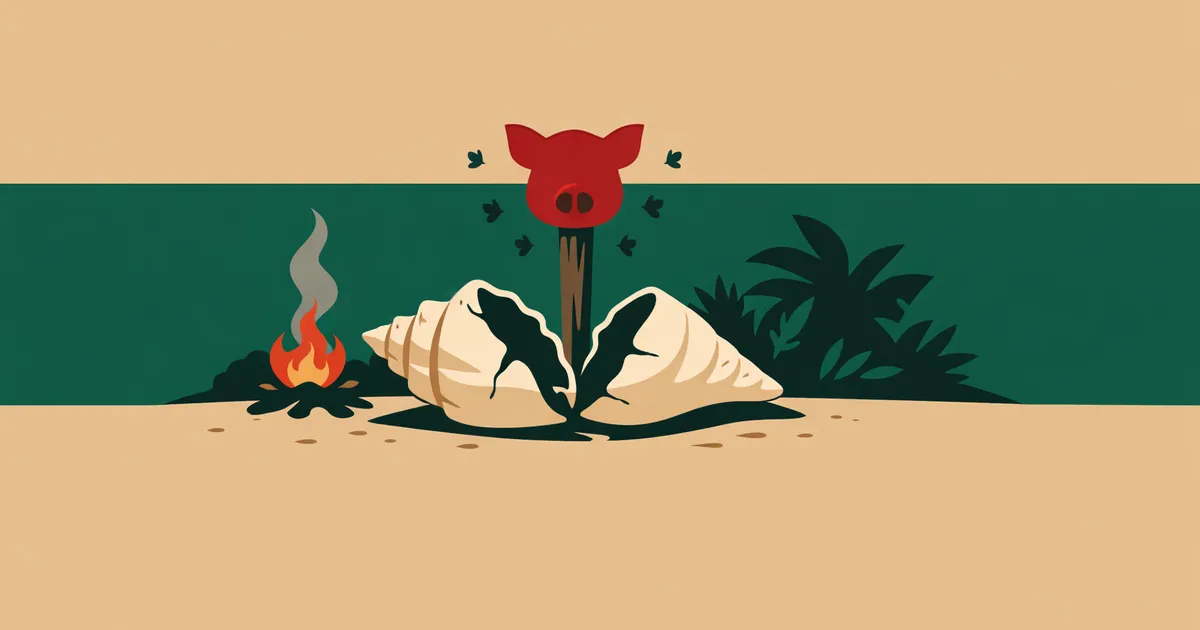
Back at camp, Jack calls an assembly and tries to depose Ralph as chief. When the vote goes against him, Jack storms off alone, weeping, and declares he's starting his own group. Gradually, most of the older boys slip away to join him. Jack's tribe kills a sow in a scene of extraordinary brutality — they chase a nursing mother through the forest, and Roger drives his spear into her. Jack mounts the sow's head on a sharpened stick as an offering to the beast: the Lord of the Flies. Simon, alone in his secret clearing in the forest, hallucinates a conversation with the pig's head. The Lord of the Flies tells him that the beast is not something that can be hunted and killed — "I'm part of you." Simon faints.
Ralph's participation in the mock hunt is one of the novel's most psychologically destabilizing moments. Until this point, the reader can maintain a clean division: Ralph represents order, Jack represents savagery. But Golding dismantles that comfort. Ralph feels the "desire to squeeze and hurt" and is "carried away" by the frenzy of the reenactment. This is not a boy pretending — it's a boy discovering something real inside himself. Golding's argument is that the capacity for violence is not Jack's particular flaw; it is a universal human inheritance. The only difference between Ralph and Jack is the degree of resistance each offers to that inheritance, and even Ralph's resistance has limits.
The killing of the sow is Golding's darkest set piece, laden with sexual and sacrificial imagery that critics have debated since publication. Roger's spear, the sow's screams, and the boys' frenzied excitement combine into a scene that transgresses not just against the animal but against every boundary of innocence the boys once possessed. The Lord of the Flies scene — Simon's dialogue with the pig's head — operates on multiple levels simultaneously. Literally, Simon is a dehydrated, epileptic boy hallucinating in the heat. Allegorically, he is a Christ figure or a prophet receiving a revelation: the evil is internal, not external. The name itself — "Lord of the Flies" is the English translation of Beelzebub — collapses the distance between the boys' island and the oldest stories humans tell about the nature of evil. Simon is the only character who understands the truth, and understanding it costs him everything.
Chapters 9-10: A View to a Death and The Shell and the Glasses
Simon wakes from his faint, climbs the mountain, and discovers the dead paratrooper — the beast is just a decaying man in a tangled parachute. He stumbles down toward the beach to share the news. On the beach below, Jack's tribe holds a feast. The storm that has been building breaks. The boys, full of meat and drunk on ritual, perform their hunting dance in the rain. Simon crawls out of the forest into the circle of dancers, but in the dark and the frenzy, the boys mistake him for the beast — or refuse to recognize him. They fall on him with their hands and teeth. Simon dies on the beach, and the tide carries his body out to sea in a passage of eerie, luminous beauty.
The morning after, Ralph and Piggy confront what happened. Piggy insists it was an accident, that they were on the outside of the circle, that it was dark. Ralph knows better but cannot fully admit what he participated in. Meanwhile, Jack has established himself at Castle Rock with most of the boys. His authority rests on meat, protection from the beast (which he insists is still real), and fear. When his tribe needs fire, Jack leads a raid on Ralph's camp in the night. They don't take the conch — it's meaningless to them now. They take Piggy's glasses, the only tool that makes fire.
Simon's death is the novel's moral catastrophe. Golding writes it with a deliberate ambiguity that refuses to let any character — or reader — claim clean hands. The boys do not kill Simon because they are evil in some cartoonish sense. They kill him because they are terrified, because the ritual has its own momentum, because the storm and the darkness dissolve the boundaries between game and reality. Ralph and Piggy were there. They participated, at least at the edges. Golding makes this point with surgical precision: the capacity for violence is not confined to Jack's tribe. It is distributed across every boy on the island, including the ones who built shelters and tended fires.
The passage describing Simon's body drifting out to sea is often cited as the most beautiful writing in the novel — "the great wave of the tide moved farther along the island and the water lifted him." Golding shifts registers entirely, moving from the brutal specificity of the murder to an almost mystical serenity. This tonal contrast does two things: it honors Simon as the novel's sacrificial innocent, and it underscores the obscenity of what just happened by forcing the reader to hold beauty and horror in the same frame. The theft of Piggy's glasses — rather than the conch — is Golding's comment on where real power lies. The conch represents the idea of legitimate authority. The glasses represent the material basis of technology. Jack has no interest in legitimacy; he wants the means of production. The political allegory is pointed: authoritarian power doesn't seize constitutions. It seizes resources.
Chapters 11-12: Castle Rock and Cry of the Hunters
Ralph, Piggy, and the twins march to Castle Rock to demand the glasses back. Piggy carries the conch, believing in its authority to the end. At Castle Rock, Jack's tribe is armed and painted. Ralph and Jack fight. Roger, stationed above, levers a massive boulder that strikes Piggy, killing him and shattering the conch simultaneously. The twins are captured and forced to join Jack's tribe. Ralph, alone, flees into the jungle.
Jack's tribe hunts Ralph across the island. They sharpen a stick at both ends — the same preparation used for the Lord of the Flies offering — signaling that Ralph is to be the next sacrifice. Sam and Eric, forced to join the hunters, warn Ralph that Roger has "sharpened a stick at both ends." The tribe sets the forest on fire to smoke Ralph out. Ralph runs blindly through burning jungle and collapses on the beach at the feet of a British naval officer who has come ashore to investigate the smoke. The officer, confronted with a group of filthy, weeping boys, is embarrassed and confused. He asks if they've been having fun, "like the Coral Island." Ralph weeps "for the end of innocence, the darkness of man's heart." The officer turns away and looks at his warship on the horizon while the island burns behind them.
Piggy's death and the conch's destruction occur in the same instant, and Golding makes this simultaneity feel inevitable rather than contrived. The conch is not simply broken; it "exploded into a thousand white fragments and ceased to exist." The language mirrors a bomb blast — a deliberate echo of the war that frames the novel. With Piggy and the conch gone, the last vestiges of rational, democratic civilization are extinguished. What remains is raw power: Roger's boulder, Jack's painted authority, and the sharpened stick intended for Ralph.
The naval officer's arrival is frequently misread as a rescue, but Golding constructs it as the novel's final irony. The officer is a representative of the adult civilization the boys were supposed to be returning to — and he commands a warship engaged in the same global conflict that stranded them. His offhand reference to The Coral Island is Golding's most explicit acknowledgment of the literary tradition he is demolishing. The boys have not been rescued from savagery; they have been transferred from one theater of war to another. Ralph's weeping — "for the end of innocence, the darkness of man's heart, and the fall through the air of the true, wise friend called Piggy" — is one of the few moments in the novel where a character achieves full understanding. But understanding, in Golding's world, arrives too late and changes nothing. The island burns, the warship waits, and the officer's discomfort suggests that the adult world is no more equipped to face the darkness than the children were.